Within Believers
Do abduction memories need alien proof?
Abduction communities raise a different question: how unusual memories and bodily fear should be understood without assuming literal aliens.
On this page
- Experience centered belief and recognition
- Memory, fear and physiological response
- Why literal proof is not the only dispute
Page outline Jump by section
Introduction
Alien abduction claims occupy a distinctive place in the relationship between UFO belief and science fiction because they shift attention away from lights in the sky and towards human experience. For many people who report abductions, the central issue is not a spacecraft that can be photographed or measured. It is a vivid memory, a feeling of terror, missing time, bodily sensations, recurring dreams, or a conviction that something extraordinary happened. The resulting debate is therefore not only about whether aliens exist, but also about how memory, fear and personal meaning should be interpreted.
 Researchers who study abduction reports often agree on one point even when they disagree about causes: the experiences are usually sincere and emotionally powerful. The main dispute is whether these memories represent literal encounters with extraterrestrials, psychological experiences interpreted through cultural expectations, or some combination of memory, trauma and imagination.[sagepub.com]journals.sagepub.comMcNally, Natasha B. Lasko, Susan A. Clancy, Michael L. Macklin, Roger K. Pitman, Scott P. Orr, 2004July 1, 2004…
Do abduction memories need alien proof?
The question surrounding abduction narratives differs from debates over UFO sightings. A sighting can be investigated through radar data, photographs or witness testimony. Abduction experiences are frequently remembered as intensely personal events that may leave little or no independently verifiable physical evidence.
This distinction helps explain why abduction accounts became so influential in UFO culture. The experience itself often becomes the evidence for the person who lived through it. Individuals may describe waking paralysed, sensing a presence in the room, being unable to move, experiencing missing time, or later recovering memories they believe explain long-standing fears and anxieties. The conviction can be profound even when outsiders remain unconvinced.[sciencedirect.com]sciencedirect.comClinique des expériences d’abduction: trauma, clivage et logiques de l’originaire - ScienceDirectApril 1, 2018…
Within UFO communities, recognition by other experiencers can reinforce belief. People frequently report discovering that others describe similar beings, procedures or emotions. Shared narratives create a sense that the experience is part of a larger pattern rather than an isolated personal event. This social process is important because it turns private memories into collective stories.
At the same time, critics note that similarities between accounts may also reflect the circulation of cultural images through books, television, films and UFO literature. In that interpretation, recurring details do not necessarily indicate a common external event; they may reveal common expectations and storytelling frameworks.[ResearchGate]researchgate.netOpen source on researchgate.net.
Experience-centred belief and recognition
One reason abduction claims remain influential is that many experiencers do not present themselves as fantasy-prone enthusiasts seeking attention. Researchers who interviewed claimants often found people who appeared psychologically ordinary and genuinely distressed by what they remembered. This observation complicated attempts to dismiss all reports as hoaxes or deliberate fabrications.[Harvard Gazette]news.harvard.eduGazette Alien abduction claims explained — Harvard GazetteHarvard GazetteAlien abduction claims explained — Harvard GazetteSeptember 22, 2005…
The psychiatrist John Mack became one of the most prominent figures associated with this approach. He argued that many people reporting abductions did not appear psychotic or detached from reality in ordinary life. Rather than treating every account as evidence of mental illness, he regarded the experiences as deserving careful investigation and respectful listening. His position attracted both support and criticism because it challenged simple explanations while stopping short of proving literal alien contact.[Harvard Gazette]news.harvard.eduGazette Alien abduction claims explained — Harvard GazetteHarvard GazetteAlien abduction claims explained — Harvard GazetteSeptember 22, 2005…
For many experiencers, the most compelling feature is not the appearance of aliens but the emotional aftermath:
- Persistent fear or anxiety.
- Feelings of violation or loss of control.
- Recurrent dreams and intrusive memories.
- A sense that ordinary explanations fail to account for what happened.
- Recognition of similar stories told by others.
These factors help explain why abduction narratives can persist even when scientific institutions state that there is no verified evidence linking UFO reports to extraterrestrial visitors. The experience feels real regardless of whether an external alien cause is accepted.[CBS News]cbsnews.comCBS NewsNASA UAP report finds no evidence of "extraterrestrial" UFOs, but some encounters still defy explanation - CBS NewsSeptember 14…
Memory, fear and physiological response
One of the most significant findings in the scientific literature is that emotional intensity does not automatically establish factual accuracy.
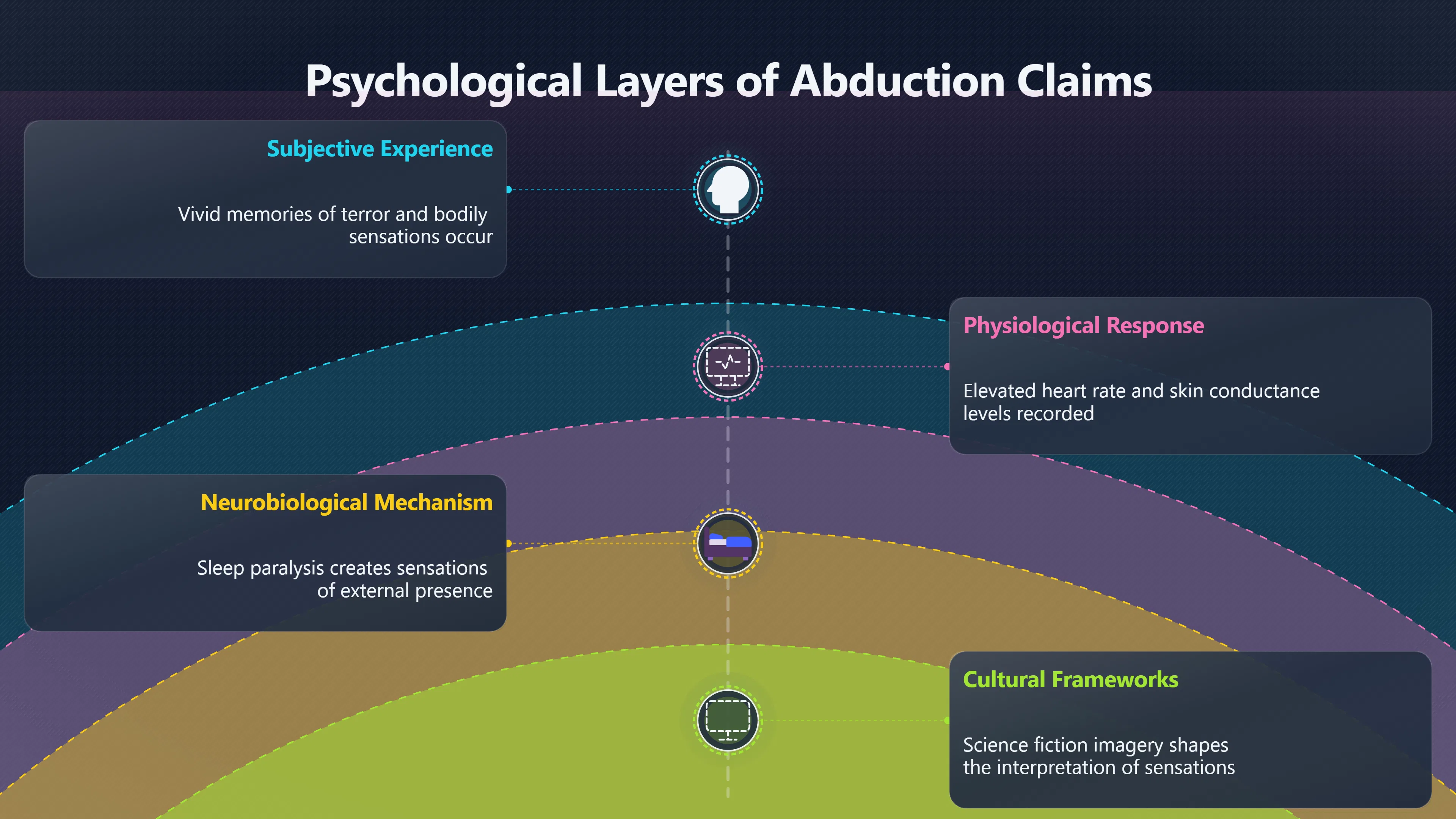
Harvard psychologist Richard McNally and colleagues studied people who believed they had been abducted by aliens. When participants listened to scripts describing their alleged abduction experiences, they showed elevated heart rate, skin conductance and other physiological signs associated with strong emotional arousal. Their reactions resembled those seen in people recalling recognised traumatic experiences.[Sage Journals]journals.sagepub.comMcNally, Natasha B. Lasko, Susan A. Clancy, Michael L. Macklin, Roger K. Pitman, Scott P. Orr, 2004July 1, 2004…
These findings are often misunderstood. They did not demonstrate that abductions occurred. Instead, they showed that the memories carried genuine emotional power. A person can experience fear, distress and bodily responses even if the underlying interpretation of an event is mistaken. In other words, sincere trauma-like reactions do not by themselves resolve the question of what happened.[Sage Journals]journals.sagepub.comMcNally, Natasha B. Lasko, Susan A. Clancy, Michael L. Macklin, Roger K. Pitman, Scott P. Orr, 2004July 1, 2004…
Research by Susan Clancy and colleagues examined another aspect of the problem: memory formation and distortion. Their work suggested that people reporting abductions may be especially susceptible to certain forms of memory construction and recovered-memory processes. The resulting memories can feel authentic and emotionally convincing while remaining vulnerable to suggestion and reinterpretation.[PubMed]pubmed.ncbi.nlm.nih.govPub Med Memory distortion in people reporting abduction by aliensMemory distortion in people reporting abduction by aliens - PubMed…
This distinction is crucial. The debate is not usually between “real experience” and “fake experience”. It is often between different explanations for a very real subjective experience.
Sleep paralysis and unusual states of consciousness
Among the most frequently discussed explanations is sleep paralysis, a condition in which a person becomes conscious while the body remains temporarily immobilised.
During these episodes, people may experience:
- A sensed presence in the room.
- Intense fear.
- Pressure on the chest.
- Visual or auditory hallucinations.
- A feeling of being observed or controlled.
Researchers have noted that many abduction narratives begin in circumstances strikingly similar to sleep-paralysis episodes, especially at the boundary between sleeping and waking. Modern accounts involving extraterrestrials may therefore represent one cultural interpretation of a neurobiological experience that has appeared in different forms throughout history.[sciencedirect.com]sciencedirect.comClinique des expériences d’abduction: trauma, clivage et logiques de l’originaire - ScienceDirectApril 1, 2018…
The important point is not that every abduction report can be reduced to sleep paralysis. Rather, sleep paralysis provides a plausible mechanism for some of the most common features reported by experiencers.
Why science fiction matters to memory
The connection to science fiction becomes especially important when examining how unusual experiences acquire meaning.
Researchers in cultural studies have argued that abduction narratives emerged within a broader environment saturated by extraterrestrial imagery, technological anxiety and science-fiction storytelling. Alien examination tables, missing time, hybridisation programmes and grey humanoids did not appear in a cultural vacuum. They became recognisable motifs through repeated circulation in popular culture.[ResearchGate]researchgate.netOpen source on researchgate.net.
This does not necessarily mean that experiencers consciously copied fiction. Human memory is reconstructive rather than photographic. People often interpret ambiguous sensations through familiar cultural frameworks. A frightening nocturnal experience in a medieval society might be described as a demonic visitation. In a modern technological culture, similar sensations may be understood as alien intervention.
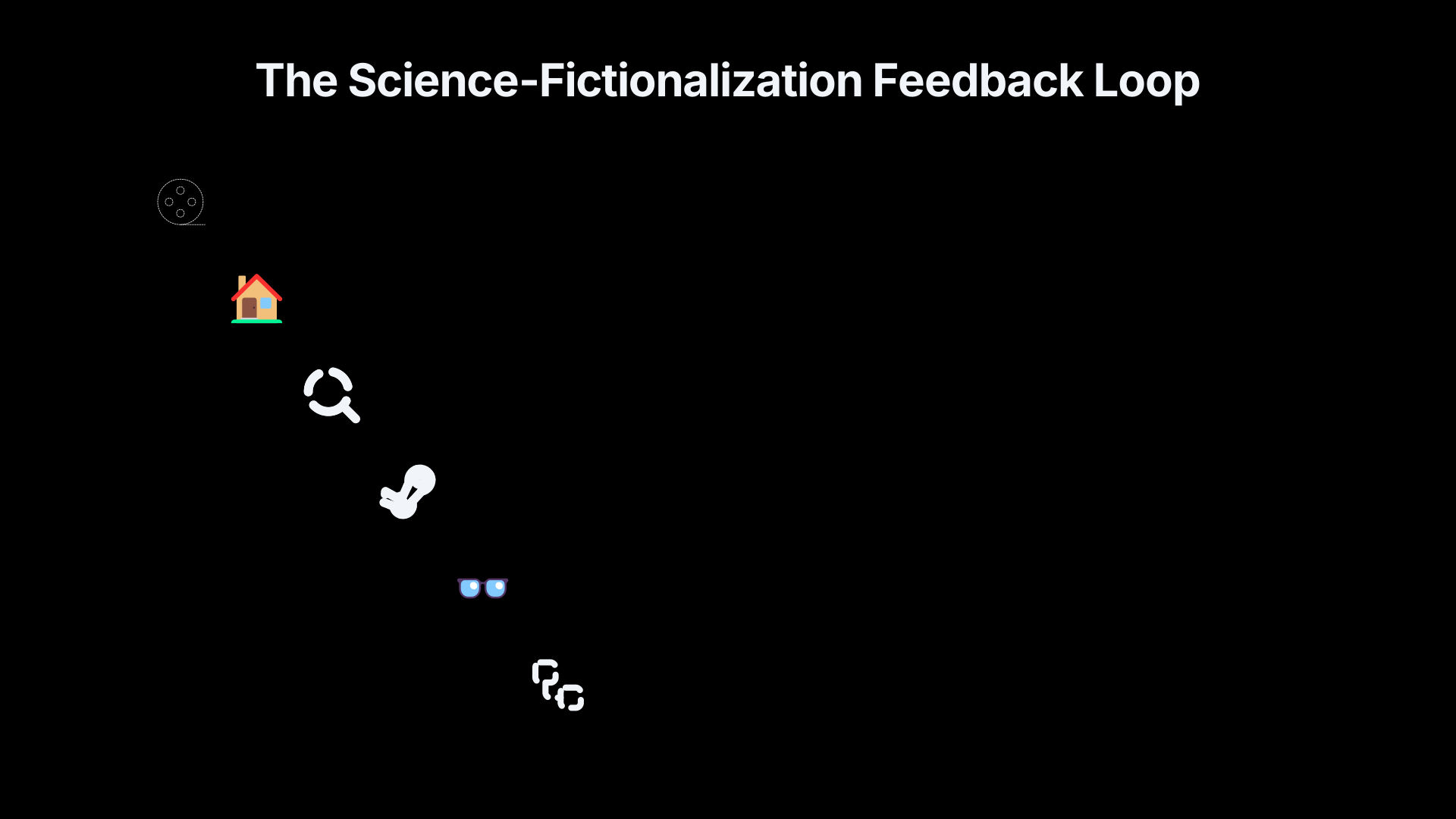
The result is a feedback loop:
- Science fiction supplies images and expectations.
- People experience unusual or frightening events.
- Memories are interpreted through available cultural narratives.
- New abduction stories enter popular culture.
- Future experiencers encounter those stories and recognise familiar patterns.
Scholars studying abduction narratives have described this process as part of a wider “science-fictionalisation” of modern culture, where the language of science fiction becomes a way of expressing fears, uncertainties and experiences that feel difficult to explain otherwise.[ResearchGate]researchgate.netOpen source on researchgate.net.
Why literal proof is not the only dispute
The most persistent disagreement about abductions is often framed incorrectly as a simple question: “Did aliens do it?”
For experiencers, the deeper issue may be whether their memories deserve recognition and whether their distress should be taken seriously. For scientists, the central concern is how memory works, how belief forms and how extraordinary claims can be tested. These are related but not identical questions.
A person may sincerely remember an alien encounter, display measurable signs of fear when recalling it and experience long-term emotional consequences. None of those facts automatically prove extraterrestrial involvement. Equally, demonstrating psychological mechanisms such as sleep paralysis or memory reconstruction does not erase the reality of the person’s distress.[sagepub.com]journals.sagepub.comMcNally, Natasha B. Lasko, Susan A. Clancy, Michael L. Macklin, Roger K. Pitman, Scott P. Orr, 2004July 1, 2004…
Within the broader relationship between UFOs and science fiction, abduction claims therefore highlight a distinctive tension. The debate is not only about evidence in the sky. It is about how people interpret extraordinary experiences, how culture shapes memory, and why a story can remain deeply meaningful even when its literal explanation remains disputed.
Amazon book picks
Further Reading
Books and field guides related to Do abduction memories need alien proof?. Use these as the next step if you want deeper reading beyond the article.
Abduction: Human Encounters with Aliens
Focuses on experiencers, memory and interpretation.
The Demon-Haunted World
Rating: 4.5/5 from 43 Google Books ratings
Addresses extraordinary claims, memory and evidence.
eBay marketplace picks
Marketplace Samples
Example marketplace items related to this page. Use the search link to explore similar finds on eBay.


Endnotes
1.
Source: news.harvard.edu
Title: Gazette Alien abduction claims examined — Harvard Gazette
Link:https://news.harvard.edu/gazette/story/2002/02/alien-abduction-claims-examined/
Source snippet
Harvard GazetteAlien abduction claims examined — Harvard Gazette...
2.
Source: sciencedirect.com
Link:https://www.sciencedirect.com/science/article/abs/pii/S0014385517300907
Source snippet
Clinique des expériences d’abduction: trauma, clivage et logiques de l’originaire - ScienceDirectApril 1, 2018...
Published: April 1, 2018
3.
Source: researchgate.net
Link:https://www.researchgate.net/publication/298942969_The_science-fictionalization_of_trauma_Remarks_on_narratives_of_alien_abduction
4.
Source: news.harvard.edu
Title: Gazette Alien abduction claims explained — Harvard Gazette
Link:https://news.harvard.edu/gazette/story/2005/09/alien-abduction-claims-explained/
Source snippet
Harvard GazetteAlien abduction claims explained — Harvard GazetteSeptember 22, 2005...
Published: September 22, 2005
5.
Source: journals.sagepub.com
Link:https://journals.sagepub.com/doi/10.1111/j.0956-7976.2004.00707.x
Source snippet
McNally, Natasha B. Lasko, Susan A. Clancy, Michael L. Macklin, Roger K. Pitman, Scott P. Orr, 2004July 1, 2004...
Published: July 1, 2004
6.
Source: pubmed.ncbi.nlm.nih.gov
Title: Pub Med Memory distortion in people reporting abduction by aliens
Link:https://pubmed.ncbi.nlm.nih.gov/12150421/
Source snippet
Memory distortion in people reporting abduction by aliens - PubMed...
7.
Source: tandfonline.com
Link:https://www.tandfonline.com/doi/abs/10.1080/13546800244000058
Source snippet
Taylor & Francis OnlineAlien abduction experiences: Some clues from neuropsychology and neuropsychiatry: Cognitive Neuropsychiatry: Vol 7...
8.
Source: pubmed.ncbi.nlm.nih.gov
Link:https://pubmed.ncbi.nlm.nih.gov/16571535/
Source snippet
Alien abduction experiences: Some clues from neuropsychology and neuropsychiatry - PubMed...
9.
Source: cbsnews.com
Link:https://www.cbsnews.com/news/nasa-ufo-report-uap-study/
Source snippet
CBS NewsNASA UAP report finds no evidence of "extraterrestrial" UFOs, but some encounters still defy explanation - CBS NewsSeptember 14...
Additional References
10.
Source: livescience.com
Link:https://www.livescience.com/space/extraterrestrial-life/us-government-declassifies-nearly-200-uap-files-including-strange-sightings-from-apollo-astronauts
Source snippet
Department of Defense released a second batch of UFO-related files, bringing the total number of newly declassified documents to 162. Spa...
11.
Source: reddit.com
Link:https://www.reddit.com/r/technology/comments/16k9qa9
Source snippet
evidence that UFOs are aliens — NASA attempts to make conversations about aerial phenomena more scientificSeptember 16, 2023...
Published: September 16, 2023
12.
Source: reddit.com
Link:https://www.reddit.com/r/UfoUapNews/comments/1t20grw/alien_abduction_narratives_and_the_memory_debate/
Source snippet
Alien Abduction Narratives and the Memory Debate: Science, Sleep Paralysis, and the Question of Reality...
13.
Source: reddit.com
Link:https://www.reddit.com/r/space/comments/13y32g1
Source snippet
panel: No convincing evidence for extraterrestrial life connected with UAPsJune 2, 2023...
Published: June 2, 2023
14.
Source: reddit.com
Link:https://www.reddit.com/r/mysteriesoftheworld/comments/1q57hx3/nasa_admits_it_cant_explain_these_ufo_encounters/
Source snippet
Admits It Can’t Explain These UFO Encounters — And That’s the ProblemJanuary 6, 2026...
Published: January 6, 2026
15.
Source: youtube.com
Title: Ralph Blumenthal
Link:http://www.youtube.com/watch?v=E6-QAqo8Kas
Source snippet
Alien abduction memory psychology science fiction What "Alien Abductions" Say About Our Brains SciShow Psych...
16.
Source: youtube.com
Title: What Causes People to Claim Alien Abduction? | What is Sleep Paralysis?
Link:http://www.youtube.com/watch?v=GBt5q7F7rAI
Source snippet
Ralph Blumenthal - Mystery Wire Interview on Alien Abduction Research...
17.
Source: youtube.com
Title: Richard Mc Nally: Memories of past lifes and space alien abduction
Link:http://www.youtube.com/watch?v=Ywvp8SstQkM
Source snippet
Space Alien Abduction: A Scientific Perspective...
18.
Source: youtube.com
Title: Space Alien Abduction: A Scientific Perspective
Link:http://www.youtube.com/watch?v=fD85AeSrXbk
Source snippet
What Causes People to Claim Alien Abduction? | What is Sleep Paralysis?...
19.
Source: youtube.com
Title: What “Alien Abductions” Say About Our Brains
Link:http://www.youtube.com/watch?v=0itEOM8oxkE
Source snippet
Richard McNally: Memories of past lifes and space alien abduction...
Topic Tree