Within Radar Reports
Why missing data makes UFOs look faster
Missing details about range, angle, location and calibration can turn a small uncertainty into a dramatic claim about impossible motion.
On this page
- The measurements needed to estimate motion
- How angle and range errors distort apparent speed
- Why NASA stressed calibration and baseline data
Page outline Jump by section
Introduction
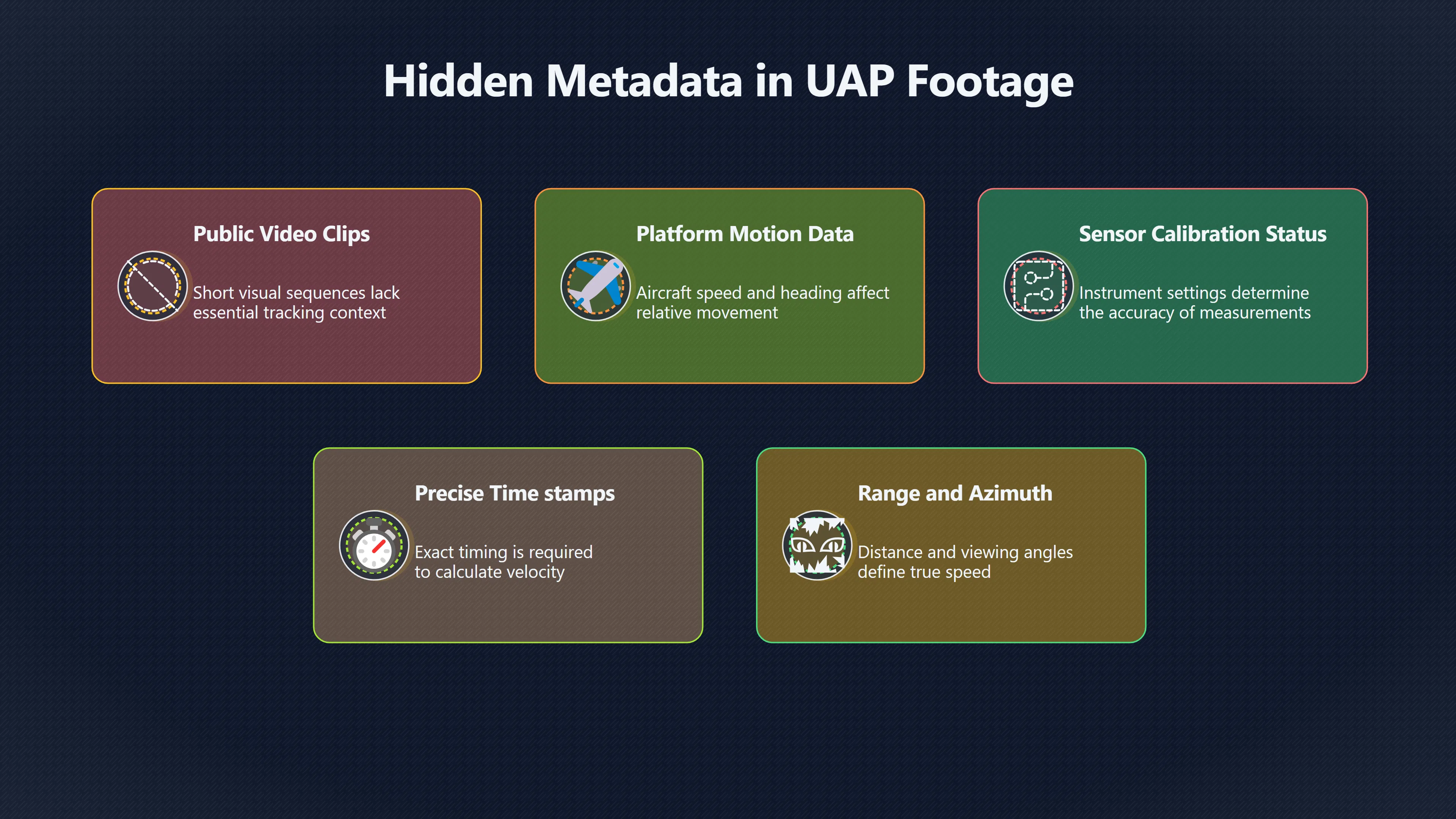
One of the most common reasons a UFO appears to display impossible speed is not necessarily that the object moved extraordinarily fast, but that the information needed to measure its motion is incomplete. In many widely discussed sensor cases, analysts and the public see a video clip, radar track, or infrared image without access to crucial metadata such as range, viewing angle, sensor mode, calibration status, platform motion, or precise timing. When those inputs are missing, small uncertainties can produce very large errors in estimated velocity. NASA’s 2023 independent study of unidentified anomalous phenomena (UAP) identified poor calibration, missing metadata, and a lack of baseline data as major obstacles to reliable analysis.[NASA]nasa.govuap independent study team final report 0UNIDENTIFIED ANOMALOUS PHENOMENA…
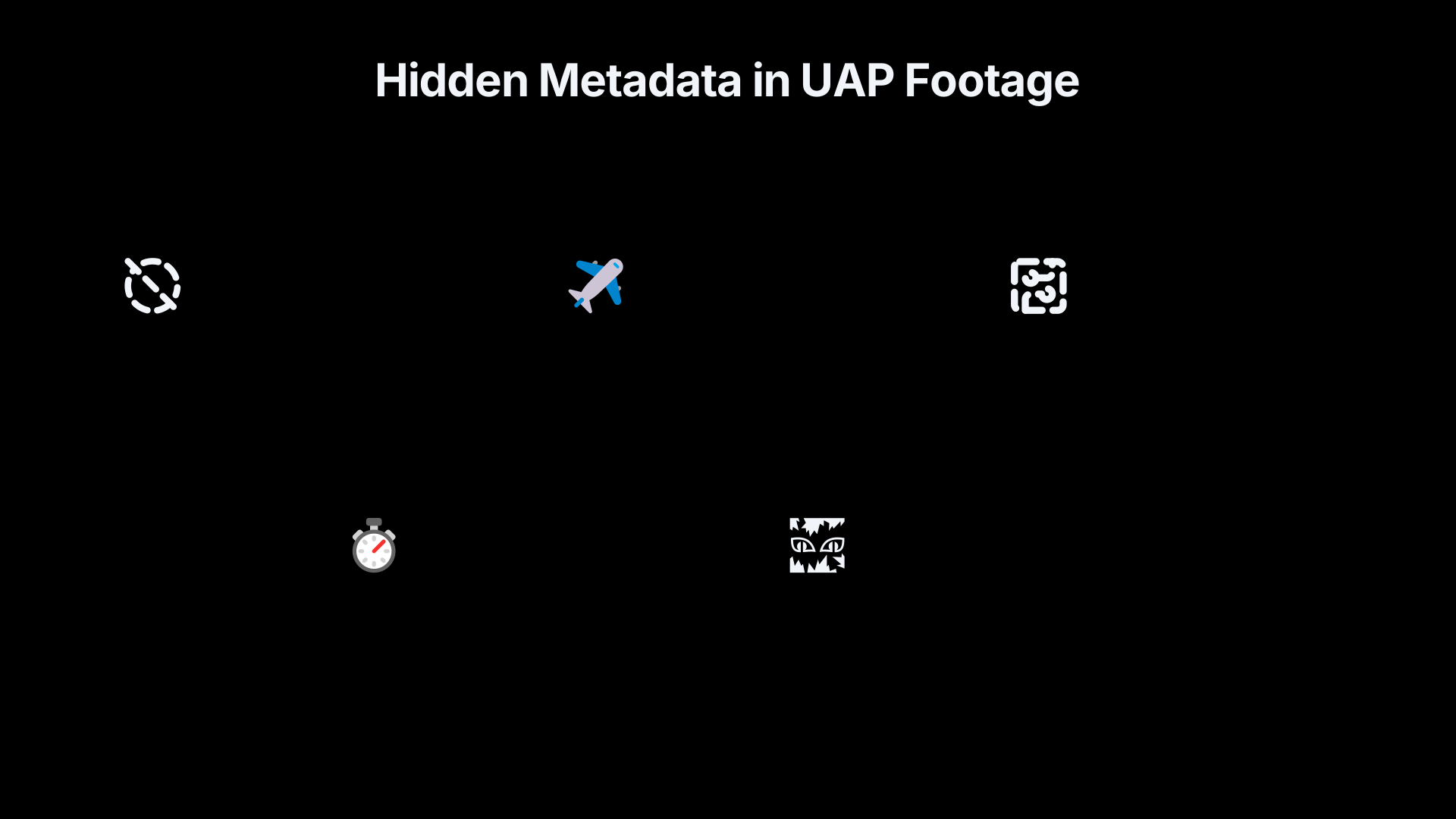 Within the broader problem of radar, sensors, and machine-generated evidence, metadata gaps are important because they can transform an ordinary object into an apparently extraordinary one. Understanding that mechanism helps explain why dramatic speed claims often weaken when more complete sensor information becomes available.
The measurements needed to estimate motion
A sensor rarely measures speed directly. Instead, analysts usually infer speed from several separate measurements.
For a flying object observed by radar, infrared systems, or targeting cameras, the most important pieces of information often include:
- Distance to the object (range).
- Direction relative to the sensor (azimuth and elevation).
- Changes in position over time.
- The motion of the observing platform itself.
- Sensor settings and calibration data.
- Precise timestamps.
If any of these values are missing, velocity estimates become increasingly uncertain. A target that appears to move a certain number of pixels across a screen cannot be assigned a reliable speed unless its distance is known. The same apparent movement could represent a nearby slow-moving object or a distant fast-moving one.
This is why radar engineering treats range, velocity, and angle as distinct measurements, each with its own uncertainty. Errors in any one parameter propagate into later calculations.[IET Research Journals]ietresearch.onlinelibrary.wiley.comIET Research JournalsHigh‐precision estimation of target range, radial velocity, and azimuth in mechanical scanning LFMCW radar - Zhou…
NASA’s UAP study emphasised that metadata is not an administrative detail but a scientific requirement. The report specifically noted the need for information about sensor type, observing conditions, noise characteristics, acquisition time, location, and operating mode in order to characterise both the object and the instrument that recorded it.[NASA]nasa.govuap independent study team final report 0UNIDENTIFIED ANOMALOUS PHENOMENA…
How angle and range errors distort apparent speed
The distance problem
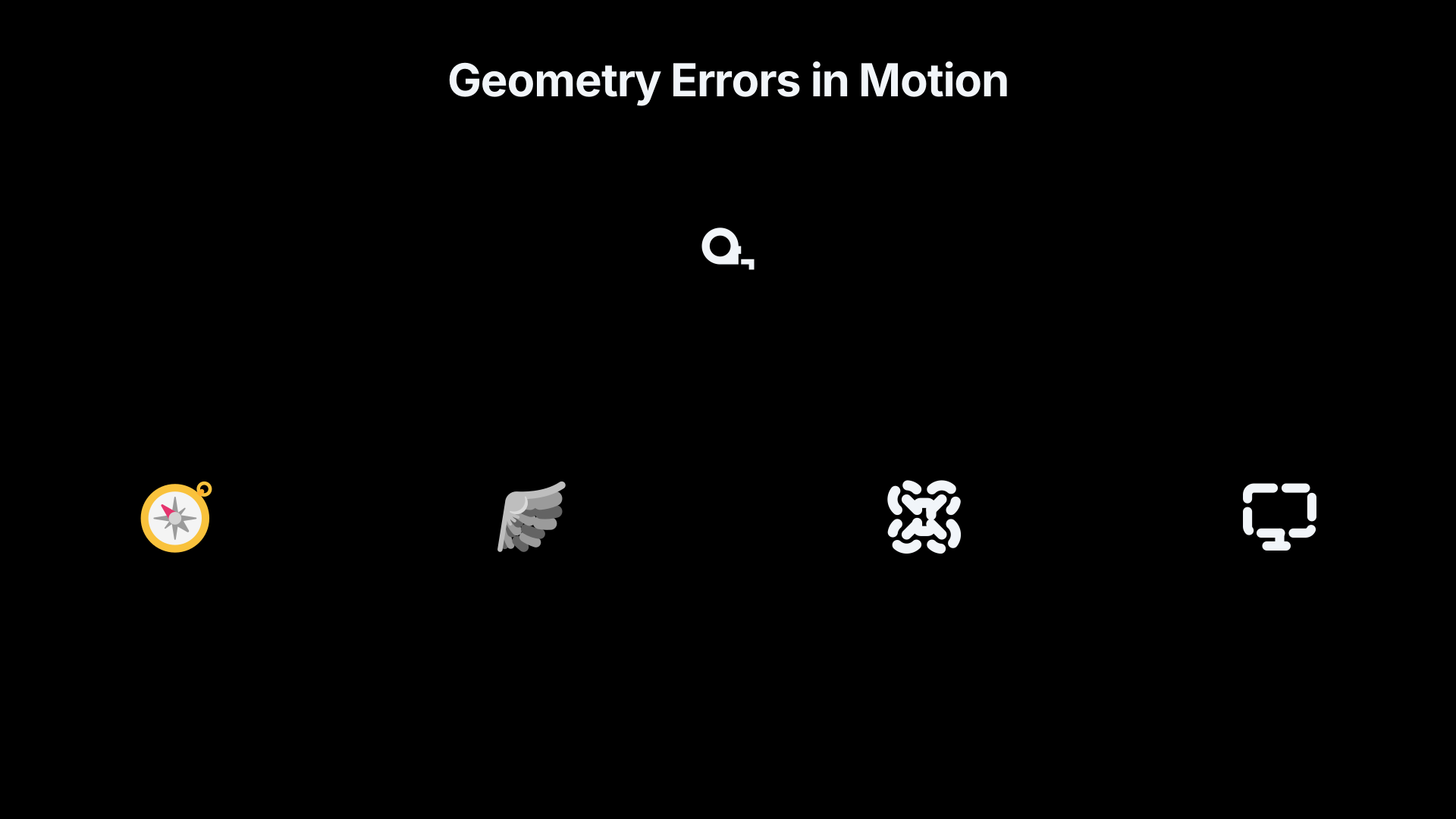
The simplest source of error is uncertainty about range.
Imagine an object crossing a camera’s field of view in two seconds. If it is one kilometre away, the implied speed may be modest. If it is fifty kilometres away, the same angular movement could imply an enormous velocity.
Without an independently verified range measurement, speed estimates can vary by orders of magnitude.
This problem appears repeatedly in public discussions of military UAP footage. External viewers often receive compressed video without the underlying tracking information needed to determine how far away the target actually was. Calculations built on assumed distances can therefore produce dramatically different results.
The angle problem
Viewing geometry can be even more deceptive.
When an object moves partly toward or away from the observer rather than across the observer’s line of sight, its apparent motion can differ greatly from its true motion. Small errors in estimating viewing angle can therefore generate large errors in reconstructed trajectories.
This effect becomes particularly important when a sensor is mounted on a moving aircraft. The apparent movement seen on a display may combine:
- The object’s motion.
- The aircraft’s motion.
- Camera slewing or tracking behaviour.
- Changes in viewing angle.
An object can seem to accelerate sharply even if much of the apparent motion comes from geometry rather than propulsion.

Parallax and relative motion
Parallax occurs when nearby and distant objects appear to move at different rates as an observer changes position.
A distant aircraft, balloon, or atmospheric target can appear to race across a sensor display when the observing aircraft is turning. If the exact geometry of the encounter is unknown, apparent speed can be significantly overstated.
NASA’s study specifically highlighted the importance of multiple well-calibrated sensors because independent measurements can help separate genuine motion from effects such as parallax, glare, and sensor artefacts.[NASA]nasa.govuap independent study team final report 0UNIDENTIFIED ANOMALOUS PHENOMENA…
Why incomplete metadata creates dramatic UFO narratives
The public often encounters UFO evidence after several layers of information have been removed.
A military sensor system may originally record:
- Platform position.
- Aircraft speed and heading.
- Sensor zoom level.
- Radar lock quality.
- Tracking confidence.
- Environmental conditions.
- Calibration information.
Yet the version released publicly may contain only a short video clip.
The resulting gap encourages speculation. Viewers naturally attempt to reconstruct speed and manoeuvres from the visible image alone. However, once key metadata is absent, multiple explanations can fit the same footage.
This helps explain a recurring pattern in UFO debates. Early interpretations frequently emphasise extraordinary performance, while later technical analyses introduce additional variables that reduce confidence in those estimates. The object may still be unidentified, but the claim of impossible velocity often becomes much harder to sustain.
The Office of the Director of National Intelligence similarly noted that some apparently unusual flight characteristics could arise from sensor limitations, observer error, or data-processing issues rather than reflecting the true behaviour of an unknown craft.[Director of National Intelligence]dni.govPrelimary Assessment UAP 20210625Director of National IntelligenceUNCLASSIFIEDJune 25, 2021…
Why NASA stressed calibration and baseline data
The most important lesson from recent official reviews is not that sensors are unreliable. It is that sensor data only becomes scientifically powerful when accompanied by calibration records and contextual information.
NASA’s independent study repeatedly identified poor calibration, missing metadata, insufficient baseline observations, and the absence of multiple measurements as major barriers to understanding UAP reports. The report noted that some apparent UAP have ultimately been shown to be sensor artefacts after detailed examination of calibration information and metadata. It also argued that future investigations should rely on multiple well-calibrated sensors and standardised data collection procedures.[NASA]nasa.govuap independent study team final report 0UNIDENTIFIED ANOMALOUS PHENOMENA…
Baseline data is especially important because analysts need to know what normal sensor behaviour looks like before they can identify genuinely anomalous behaviour. Without such reference points, an unusual track may reflect an unusual object, an atmospheric effect, a processing artefact, or a sensor operating outside its expected conditions.
Within the wider relationship between UFOs and science fiction, this point is significant. Science-fiction narratives often focus on spectacular capabilities: impossible acceleration, instantaneous turns, or extreme velocity. Sensor metadata gaps can unintentionally create the appearance of exactly those traits. The machine witness may seem to confirm extraordinary performance, yet the underlying calculation may depend on assumptions about range, angle, timing, or calibration that were never actually measured. Until those missing pieces are available, dramatic speed claims remain hypotheses rather than established facts.
Amazon book picks
Further Reading
Books and field guides related to Why missing data makes UFOs look faster. Use these as the next step if you want deeper reading beyond the article.
The UFO Experience
Focuses on evaluating sightings and separating strong from weak evidence.

UFOs : Generals, Pilots, and Government Officials Go on the R...
Discusses evidence quality, sensor cases, and limits of available data.
The Demon-Haunted World
Rating: 4.5/5 from 43 Google Books ratings
Explains how incomplete data and measurement errors can create extraordinary claims.
How to Lie with Statistics
Illustrates how missing information can distort conclusions.
eBay marketplace picks
Marketplace Samples
Example marketplace items related to this page. Use the search link to explore similar finds on eBay.



Endnotes
1.
Source: nasa.gov
Title: uap independent study team final report 0
Link:https://www.nasa.gov/wp-content/uploads/2023/09/uap-independent-study-team-final-report-0.pdf?emrc=665b1ec1d2c32
Source snippet
UNIDENTIFIED ANOMALOUS PHENOMENA...
2.
Source: ietresearch.onlinelibrary.wiley.com
Link:https://ietresearch.onlinelibrary.wiley.com/doi/full/10.1049/iet-rsn.2017.0026
Source snippet
IET Research JournalsHigh‐precision estimation of target range, radial velocity, and azimuth in mechanical scanning LFMCW radar - Zhou...
3.
Source: dni.gov
Title: Prelimary Assessment UAP 20210625
Link:https://www.dni.gov/files/ODNI/documents/assessments/Prelimary-Assessment-UAP-20210625.pdf?stream=science
Source snippet
Director of National IntelligenceUNCLASSIFIEDJune 25, 2021...
Published: June 25, 2021
Additional References
4.
Source: reddit.com
Link:https://www.reddit.com/r/UFOs/comments/1fqhn02
Source snippet
AARO has resolved only four cases, none of which were weather balloons. I find it hard to believe this was an honest mistake.September 27...
5.
Source: reddit.com
Link:https://www.reddit.com/r/UFOB/comments/1i6y9o8
Source snippet
Internal Report Analysis: Major Inconsistencies Between Public and Private MessagingJanuary 22, 2025...
Published: January 22, 2025
6.
Source: reddit.com
Link:https://www.reddit.com/r/UFOs/comments/1ccnj6t
Source snippet
does not have a 100% confidence in its report, so why release it? And other questions.April 25, 2024...
Published: April 25, 2024
7.
Source: wired.com
Title: NASA Didn’t Find Aliens—but if You See Any UFOs, Holler | WIRED
Link:https://www.wired.com/story/nasa-ufos-aliens-report-2023/
Source snippet
NASA Didn’t Find Aliens—but if You See Any UFOs, Holler | WIRED...
8.
Source: en.wikisource.org
Title: Page:Prelimary Assessment UAP 20210625(1)
Link:https://en.wikisource.org/wiki/Page%3APrelimary-Assessment-UAP-20210625%281%29.pdf/2
Source snippet
Page:Prelimary-Assessment-UAP-20210625(1).pdf/2 - Wikisource, the free online libraryJune 25, 2021...
Published: June 25, 2021
9.
Source: youtube.com
Link:http://www.youtube.com/watch?v=mvsU4p0Gsas
Source snippet
Declassified & Decoded: The 2013 Aguadilla UAP...
10.
Source: youtube.com
Title: The Unknown Itself: What Are We Actually Observing?
Link:http://www.youtube.com/watch?v=W3LD0OTxhKg
Source snippet
UAP sensor limitations parallax explained The Unknown Itself: What Are We Actually Observing?...
11.
Source: uap-archive.org
Title: aaro historical record report findings
Link:https://uap-archive.org/uap/learn/aaro-historical-record-report-findings/
Source snippet
What the AARO Historical Record Report Found (2024) | UAP Records Archive...
12.
Source: uap-archive.org
Title: odni 2021 preliminary assessment uap
Link:https://uap-archive.org/uap/records/odni-2021-preliminary-assessment-uap/
Source snippet
ODNI Preliminary Assessment on UAP (2021) | UAP Records ArchiveJune 25, 2021...
Published: June 25, 2021
13.
Source: youtube.com
Title: The parallax Effect explained! #facts
Link:http://www.youtube.com/watch?v=cwozfiBvk9U
Source snippet
Breaking Down UAP Footage with the Head of The Pentagon’s UAP Taskforce, Dr. Jon Kosloski...
Topic Tree