Within Radio Rumors
How Local UFO Stories Went National
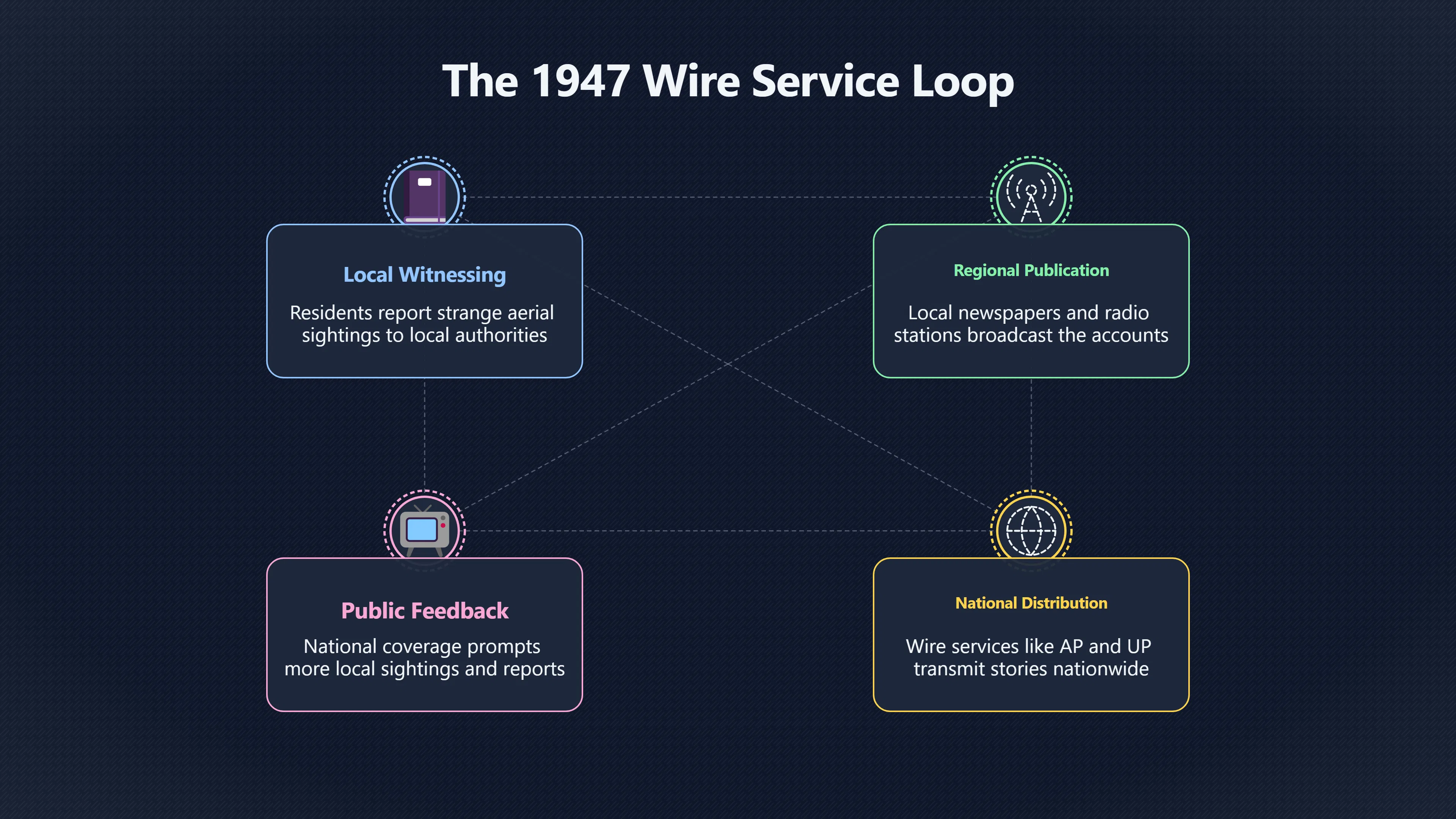
Wire services turned local sightings into national evidence trails, then sent those national stories back into local communities.
On this page
- How local reports reached newspapers and radio
- Why wire services selected and repeated saucer claims
- How national coverage encouraged fresh local sightings
Page outline Jump by section
Introduction
In the early years of the UFO phenomenon, wire services acted as the circulation system of the story. A sighting that began with a pilot, police officer or local resident could move from a small-town newspaper to national headlines within hours. Once distributed through organisations such as the Associated Press (AP) and United Press (UP), the same reports returned to local communities through newspapers and radio bulletins, often carrying greater authority because they now appeared to be part of a nationwide pattern. This feedback loop helped transform isolated observations into what many readers perceived as a growing body of evidence. It also linked UFO culture to science fiction by giving extraordinary claims a mass audience and a shared vocabulary.[National Air and Space Museum]airandspace.si.edu1947 year flying saucerNational Air and Space Museum1947: Year of the Flying Saucer | National Air and Space MuseumJune 24, 2022…
How Local Reports Reached Newspapers and Radio
The mechanism was straightforward but powerful. Local reporters collected accounts from witnesses, police departments, airports, military personnel and ordinary citizens. If editors believed a report was unusual enough to interest readers elsewhere, they sent it to a wire service. The wire service condensed the story into a standard format and transmitted it to subscribing newspapers and radio stations across the country.
The most influential example came from Kenneth Arnold’s sighting near Mount Rainier on 24 June 1947. Arnold first described his experience to reporters at the East Oregonian. Reporter Bill Bequette suggested that wider distribution might produce official responses or explanations. A short account was then picked up by the Associated Press wire. Within hours, newspapers and radio stations nationwide were carrying versions of the story. The phrase “flying saucer” spread with the wire copy and rapidly became the label through which later sightings were interpreted.[National Air and Space Museum]airandspace.si.edu1947 year flying saucerNational Air and Space Museum1947: Year of the Flying Saucer | National Air and Space MuseumJune 24, 2022…
Radio amplified the process further. Newsrooms routinely read wire-service material on air, meaning that a report originating in Oregon or Washington could be heard the same day by listeners thousands of miles away. Contemporary broadcasts noted that both AP and UP were pursuing the Arnold story and distributing it nationally.[National Air and Space Museum]airandspace.si.edu1947 year flying saucerNational Air and Space Museum1947: Year of the Flying Saucer | National Air and Space MuseumJune 24, 2022…
Why Wire Services Selected and Repeated Saucer Claims
Wire services did not promote UFO reports because they endorsed them. Their goal was to distribute stories that appeared newsworthy, surprising and likely to attract reader interest. Flying saucer reports met all three criteria.
Several features made such stories especially attractive:
- Novelty: Disc-shaped objects travelling at extraordinary speeds were inherently unusual.
- Geographical spread: Reports arriving from different states created the appearance of a developing national story.
- Official involvement: Accounts involving pilots, police officers or military personnel appeared more credible than ordinary rumours.
- Lack of resolution: The absence of an agreed explanation kept the story alive and encouraged follow-up reports.
As wire services circulated more sightings, editors increasingly framed new reports as part of an ongoing mystery rather than isolated incidents. AP dispatches from late June and early July 1947 often collected observations from multiple states into a single story, presenting them as evidence of a broader phenomenon. Readers encountered not one witness account but a catalogue of similar claims arriving from widely separated locations.[Ufologie]ufologie.patrickgross.orgUFOs at close sight: Kenneth Arnold sighting reports in the Press, The Tennessean, Nashville, Tennessee, USA, on page 1, on June 27, 1947…
This editorial practice had an important cultural effect. By gathering many local stories together, wire services transformed scattered observations into a coherent narrative. A reader who might dismiss one strange sighting could find a dozen reports harder to ignore.
How National Coverage Encouraged Fresh Local Sightings
The most important consequence of wire distribution was the feedback loop it created.
When local residents read national stories about flying saucers, they gained a framework for interpreting unusual sights in the sky. Objects that might previously have been dismissed as aircraft, balloons, reflections or atmospheric phenomena could now be recognised as possible “saucers”. New reports were then submitted to local newspapers, police stations and radio stations, where they entered the news system again.
The pattern is visible in newspaper coverage from July 1947. Local papers frequently paired reports from nearby witnesses with Associated Press summaries describing saucer sightings across the country. A reader might encounter a local resident’s claim on one side of the page and a national AP roundup on the other. The local story appeared validated by the national one, while the national story gained another data point from the local report.[Ufologie]ufologie.patrickgross.orgUFOs at close sight: Kenneth Arnold sighting reports in the Press, The Herald and News, Klamath Falls, Oregon, USA, on page 1, on July 8…
This process did not require deliberate fabrication. Social psychologists and historians of rumours have long noted that people interpret ambiguous events through available cultural narratives. Once newspapers repeatedly described mysterious discs moving through the sky, witnesses had a ready-made category into which unusual observations could fit. The national story shaped local perception, and local perception supplied new material for the national story.
The Wire Loop and Science Fiction Imaginations
The connection to science fiction lay less in direct borrowing from specific stories than in the circulation of familiar themes. By the late 1940s, audiences already recognised ideas such as advanced aircraft, secret technologies and visitors from elsewhere through popular fiction, magazines and radio drama.
Wire services gave these imaginative possibilities a news format. A report could begin as a local observation, be repeated nationally as a factual news item, and return to communities carrying the authority of widespread coverage. The result was a hybrid cultural space in which readers encountered science-fictional possibilities through ordinary journalism rather than through novels or films alone.
The famous phrase “flying saucer” illustrates this transformation. Once established through wire-service circulation, it provided a common image that linked thousands of otherwise unrelated reports. The term helped create a national UFO conversation because it allowed people in different places to believe they were witnessing versions of the same phenomenon.[National Air and Space Museum]airandspace.si.edu1947 year flying saucerNational Air and Space Museum1947: Year of the Flying Saucer | National Air and Space MuseumJune 24, 2022…

What Made the Wire Loop So Influential
The influence of wire services came from their position between local observation and national awareness. They did not merely spread UFO stories; they connected communities into a shared interpretive network.
A typical cycle looked like this:
- A witness reported a strange aerial sighting locally.
- A newspaper or radio station published the account.
- AP, UP or another wire service distributed the story nationally.
- Other newspapers and broadcasters repeated it.
- Readers and listeners became more attentive to unusual sights.
- New local reports emerged and entered the system again.
This loop helped explain why UFO waves often appeared to spread rapidly across large regions. The mechanism was not simply the movement of rumours from person to person. It was the interaction between local reporting, national wire distribution and renewed local attention. In the formative years of UFO culture, wire services served as the infrastructure that turned isolated stories into a nationwide phenomenon. Military Times+3National Air and Space Museum+3Ufologie[airandspace.si.edu]airandspace.si.edu1947 year flying saucerNational Air and Space Museum1947: Year of the Flying Saucer | National Air and Space MuseumJune 24, 2022…
Amazon book picks
Further Reading
Books and field guides related to How Local UFO Stories Went National. Use these as the next step if you want deeper reading beyond the article.
The Flying Saucers are Real
Illustrates how national media exposure strengthened UFO belief.
The Report on Unidentified Flying Objects
Covers early flying-saucer waves and public dissemination of reports.
eBay marketplace picks
Marketplace Samples
Example marketplace items related to this page. Use the search link to explore similar finds on eBay.



Endnotes
1.
Source: airandspace.si.edu
Title: 1947 year flying saucer
Link:https://airandspace.si.edu/stories/editorial/1947-year-flying-saucer
Source snippet
National Air and Space Museum1947: Year of the Flying Saucer | National Air and Space MuseumJune 24, 2022...
Published: June 24, 2022
2.
Source: militarytimes.com
Title: Military Times Flying saucers still evasive 70 years after pilot’s report
Link:https://www.militarytimes.com/news/pentagon-congress/2017/06/25/flying-saucers-still-evasive-70-years-after-pilot-s-report/
3.
Source: ufologie.patrickgross.org
Link:https://ufologie.patrickgross.org/press/tennessean27jun1947.htm
Source snippet
UFOs at close sight: Kenneth [Arnold sighting]({{ 'arnold-sighting/' | relative_url }}) reports in the Press, The Tennessean, Nashville, Tennessee, USA, on page 1, on June 27, 1947...
Published: June 27, 1947
4.
Source: ufologie.patrickgross.org
Link:https://ufologie.patrickgross.org/press/heraldandnews8jul1947.htm
Source snippet
UFOs at close sight: Kenneth Arnold sighting reports in the Press, The Herald and News, Klamath Falls, Oregon, USA, on page 1, on July 8...
Additional References
5.
Source: youtube.com
Link:http://www.youtube.com/watch?v=z25NfZ0Ea9c
Source snippet
Kenneth Arnold 1947 wire services media flying saucers UFOTV: UFOs The Best Evidence Vol 2 | Full Government Cover-Up Documentary Free Mo...
6.
Source: youtube.com
Link:http://www.youtube.com/watch?v=eh-qtQRMZzM
Source snippet
Kenneth Arnold 1947 UFO flying saucer story history Kenneth Arnold UFO Sighting, 1947 Think Anomalous...
8.
Source: youtube.com
Link:http://www.youtube.com/watch?v=Drq2Z9l8Jzw
Source snippet
Kenneth Arnold UFO Sighting (1947) - The True Origin of Flying Saucers | The Anomaly Bureau...
10.
Source: reddit.com
Title: www.reddit.com Mass UFO Sightings of the Kenneth Arnold UFO Fleet
Link:https://www.reddit.com/r/UFObelievers/comments/10k8980
Source snippet
UFO Sightings of the Kenneth Arnold UFO Fleet - Prior to the Roswell Crash!January 24, 2023...
Published: January 24, 2023
11.
Source: youtube.com
Link:https://www.youtube.com/watch?v=bretHCA89bQ
Source snippet
Kenneth Arnold UFO Sighting The First UFOs - Jimmy Akin's Mysterious World...
12.
Source: youtube.com
Title: Where Did The Term ‘Flying Saucer’ Come From? | Mossback’s Northwest
Link:https://www.youtube.com/watch?v=ap0whDDDU1Y
Source snippet
Ep. 2 | Flying Saucer UFOs | Roswell, Kenneth Arnold, McMinnville, Rex Heflin | The Basement Office...
13.
Source: youtube.com
Link:http://www.youtube.com/watch?v=01sVLTO8xmo
Source snippet
1947: The Kenneth Arnold Sighting | Weird History Ep. #5...
Published: June 1947
14.
Source: youtube.com
Title: The Coming of the Saucers By Kenneth Arnold, Raymond Palmer. FULL Audiobook
Link:https://www.youtube.com/watch?v=12uXbLC7Xug
Source snippet
Kenneth Arnold and the First UFOs - Jimmy Akin's Mysterious World...
Topic Tree