Within Invasion Films
Why Monsters and Saucers Shared One Fear
Films like Them!
On this page
- Radiation as a story engine
- Threats from above and below
- How science lost its promise of control
Page outline Jump by section
Introduction
The flying saucer panic of the 1950s did not exist in isolation. In the same cinemas that showed alien spacecraft crossing the skies, audiences also watched giant ants, mutated insects and radiation-created creatures emerge from deserts, tunnels and laboratories. Together, these films formed a wider culture of technological dread. Flying saucers represented threats arriving from beyond Earth, while atomic monsters embodied dangers created by humanity itself. Both drew upon the same anxieties: nuclear weapons, scientific uncertainty, Cold War insecurity and the fear that modern technology had escaped human control. Rather than competing trends, saucer invasions and atomic monsters were often parallel expressions of a single question: what happens when scientific progress produces consequences no one can manage?[BFI]bfi.org.uk10 great american sci fi films 1950s10 great American sci-fi films of the 1950s | BFIOctober 30, 2014…

Radiation as a Story Engine
The most distinctive feature of atomic-age monster films was their reliance on radiation as a narrative explanation. Nuclear testing and atomic research provided a convenient mechanism through which ordinary creatures could become extraordinary threats. Unlike earlier horror monsters rooted in folklore or Gothic science, the new creatures were products of contemporary fears.
The clearest example is Them! (1954), in which giant ants emerge from the New Mexico desert after exposure to radiation from atomic tests. The film explicitly links nuclear experimentation to mutation and treats the ants not as supernatural beings but as biological consequences of the atomic age. Scientists, military officers and federal investigators work together to understand and destroy the threat, making the story feel like a crisis produced by modern technology rather than ancient evil.[IMDb]imdb.comThem! (1954) - Plot - IMDb…
Them! was not alone. Throughout the decade, films repeatedly used radiation to explain giant tarantulas, oversized grasshoppers, colossal crabs and other mutants. These stories transformed invisible atomic forces into visible monsters. Radiation could not be seen, but a giant insect destroying a city could. Cinema translated an abstract fear into something audiences could watch, hear and emotionally process.[coldwarstudies.com]coldwarstudies.comthe scary cold war 1950s science fiction filmsThe Scary Cold War: 1950s Science Fiction Films | Cold WarSeptember 14, 2023…
This helped explain why atomic monsters flourished alongside UFO films. Both genres emerged from a society struggling to imagine the consequences of technologies that seemed increasingly powerful and poorly understood.
Threats from Above and Below
Flying saucer films and monster films often differed in where danger originated, but they shared remarkably similar dramatic structures.
Saucer invasion films typically brought danger from the sky. Alien craft appeared on radar screens, descended from space and challenged military defences. Films such as The Day the Earth Stood Still and Earth vs. the Flying Saucers focused on aerial mystery, advanced technology and the possibility of hostile extraterrestrial intelligence.[Encyclopedia]encyclopedia.comThe Day the Earth Stood Still | Encyclopedia.comThe Day the Earth Stood Still | Encyclopedia.com…
Atomic monster films, by contrast, frequently brought danger from beneath the surface. In Them!, the giant ants emerge from desert nests and eventually spread into the underground tunnel systems of Los Angeles. The threat is hidden inside the nation’s own landscape rather than arriving from another world.[IMDb]imdb.comThem! (1954) - Plot - IMDb…
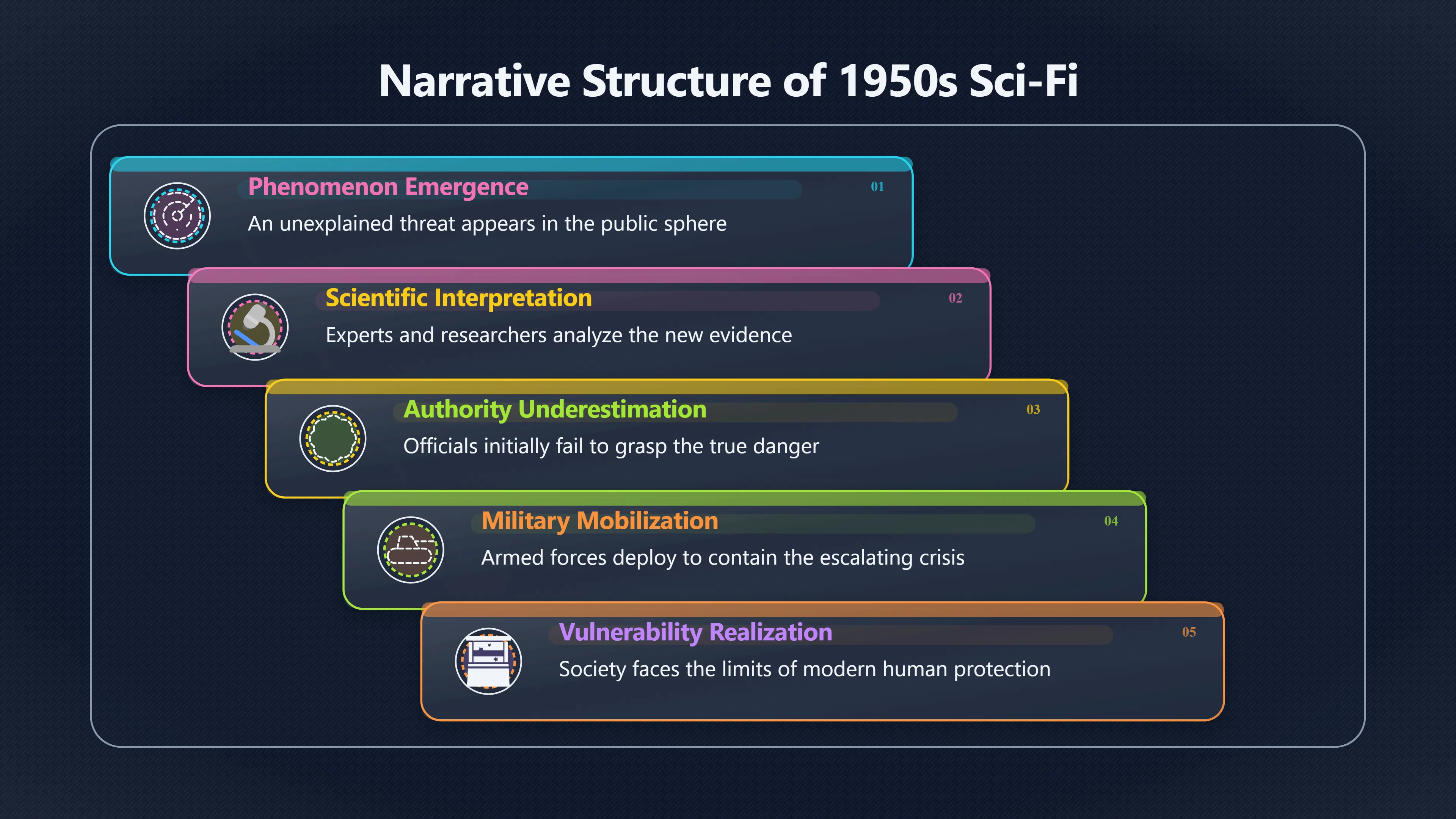
Despite this difference, both forms of science fiction followed a similar pattern:
- An unexplained phenomenon appears.
- Scientists struggle to interpret the evidence.
- Authorities initially underestimate the threat.
- Military forces mobilise.
- Society confronts the possibility that ordinary protections are inadequate.
Invasion stories and monster stories therefore shared the same emotional rhythm. Whether the enemy descended from a saucer or crawled out of an irradiated nest, the audience experienced a crisis of vulnerability. The familiar world suddenly seemed exposed.
This overlap explains why cinema audiences moved easily between giant insect films and UFO invasion narratives. Both suggested that modern civilisation stood only one scientific surprise away from catastrophe.

How Science Lost Its Promise of Control
A striking feature of 1950s science fiction is that science occupied two contradictory roles at once.
Scientists were often heroes. In Them!, expert knowledge identifies the ants and helps organise the response. Similar films relied on researchers, military technicians and government specialists to solve problems beyond ordinary understanding.[IMDb]imdb.comThem! (1954) - Plot - IMDb…
Yet science was also the source of the danger. Atomic testing created the ants. Experimental technologies produced mutations. New forms of energy threatened to unleash uncontrollable consequences. The same scientific enterprise that promised progress also generated disaster.
This tension reflected broader public debates about nuclear technology. The atomic bomb had demonstrated extraordinary scientific achievement while simultaneously revealing humanity’s capacity for self-destruction. Historians of the nuclear age note that many scientists themselves worried about proliferation, arms races and the long-term consequences of atomic technology. Those concerns filtered into popular culture.[arXiv]arxiv.orgPhysicists and the 1945 Decision to Drop the BombOctober 13, 2002…
As a result, 1950s science fiction often portrayed scientific knowledge as necessary but insufficient. Experts could diagnose a crisis, but they could not guarantee that future discoveries would remain safe. The central fear was not ignorance. It was that knowledge itself had become powerful enough to create threats beyond human control.
Why Atomic Monsters Fit Beside Saucer Panic
From a historical perspective, atomic monsters and flying saucers were two branches of the same cultural imagination.
Flying saucers expressed fears about unknown powers arriving from outside humanity. Atomic monsters expressed fears about dangers created from within human society. One looked outward toward space; the other looked inward toward laboratories, weapons programmes and technological experimentation.
The distinction mattered less than the shared emotional foundation. Both genres emerged during a period defined by nuclear testing, Cold War confrontation and rapid technological change. Audiences were being asked to imagine a world transformed by forces that seemed larger than any individual citizen or institution.[BFI]bfi.org.uk10 great american sci fi films 1950s10 great American sci-fi films of the 1950s | BFIOctober 30, 2014…
That is why Them! remains such an important companion to the flying-saucer cycle. The giant ants are not aliens, yet they occupy the same imaginative territory as UFO invaders. They are manifestations of a civilisation anxious about what modern science might unleash next. In the broader relationship between UFO culture and science fiction, atomic monsters reveal that the deepest fear was often not the visitor from another planet, but the possibility that humanity had already created its own invasion.
Amazon book picks
Further Reading
Books and field guides related to Relationships betwee d7372c hollywood invasion s 2182e1 atomic monsters sauc 0488c6. Use these as the next step if you want deeper reading beyond the article.
Keep Watching the Skies!
Directly covers the flying-saucer invasion and atomic-monster films discussed on the page.
Watch the Skies!
Directly explains how flying saucers evolved into a major cultural and cinematic myth.
An Illustrated History Of Horror And Science-fiction Films
Places atomic-monster and invasion films within the wider evolution of genre cinema.
The Monster Show
Explores how social fears shaped monster narratives, including Cold War-era anxieties relevant to atomic creatures.
eBay marketplace picks
Marketplace Samples
Example marketplace items related to this page. Use the search link to explore similar finds on eBay.
Endnotes
1.
Source: encyclopedia.com
Title: The Day the Earth Stood Still | Encyclopedia.com
Link:https://www.encyclopedia.com/media/encyclopedias-almanacs-transcripts-and-maps/day-earth-stood-still
Source snippet
The Day the Earth Stood Still | Encyclopedia.com...
2.
Source: imdb.com
Link:https://www.imdb.com/title/tt0047573/plotsummary/
Source snippet
Them! (1954) - Plot - IMDb...
3.
Source: coldwarstudies.com
Title: the scary cold war 1950s science fiction films
Link:https://coldwarstudies.com/2023/09/14/the-scary-cold-war-1950s-science-fiction-films/
Source snippet
The Scary Cold War: 1950s Science Fiction Films | Cold WarSeptember 14, 2023...
Published: September 14, 2023
4.
Source: imdb.com
Link:https://www.imdb.com/title/tt0046026/
Source snippet
The Magnetic Monster (1953) - IMDb...
5.
Source: arxiv.org
Link:https://arxiv.org/abs/physics/0210058
Source snippet
Physicists and the 1945 Decision to Drop the BombOctober 13, 2002...
Published: October 13, 2002
6.
Source: arxiv.org
Title: Astronuclear Physics: a Tale of the Atomic Nuclei in the Skies
Link:https://arxiv.org/abs/2001.11228
Source snippet
January 30, 2020...
Published: January 30, 2020
7.
Source: bfi.org.uk
Title: 10 great american sci fi films 1950s
Link:https://www.bfi.org.uk/lists/10-great-american-sci-fi-films-1950s
Source snippet
10 great American sci-fi films of the 1950s | BFIOctober 30, 2014...
Published: October 30, 2014
Additional References
8.
Source: coolcleveland.com
Title: giant irradiated ants explored in screening of 1954s them at the capitol theatre
Link:https://coolcleveland.com/2019/01/giant-irradiated-ants-explored-in-screening-of-1954s-them-at-the-capitol-theatre/
Source snippet
Giant Irradiated Ants Explored in Screening of 1954’s “Them!” at the Capitol Theatre | CoolCleveland...
9.
Source: youtube.com
Link:https://www.youtube.com/watch?v=yE3TY23HZPM
Source snippet
The first video, 10 '50s Atomic Monster Movies Born From Real Nuclear Panic, details how nuclear anxieties and mushroom clouds manifested...
10.
Source: tandfonline.com
Link:https://www.tandfonline.com/doi/full/10.1080/10509208.2023.2278388
Source snippet
article: Robert Wise’s The Day the Earth Stood Still (1951) is Not an Alien Invasion Film: A Re-Evaluation of the Filmic EvidenceNovember...
11.
Source: pitchfork.com
Title: 20386 phase iv ost
Link:https://pitchfork.com/reviews/albums/20386-phase-iv-ost
Source snippet
This trend continued with horror films into the 1970s, epitomized by movies about dangerous insects like roaches, killer bees, and earthw...
12.
Source: youtube.com
Link:https://www.youtube.com/watch?v=jUzzNL6iCUg
Source snippet
10 Forgotten 1950s Atomic Horror Films That Predicted Our Worst Fears...
13.
Source: youtube.com
Title: 10 ’50s Atomic Monster Movies Born From Real Nuclear Panic
Link:https://www.youtube.com/watch?v=TjcOJobmShE
Source snippet
Ultimate 1950s Flying Saucer, UFO, and Alien Encounter Movies...
14.
Source: filmmusic.com
Title: the day the earth stood still 1951
Link:https://filmmusic.com/movie/the-day-the-earth-stood-still-1951/
Source snippet
The Day the Earth Stood Still (1951) - FilmMusic.comDecember 8, 2008...
Published: December 8, 2008
15.
Source: moriareviews.com
Title: earth vs the flying saucers 1956
Link:https://moriareviews.com/sciencefiction/earth-vs-the-flying-saucers-1956.htm
Source snippet
Moria Film ReviewEarth vs the Flying Saucers (1956) - Moria...
16.
Source: cbr.com
Title: best sci fi movies of the 1950s
Link:https://www.cbr.com/best-sci-fi-movies-of-the-1950s/
Source snippet
www.cbr.com10 Best Sci-Fi Movies Of The 1950sMarch 22, 2023...
Published: March 22, 2023
17.
Source: reddit.com
Link:https://www.reddit.com/r/TrueFilm/comments/mvmc6j
Source snippet
www.reddit.comThem! (1954) - A standout among the nuclear monster trend from the 1950sApril 21, 2021...
Published: April 21, 2021
Topic Tree