Within Witness Images
How One Word Sharpened UFO Sightings
Once saucer language became familiar, brief and ambiguous sightings could be retold through a sharper image than the witness originally perceived.
On this page
- From comparison word to object category
- Why labels make memories feel cleaner
- Where witness language meets media language
Page outline Jump by section
Introduction
The phrase “flying saucer” did more than provide a convenient label for unidentified objects. It changed how uncertain experiences could be described, remembered, and retold. Once the term became widely known after the Kenneth Arnold sighting of 1947, people no longer had to explain an unusual aerial observation from scratch. A brief glimpse of an unfamiliar object, a distant light, or a poorly seen shape could be translated into a recognised category: a saucer. The result was that reports often sounded more precise than the original perception may have been. This was not necessarily deception. It reflected a common feature of human memory and language: when people encounter something ambiguous, they interpret it through familiar words and images. In the UFO era, “saucer” became one of the most powerful of those interpretive tools.[Academic Dictionaries and Encyclopedias]en-academic.comAcademic Dictionaries and Encyclopedias Flying saucerAcademic Dictionaries and Encyclopedias Flying saucer

From Comparison Word to Object Category
The original meaning of “flying saucer” was less straightforward than later popular culture suggested. Histories of the Kenneth Arnold case note that the famous phrase emerged through newspaper reporting and public interpretation. Arnold described unusual objects moving in a manner comparable to a saucer skipping across water, yet the expression quickly became attached to the objects themselves. Within days, “flying saucer” had become a recognised thing rather than merely a comparison.[britannica.com]britannica.comOpen source on britannica.com.
That shift mattered because categories influence perception. Before a category exists, a witness may describe an object in uncertain terms: a flash, a shape, a glint, or something difficult to identify. After a category exists, the witness can select it immediately. Instead of saying, “I saw something roundish for a moment,” a person can say, “I saw a flying saucer.”
The difference is subtle but important. The first description highlights uncertainty. The second highlights classification. The underlying experience may be identical, yet the language creates a stronger impression that a definite object was observed.
As the term spread through newspapers, radio, magazines, comic books, and science-fiction imagery, it became increasingly familiar. A witness no longer needed to invent a description; the culture had already supplied one.[Academic Dictionaries and Encyclopedias]en-academic.comAcademic Dictionaries and Encyclopedias Flying saucerAcademic Dictionaries and Encyclopedias Flying saucer
Why Labels Make Memories Feel Cleaner
Psychological research has repeatedly shown that memory is reconstructive rather than photographic. People do not simply replay a stored recording of an event. Instead, they rebuild memories using fragments of perception, later information, expectations, and available language. Suggestion and social influence can alter how an event is remembered and reported.[PubMed]pubmed.ncbi.nlm.nih.govMagic and memory: using conjuring to explore the effects of suggestion, social influence, and paranormal belief on eyewitness testi…
In the context of UFO reports, this means that labels can perform two functions at once:
- They help witnesses communicate an experience.
- They also shape how that experience is remembered.
A witness who initially saw only a distant, poorly defined object may later remember the event through the vocabulary used to describe it. Once “saucer” becomes the accepted term, the memory can gradually acquire sharper edges. The report sounds cleaner because the label itself is cleaner.
This process does not require deliberate embellishment. Human beings naturally organise ambiguous information into meaningful categories. Historians of UFO culture have often noted that many reports begin with limited observational detail but become more structured as witnesses recount them over time. The existence of a widely recognised object category encourages that transformation.
An additional effect is conversational efficiency. Saying “flying saucer” instantly conveys shape, technology, and cultural associations. A long explanation of uncertainty is replaced by a short, vivid image. The listener receives a clearer picture, but that picture may owe as much to the shared cultural meaning of the term as to the witness’s original visual experience.

Where Witness Language Meets Media Language
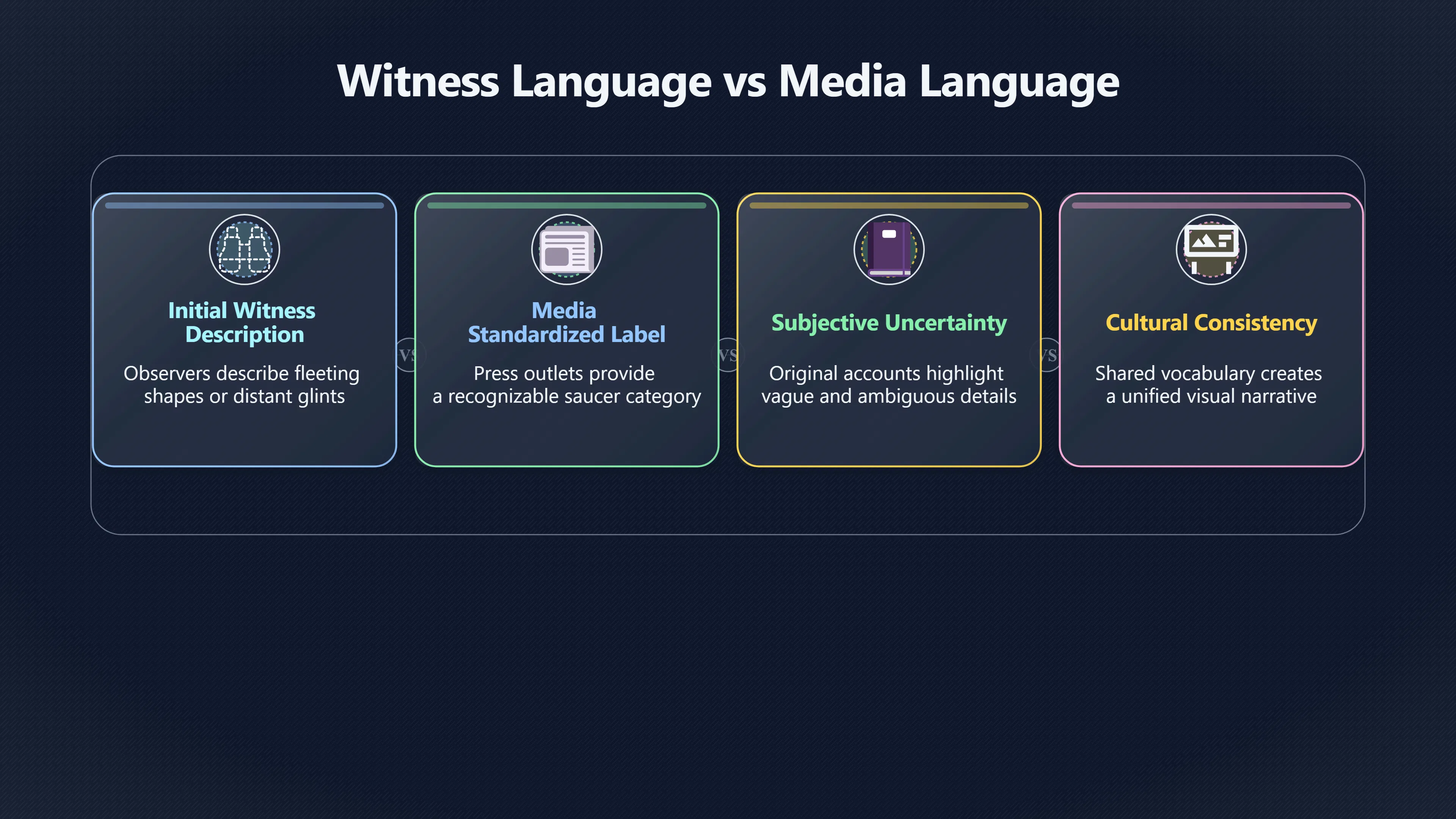
The power of the saucer label grew because witness language and media language reinforced one another. Newspapers sought memorable descriptions. Illustrators needed recognisable shapes. Science-fiction publishers wanted visually striking spacecraft. The saucer satisfied all three needs.
As media depictions multiplied, the word acquired a standard visual form: a metallic disc, often with a dome, moving in extraordinary ways. Future witnesses encountering something unusual in the sky were therefore not selecting from an unlimited range of descriptions. They were choosing from a culturally available set of images, with the saucer among the most familiar.
This feedback loop worked in both directions:
- Reports supplied the initial vocabulary.
- Media popularised and standardised that vocabulary.
- Witnesses adopted the standardised vocabulary when describing later experiences.
- New reports appeared more consistent because they used the same language.
Consistency in wording can create the impression of consistency in observation. Yet identical descriptions do not necessarily mean identical perceptions. People may be drawing on the same cultural template when attempting to describe different ambiguous stimuli.
The eventual adoption of the broader term “UFO” in the 1950s reflected recognition of this problem. Investigators increasingly realised that “flying saucer” implied a specific shape and carried strong cultural baggage. “UFO” was intended as a more neutral label for an unidentified observation rather than a particular kind of craft.[BUFORA]bufora.org.ukBUFORAGUIDE TO UFOS | BUFORABUFORAGUIDE TO UFOS | BUFORA
How One Word Changed the Tone of UFO Testimony
The enduring significance of the saucer label lies in its ability to convert uncertainty into apparent specificity. A witness may have experienced only a fleeting and puzzling sighting. Once described as a saucer, however, the event acquires a clearer form, a recognisable identity, and a place within a larger cultural story.
Within the broader relationship between UFOs and science fiction, this is one of the most important mechanisms by which popular imagery influenced testimony. Science fiction did not need to dictate what witnesses saw. It only needed to supply a familiar vocabulary. When people faced an ambiguous experience, that vocabulary helped organise perception and memory into a more definite narrative.
The result was not merely a new word. It was a new way of describing the unknown—one that made uncertain sightings sound as though they had always been sharply defined.[en-academic.com]en-academic.comAcademic Dictionaries and Encyclopedias Flying saucerAcademic Dictionaries and Encyclopedias Flying saucer
Amazon book picks
Further Reading
Books and field guides related to Relationships betwee d7372c witness templates 6ca7c3 saucer words sightin 6e851e. Use these as the next step if you want deeper reading beyond the article.
The Report on Unidentified Flying Objects
Covers the flying-saucer era and how terminology shaped reports.
Passport to Magonia
Discusses how cultural narratives influence descriptions of strange phenomena.
eBay marketplace picks
Marketplace Samples
Live-tested eBay searches with available results related to this page.


Endnotes
1.
Source: britannica.com
Link:https://www.britannica.com/question/What-are-some-common-shapes-or-features-people-report-seeing-in-UFOs
2.
Source: encyclopedia.com
Title: www.encyclopedia.com Ufo | Encyclopedia.com
Link:https://www.encyclopedia.com/science-and-technology/technology/aviation-general/ufo
Source snippet
18, 2018...
Published: August 18, 2018
3.
Source: en-academic.com
Title: Academic Dictionaries and Encyclopedias Flying saucer
Link:https://en-academic.com/dic.nsf/enwiki/7231124/
4.
Source: en-academic.com
Title: Academic Dictionaries and Encyclopedias Kenneth Arnold
Link:https://en-academic.com/dic.nsf/enwiki/303304
5.
Source: pubmed.ncbi.nlm.nih.gov
Link:https://pubmed.ncbi.nlm.nih.gov/25431565/
Source snippet
Magic and memory: using conjuring to explore the effects of suggestion, social influence, and paranormal belief on eyewitness testi...
6.
Source: bufora.org.uk
Title: BUFORAGUIDE TO UFOS | BUFORA
Link:https://www.bufora.org.uk/guide-to-ufos
Additional References
7.
Source: oars.uos.ac.uk
Link:https://oars.uos.ac.uk/529/
Source snippet
or an ostensibly paranormal event | Open Access Repository Suffolk - OARS...
8.
Source: youtube.com
Link:https://www.youtube.com/watch?v=01sVLTO8xmo
Source snippet
The UFO Deluge of July 4th, 1947 | Part 1: Omens (Before the Storm)...
Published: June 1947
9.
Source: youtube.com
Title: Where Did The Term ‘Flying Saucer’ Come From? | Mossback’s Northwest
Link:https://www.youtube.com/watch?v=ap0whDDDU1Y
Source snippet
24th June 1947: The first widely-reported UFO sighting was made by private pilot Kenneth Arnold...
Published: June 1947
10.
Source: youtube.com
Link:https://www.youtube.com/watch?v=sSY6NB6m2PU
Source snippet
Kenneth Arnold and the First UFOs - Jimmy Akin's Mysterious World...
11.
Source: youtube.com
Title: Kenneth Arnold and the First UFOs
Link:https://www.youtube.com/watch?v=qdXNAOxs6mo
Source snippet
Can language change the way you think? The science of Arrival...
12.
Source: youtube.com
Title: Can language change the way you think? The science of Arrival
Link:https://www.youtube.com/watch?v=lIPi3OiaG3I
Topic Tree