Within Comics
The Human Face That Made UFOs Clear
Pointing farmers, pilots, police, and crowds told readers whether a saucer meant fear, wonder, skepticism, or invasion.
On this page
- Reaction shots as interpretation guides
- Farmers, pilots, scientists, and crowds
- How witnesses turned objects into encounters
Page outline Jump by section
Introduction
In UFO comics, the unidentified object was rarely expected to carry the entire meaning of a scene by itself. A disc in the sky could be a machine, a misunderstanding, a joke, a miracle, or a threat. What made the image immediately understandable was often the reaction of the people beneath it. Pointing farmers, alarmed police officers, astonished pilots, cautious scientists, and fleeing crowds acted as visual interpreters for the reader. Their faces and gestures told audiences how to understand the object before any dialogue box or caption did.
 This approach linked UFO imagery to broader science-fiction storytelling. Comics depended on quick visual communication, and witness reactions transformed an ambiguous shape into a clear narrative event. The human response completed the scene, turning a distant object into an encounter.
Reaction Shots as Interpretation Guides
Comics are a medium built on inference. Readers connect images, emotions, and actions across panels, mentally supplying information that is not explicitly shown. Scholars of visual narrative describe this process as reader-driven interpretation, in which meaning emerges from the combination of depicted events and the inferences readers make between them.[arXiv]arxiv.orgThe Amazing Mysteries of the Gutter: Drawing Inferences Between Panels in Comic Book NarrativesNovember 16, 2016…
UFO artists exploited this principle through reaction shots. Instead of explaining what a saucer meant, they showed someone looking at it.
A single witness could communicate several possible readings:
- A farmer shielding his eyes suggested wonder or curiosity.
- A pilot leaning forward in a cockpit implied investigation.
- A police officer reaching for a radio suggested urgency.
- A terrified crowd signalled danger or invasion.
- A scientist taking notes implied sceptical examination.
The UFO itself often remained visually simple. The emotional content came from the people observing it. Readers instinctively followed the witnesses’ gaze and adopted their emotional framing.
This technique was especially useful because UFOs were, by definition, unidentified. The witnesses supplied certainty where the object could not.
Farmers, Pilots, Scientists, and Crowds
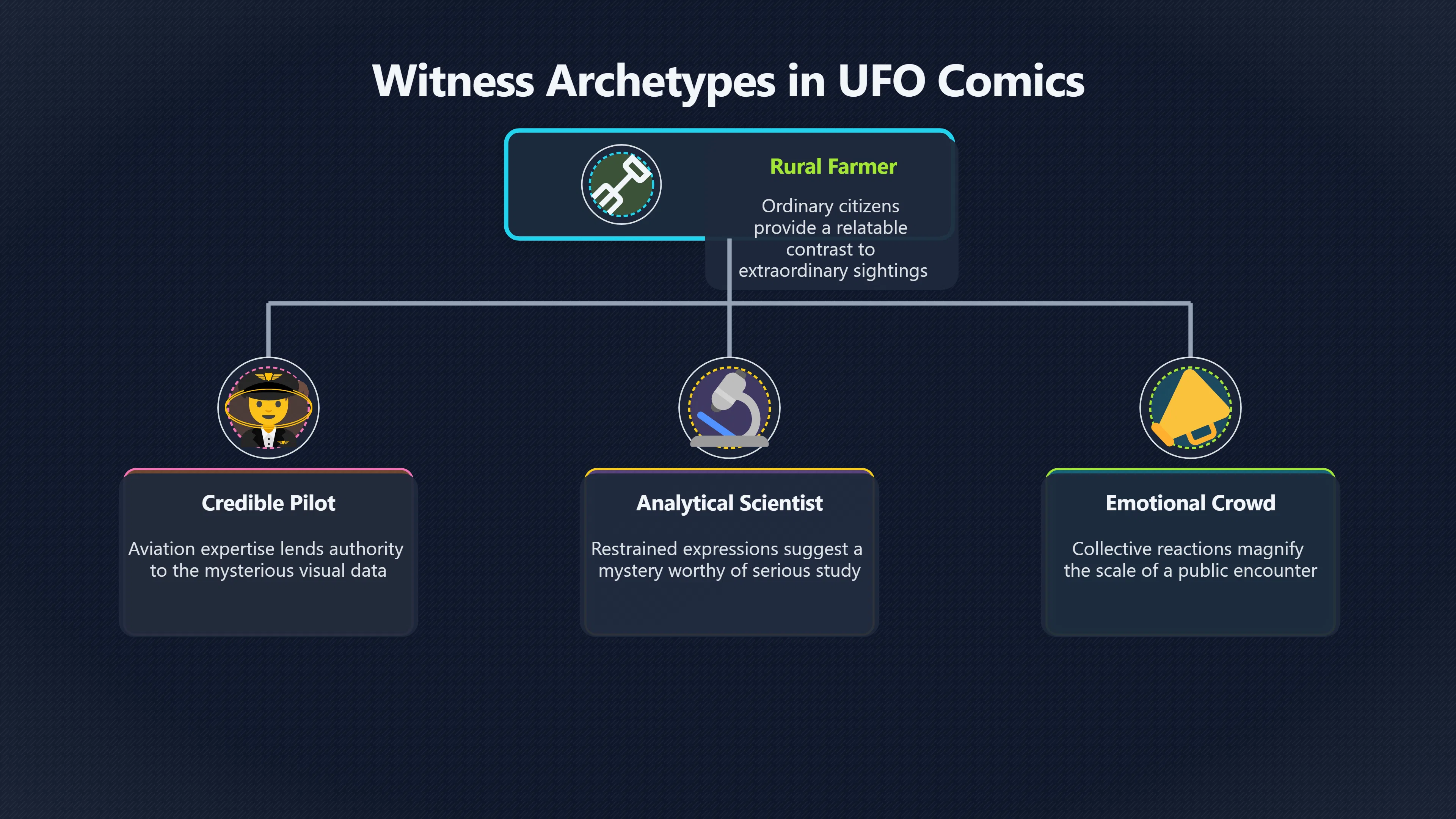
The Farmer as Everyday Observer
Rural witnesses became a recurring feature of post-war UFO imagery. A farmhouse, open field, and lone observer created an immediate contrast between ordinary life and extraordinary intrusion.
The farmer served an important narrative purpose. Readers were encouraged to identify with someone presented as an ordinary citizen rather than a technical expert. When such a character pointed at the sky in amazement, the scene implied that something unusual had interrupted normal reality.
The visual formula required little explanation: horizon, saucer, pointing figure. In a few lines of artwork, the encounter became understandable.
The Pilot as Credible Witness
Pilots occupied a different symbolic role. Because flying-saucer culture emerged alongside aviation culture, comic artists frequently used military or civilian aviators to lend authority to sightings.
Aviation-themed strips and stories often portrayed UFOs through cockpit viewpoints or aerial chases. In one 1953 Buz Sawyer storyline, official discussion of “unidentified flying objects” framed the phenomenon as something requiring calm observation rather than immediate dismissal.[Comics Kingdom]comicskingdom.comComics KingdomBuz Sawyer Comic Strip 1953-12-15 | Comics KingdomDecember 15, 1953…
When a pilot reacted with surprise, readers were invited to think that even trained observers found the object difficult to explain. The witness’s expertise increased the dramatic weight of the encounter.
Scientists and Investigators
Scientists, military personnel, and investigators frequently appeared in UFO comics not simply to witness events but to model interpretation.
Unlike frightened civilians, these characters often displayed restraint. Their expressions communicated concentration rather than panic. Clipboards, instruments, and laboratory settings visually suggested that the mystery deserved study.
Yet even sceptical investigators were usually drawn looking upward, examining traces, or pursuing evidence. Their presence reassured readers that the encounter mattered enough to investigate.
The Crowd as Emotional Amplifier
If a lone witness established an encounter, a crowd transformed it into a public event.
Artists frequently depicted groups staring skyward in unison. The crowd’s collective reaction served two functions:
- It confirmed that the object was visible to many people.
- It magnified the emotional tone of the scene.
A crowd running implied invasion. A crowd gathering implied curiosity. A crowd pointing and arguing suggested uncertainty.
Because readers instinctively read group behaviour as social evidence, the crowd often made a UFO appear more significant than the object itself.
How Witnesses Turned Objects into Encounters
The most important contribution of witness figures was narrative transformation.
Without witnesses, a saucer floating against a blank sky remained a design element. With witnesses, it became an event.
Comics routinely organised UFO scenes around visual relationships:
- Witness looking upward.
- Reader following the witness’s gaze.
- UFO revealed in the same panel or a subsequent panel.
- Emotional reaction establishing interpretation.
This structure resembles broader principles of visual storytelling in which characters guide audience attention and emotion. Research on comics repeatedly shows that readers rely on depicted bodies, expressions, and visual cues to construct meaning and motion from otherwise static images.[edu.mt]um.edu.mtOpen source on edu.mt.
In UFO comics, witnesses effectively acted as narrative arrows directing interpretation.
A frightened face could make a harmless-looking disc seem threatening. A delighted face could make the same disc appear wondrous. A sceptical expression could encourage readers to question what they were seeing.
The object changed less than the reaction surrounding it.
The Risk of Borrowed Emotion
This visual shorthand was effective, but it carried a limitation. Witness reactions could predetermine interpretation before readers had enough information to judge the situation themselves.
A crowd fleeing encouraged readers to assume danger even when no hostile action had occurred. A scientist’s fascination encouraged readers to treat a sighting as significant before evidence was presented. The emotional framing sometimes became more persuasive than the object being observed.
This was particularly important in UFO stories because the central subject was ambiguity. Comics often resolved that ambiguity visually by assigning emotions to witnesses. The human response supplied meaning faster than the mystery itself could.
As a result, many memorable UFO images from the 1950s and 1960s are remembered not simply as pictures of flying saucers but as pictures of people reacting to flying saucers. The startled witness became part of the iconography. A saucer in the sky identified the phenomenon; the human face beneath it told readers what that phenomenon meant.
Amazon book picks
Further Reading
Books and field guides related to The Human Face That Made UFOs Clear. Use these as the next step if you want deeper reading beyond the article.
Expressive Anatomy for Comics and Narrative
Focuses on body language and reaction shots.
eBay marketplace picks
Marketplace Samples
Example marketplace items related to this page. Use the search link to explore similar finds on eBay.
Endnotes
1.
Source: arxiv.org
Link:https://arxiv.org/abs/1611.05118
Source snippet
The Amazing Mysteries of the Gutter: Drawing Inferences Between Panels in Comic Book NarrativesNovember 16, 2016...
Published: November 16, 2016
2.
Source: pmc.ncbi.nlm.nih.gov
Title: PMCLinguistic typology of motion events in visual narratives
Link:https://pmc.ncbi.nlm.nih.gov/articles/PMC9767167/
3.
Source: pmc.ncbi.nlm.nih.gov
Link:https://pmc.ncbi.nlm.nih.gov/articles/PMC12552011/
4.
Source: arxiv.org
Title: Vi NTE R: Image Narrative Generation with Emotion-Arc-Aware Transformer
Link:https://arxiv.org/abs/2202.07305
Source snippet
ViNTER: Image Narrative Generation with Emotion-Arc-Aware TransformerFebruary 15, 2022...
Published: February 15, 2022
5.
Source: comicskingdom.com
Link:https://comicskingdom.com/vintage/buz-sawyer/1953
Source snippet
Comics KingdomBuz Sawyer Comic Strip 1953-12-15 | Comics KingdomDecember 15, 1953...
Published: December 15, 1953
6.
Source: um.edu.mt
Link:https://www.um.edu.mt/library/oar//handle/123456789/16375
7.
Source: orau.org
Link:https://www.orau.org/health-physics-museum/collection/civil-defense/miscellaneous/comic.html
Source snippet
Defense Comic (1957-1960) | Museum of Radiation and Radioactivity...
Additional References
8.
Source: theguardian.com
Title: www.theguardian.com Alien invasions and corrupt cops! The history of EC Comics
Link:https://www.theguardian.com/artanddesign/gallery/2020/aug/20/alien-invasions-and-corrupt-cops-the-history-of-ec-comics-in-pictures
Source snippet
invasions and corrupt cops! The history of EC Comics - in pictures | Graphic design | The GuardianAugust 20, 2020...
Published: August 20, 2020
9.
Source: theparisreview.org
Link:https://www.theparisreview.org/blog/2016/09/13/flying-saucers-art-department/
Source snippet
Saucers Over the Art Dept.! How Book Designers Took on UFOsSeptember 13, 2016...
Published: September 13, 2016
10.
Source: clickamericana.com
Title: vintage mad magazine covers company history
Link:https://clickamericana.com/eras/1950s/vintage-mad-magazine-covers-company-history
Source snippet
Mad magazine: How a wicked 1952 comic book taught America to mock everything - Click AmericanaMay 20, 2026...
Published: May 20, 2026
11.
Source: youtube.com
Link:https://www.youtube.com/watch?v=Qhife4xjiMs
Source snippet
EARTH VS THE FLYING SAUCERS Best UFO Clips (1965) Sci-Fi...
12.
Source: youtube.com
Link:https://www.youtube.com/watch?v=jUzzNL6iCUg
Source snippet
Steven Spielberg Cannot Stop Remaking [Close Encounters]({{ 'close-encounters/' | relative_url }}) of the Third Kind (Movie Review)...
13.
Source: youtube.com
Link:https://www.youtube.com/watch?v=xg713GtUUxY
Source snippet
Close Encounters Of The Third Kind - 16 Weird Facts And The Ending The Studio Tried to Hide...
14.
Source: history.com
Title: ufos washington dc news reports
Link:https://www.history.com/news/ufos-washington-dc-news-reports/
Source snippet
1952, 'Flying Saucers' Over Washington Sent the Press Into a Frenzy | HISTORYMarch 11, 2019...
Published: March 11, 2019
15.
Source: wyominghistoryday.org
Title: ufos comics day 1950s and 1960s
Link:https://www.wyominghistoryday.org/index.php/theme-topics/collections/items/ufos-comics-day-1950s-and-1960s
Source snippet
in comics of the day, 1950s and 1960s | Wyoming History Day...
16.
Source: youtube.com
Title: Watch The Skies! A Brief History Of UFO Comics
Link:https://www.youtube.com/watch?v=lpFgPpvX2gI
Source snippet
Ultimate 1950s Flying Saucer, UFO, and Alien Encounter Movies...
17.
Source: britannica.com
Title: www.britannica.com Comic strip
Link:https://www.britannica.com/art/comic-strip/The-first-half-of-the-20th-century-the-evolution-of-the-form
Source snippet
strip - Evolution, 20th Century, Form | Britannica...
Topic Tree