Within Jung
Did Jung Believe Flying Saucers Were Real?
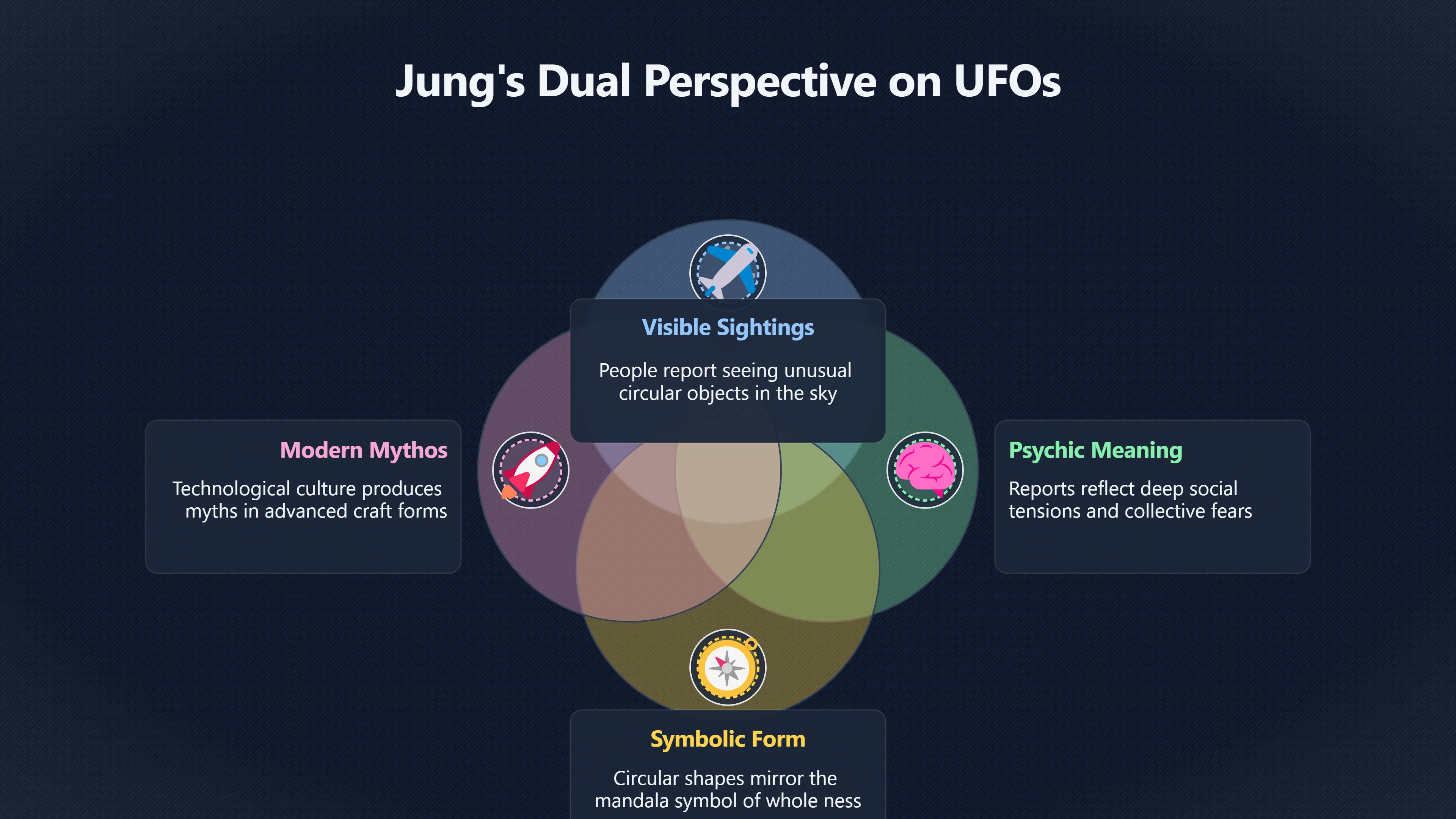
Jung neither dismissed every sighting nor endorsed alien spacecraft; he separated the physical question from the cultural meaning of reports.
On this page
- Why Jung refused a simple believer or sceptic label
- What psychology can explain about UFO reports
- What empirical investigation still has to answer
Page outline Jump by section
Introduction
Did Carl Jung believe flying saucers were real? The short answer is that he refused to give a simple yes-or-no answer. Jung did not argue that all UFO reports were fantasies, nor did he endorse the idea that they were alien spacecraft. Instead, he drew a careful distinction between two questions: whether something objective was being observed in the sky, and why reports of flying saucers had acquired such powerful cultural and psychological meaning. His position is often misrepresented because later readers have tried to place him in either the believer or sceptic camp. Jung explicitly resisted both labels. He regarded the physical reality of UFOs as an open empirical question while arguing that the social and psychological reality of the UFO phenomenon was already beyond doubt.[routledge.com]routledge.comFlying Saucers: A Modern Myth of Things Seen in the SkyFlying Saucers: A Modern Myth of Things Seen in the Sky - 2nd Edition…
Why Jung refused a simple believer-or-sceptic label
Jung’s 1958 book Flying Saucers: A Modern Myth of Things Seen in the Sky was not written as a verdict on extraterrestrial visitation. He repeatedly stated that his primary concern was the psychic aspect of the phenomenon rather than proving or disproving specific sightings. The book’s own summaries stress that it was not intended as an authoritative judgment on whether UFOs physically existed. Instead, Jung wanted to understand what the reports meant and why they spread so widely.[jungpage.org]jungpage.orgAbstracts of the Collected Works of C.G. JungAbstracts of the Collected Works of C.G. Jung
This distinction is crucial. Jung thought many commentators were making a false choice between two extremes:
- Either UFOs were physical machines from elsewhere.
- Or UFOs were entirely imaginary and therefore unimportant.
He believed both positions overlooked the phenomenon’s complexity. People were clearly reporting experiences, seeing unusual objects, sharing stories, and developing beliefs around them. Even if some reports were misinterpretations, rumours, or projections, the phenomenon itself demanded explanation.[mitpressbookstore]mitpressbookstore.mit.eduFlying Saucers: A Modern Myth of Things Seen in the Sky. (from Vols. 10 and 18, Collected Works) (Jung Extracts #20) | m…
Jung therefore adopted a deliberately cautious position. He acknowledged that some reports appeared sincere and difficult to dismiss. He also admitted that available evidence did not allow him to determine the true physical nature of the objects being reported. Later summaries of his comments quote him as saying, in effect, that “something is seen, but one does not know what.” That phrase captures his central position better than either “UFOs are real spacecraft” or “UFOs are hallucinations.”[jungiancenter.org]jungiancenter.orgJung On Signs in the Skies: A Jungian Perspective on UFOsJungian Center for the Spiritual SciencesSeptember 26, 2012…
What psychology can explain about UFO reports
Where Jung believed psychology had explanatory power was not in identifying the objects themselves but in explaining the form taken by the reports.
He argued that periods of collective anxiety often generate symbolic images that express deep social tensions. The Cold War, nuclear weapons, and fears about humanity’s future created exactly such conditions during the late 1940s and 1950s. In that environment, reports of mysterious circular objects in the sky could acquire meanings that went far beyond any individual sighting.[mitpressbookstore]mitpressbookstore.mit.eduFlying Saucers: A Modern Myth of Things Seen in the Sky. (from Vols. 10 and 18, Collected Works) (Jung Extracts #20) | m…
For Jung, the flying saucer became a modern symbolic image. Its circular shape resembled what he called a mandala, a recurring symbol of wholeness and order in dreams, religions, and psychological life. He argued that societies experiencing uncertainty might unconsciously gravitate toward images that suggest unity, guidance, or salvation. UFOs therefore functioned not only as alleged objects but also as symbols through which people expressed hopes and fears.[psi-encyclopedia.spr.ac.uk]psi-encyclopedia.spr.ac.ukCarl Gustav Jung – Psi EncyclopediaCarl Gustav Jung – Psi Encyclopedia
This is where Jung’s work intersects with science fiction. He saw modern technological culture producing myths in technological forms. Earlier cultures might imagine angels, heavenly signs, or divine messengers. Modern societies, shaped by aviation, rockets, and scientific imagery, were more likely to imagine advanced craft, visitors from space, or superior intelligences. The symbolic role remained similar even though the imagery had changed.[Encyclopedia]encyclopedia.comJung, C. G. | Encyclopedia.comJung, C. G. | Encyclopedia.com…
Importantly, Jung did not claim that every witness was mentally ill, deceptive, or irrational. His argument was subtler. A psychologically meaningful phenomenon could involve genuine observations, misinterpretations, rumours, expectations, and symbolic projections simultaneously. Psychology could explain why particular interpretations became compelling without necessarily explaining every object reported.[jungpage.org]jungpage.orgAbstracts of the Collected Works of C.G. JungAbstracts of the Collected Works of C.G. Jung


What empirical investigation still has to answer
Jung repeatedly emphasised that psychology could not settle the physical question.
He believed psychological analysis could illuminate why people reported saucers, why certain shapes recurred, and why the phenomenon emerged when it did. But none of that demonstrated what, if anything, was actually present in the sky. Determining the physical nature of reported UFOs remained a matter for observation, evidence, and empirical investigation.[jungpage.org]jungpage.orgAbstracts of the Collected Works of C.G. JungAbstracts of the Collected Works of C.G. Jung
This is one reason his position remains difficult to classify. Sceptics sometimes cite him as someone who reduced UFOs to psychological projections. Believers sometimes cite his willingness to leave open the possibility that some sightings had an objective basis. Both readings capture part of his argument but not the whole of it. Jung explicitly maintained that the psychological significance of UFO reports did not depend on proving or disproving extraterrestrial spacecraft. At the same time, he refused to declare that all reports lacked any physical reality.[jungiancenter.org]jungiancenter.orgJung On Signs in the Skies: A Jungian Perspective on UFOsJungian Center for the Spiritual SciencesSeptember 26, 2012…
His actual claim was therefore narrower and more careful than many later interpretations. The physical status of UFOs remained unresolved in his view. What was already demonstrably real was the cultural phenomenon: the rumours, visions, expectations, fears, beliefs, and symbolic meanings attached to flying saucers. That phenomenon, he argued, revealed something important about the modern psyche regardless of what future investigations might ultimately conclude about the objects themselves.[routledge.com]routledge.comFlying Saucers: A Modern Myth of Things Seen in the SkyFlying Saucers: A Modern Myth of Things Seen in the Sky - 2nd Edition…
Amazon book picks
Further Reading
Books and field guides related to Relationships betwee d7372c jung modern myth b5cede jung ufo reality cla db6677. Use these as the next step if you want deeper reading beyond the article.
Flying Saucers
Directly addresses Jung's views on UFOs, modern myth, symbolism, and the question of physical versus psychological reality.
The Myth and Mystery of UFOs
Examines UFOs as modern folklore and myth, closely paralleling the cultural questions Jung explored.
Man and His Symbols
Provides the symbolic and archetypal framework needed to understand Jung's interpretation of UFO reports as meaningful psychic phenomena.
The Undiscovered Self
Explores mass psychology, modern society, and collective anxieties that overlap with Jung's analysis of the UFO phenomenon.
eBay marketplace picks
Marketplace Samples
Live-tested eBay searches with available results related to this page.


Endnotes
1.
Source: routledge.com
Title: Flying Saucers: A Modern Myth of Things Seen in the Sky
Link:https://www.routledge.com/Flying-Saucers-A-Modern-Myth-of-Things-Seen-in-the-Sky/Jung/p/book/9780415278379
Source snippet
Flying Saucers: A Modern Myth of Things Seen in the Sky - 2nd Edition...
2.
Source: jungpage.org
Title: Abstracts of the Collected Works of C.G. Jung
Link:https://www.jungpage.org/learn/resources/jung-s-collected-works-abstracts/854-abstracts-of-the-collected-works-of-cg-jung
3.
Source: jungiancenter.org
Title: Jung On Signs in the Skies: A Jungian Perspective on UFOs
Link:https://jungiancenter.org/jung-on-signs-in-the-skies-a-jungian-perspective-on-ufos/
Source snippet
Jungian Center for the Spiritual SciencesSeptember 26, 2012...
Published: September 26, 2012
4.
Source: psi-encyclopedia.spr.ac.uk
Title: Carl Gustav Jung – Psi Encyclopedia
Link:https://psi-encyclopedia.spr.ac.uk/articles/carl-gustav-jung/
5.
Source: encyclopedia.com
Title: Jung, C. G. | Encyclopedia.com
Link:https://www.encyclopedia.com/environment/encyclopedias-almanacs-transcripts-and-maps/jung-c-g
Source snippet
Jung, C. G. | Encyclopedia.com...
6.
Source: mitpressbookstore.mit.edu
Link:https://mitpressbookstore.mit.edu/book/9780691018225
Source snippet
Flying Saucers: A Modern Myth of Things Seen in the Sky. (from Vols. 10 and 18, Collected Works) (Jung Extracts #20) | m...
7.
Source: ytscribe.com
Title: Scribe The Psychology of UFOs
Link:https://ytscribe.com/v/ASnRs1ri44o
Source snippet
ScribeThe Psychology of UFOs - Carl Jung | Eternalised Transcripts...
Additional References
8.
Source: wired.com
Link:https://www.wired.com/2013/09/sts-peter-coffin-ufo
Source snippet
Although UFOs by definition should have origins unknown, Coffin's man-made saucer explores how we project our insecurities and desires on...
9.
Source: tandfonline.com
Link:https://www.tandfonline.com/doi/full/10.1080/00332925.2023.2276008
Source snippet
Skies: UFOs and the Religious Function of the Psyche: Psychological Perspectives: Vol 66, No 3 - Get AccessFebruary 23, 2024...
Published: February 23, 2024
10.
Source: reddit.com
Title: www.reddit.com A Jungian take on the uptick in UAP ‘activity’ / sightings
Link:https://www.reddit.com/r/UFOs/comments/1hhcn8r
Source snippet
Jungian take on the uptick in UAP 'activity' / sightingsDecember 18, 2024...
Published: December 18, 2024
11.
Source: thecrimson.com
Title: www.thecrimson.com Flying Saucers and Your Head | News | The Harvard Crimson
Link:https://www.thecrimson.com/article/1970/1/6/flying-saucers-and-your-head-pthe/
Source snippet
Saucers and Your Head | News | The Harvard CrimsonJanuary 6, 1970...
Published: January 6, 1970
12.
Source: youtube.com
Link:https://www.youtube.com/watch?v=4jnm1K0PjR0
Source snippet
Are UAP's Spiritual? | Professor Explains Carl Jung's View | Jeffrey Kripal, PhD...
13.
Source: youtube.com
Title: Prof. Paul Bishop, Ph.D. | Flying Saucers: A Modern Myth | Speaking of Jung #141
Link:https://www.youtube.com/watch?v=1HfQeHM99r0
Source snippet
FLYING SAUCERS: A Modern Myth of Things Seen in... by C.G. Jung · Audiobook preview...
14.
Source: youtube.com
Title: Carl Jung on UFOs: A Modern Myth of Hope and Fear
Link:https://www.youtube.com/watch?v=ASnRs1ri44o
Source snippet
Prof. Paul Bishop, Ph.D. | Flying Saucers: A Modern Myth | Speaking of Jung #141...
15.
Source: youtube.com
Link:https://www.youtube.com/watch?v=oz517W3A6ho
Topic Tree