Within UFO Fiction
When UFOs Stopped Meaning Invasion
Not all UFO fiction imagined invasion; later stories also used visitors to explore wonder, rescue, peace, and spiritual hope.
On this page
- From threat to contact
- Visitors as teachers or rescuers
- Why hope became part of UFO belief
Page outline Jump by section
Introduction
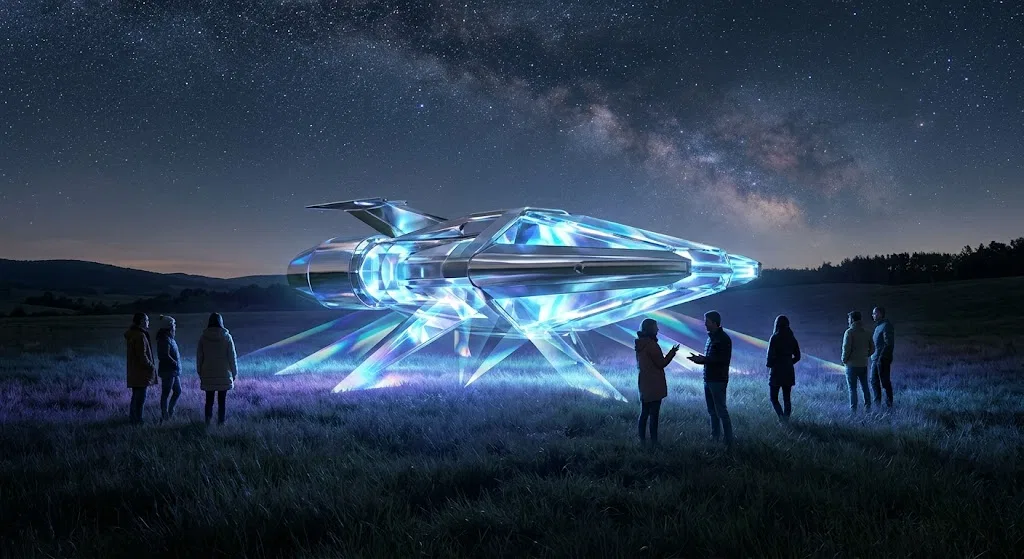
Not every UFO story imagines invasion. From the early 1950s onwards, a powerful rival tradition presented alien visitors as teachers, rescuers, healers or stern but compassionate messengers. These “friendly aliens” mattered because they changed the emotional meaning of the flying saucer. A UFO could still be frightening, but it could also become a sign of hope: a warning against nuclear war, a promise of rescue from catastrophe, or proof that humanity was not alone in a cold universe.
That hopeful turn sits at the centre of the relationship between UFOs and science fiction. Popular culture did not simply borrow from reports of sightings; it also helped organise them into recognisable story patterns. The benevolent contact story is one of those patterns. It moved UFO belief away from pure threat and towards encounter, moral instruction and spiritual expectation, while films such as The Day the Earth Stood Still, Close Encounters of the Third Kind and later Arrival translated similar hopes into mainstream science-fiction drama. At the same time, official and scientific sources give an important caution: UFO or UAP reports remain culturally significant, but NASA says there are no data supporting UAP as evidence of alien technologies, and Project Blue Book concluded that its unidentified cases did not prove extraterrestrial vehicles.[NASA Science]science.nasa.govScience UAP FAQsScience UAP FAQs
From Threat to Contact
The best-known early Cold War alien story is the invasion narrative: visitors arrive, humanity panics, governments mobilise, and the sky becomes another battlefield. That storyline made sense in an era shaped by atomic weapons, rockets, air-defence systems and fear of hidden enemies. But it was never the only available UFO script. Alongside the saucer as threat grew another figure: the alien as messenger.
The change is easiest to see in 1950s contactee culture. Contactees were people who claimed not merely to have seen strange objects, but to have met, spoken with or received messages from extraterrestrial beings. Sociologist Christopher Bader’s study of the UFO contact movement describes the early 1950s claims as strikingly different from later, darker abduction accounts: the visitors were often beautiful, morally advanced and concerned for humanity rather than predatory or indifferent.[Chapman University Digital Commons]digitalcommons.chapman.eduOpen source on chapman.edu.
George Adamski became the most famous example. In Flying Saucers Have Landed in 1953, Adamski and Desmond Leslie presented a desert meeting with a Venusian named Orthon. The message, as later summarised by the Critical Dictionary of Apocalyptic and Millenarian Movements, was not conquest but concern: the “Space People” were worried about nuclear weapons and radioactive fallout, and Adamski portrayed the alien’s attitude as friendly and compassionate rather than hostile.[CDAMM]cdamm.orgExtraterrestrial/UFO ReligionExtraterrestrial/UFO Religion
This was a decisive narrative shift. The alien visitor did not need to be a monster, soldier or coloniser. He could be an elder sibling, a cosmic neighbour, or a morally superior observer warning Earth not to destroy itself. That pattern borrowed from older spiritual and esoteric traditions as much as from science fiction. The same source notes Adamski’s pre-existing involvement with Theosophical ideas, where “Elder Brothers” or advanced masters guide humanity; in the contactee version, those spiritual helpers were reimagined as interplanetary beings arriving in flying saucers.[CDAMM]cdamm.orgExtraterrestrial/UFO ReligionExtraterrestrial/UFO Religion
The mechanism was simple but powerful: UFO technology made ancient salvation language look modern. The vehicle was no longer a chariot, cloud or angelic sign. It was a saucer.

Visitors as Teachers or Rescuers
Benevolent contact stories usually give aliens one of three roles. They teach, they warn, or they rescue. These roles overlap, but each gave UFO culture a different kind of emotional appeal.
Teachers offered humanity a wider view of itself. In contactee stories, aliens often brought lessons about peace, spiritual evolution, vegetarianism, universal brotherhood, anti-materialism or the misuse of science. The claim was not simply “they exist”; it was “they know how we should live”. The Critical Dictionary article places UFO religion within traditions where extraterrestrials act as saviours and agents of millenarian transformation, especially under Cold War pressure and the threat of nuclear weapons.[CDAMM]cdamm.orgExtraterrestrial/UFO ReligionExtraterrestrial/UFO Religion
Warners made alien contact a moral alarm. The classic message was that Earth’s scientific progress had outpaced its wisdom. This is why atomic weapons recur so often in friendly-alien stories. Donald Keyhoe, an early advocate of the extraterrestrial interpretation of UFOs, argued that alien observation of Earth intensified after the first atomic bomb explosions, and Adamski’s Orthon story made nuclear danger central to the encounter.[CDAMM]cdamm.orgExtraterrestrial/UFO ReligionExtraterrestrial/UFO Religion
Rescuers turned contact into escape. Some groups believed friendly space beings would evacuate selected humans before disaster. Dorothy Martin’s 1954 prophecy is the best-known case: followers expected a catastrophic flood and rescue by flying saucer. The episode became famous through When Prophecy Fails, the 1956 social-psychology study of belief after failed prophecy, though recent scholarship has challenged that book’s account of what happened after the prediction failed.[Wikipedia]WikipediaWhen Prophecy FailsWhen Prophecy Fails
This rescue pattern shows why hopeful UFO stories could be comforting and dangerous at the same time. On one level, they imagined a universe in which superior beings cared about humanity. On another, they could encourage dependence on outside salvation: if the Space Brothers were coming, human political action might feel less urgent.
The Space Brother as a Science-Fiction Figure
The “Space Brother” was not just a religious image. It was also a science-fiction character type: humanoid, advanced, calm, technologically superior and morally disappointed in Earth. Unlike the bug-eyed monster or the faceless invader, the Space Brother was meant to be recognisable. He often looked like an idealised human from a cleaner, wiser civilisation.
That human-like form mattered. A grotesque alien body tends to generate fear or disgust; a beautiful humanoid visitor invites identification. The message becomes easier to receive because the messenger looks like a perfected version of ourselves. This is why benevolent contact stories so often feel less like zoology than moral allegory. The alien is not there to show biological difference. The alien is there to show what humanity might become.
The same pattern appears in The Day the Earth Stood Still in 1951. Klaatu arrives in a saucer, appears human, and warns Earth that its violence threatens others. Although the film includes the possibility of punishment, its central contact situation is not invasion. It is an intervention: a superior civilisation attempts to stop humanity from exporting its aggression into space. Contemporary summaries still identify the film as a Cold War story shaped by nuclear tension and a warning about the dangers of global conflict.[EBSCO]ebsco.comOpen source on ebsco.com.
Contactee claims and science-fiction films therefore shared a moral grammar. The visitor’s advanced technology mattered, but it was not the whole point. The saucer, robot, beam or mother ship served as proof of superiority; the real drama was whether Earth would listen.
Close Encounters and the Turn Towards Wonder
By the late 1970s, Close Encounters of the Third Kind gave the friendly-contact tradition one of its most influential cinematic forms. Steven Spielberg’s film did not deny fear: people are confused, abducted, misled by authorities and drawn into obsession. Yet its final movement turns UFO contact into awe, music, communication and voluntary departure rather than war.
The British Film Institute describes Close Encounters as a story built from Spielberg’s long-standing interest in UFOs, noting that its plot connects ordinary people’s encounters with a scientific investigation and a government cover-up. Its climax at Devil’s Tower is treated not as a battle scene but as one of science-fiction cinema’s great moments of contact.[BFI]bfi.org.ukOpen source on bfi.org.uk.
The film also drew directly on UFO investigation culture. Allen Hynek, the astronomer who advised the US Air Force’s Project Blue Book and later became a major figure in UFO studies, served as a technical adviser on the film. A separate BFI essay links the film to Hynek’s phrase “cosmic provincialism”: the idea that humanity may be too narrow in imagining itself as the centre or summit of intelligence.[BFI]bfi.org.ukBFIIs Close Encounters of the Third Kind Spielberg’s most optimistic film? | BFIBFIIs Close Encounters of the Third Kind Spielberg’s most optimistic film? | BFI
That is the benevolent-contact mechanism in cinematic form. The aliens are not friendly because they hand humans gifts or solve all problems. They are friendly because they expand the human horizon. Contact becomes a cure for smallness: small politics, small imagination, small ideas of what intelligence can be.

Why Hope Became Part of UFO Belief
Hope entered UFO belief because the flying saucer arrived at the intersection of fear and longing. The same image could carry both. A silent object in the sky could suggest surveillance, invasion or secret weapons; it could also suggest that someone wiser was watching, and perhaps that human disaster was not inevitable.
Three historical pressures made benevolent aliens especially attractive.
First, the nuclear age created a need for outside judgement. If humanity had gained the power to destroy itself, then a peaceful alien civilisation could function as a moral witness. Contactee messages about radiation and atomic war made the UFO a sign that the universe itself objected to Earth’s violence.[CDAMM]cdamm.orgExtraterrestrial/UFO ReligionExtraterrestrial/UFO Religion
Second, modern institutions often seemed untrustworthy or inadequate. UFO believers frequently suspected governments of concealment, and Close Encounters taps into a post-Watergate mood of distrust towards officialdom. In that setting, benevolent aliens could appear more honest than human authorities.[BFI]bfi.org.ukOpen source on bfi.org.uk.
Third, older religious hopes adapted easily to space-age language. The Critical Dictionary article notes that UFO religions often recast biblical and apocalyptic motifs through extraterrestrial imagery: clouds, ascension, rescue and heavenly beings could all be reinterpreted through saucers and visitors from other worlds.[CDAMM]cdamm.orgExtraterrestrial/UFO ReligionExtraterrestrial/UFO Religion
This did not make every hopeful UFO story religious. Many were secular, cinematic or philosophical. But the emotional structure was often similar: humanity is endangered, ordinary politics cannot save it, and contact with a higher intelligence may reveal a path beyond violence, isolation or despair.
The Softer Alien Did Not Replace the Dark One
Benevolent contact stories never eliminated frightening UFO narratives. They coexisted with invasion films, government-conspiracy stories, abduction accounts, cattle-mutilation rumours and later images of manipulative greys or hostile reptilians. In fact, the hopeful alien often became more noticeable because it contrasted so sharply with the darker tradition.
That contrast helps explain why UFO culture is so durable. It can absorb opposite emotions. For sceptics, a UFO report may be a misidentified aircraft, a psychological episode, a hoax, a classified technology, or simply an unresolved observation. For believers, the same broad mythology can support dread or consolation. The alien can be invader, scientist, jailer, angel, sibling or teacher.
Official investigations are important here because they separate cultural meaning from evidential proof. Project Blue Book collected 12,618 reports from 1947 to 1969, with 701 left unidentified, but the Air Force stated that it found no evidence that unidentified sightings represented extraterrestrial vehicles or technology beyond known science. NASA’s current UAP FAQ similarly says that available data do not support the idea that UAP are alien technologies.[National Archives]archives.govNational Archives Project BLUE BOOKNational Archives Project BLUE BOOK
Those conclusions do not make benevolent alien stories irrelevant. They clarify what kind of evidence the stories provide. They are not reliable proof that friendly extraterrestrials are visiting Earth. They are strong evidence that people have repeatedly used UFOs to think through fear, rescue, peace, authority, spiritual transformation and the possibility of not being alone.
From Space Brothers to Modern Contact Films
Modern science fiction often avoids the simple “Space Brother” figure, but it continues the benevolent-contact tradition in subtler forms. The alien may be incomprehensible rather than humanoid, and the gift may be communication rather than sermon.
Arrival is a good example. Its extraterrestrials are not comforting human-like teachers, yet the story still resists the invasion template. The central problem is interpretation: are the visitors offering help, threatening humanity, or being misunderstood? Wired’s discussion of the film’s science emphasises its focus on the slow work of language learning and the danger of asking complex questions before establishing basic meaning.[WIRED]wired.comThe science of Arrival: what the film got right (and wrongThe science of Arrival: what the film got right (and wrong
That makes Arrival a descendant of the benevolent-contact tradition, not a copy of the 1950s version. The aliens are not Space Brothers in shining suits. They are opaque, strange and difficult. But the hopeful mechanism remains: contact can make humanity wiser if humans resist panic long enough to understand.
This is where the relationship between UFOs and science fiction becomes especially clear. Contactee stories gave popular culture a ready-made script of visitors with messages. Science fiction then tested, refined and sometimes complicated that script. Instead of asking only “will they attack?”, the better contact stories ask: what would we have to change in ourselves to hear them correctly?
Why Friendly Aliens Still Matter
Benevolent aliens remain compelling because they make UFOs emotionally double-edged. The unknown sky is not only a source of threat; it is also a screen for hope. In these stories, extraterrestrials expose human weakness but also imply human potential. They warn because they care. They arrive because Earth still matters. They seem superior not simply because their machines are faster, but because they have survived the dangers that may destroy us.
That is why friendly-alien contact stories are central to UFO culture’s survival. Fear can produce a memorable spectacle, but hope produces attachment. Invasion stories ask how humanity might defend itself. Benevolent contact stories ask whether humanity might be worth saving, teaching or joining. For UFO belief and science fiction alike, that question has proved just as powerful as the fear of conquest.
Amazon book picks
Further Reading
Books and field guides related to When UFOs Stopped Meaning Invasion. Use these as the next step if you want deeper reading beyond the article.
Passport to Magonia
Explores how UFO contact narratives shifted toward cultural and mythic encounter stories.
eBay marketplace picks
Marketplace Samples
Live-tested eBay searches with available results related to this page.


Endnotes
1.
Source: science.nasa.gov
Title: Science UAP FAQs
Link:https://science.nasa.gov/uap/faqs/
2.
Source: archives.gov
Title: National Archives Project BLUE BOOK
Link:https://www.archives.gov/research/military/air-force/ufos
3.
Source: digitalcommons.chapman.edu
Link:https://digitalcommons.chapman.edu/cgi/viewcontent.cgi?article=1002&context=sociology_articles
4.
Source: cdamm.org
Title: Extraterrestrial/UFO Religion
Link:https://www.cdamm.org/articles/extraterrestrial
5.
Source: Wikipedia
Title: When Prophecy Fails
Link:https://en.wikipedia.org/wiki/When_Prophecy_Fails
6.
Source: ebsco.com
Link:https://www.ebsco.com/research-starters/film/day-earth-stood-still-film
7.
Source: bfi.org.uk
Link:https://www.bfi.org.uk/features/why-i-love-close-encounters-third-kind
8.
Source: bfi.org.uk
Title: BFIIs Close Encounters of the Third Kind Spielberg’s most optimistic film? | BFI
Link:https://www.bfi.org.uk/features/spielberg-goes-sublime-close-encounters-third-kind
9.
Source: wired.com
Title: The science of Arrival: what the film got right (and wrong)
Link:https://www.wired.com/story/arrival-science-fact-fiction
10.
Source: science.nasa.gov
Link:https://science.nasa.gov/uap/
11.
Source: science.nasa.gov
Title: uap independent study team final report
Link:https://science.nasa.gov/wp-content/uploads/2023/09/uap-independent-study-team-final-report.pdf
12.
Source: nasa.gov
Link:https://www.nasa.gov/news-release/nasa-to-release-discuss-unidentified-anomalous-phenomena-report/
13.
Source: Wikipedia
Title: Space Brothers (myth)
Link:https://en.wikipedia.org/wiki/Space_Brothers_%28myth%29
14.
Source: Wikipedia
Title: UFO conspiracy theories
Link:https://en.wikipedia.org/wiki/UFO_conspiracy_theories
15.
Source: Wikipedia
Title: UFO reports and atomic sites
Link:https://en.wikipedia.org/wiki/UFO_reports_and_atomic_sites
16.
Source: Wikipedia
Link:https://en.wikipedia.org/wiki/Contactee
17.
Source: Wikipedia
Title: Space Brothers
Link:https://en.wikipedia.org/wiki/Space_Brothers
18.
Source: Wikipedia
Title: Potential cultural impact of extraterrestrial contact
Link:https://en.wikipedia.org/wiki/Potential_cultural_impact_of_extraterrestrial_contact
19.
Source: Wikipedia
Title: George Adamski
Link:https://en.wikipedia.org/wiki/George_Adamski
20.
Source: Wikipedia
Title: The Day the Earth Stood Still
Link:https://en.wikipedia.org/wiki/The_Day_the_Earth_Stood_Still
21.
Source: Wikipedia
Title: Arrival (film)
Link:https://en.wikipedia.org/wiki/Arrival_%28film%29
22.
Source: Wikipedia
Title: Project Blue Book
Link:https://en.wikipedia.org/wiki/Project_Blue_Book
23.
Source: Wikipedia
Title: NASA Unidentified Anomalous Phenomena Independent Study Team
Link:https://en.wikipedia.org/wiki/NASA_Unidentified_Anomalous_Phenomena_Independent_Study_Team
24.
Source: Wikipedia
Title: Post detection policy
Link:https://en.wikipedia.org/wiki/Post-detection_policy
25.
Source: Wikipedia
Title: George Van Tassel
Link:https://en.wikipedia.org/wiki/George_Van_Tassel
26.
Source: digitalcommons.chapman.edu
Title: sociology articles
Link:https://digitalcommons.chapman.edu/sociology_articles/3/
27.
Source: youtube.com
Title: Best Films About UFOs & Alien Encounters
Link:https://www.youtube.com/watch?v=bcxpgMW01g4
Source snippet
Benevolent Aliens...
28.
Source: youtube.com
Title: Benevolent Aliens
Link:https://www.youtube.com/watch?v=xWcEXBikPgw
Source snippet
Reinhold O. Schmidt...
29.
Source: facebook.com
Link:https://www.facebook.com/groups/324897304599197/posts/2349302128825361/
30.
Source: encyclopedia.com
Link:https://www.encyclopedia.com/science/encyclopedias-almanacs-transcripts-and-maps/contactees
31.
Source: scribd.com
Link:https://www.scribd.com/document/800711166/adamski
32.
Source: science.howstuffworks.com
Title: george adamski
Link:https://science.howstuffworks.com/space/aliens-ufos/george-adamski.htm
33.
Source: davescorneroftheuniverse.wordpress.com
Title: george adamski
Link:https://davescorneroftheuniverse.wordpress.com/tag/george-adamski/
Additional References
34.
Source: youtube.com
Title: Reinhold O. Schmidt
Link:https://www.youtube.com/watch?v=zjF52HHXw9Q
Source snippet
The second video, Benevolent Aliens, explores how science fiction works handle the concept of genuinely friendly or compassionate extrate...
35.
Source: loc.gov
Link:https://www.loc.gov/collections/finding-our-place-in-the-cosmos-with-carl-sagan/articles-and-essays/life-on-other-worlds/ufos-and-aliens-among-us
36.
Source: nsa.gov
Link:https://www.nsa.gov/portals/75/documents/news-features/declassified-documents/ufo/usaf_fact_sheet_95_03.pdf
37.
Source: facebook.com
Link:https://www.facebook.com/aigkenham/posts/some-report-communication-with-aliens-and-some-even-claim-to-have-been-taken-abo/3517722971591367/
38.
Source: cinephiliabeyond.org
Link:https://cinephiliabeyond.org/close-encounters-of-the-third-kind-steven-spielbergs-gamble-that-paid-off-generously/
39.
Source: researchgate.net
Link:https://www.researchgate.net/publication/358063410_UFO_Mythologies_Extraterrestrial_Cosmology_and_Intergalactic_Eschatology
40.
Source: academia.edu
Link:https://www.academia.edu/60440004/UFOs_and_the_extraterrestrial_contact_movement_a_bibliography_Volume
41.
Source: researchgate.net
Link:https://www.researchgate.net/publication/261854096_Extraterrestrial_encounters_UFOs_science_and_the_quest_for_transcendence
42.
Source: reddit.com
Link:https://www.reddit.com/r/Otherworldpod/comments/1ew9557/another_alien_warning_about_the_environment/
43.
Source: joe.ie
Link:https://www.joe.ie/movies-tv/disclosure-day-ending-explained-aliens-ufo-real-steven-spielberg-firelight-873868
Topic Tree