Within Skeptics
Do UFO Reports Rise After Sci Fi Hits?
Public UFO waves can rise when films, television, and news make ambiguous lights feel worth noticing and reporting.
On this page
- What reporting spikes can and cannot show
- How popular media changes attention and thresholds
- Why more reports do not mean better evidence
Page outline Jump by section
Introduction
Do UFO reports rise after major science-fiction films, television programmes, or intense media coverage? In many cases, yes. Historical UFO databases, sociological studies, and well-known reporting waves suggest that public reporting often increases when attention to the subject increases. That does not necessarily mean more unusual objects are appearing in the sky. Instead, it may mean that more people notice, remember, interpret, and report ambiguous sights that they would otherwise ignore. For sceptics examining the relationship between UFOs and science fiction, this distinction is crucial. A surge in reports can demonstrate heightened public attention without demonstrating a corresponding surge in extraordinary events.[ScienceDirect]sciencedirect.comScienceDirect On the dynamics of reporting data: A case study of UFO sightingsOn the dynamics of reporting data: A case study of UFO sightings - ScienceDirectOctober 1, 2022…
 The key question is therefore not simply whether report numbers rise, but what report numbers actually measure. They may reflect a mixture of physical observations, social interest, media attention, and changing thresholds for deciding that an experience is worth reporting.
What Reporting Spikes Can and Cannot Show
A common assumption is that a wave of UFO reports indicates a wave of unusual aerial phenomena. However, reporting data are more complicated than that.
Studies of large UFO databases have found that reporting behaviour is sensitive to social factors, including media broadcasting. Analysis of more than 80,000 reports found evidence that new reports respond to media exposure and other human reporting patterns rather than reflecting a simple count of unusual events. The same research identified strong behavioural effects such as rounding times to convenient values and rapid reporting after highly memorable experiences, illustrating that UFO databases contain both observation data and human-response data.[ScienceDirect]sciencedirect.comScienceDirect On the dynamics of reporting data: A case study of UFO sightingsOn the dynamics of reporting data: A case study of UFO sightings - ScienceDirectOctober 1, 2022…
This means a reporting spike can show:
- Increased public awareness of UFO stories.
- Greater willingness to interpret ambiguous sights as unusual.
- More knowledge of where and how to submit reports.
- More media interest encouraging witnesses to come forward.
What it cannot show on its own is that the underlying cause of the reports has changed. A sudden increase in submissions does not automatically establish an increase in extraordinary objects, extraterrestrial craft, or even unidentified aerial phenomena.
For sceptics, report counts are therefore considered evidence of public behaviour before they are considered evidence of unusual events.
How Popular Media Changes Attention and Thresholds
The strongest sceptical argument is not that science fiction invents sightings but that it changes attention.
Every night, people are exposed to aircraft lights, planets, satellites, meteors, atmospheric effects, drones, balloons, and optical illusions. Most attract little notice. A person who sees a bright light may simply assume it is an aircraft and move on.
During periods of intense UFO publicity, the threshold changes. The same observation may now seem noteworthy enough to discuss with friends, post online, or submit to a reporting organisation.
Several mechanisms contribute to this effect:
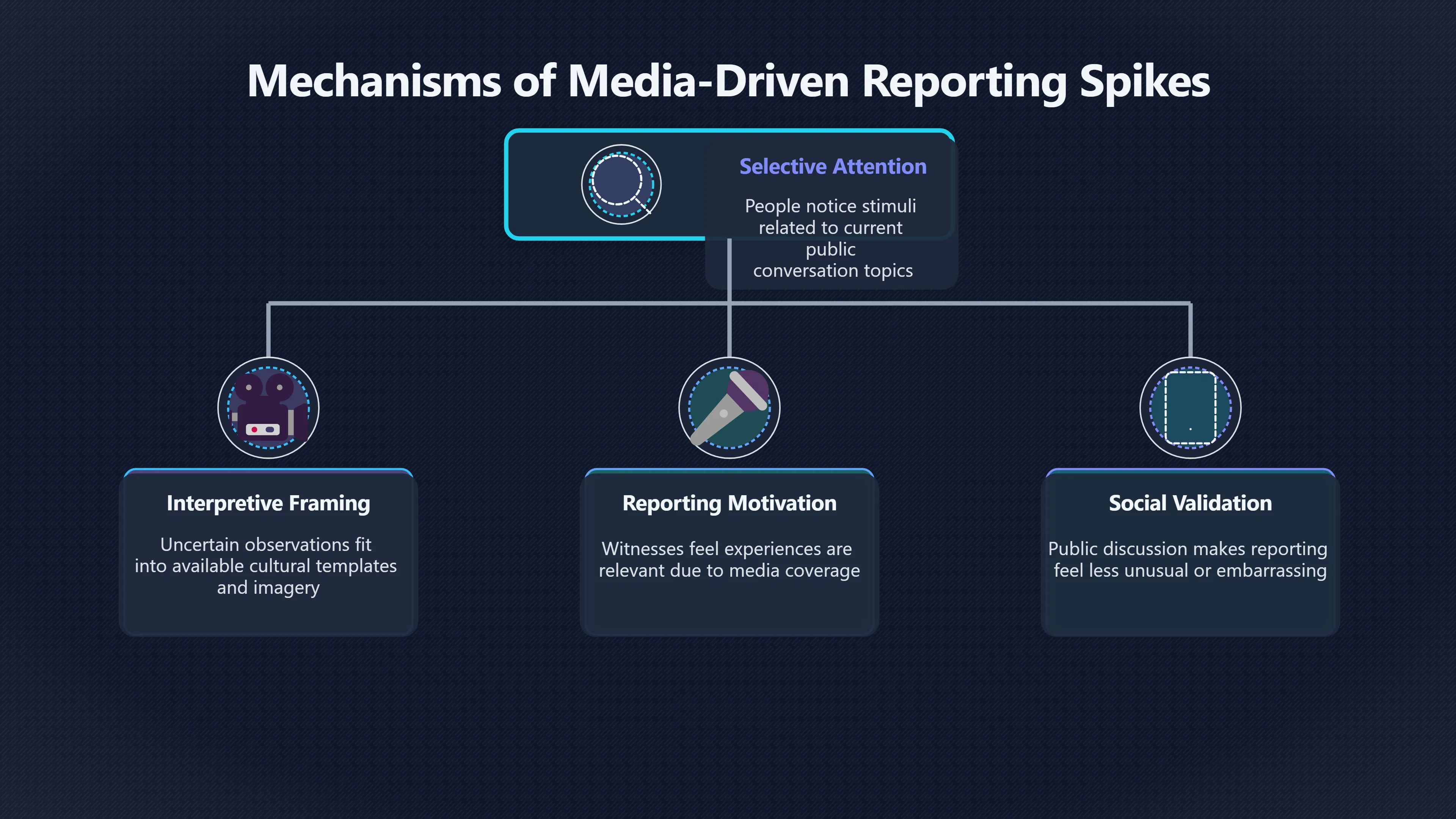
Selective attention. People are more likely to notice things related to topics already occupying public conversation.
Interpretive framing. When a cultural template is readily available, an uncertain observation is more likely to be fitted into that template.
Reporting motivation. Witnesses may feel that their experience is relevant because similar stories are appearing in newspapers, television programmes, films, or social media feeds.
Social validation. If many others are discussing UFOs, reporting a sighting feels less unusual or embarrassing.
The result is a lower reporting threshold. The sky may contain the same mix of ordinary stimuli as before, but more people decide that what they saw deserves to be recorded.
The Classic Example: The 1947 Flying Saucer Wave
The most famous historical example occurred in 1947.
After pilot Kenneth Arnold reported seeing unusual objects near Mount Rainier in June 1947, newspapers across the United States rapidly popularised the phrase “flying saucer”. Media coverage was extensive and immediate. In the weeks that followed, reports multiplied dramatically and a national UFO wave emerged. Contemporary accounts and later historical analyses describe a feedback loop in which reports generated headlines and headlines encouraged further reports.[WIRED]wired.comhow ufo sightings became an american obsessionHow UFO Sightings Became an American Obsession | WIREDMarch 3, 2020…
Importantly, sceptics do not argue that every witness copied Arnold’s account. Rather, Arnold’s sighting and the subsequent publicity provided a vocabulary and framework that made similar experiences easier to recognise and report.
Once the “flying saucer” image became culturally familiar, observers had a ready-made label for ambiguous aerial observations. The reporting threshold fell because people now knew what kind of event counted as a UFO sighting.

Science Fiction, Television, and Later UFO Waves
The same logic has been applied to later periods shaped by science-fiction culture.
Throughout the twentieth century, UFO themes became common in films, television dramas, documentaries, magazines, and popular books. Alien spacecraft evolved from niche pulp-fiction imagery into widely recognised cultural symbols.
Researchers and sceptical commentators have noted that descriptions reported by witnesses often changed alongside popular imagery. Different eras emphasised different shapes, occupants, and narratives. Disc-shaped craft became common after the flying-saucer era. Later decades saw increased reports involving large triangular objects, alien abductions, and technologically sophisticated craft. The specific content of reports appeared to evolve alongside broader cultural expectations rather than remaining constant over time.[WIRED]wired.comhow ufo sightings became an american obsessionHow UFO Sightings Became an American Obsession | WIREDMarch 3, 2020…
This does not prove that media created the reports. It does suggest that media influence can affect which observations are noticed, how they are interpreted, and which details become memorable.
Modern Attention Cycles
The mechanism has arguably become even stronger in the internet era.
A viral video, television special, government disclosure story, or social-media trend can expose millions of people to UFO-related content within hours. Increased attention may encourage retrospective reporting, with people recalling older experiences and deciding to submit them after seeing current coverage.
As a result, modern reporting spikes may reflect both new observations and renewed interest in past observations.
Why More Reports Do Not Mean Better Evidence
One of the most important sceptical lessons is that quantity and quality are different things.
A thousand reports generated during a media-driven wave may provide less evidential value than a single well-documented case with multiple sensors, independent witnesses, and high-quality records.
Large reporting spikes often include:
- Brief observations.
- Night-time sightings.
- Poor-quality photographs.
- Retrospective memories.
- Reports lacking independent corroboration.
The increase in numbers can therefore dilute as well as expand the available evidence.
Research examining public UFO reports has found that many reporting patterns are consistent with opportunities for observation rather than with evidence for a single extraordinary cause. Areas with greater visibility of the sky, more air traffic, and more opportunities to observe airborne objects tend to generate more reports. In other words, people often report more phenomena where they are simply more likely to see things in the sky.[Nature]nature.comAn environmental analysis of public UAP sightings and sky view potential | Scientific Reports…
From an evidential perspective, a reporting wave is therefore best understood as a signal that public attention has changed. Whether the underlying observations represent ordinary objects, rare atmospheric events, military activity, or something genuinely unexplained remains a separate question requiring case-by-case investigation.
The Science-Fiction Filter and Reporting Thresholds
Within the broader discussion of science fiction’s relationship to UFO culture, reporting thresholds provide one of the clearest mechanisms linking media and sightings.
The sceptical position does not require films or television programmes to manufacture experiences. Instead, media can alter the likelihood that people notice an event, interpret it as unusual, remember it in UFO-related terms, and decide to report it.
When a major science-fiction hit, a headline-grabbing UFO story, or an intense period of media coverage is followed by a surge in reports, the increase demonstrates that public attention matters. The evidence suggests that UFO waves often measure both what is happening in the sky and what is happening in the culture below it.[sciencedirect.com]sciencedirect.comScienceDirect On the dynamics of reporting data: A case study of UFO sightingsOn the dynamics of reporting data: A case study of UFO sightings - ScienceDirectOctober 1, 2022…
Amazon book picks
Further Reading
Books and field guides related to Do UFO Reports Rise After Sci-Fi Hits?. Use these as the next step if you want deeper reading beyond the article.
The Demon-Haunted World
Rating: 4.5/5 from 43 Google Books ratings
Addresses UFO claims and public fascination with them.
Why People Believe Weird Things
Rating: 4.0/5 from 7 Google Books ratings
Explores cultural and media effects on unusual beliefs.
eBay marketplace picks
Marketplace Samples
Live-tested eBay searches with available results related to this page.



Endnotes
1.
Source: sciencedirect.com
Title: ScienceDirect On the dynamics of reporting data: A case study of UFO sightings
Link:https://www.sciencedirect.com/science/article/abs/pii/S0378437122005295
Source snippet
On the dynamics of reporting data: A case study of UFO sightings - ScienceDirectOctober 1, 2022...
Published: October 1, 2022
2.
Source: nature.com
Link:https://www.nature.com/articles/s41598-023-49527-x
Source snippet
An environmental analysis of public UAP sightings and sky view potential | Scientific Reports...
3.
Source: wired.com
Title: how ufo sightings became an american obsession
Link:https://www.wired.com/story/how-ufo-sightings-became-an-american-obsession/
Source snippet
How UFO Sightings Became an American Obsession | WIREDMarch 3, 2020...
Published: March 3, 2020
4.
Source: wired.com
Title: june 24 1947 they came from outer space
Link:https://www.wired.com/2008/06/june-24-1947-they-came-from-outer-space
Source snippet
Outer Space?On June 24, 1947, pilot Kenneth Arnold reported seeing nine unidentified flying objects near Mt. Rainier, Washington, marking...
Published: June 24, 1947
Additional References
5.
Source: youtube.com
Link:http://www.youtube.com/watch?v=W9zakhAd9dA
Source snippet
UFO reporting waves media influence data science UFO report: U.S. has no explanation for over 140 "unidentified aerial phenomena" CBS Mor...
6.
Source: youtube.com
Link:https://www.youtube.com/watch?v=nraHhvzdZAQ
Source snippet
UFO Sightings: How Scientists are Trying to Capture More Data | NOVA | PBS...
7.
Source: youtube.com
Link:https://www.youtube.com/watch?v=A04PP2pBZ80
Source snippet
Skeptic: Whistleblower claim on UFOs isn't 'accurate' | Elizabeth Vargas Reports...
8.
Source: youtube.com
Title: Skeptic: Whistleblower claim on UFOs isn’t ‘accurate’ | Elizabeth Vargas Reports
Link:https://www.youtube.com/watch?v=9xiMWioOw_M
Source snippet
UFO Hearing Insanity - Jeremy Corbell & George Knapp Influencing Congress on UFOs...
9.
Source: youtube.com
Title: Understanding Probabilistic Data Structures with 112,092 UFO Sightings
Link:https://www.youtube.com/watch?v=2SpYbEfp4vA
Source snippet
UFO Sightings Data & Trends [Python Data Visualization Project]...
10.
Source: youtube.com
Title: UFO Sightings: How Scientists are Trying to Capture More Data | NOVA | PBS
Link:https://www.youtube.com/watch?v=qho0N3vv7Gw
Source snippet
Governments Using AI To Decode Massive UFO Databases | WION Podcast...
11.
Source: youtube.com
Title: Why Ufology and UFO Studies Need To Go Mainstream
Link:https://www.youtube.com/watch?v=Pz45-RIc8iA
Source snippet
UFO files: UAP disclosures & evidence for unexplained cases | Backscroll...
12.
Source: youtube.com
Title: Pop Culture’s Impact On UFO’s Ahead Of US Intelligence Report
Link:http://www.youtube.com/watch?v=mx6qhoJ1XLc
Source snippet
2 Popular Science Fiction and the Genesis of Paranormal Claims (Thomas Holtz)...
14.
Source: youtube.com
Title: Popular Science Fiction and the Genesis of Paranormal Claims (Thomas Holtz)
Link:http://www.youtube.com/watch?v=KMv4E8TCL9A
Source snippet
3 UFOs History in TV, Movies, and Pop Culture Explained...
Topic Tree