Within Folklore Links
Why Strange Lights Become UFO Stories
Unexplained lights become UFO stories when witnesses use the most available cultural language to describe ambiguity.
On this page
- Ambiguous sightings before interpretation
- Folklore categories as sense making tools
- The West Virginia hunting story example
Page outline Jump by section
Introduction
Why do some people look at an unexplained light and conclude that it might be a UFO, while others describe the same kind of sighting as a spirit, an omen, a secret aircraft, or simply an unknown object? Folklore research suggests that the answer often lies less in the light itself than in the cultural labels available to the witness. When people encounter something ambiguous, they typically interpret it through familiar stories and categories. In the modern era, “UFO” has become one of those categories. Rather than proving that strange lights are extraterrestrial craft, many studies of folklore and witness testimony show how uncertain experiences are translated into culturally meaningful narratives. The process helps explain why UFO stories often emerge from ordinary sightings whose original nature remains unclear.[archives.internetscout.org]archives.internetscout.orgScout ArchivesFinding Our Place in the Cosmos: From Galileo to Sagan and BeyondMay 30, 2014…
Ambiguous Sightings Before Interpretation
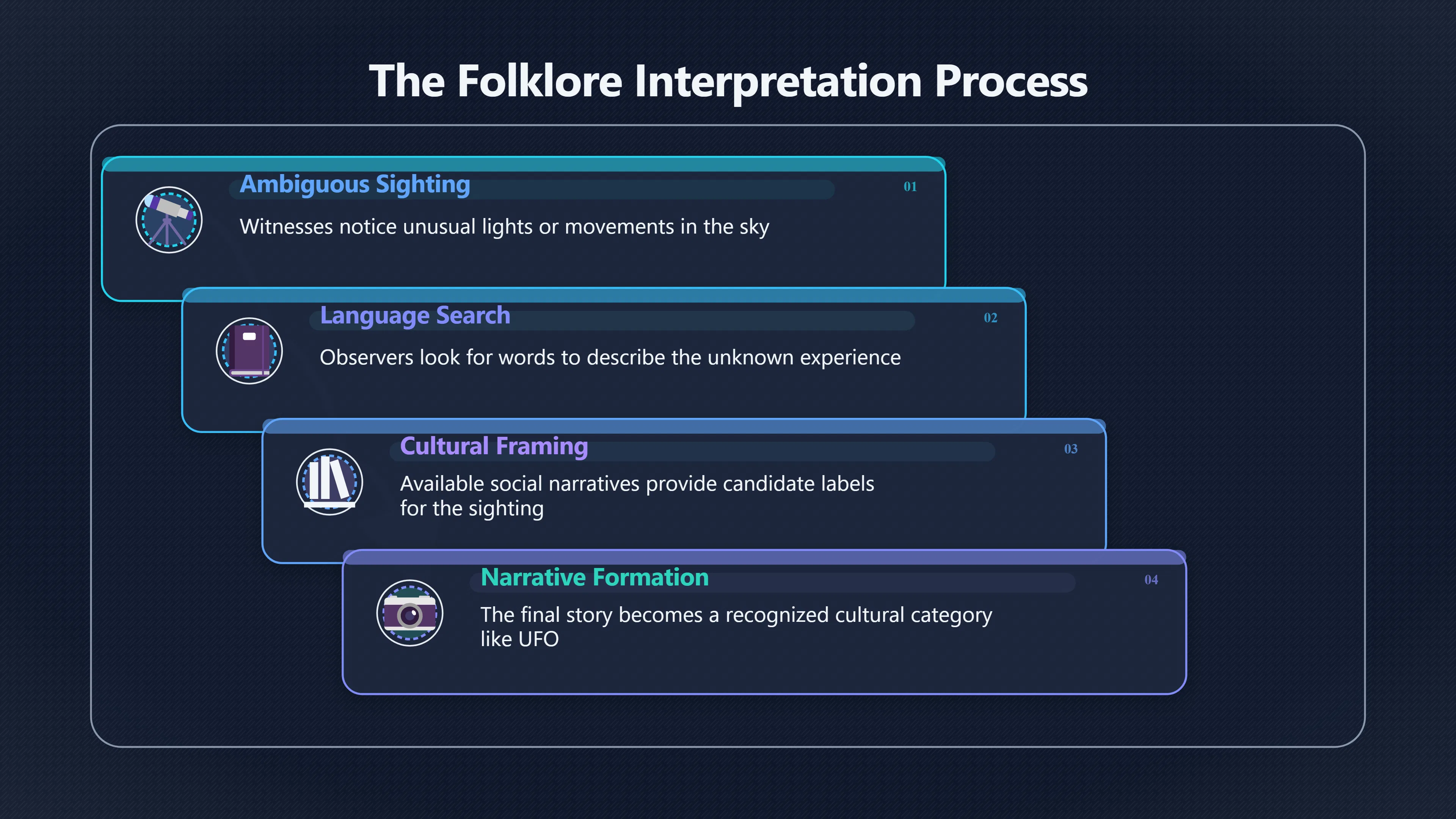
A key finding in folklore studies is that witnesses rarely begin with a complete interpretation. The first stage is usually much simpler: a person notices an unusual light, movement, colour, or aerial object that does not fit their expectations.
At that moment, the experience is often highly uncertain. Distance, darkness, weather conditions, unfamiliar astronomical objects, aircraft lights, and the limits of human perception can all contribute to ambiguity. The witness has an event but not yet a story. The story develops afterwards as the witness searches for language that can explain what was seen.
Researchers of anomalous experiences have repeatedly noted that reports often evolve through interpretation. A light may initially be described as “strange”, “unusual”, or “hard to identify”. Only later does it become labelled a UFO, an alien craft, a supernatural sign, or another recognised category. The label gives the experience a place within a larger cultural framework.[Taylor & Francis Online]tandfonline.comTaylor & Francis OnlineFull article: The Neuroscience and Psychology of the Alien Abduction Phenomenon: A ReviewApril 19, 2026…
This distinction is important. Folklore scholars are not arguing that witnesses are inventing experiences. Instead, they examine how people transform uncertain perceptions into narratives that make sense within their social and cultural environment.
How Folklore Categories Help People Make Sense of Lights
Human beings rarely leave unexplained events completely unclassified. Folklore provides ready-made categories for unusual experiences, and those categories change over time.
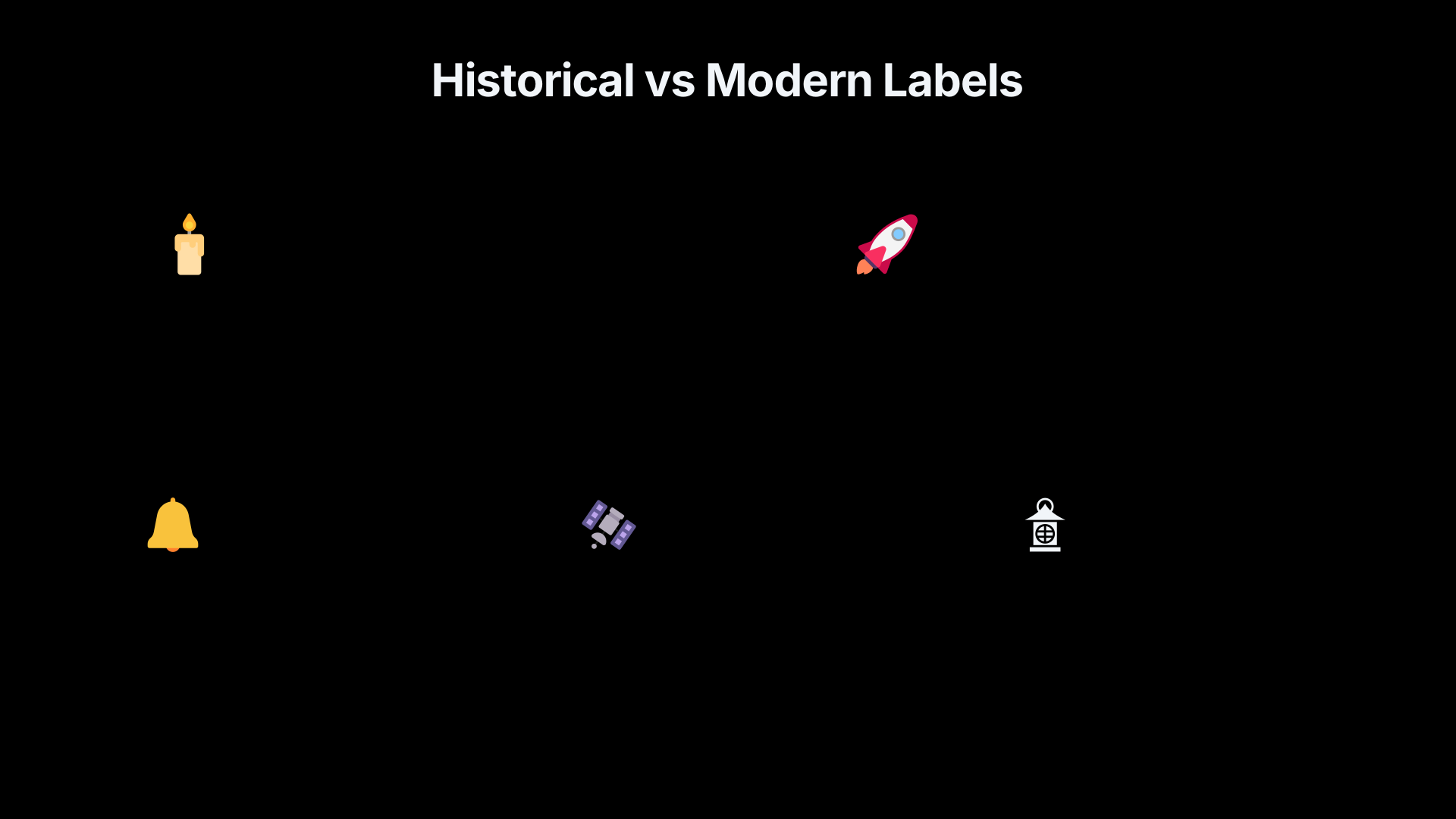
In earlier centuries, mysterious lights might have been described as:
- Spirits or ghosts.
- Fairy lights or supernatural beings.
- Religious signs or divine warnings.
- Omens connected to local legends.
In the twentieth and twenty-first centuries, however, science fiction, space exploration, popular media, and UFO culture have supplied a different vocabulary. The same interpretive need remains, but the language changes. A witness who grows up surrounded by stories of extraterrestrials and spacecraft has access to a different set of explanations than someone living in a culture dominated by fairy traditions or religious miracle stories.
Folklore specialists often describe this as a process of cultural framing. The unusual event comes first; the available cultural story helps shape the explanation afterwards. The resulting account may sincerely reflect what the witness believes happened, even though the description is influenced by contemporary ideas about what kinds of things can exist.[psi-encyclopedia.spr.ac.uk]psi-encyclopedia.spr.ac.ukForteana – Psi EncyclopediaForteana – Psi Encyclopedia
This is one reason UFO narratives sit so naturally within the broader relationship between UFO culture and science fiction. Science fiction did not create every strange-light report, but it supplied a powerful modern language for describing unexplained aerial phenomena. Concepts such as spacecraft, alien visitors, advanced technology, and interstellar travel became familiar interpretive tools available to ordinary observers.
The West Virginia Hunting-Story Example
A particularly revealing example comes from material highlighted by the Library of Congress in its discussion of UFOs as part of American folk culture. The collection points to a hunting story from West Virginia in which a witness encountered an unexplained light while outdoors.
What makes the account valuable is not evidence for extraterrestrial visitation. Instead, it shows the process of interpretation in action. The witness did not begin with a detailed alien narrative. Rather, an unusual light was observed and then cautiously described through a recognised cultural category. The witness effectively reached for the label “UFO” because it was a familiar way to talk about something that resisted easy explanation.[psi-encyclopedia.spr.ac.uk]psi-encyclopedia.spr.ac.ukForteana – Psi EncyclopediaForteana – Psi Encyclopedia
The significance of the story lies in its ordinariness. It demonstrates how folklore operates in everyday life:
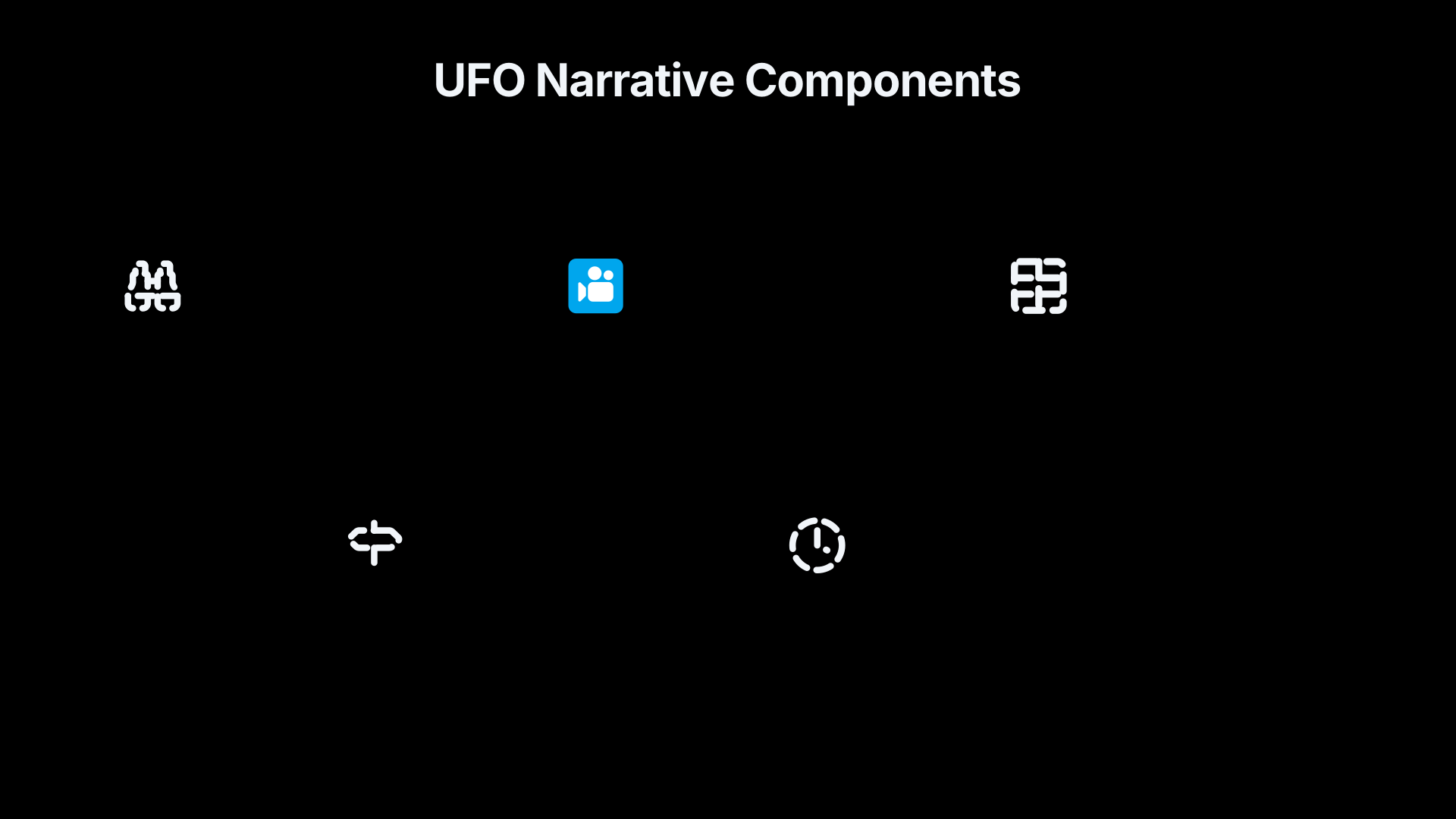
- An ambiguous event occurs.
- The witness seeks an explanation.
- Available cultural narratives provide candidate interpretations.
- One of those interpretations becomes the story that is told and remembered.
The resulting UFO account therefore reveals not only something about the original sighting but also something about the cultural environment in which the witness lives.
Why the Label Matters More Than the Light
From a folklore perspective, the most revealing question is often not “What was the light?” but “Why was it described in that particular way?”
Different periods generate different answers. A mysterious aerial glow in one era may become a fairy lantern; in another, a divine sign; in another, a flying saucer. The underlying experience may remain uncertain, yet the narrative framework changes with culture.
This helps explain why UFO reports frequently reflect the imagery of their time. During the early flying-saucer era, witnesses often described disc-shaped craft. During periods when alien-abduction stories became widely known, reports increasingly incorporated extraterrestrial beings and technological encounters. The labels available in public culture influenced how witnesses organised and communicated unusual experiences.[Taylor & Francis Online]tandfonline.comTaylor & Francis OnlineFull article: The Neuroscience and Psychology of the Alien Abduction Phenomenon: A ReviewApril 19, 2026…
For scholars studying the folklore roots of alien encounter stories, this pattern is one of the strongest pieces of evidence that UFO narratives are not simply reports of objects in the sky. They are also acts of interpretation. Strange lights become UFO stories when witnesses borrow the most meaningful cultural language available to describe uncertainty. In the modern world, shaped by decades of science fiction and UFO mythology, “UFO” has become one of the most powerful labels for making sense of the unknown.[psi-encyclopedia.spr.ac.uk]psi-encyclopedia.spr.ac.ukForteana – Psi EncyclopediaForteana – Psi Encyclopedia
Amazon book picks
Further Reading
Books and field guides related to Relationships betwee d7372c folklore alien encou bc488c strange lights cultu 734a88. Use these as the next step if you want deeper reading beyond the article.
The Myth and Mystery of UFOs
Explores UFO reports through mythmaking, folklore, witness testimony, and cultural belief systems.
The Mothman Prophecies
Rating: 4.5/5 from 6 Google Books ratings
Shows how strange sightings, folklore, witness reports, and cultural narratives intertwine around unexplained events.
Passport to Magonia
Directly examines connections between UFO reports, folklore traditions, and cultural interpretation of anomalous experiences.
Operation Trojan Horse
Links modern UFO encounters with older folklore, supernatural traditions, and recurring anomalous reports.
eBay marketplace picks
Marketplace Samples
Example marketplace items related to this page. Use the search link to explore similar finds on eBay.

Endnotes
1.
Source: archives.internetscout.org
Title: Scout Archives
Link:https://archives.internetscout.org/r43128/finding_our_place_in_the_cosmos_from_galileo_to_sagan_and_beyond
Source snippet
Finding Our Place in the Cosmos: From Galileo to Sagan and BeyondMay 30, 2014...
Published: May 30, 2014
2.
Source: psi-encyclopedia.spr.ac.uk
Title: Forteana – Psi Encyclopedia
Link:https://psi-encyclopedia.spr.ac.uk/articles/forteana/
3.
Source: tandfonline.com
Link:https://www.tandfonline.com/doi/full/10.1080/02604027.2026.2656121
Source snippet
Taylor & Francis OnlineFull article: The Neuroscience and Psychology of the Alien Abduction Phenomenon: A ReviewApril 19, 2026...
Published: April 19, 2026
Additional References
4.
Source: infodocket.com
Link:https://www.infodocket.com/2014/01/30/library-of-congress-debuts-new-online-collection-finding-our-place-in-the-cosmos-from-galileo-to-sagan-and-beyond/
Source snippet
Library of Congress Debuts New Online Collection: "Finding Our Place in the Cosmos: From Galileo to Sagan and Beyond" - Library Journal i...
5.
Source: reddit.com
Link:https://www.reddit.com/r/UFOs_Archive/comments/1tidnbj/the_connections_between_faerie_folklore/
Source snippet
Connections Between Faerie Folklore, Paranormal Manifestations, Plasmoids, and UFO Close EncountersMay 20, 2026...
Published: May 20, 2026
6.
Source: youtube.com
Title: UFOs and the Crisis of Reality | Aliens, Myth, Psyops or Something Stranger?
Link:https://www.youtube.com/watch?v=Jv_PYCiGHk0
Source snippet
A Guide to Alien Species | Mothman, Reptilians & More | Full UFO Documentary...
7.
Source: youtube.com
Title: A Guide to Alien Species | Mothman, Reptilians & More | Full UFO Documentary
Link:https://www.youtube.com/watch?v=xjoLpxjbGF4
Source snippet
How UFO Reports Change With the Technology of the Times...
8.
Source: youtube.com
Title: The UFO Phenomenon As A Cultural Interface With Jacques Vallée
Link:https://www.youtube.com/watch?v=8FsEb_7W248
Source snippet
The UFO Disclosure: What Does It Mean for God?...
9.
Source: openlibrary.org
Title: Aliens among us by Ruth Shick Montgomery | Open Library
Link:https://openlibrary.org/books/OL2863639M/Aliens_among_us
Source snippet
January 1, 1985...
Published: January 1, 1985
10.
Source: open-data.spr.ac.uk
Title: Psi Open Data Forteana | Psi Encyclopedia
Link:https://open-data.spr.ac.uk/articles/forteana
11.
Source: wvencyclopedia.org
Title: West Virginia Encyclopediae-WV
Link:https://www.wvencyclopedia.org/articles/349
Source snippet
Gray Barker...
Topic Tree