Within Arnold Sighting
The Local Story That Went National
A short local newspaper story from Pendleton helped turn one pilot's report into a national UFO event.
On this page
- Bill Bequette, Nolan Skiff, and the first report
- How the Associated Press spread the account
- What the later anniversary account clarified
Page outline Jump by section
Introduction
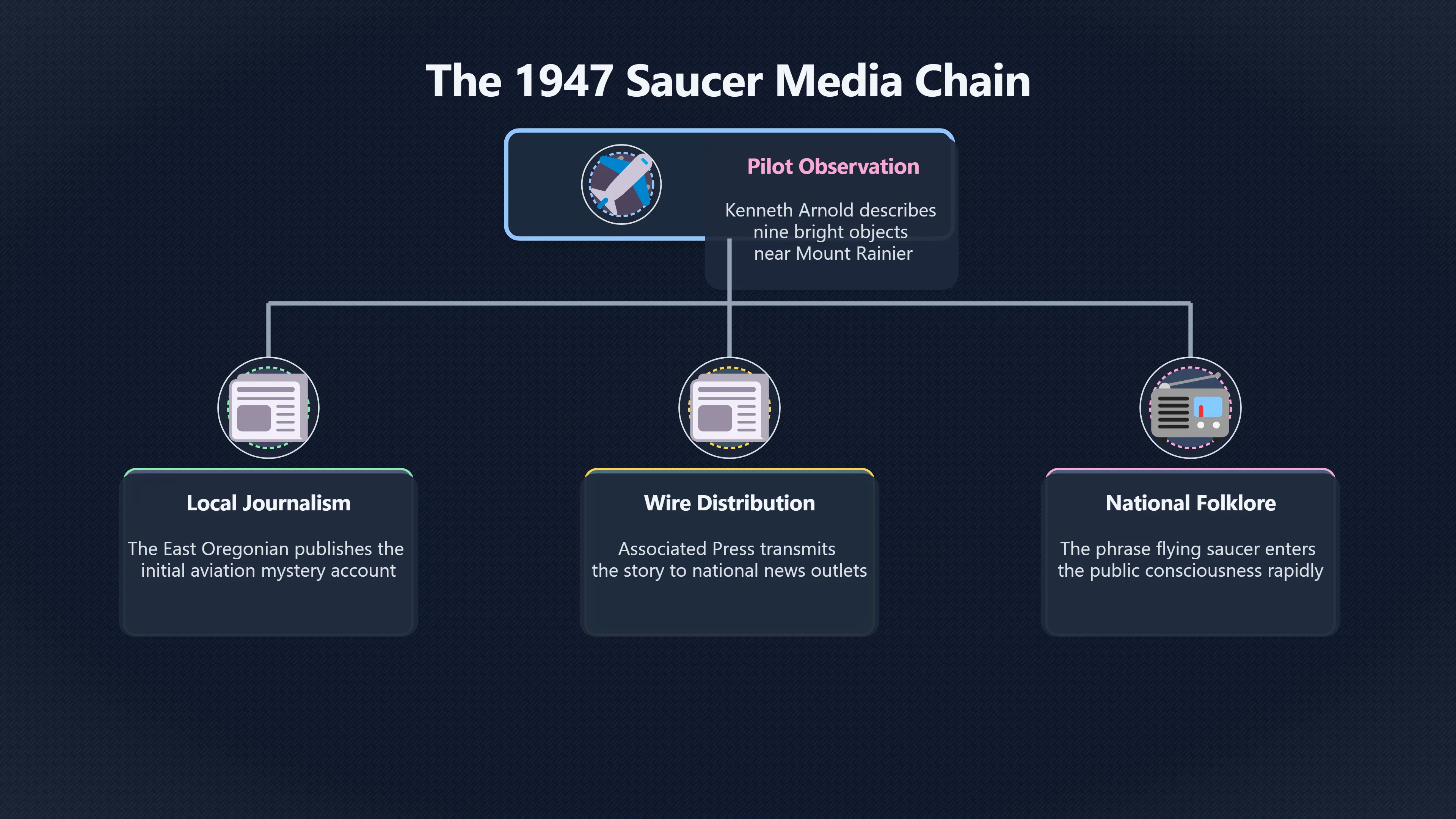
The transformation of Kenneth Arnold’s Mount Rainier sighting into the first great “flying saucer” story did not begin in a national newsroom. It began in Pendleton, Oregon, where the local newspaper The East Oregonian handled Arnold’s account only hours after he arrived for an air show. What made the episode historically important was not simply that the paper published the story first, but that its reporting provided the bridge between a pilot’s unusual observation and a nationwide media phenomenon. Through the work of reporter Bill Bequette and editor Nolan Skiff, a brief local article entered the Associated Press wire system and rapidly became one of the most influential news stories in UFO history.[Military Times]militarytimes.comMilitary Times Flying saucers still evasive 70 years after pilot's reportMilitary TimesFlying saucers still evasive 70 years after pilot's reportJune 25, 2017…
 Within a day, newspapers across the United States were discussing “flying saucers”. The imagery that later shaped both UFO culture and science-fiction visual conventions emerged from this chain of reporting, making The East Oregonian a pivotal actor in the creation of the modern saucer narrative.[National Air and Space Museum]airandspace.si.edu1947 year flying saucerNational Air and Space Museum1947: Year of the Flying Saucer | National Air and Space Museum…
Bill Bequette, Nolan Skiff, and the First Report
When Arnold landed in Pendleton on 24 June 1947, he described to local journalists what he had seen near Mount Rainier: nine bright objects moving at extraordinary speed. The story did not initially arrive as a polished account of alien spacecraft. Instead, it was treated as an unusual aviation report from a respected pilot.[National Air and Space Museum]airandspace.si.edu1947 year flying saucerNational Air and Space Museum1947: Year of the Flying Saucer | National Air and Space Museum…
The key figures were reporter Bill Bequette and editor Nolan Skiff of The East Oregonian. According to later recollections and anniversary reporting by the newspaper itself, they quickly prepared a short article for publication and for transmission through news-wire channels. Neither man expected the account to become a cultural landmark. The original report was extremely brief, yet it contained the elements that captured public attention: multiple unidentified objects, remarkable speed estimates, and comparisons to saucers.[Military Times]militarytimes.comMilitary Times Flying saucers still evasive 70 years after pilot's reportMilitary TimesFlying saucers still evasive 70 years after pilot's reportJune 25, 2017…
An important detail is that Arnold’s own description was more complicated than the later legend suggests. He described unusual movement and appearance, while the newspaper used phrases such as “saucer-like aircraft” and “bright saucer-like objects”. The distinction matters because it shows that the iconic image of a round flying disc was not fully formed at the moment of the sighting. It emerged through the process of reporting and retelling.[National Air and Space Museum]airandspace.si.edu1947 year flying saucerNational Air and Space Museum1947: Year of the Flying Saucer | National Air and Space Museum…
How the Associated Press Spread the Account
The crucial step was not merely publication in Pendleton but distribution beyond Pendleton. Bequette recognised that wider publicity might attract information from military or aviation authorities who could explain the sighting. As a result, the story was sent onto the Associated Press wire.[National Air and Space Museum]airandspace.si.edu1947 year flying saucerNational Air and Space Museum1947: Year of the Flying Saucer | National Air and Space Museum…
Once on the wire, the report escaped local control. Newspapers across the United States rewrote, shortened, headlined and interpreted the story for their own audiences. The phrase “flying saucer” rapidly became attached to Arnold’s account, and the expression spread far faster than any careful explanation of what he had actually reported. Within roughly a day, the sighting had become national news. Radio broadcasts, newspaper headlines and wire-service summaries repeated the new terminology, helping establish a standard image for unidentified aerial objects.[National Air and Space Museum]airandspace.si.edu1947 year flying saucerNational Air and Space Museum1947: Year of the Flying Saucer | National Air and Space Museum…
This process illustrates an important media dynamic. Arnold supplied the observation, but the wire-service system supplied the scale. Without the Associated Press network, the sighting might have remained a regional curiosity. Instead, it became the opening event in a nationwide wave of saucer reports during the summer of 1947. Historians of UFO culture often identify this moment as the point at which the modern UFO era entered public consciousness.[National Air and Space Museum]airandspace.si.edureports ufos 1947 roswell incidentNational Air and Space MuseumReports of UFOs: 1947 Roswell Incident | National Air and Space Museum…

Why the Local Story Changed the Public Image
The significance of The East Oregonian lies less in any single phrase than in the framework it created. The newspaper presented Arnold as a credible pilot reporting an aviation mystery rather than a teller of fantastic tales. That framing gave the story legitimacy at a moment when post-war audiences were fascinated by advanced aircraft, rockets and technological breakthroughs.[National Air and Space Museum]airandspace.si.edu1947 year flying saucerNational Air and Space Museum1947: Year of the Flying Saucer | National Air and Space Museum…
At the same time, the language used in the report encouraged readers to visualise the objects in a particular way. Later science-fiction illustrations, UFO reports and popular culture representations overwhelmingly favoured disc-shaped craft. Yet Arnold’s later sketches and descriptions were more complex than the classic saucer image. The gap between the witness’s account and the public image demonstrates how journalism can shape collective memory.[National Air and Space Museum]airandspace.si.edu1947 year flying saucerNational Air and Space Museum1947: Year of the Flying Saucer | National Air and Space Museum…
For the broader relationship between UFOs and science fiction, this is a revealing case. A local newspaper story did not merely report an event; it helped create a visual symbol. The flying disc became one of the defining images of post-war science fiction, appearing in magazines, films, comic books and television for decades afterward. The media pathway that began in Pendleton helped establish that iconography.[National Air and Space Museum]airandspace.si.edu1947 year flying saucerNational Air and Space Museum1947: Year of the Flying Saucer | National Air and Space Museum…
What the Later Anniversary Account Clarified
Decades later, The East Oregonian revisited its role in the story and clarified several points that had become simplified in popular retellings. The newspaper emphasised that the original article was a short local report prepared under deadline pressure and that neither Bequette nor Skiff anticipated its enormous impact. It also stressed that the exact phrase “flying saucer” was not the centre of the original reporting in the way later myths often suggest.[Military Times]militarytimes.comMilitary Times Flying saucers still evasive 70 years after pilot's reportMilitary TimesFlying saucers still evasive 70 years after pilot's reportJune 25, 2017…
The anniversary reassessment also highlighted how quickly the story moved from local journalism into national folklore. Once wire services and larger newspapers became involved, the account acquired interpretations and emphases that were difficult to control. Arnold himself later complained about inaccuracies and simplifications in some subsequent coverage.[National Air and Space Museum]airandspace.si.edu1947 year flying saucerNational Air and Space Museum1947: Year of the Flying Saucer | National Air and Space Museum…
What emerges from these retrospective accounts is a more nuanced picture than the familiar tale of a single misquote. The birth of the saucer story was a collaborative media event involving a witness, local reporters, editors, wire services and headline writers. The East Oregonian was the starting point of that chain, making it one of the most consequential local newspapers in the history of UFO reporting.[Military Times]militarytimes.comMilitary Times Flying saucers still evasive 70 years after pilot's reportMilitary TimesFlying saucers still evasive 70 years after pilot's reportJune 25, 2017…

eBay marketplace picks
Marketplace Samples
Example marketplace items related to this page. Use the search link to explore similar finds on eBay.
Endnotes
1.
Source: militarytimes.com
Title: Military Times Flying saucers still evasive 70 years after pilot’s report
Link:https://www.militarytimes.com/news/pentagon-congress/2017/06/25/flying-saucers-still-evasive-70-years-after-pilot-s-report/
Source snippet
Military TimesFlying saucers still evasive 70 years after pilot's reportJune 25, 2017...
Published: June 25, 2017
2.
Source: airandspace.si.edu
Title: 1947 year flying saucer
Link:https://airandspace.si.edu/stories/editorial/1947-year-flying-saucer
Source snippet
National Air and Space Museum1947: Year of the Flying Saucer | National Air and Space Museum...
3.
Source: airandspace.si.edu
Title: reports ufos 1947 [roswell]({{ ‘roswell/’ | relative_url }}) incident
Link:https://airandspace.si.edu/stories/editorial/reports-ufos-1947-roswell-incident
Source snippet
National Air and Space MuseumReports of UFOs: 1947 Roswell Incident | National Air and Space Museum...
Additional References
4.
Source: youtube.com
Link:https://www.youtube.com/watch?v=01sVLTO8xmo
Source snippet
Kenneth Arnold UFO Sighting The First UFOs - Jimmy Akin's Mysterious World...
Published: June 1947
5.
Source: youtube.com
Title: Where Did The Term ‘Flying Saucer’ Come From? | Mossback’s Northwest
Link:https://www.youtube.com/watch?v=ap0whDDDU1Y
Source snippet
24th June 1947: The first widely-reported UFO sighting was made by private pilot Kenneth Arnold...
Published: June 1947
6.
Source: youtube.com
Title: Kenneth Arnold and the First UFOs
Link:https://www.youtube.com/watch?v=qdXNAOxs6mo
Source snippet
"What happened to the first man to see a flying saucer?[https://www.youtube.com/watch?v=UscfDNDX1mY..."](https://www.youtube.com/watch?v=UscfDNDX1mY...")...
7.
Source: youtube.com
Title: Kenneth Arnold UFO Sighting The First UFOs
Link:https://www.youtube.com/watch?v=xLuHgsXGpqc
Source snippet
Kenneth Arnold and the First UFOs - Jimmy Akin's Mysterious World...
Topic Tree