Within Rockets
How rockets made alien visitors feel possible
Postwar rockets made interplanetary travel feel nearer, letting UFO stories move between military technology and alien spacecraft.
On this page
- Why rockets pointed beyond wartime weapons
- How spaceflight changed science fiction plausibility
- Why UFOs sat between missile and spacecraft
Page outline Jump by section
Introduction
Rockets changed UFO imagination by making journeys beyond Earth seem technologically achievable rather than purely fantastical. Before the Second World War, stories about visitors from other worlds often depended on speculative inventions that had no obvious path to reality. After 1945, that changed. The same rocket technology that produced the V-2 missile became the foundation of modern spaceflight, creating a powerful new idea: if humans were beginning to reach space, perhaps advanced beings from elsewhere could have done so long ago. In the public imagination, UFOs increasingly occupied a middle ground between known military technology and future spacecraft.[Smithsonian Institution]si.eduOpen source on si.edu.
 This shift mattered because it altered the plausibility of science-fiction concepts. Alien visitors no longer had to arrive through magical or unexplained means. Rockets provided a visible technological pathway linking Earth, space exploration and the possibility of interplanetary travel.
Why rockets pointed beyond wartime weapons
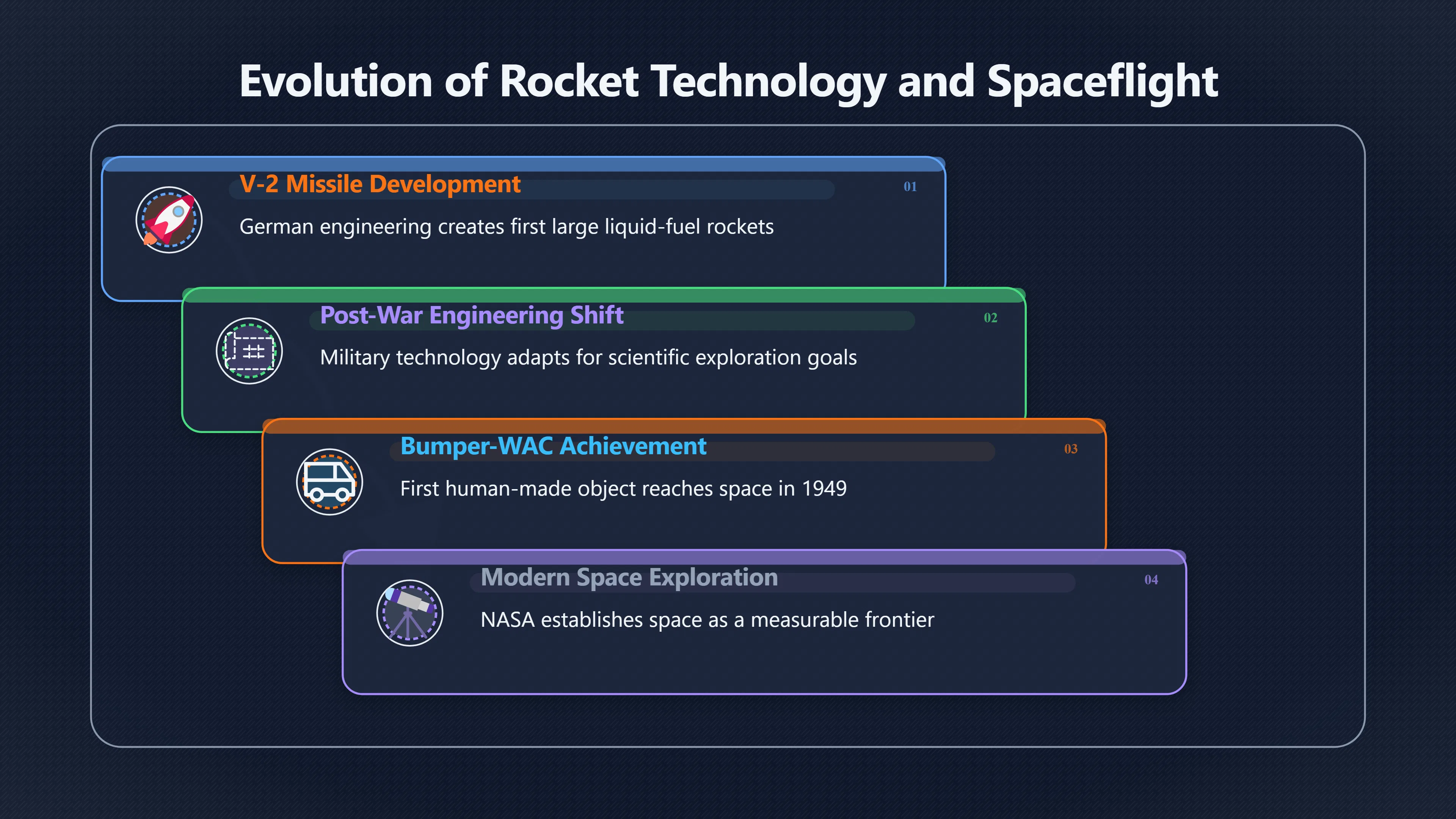
The V-2 was frightening because it was a weapon, but it was also revolutionary because it demonstrated that machines could travel higher and faster than conventional aircraft. Historians of rocketry frequently describe it as the ancestor of later large liquid-fuel launch vehicles. The same engineering principles that delivered warheads across countries could, with modification, send instruments and eventually people towards space.[Smithsonian Institution]si.eduOpen source on si.edu.
This dual identity had a significant cultural effect. Rockets were not merely destructive devices. They became evidence that humanity was approaching a new frontier. Public discussions increasingly linked missile development, scientific exploration and future travel beyond Earth. Instead of seeing space as a distant fantasy realm, many people began to regard it as an engineering challenge that might soon be solved.
The transition was visible almost immediately after the war. In 1949, the Bumper-WAC rocket, built using a V-2 first stage, became the first human-made object to reach space, demonstrating that rocket technology had already crossed the boundary between atmospheric flight and space travel.[NASA]nasa.govFirst Human-Made Object to Enter SpaceFirst Human-Made Object to Enter Space - NASAJanuary 3, 2008…
For UFO culture, this was crucial. Reports of strange aerial objects no longer appeared in a world where space travel was impossible. They appeared in a world where rockets were already proving that the route to space existed.
How spaceflight changed science fiction plausibility
Science fiction had imagined voyages to other planets for decades, but post-war rockets transformed those stories from distant fantasy into projections of emerging technology. Writers increasingly portrayed space travel as an extension of contemporary engineering rather than a miraculous breakthrough.
A useful example is the work of science-fiction authors such as Arthur C. Clarke, whose post-war novels treated spaceflight as a practical future development built on real rocket science rather than on imaginary forces. Works such as Prelude to Space reflected a broader trend in which readers encountered stories that felt connected to genuine technological progress.[Wikipedia]WikipediaPrelude to SpacePrelude to Space
This change affected UFO interpretation in two ways:
- Alien visitors became easier to imagine because interplanetary travel no longer seemed physically impossible.
- Spacecraft designs in fiction increasingly borrowed from actual rocket engineering, making extraordinary vehicles appear more credible.
- Readers and audiences learned to think about other planets as destinations rather than abstract locations in fantasy stories.
- Discussions of UFOs could draw on contemporary science and engineering language rather than relying solely on mythic or supernatural explanations.
As rockets became more capable, the gap between scientific possibility and science-fiction speculation narrowed. UFO narratives benefited from that narrowing gap.
A new sense of cosmic neighbourhood
Rocket achievements also changed how people imagined the Solar System itself. Early space programmes promised that humans might soon reach orbit, the Moon and eventually other planets. Public attention shifted from wondering whether space could ever be entered to asking what might be found there. NASA’s historical accounts of early space exploration emphasise how rapidly the post-war decades transformed humanity’s relationship with space, turning it into a place that could be observed, measured and explored.[NASA Science]science.nasa.govScience Space-based Observations of the EarthNASA ScienceSpace-based Observations of the Earth - NASA ScienceMay 11, 2000…
Within that environment, alien visitation seemed less disconnected from reality than it had before. If humans expected to travel outward, many people naturally considered the reverse possibility: perhaps someone else had already travelled inward.
Why UFOs sat between missile and spacecraft
One reason UFO stories flourished in the early Cold War was that observers often could not easily distinguish between advanced military technology and imagined extraterrestrial craft. Rockets helped create that ambiguity.
Many reported objects possessed characteristics associated with both categories. They appeared technologically advanced, moved in unusual ways and seemed connected to developments beyond ordinary aviation. To some observers they looked like secret missiles, experimental vehicles or classified aerospace projects. To others they looked like evidence of visitors from space.
The result was a hybrid imagination. UFOs were often described using technological language rather than supernatural language. Newspapers, military investigators and science-fiction writers all drew from the same expanding vocabulary of rockets, propulsion systems, guided flight and space travel.
This explains why debates over flying saucers frequently moved between terrestrial and extraterrestrial explanations. Even sceptics who rejected alien visitation often framed UFOs as potential aerospace technologies rather than folklore. Contemporary commentators who opposed extraterrestrial interpretations still recognised that the discussion was occurring within a newly technological age shaped by rockets and the prospect of spaceflight.[Time]time.coman astronomers explanation those flying saucersAn Astronomer's Explanation: THOSE FLYING SAUCERSJune 9, 1952…
The lasting mechanism linking rockets, UFOs and science fiction
The most important effect of post-war rockets was not that they proved UFOs were alien spacecraft. They did not. Instead, rockets altered the boundaries of what people considered possible.
By demonstrating that humans could build machines capable of reaching the edge of space and eventually beyond it, rocket programmes supplied a realistic technological framework for ideas that had previously belonged mainly to speculative fiction. UFO stories inherited that framework. Alien visitors became easier to imagine because the mechanics of travelling through space no longer seemed entirely beyond reach.[NASA]nasa.govFirst Human-Made Object to Enter SpaceFirst Human-Made Object to Enter Space - NASAJanuary 3, 2008…
In that sense, rockets acted as a bridge. They connected wartime military technology to the emerging Space Age, and they connected science-fiction visions of interplanetary travel to popular UFO narratives. The result was a distinctive post-war imagination in which a strange object in the sky could plausibly be interpreted as either tomorrow’s human spacecraft or someone else’s.

Amazon book picks
Further Reading
Books and field guides related to How rockets made alien visitors feel possible. Use these as the next step if you want deeper reading beyond the article.
Cosmos
Connects space exploration, extraterrestrial possibilities, and public fascination with the universe.
Rocket Men
Demonstrates how successful space missions expanded belief in travel beyond Earth.
The Right Stuff
Rating: 4.5/5 from 8 Google Books ratings
Captures the cultural impact of the early space age that reshaped public imagination.
Spaceflight: The Complete Story from Sputnik to Curiosity
Explains how real spaceflight made interplanetary travel seem technologically plausible.
eBay marketplace picks
Marketplace Samples
Example marketplace items related to this page. Use the search link to explore similar finds on eBay.

Endnotes
1.
Source: nasa.gov
Title: First Human-Made Object to Enter Space
Link:https://www.nasa.gov/image-article/first-human-made-object-enter-space/
Source snippet
First Human-Made Object to Enter Space - NASAJanuary 3, 2008...
Published: January 3, 2008
2.
Source: Wikipedia
Title: Prelude to Space
Link:https://en.wikipedia.org/wiki/Prelude_to_Space
3.
Source: science.nasa.gov
Title: Science Space-based Observations of the Earth
Link:https://science.nasa.gov/earth/earth-observatory/space-based-observations-of-the-earth/
Source snippet
NASA ScienceSpace-based Observations of the Earth - NASA ScienceMay 11, 2000...
Published: May 11, 2000
4.
Source: science.nasa.gov
Title: Science History of Lunar Exploration
Link:https://science.nasa.gov/solar-system/moon/history-of-lunar-exploration/
Source snippet
NASA ScienceHistory of Lunar Exploration - NASA Science...
5.
Source: time.com
Title: an astronomers explanation those flying [saucers]({{ ‘saucers/’ | relative_url }})
Link:https://time.com/archive/6608795/an-astronomers-explanation-those-flying-saucers/
Source snippet
An Astronomer's Explanation: THOSE FLYING SAUCERSJune 9, 1952...
Published: June 9, 1952
6.
Source: Wikipedia
Title: Have We Visitors From Space?
Link:https://en.wikipedia.org/wiki/Have_We_Visitors_From_Space
7.
Source: Wikipedia
Title: V-2 rocket
Link:https://en.wikipedia.org/wiki/V-2_rocket
8.
Source: si.edu
Link:https://www.si.edu/object/missile-surface-surface-v-2-4-miscellaneous-parts%3Anasm_A19600342005
Additional References
9.
Source: ufologie.patrickgross.org
Link:https://www.ufologie.patrickgross.org/htm/foia02.htm
Source snippet
UFOs at close sight: FOIA - memo to President Truman, 1948August 22, 1946...
Published: August 22, 1946
10.
Source: airandspace.si.edu
Link:https://airandspace.si.edu/collection-objects/missile-surface-surface-v-2-4-miscellaneous-parts/nasm_A19600342005
11.
Source: library.si.edu
Link:https://library.si.edu/digital-library/book/reportonoperati5grea
Source snippet
Report on operation "Backfire" v. 5January 1, 1946...
Published: January 1, 1946
12.
Source: youtube.com
Title: Science fiction-Science fact
Link:https://www.youtube.com/watch?v=lMPfpFskdkc
Source snippet
This Isn't Sci-Fi. It's the Future of Space Travel...
13.
Source: arxiv.org
Title: Aerodynamics of flying saucers
Link:https://arxiv.org/abs/1810.04855
Source snippet
October 11, 2018...
Published: October 11, 2018
14.
Source: cia.gov
Title: Declassified in Part
Link:https://www.cia.gov/readingroom/docs/CIA-RDP60-00321R000400090003-6.pdf
Source snippet
Sanitized Copy ApproveMarch 26, 2026...
Published: March 26, 2026
15.
Source: youtube.com
Title: Did Nazi Germany Attempt a Moon Mission? | Haunebu Files
Link:https://www.youtube.com/watch?v=l6h20yXniFs
Source snippet
Science fiction-Science fact...
16.
Source: youtube.com
Title: This Isn’t Sci-Fi. It’s the Future of Space Travel
Link:https://www.youtube.com/watch?v=eW_moV6votA
Topic Tree