Within Pulp Roots
When pulp weapons met postwar reality
Future-war pulp stories linked the sky with rays, rockets, atomic power and secret machines before postwar technology made them credible.
On this page
- Air Wonder Stories and technical flying fiction
- Rockets, rays and secret weapons in popular plots
- Why wartime technology changed how readers judged speculation
Page outline Jump by section
Introduction
Before the 1947 flying-saucer wave, pulp science fiction had already spent decades teaching readers to imagine the sky as a place filled with advanced machines. One of the most important strands was the future-war story: tales of secret aircraft, death rays, rocket weapons and revolutionary engines that transformed warfare. These stories did not merely predict future technology. They accustomed readers to the idea that governments, inventors and hidden military organisations might possess aircraft far beyond what the public knew about.
 This mattered because the Second World War altered the boundary between fantasy and reality. Technologies that had once belonged to speculative fiction—rockets, jets, radar, guided weapons and atomic bombs—appeared in the real world with startling speed. As a result, claims about unusual aircraft no longer sounded automatically impossible. Future-war pulps had already prepared a cultural framework in which mysterious machines in the sky could be interpreted as secret technology rather than pure fantasy.[Cambridge University Press & Assessment]cambridge.orgUniversity Press & Assessment Unleashing the Atom (Chapter FiveCambridge University Press & AssessmentUnleashing the Atom (Chapter Five) - The Time MachinesJuly 25, 2017…
Air Wonder Stories and technical flying fiction
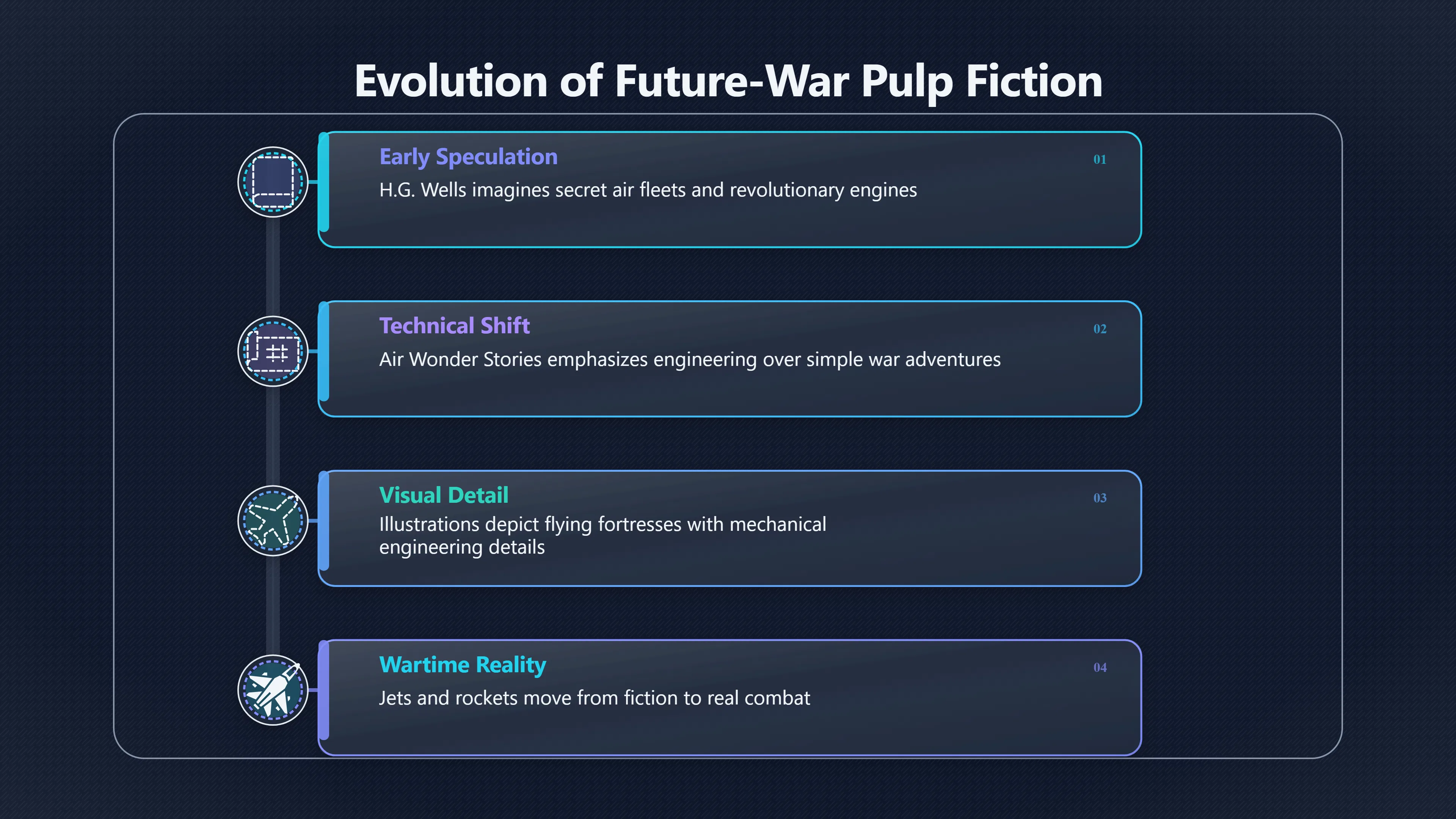
When Hugo Gernsback launched Air Wonder Stories in 1929, he deliberately distinguished it from ordinary aviation adventure magazines. In his introductory editorial, he promised stories of future flight that would be scientific, mechanical and technical rather than simple war adventures. The magazine focused on advanced aircraft, experimental propulsion systems and the future of aerial transport and combat.[Amazing Stories]amazingstories.comwonder histories july 1929 taking to the airAmazing StoriesWonder Histories, July 1929: Taking to the Air - Amazing Stories…
This emphasis was important because it encouraged readers to think about aviation as an engineering problem rather than a fantasy. Aircraft in these stories were often presented with diagrams, technical explanations and pseudo-scientific reasoning. The underlying message was that extraordinary flying machines might emerge from scientific progress rather than magic.
The magazine also connected itself to an earlier tradition of speculative air warfare. Gernsback explicitly pointed readers toward works such as H. G. Wells’s The War in the Air, a novel that imagined secret air fleets and devastating aerial conflict years before large-scale military aviation became reality. Wells’s story centred on hidden preparations, surprise attacks and revolutionary aircraft technologies, themes that became standard ingredients in later pulp fiction.[Amazing Stories]amazingstories.comwonder histories july 1929 taking to the airAmazing StoriesWonder Histories, July 1929: Taking to the Air - Amazing Stories…
Illustrations reinforced the effect. Covers frequently showed giant aircraft, flying fortresses and strange military machines rendered with enough mechanical detail to look engineered rather than magical. Readers repeatedly encountered visual depictions of technology that seemed only a few steps beyond contemporary aviation.
Rockets, rays and secret weapons in popular plots
Future-war pulps rarely limited themselves to improved aeroplanes. Writers filled their stories with death rays, rocket-powered craft, remote-controlled weapons, aerial armadas and exotic power sources. These inventions served dramatic purposes, but they also created a recurring narrative pattern: somewhere, someone was developing a breakthrough weapon in secret.
A striking example appeared on the March 1930 cover of Air Wonder Stories, which depicted a gigantic flying fortress attacking a city with a destructive energy beam. Such imagery linked aviation with hidden super-weapons and suggested that technological surprises could abruptly reshape warfare.[OONA 13]oona13.comOONA 13Air Wonder Stories March 1930 — Death Ray Flying Fortress Attacks City | OONA 13March 1, 1930…
The broader future-war genre had long relied on similar ideas. Nineteenth- and early twentieth-century stories frequently imagined weapons that did not yet exist, including advanced airships, missiles and destructive energy devices. As the genre evolved, the notion that a single technological breakthrough could alter the balance of power became one of its defining assumptions.[Wikipedia]WikipediaSpace warfare in science fictionSpace warfare in science fiction
Several recurring themes helped make secret aircraft feel plausible:
- Hidden development programmes: Inventors or governments quietly created revolutionary machines before revealing them in war.
- Technological leaps: New aircraft were portrayed as dramatic departures from existing designs rather than gradual improvements.
- Strategic surprise: The public and rival nations were often unaware of these weapons until they appeared in the sky.
- Scientific legitimacy: Stories commonly wrapped speculative inventions in engineering language and contemporary scientific ideas.
For readers, the lesson was not necessarily that any particular weapon would exist. Rather, it was that major technological surprises were expected.
Why wartime technology changed how readers judged speculation
The Second World War transformed the relationship between speculative fiction and technological reality. During the 1930s many pulp concepts remained clearly fictional. By the mid-1940s, however, real military research had produced developments that resembled earlier speculative visions.
Jet aircraft entered combat. Radar became a decisive military technology. Germany deployed the V-1 and V-2 weapons, demonstrating long-range guided and rocket-powered attack systems. The atomic bomb revealed a level of destructive power that had previously seemed the province of speculative fiction. Historians of science fiction have noted that wartime advances made many fans feel they were watching once-imaginary inventions emerge into reality.[Cambridge University Press & Assessment]cambridge.orgUniversity Press & Assessment Unleashing the Atom (Chapter FiveCambridge University Press & AssessmentUnleashing the Atom (Chapter Five) - The Time MachinesJuly 25, 2017…
Secrecy amplified the effect. Many wartime technologies were developed under strict security and became widely known only after deployment. Readers who had spent years encountering stories about hidden laboratories and surprise weapons now had real examples of secret projects producing astonishing results. The pattern familiar from pulp fiction appeared to have happened in real life.[Cambridge University Press & Assessment]cambridge.orgUniversity Press & Assessment Unleashing the Atom (Chapter FiveCambridge University Press & AssessmentUnleashing the Atom (Chapter Five) - The Time MachinesJuly 25, 2017…
This did not mean readers believed every extraordinary claim. Instead, the threshold of plausibility shifted. A strange aircraft reported in the distance could now be interpreted as a possible secret military development because recent history had demonstrated that governments really could possess advanced technology unknown to the public.
From speculative aircraft to UFO-era interpretations
The significance of future-war pulps for later UFO culture lies less in specific spacecraft designs than in habits of thought. These magazines repeatedly portrayed the sky as a domain of hidden technology, secret research and unexpected breakthroughs. Unknown aerial objects were often explained through engineering rather than the supernatural.
When reports of unusual flying objects began attracting attention after the war, many observers already possessed a narrative framework shaped by decades of pulp fiction. An unexplained object could be imagined as an advanced aircraft, a revolutionary weapon or a classified military project. Such interpretations fit comfortably within the worldview cultivated by future-war stories.
The cultural bridge was strengthened by the fact that wartime experience had validated part of the pulp imagination. Rockets, jets and atomic weapons proved that yesterday’s speculation could become today’s reality. In that environment, the idea of secret aircraft no longer seemed merely fictional. Future-war pulps had helped make it feel possible.

eBay marketplace picks
Marketplace Samples
Example marketplace items related to this page. Use the search link to explore similar finds on eBay.

Endnotes
1.
Source: cambridge.org
Title: University Press & Assessment Unleashing the Atom (Chapter Five)
Link:https://www.cambridge.org/core/books/abs/time-machines/unleashing-the-atom/9D1A63E1BAECF22EE3A89D8D455ACEF9
Source snippet
Cambridge University Press & AssessmentUnleashing the Atom (Chapter Five) - The Time MachinesJuly 25, 2017...
Published: July 25, 2017
2.
Source: Wikipedia
Title: Wonder Stories
Link:https://es.wikipedia.org/wiki/Wonder_Stories
3.
Source: oona13.com
Link:https://oona13.com/archive/image/316
Source snippet
OONA 13Air Wonder Stories March 1930 — Death Ray Flying Fortress Attacks City | OONA 13March 1, 1930...
Published: March 1, 1930
4.
Source: Wikipedia
Title: Space warfare in science fiction
Link:https://en.wikipedia.org/wiki/Space_warfare_in_science_fiction
5.
Source: oona13.com
Link:https://oona13.com/archive/image/5173
Source snippet
Thrilling Wonder Stories Fall 1943 – Futuristic Aircraft Firing Ray Guns | OONA 13...
6.
Source: Wikipedia
Title: The Argonauts of the Air
Link:https://en.wikipedia.org/wiki/The_Argonauts_of_the_Air
7.
Source: Wikipedia
Title: Wonder Stories
Link:https://en.wikipedia.org/wiki/Wonder_Stories
8.
Source: Wikipedia
Title: Fighting machine (The War of the Worlds)
Link:https://en.wikipedia.org/wiki/Fighting_machine_%28The_War_of_the_Worlds%29
9.
Source: youtube.com
Title: Pulp Science: A Brief History of Science Fiction Magazines
Link:https://www.youtube.com/watch?v=pWxXCPe0oEM
Source snippet
Hugo Gernsback | STUFF YOU MISSED IN HISTORY CLASS...
10.
Source: youtube.com
Title: Hugo Gernsback | STUFF YOU MISSED IN HISTORY CLASS
Link:https://www.youtube.com/watch?v=dckbfZWygEc
Source snippet
Adventure in the Skies!- Aviation Pulp Fiction- Air Force Museum...
11.
Source: amazingstories.com
Title: wonder histories july 1929 taking to the air
Link:https://amazingstories.com/2021/07/wonder-histories-july-1929-taking-to-the-air/
Source snippet
Amazing StoriesWonder Histories, July 1929: Taking to the Air - [Amazing Stories]({{ 'amazing-stories/' | relative_url }})...
Published: july 1929
12.
Source: sm-201.org
Title: www.sm-201.org Wonder Stories
Link:https://www.sm-201.org/a/Wonder_Stories
Source snippet
Stories - Robin's SM-201 Website...
13.
Source: en-academic.com
Title: Wonder Stories
Link:https://en-academic.com/dic.nsf/enwiki/740779
14.
Source: gutenberg.org
Title: www.gutenberg.org The War in the Air | Project Gutenberg
Link:https://www.gutenberg.org/files/780/780-h/780-h.htm
Source snippet
War in the Air | Project Gutenberg...
Additional References
15.
Source: spaceflighthistories.com
Title: www.spaceflighthistories.com Boeing’s X-20 Dyna-Soar Hypersonic Space Bomber
Link:https://www.spaceflighthistories.com/post/x-20-dyna-soar
Source snippet
www.spaceflighthistories.comBoeing's X-20 Dyna-Soar Hypersonic Space BomberFebruary 7, 2020...
Published: February 7, 2020
16.
Source: gutenberg.org
Link:https://www.gutenberg.org/ebooks/69254
Source snippet
vortex blaster makes war by E. E. Smith | Project GutenbergOctober 28, 2022...
Published: October 28, 2022
17.
Source: skjam.com
Title: magazine review wonder stories january 1934
Link:https://www.skjam.com/2019/01/20/magazine-review-wonder-stories-january-1934/
Source snippet
Review: Wonder Stories January 1934 – SKJAM! ReviewsJanuary 20, 2019...
Published: january 1934
18.
Source: goodreads.com
Title: The War in the Air by H.G. Wells | Goodreads
Link:https://www.goodreads.com/book/show/36506764
Source snippet
The War in the Air by H.G. Wells | Goodreads...
19.
Source: m.youtube.com
Title: Adventure in the Skies!- Aviation Pulp Fiction- Air Force Museum
Link:https://m.youtube.com/watch?v=19xcHHCj2XE
Source snippet
The History of Science Fiction | CC EP: 12...
20.
Source: pulpfest.com
Title: Wonder in the Air – Pulp Fest
Link:https://pulpfest.com/2019/06/12/wonder-in-the-air/
Source snippet
Wonder in the Air – PulpFestJune 12, 2019...
Published: June 12, 2019
21.
Source: reddit.com
Link:https://www.reddit.com/r/RedditReads/comments/gnus1l
Source snippet
War in the Air by H. G. Wells [Science Fiction](1908) May 21, 2020...
Published: May 21, 2020
22.
Source: library.si.edu
Title: Smithsonian Libraries The War in the Air
Link:https://library.si.edu/es/donate/adopt-a-book/war-air
23.
Source: fancyclopedia.org
Title: Thrilling Wonder Stories
Link:https://fancyclopedia.org/wiki/Wonder_Stories
24.
Source: pulpmags.org
Title: www.pulpmags.org Air Stories
Link:https://www.pulpmags.org/content/info/air-stories.html
Topic Tree