Within UFO Fiction
Why Skeptics Talk About Science Fiction
Skeptics often argue that UFO reports reflect cultural expectations as much as unexplained physical events.
On this page
- Cultural templates as an explanation
- Ordinary causes and unresolved cases
- Where skeptical readings can overreach
Page outline Jump by section
Introduction
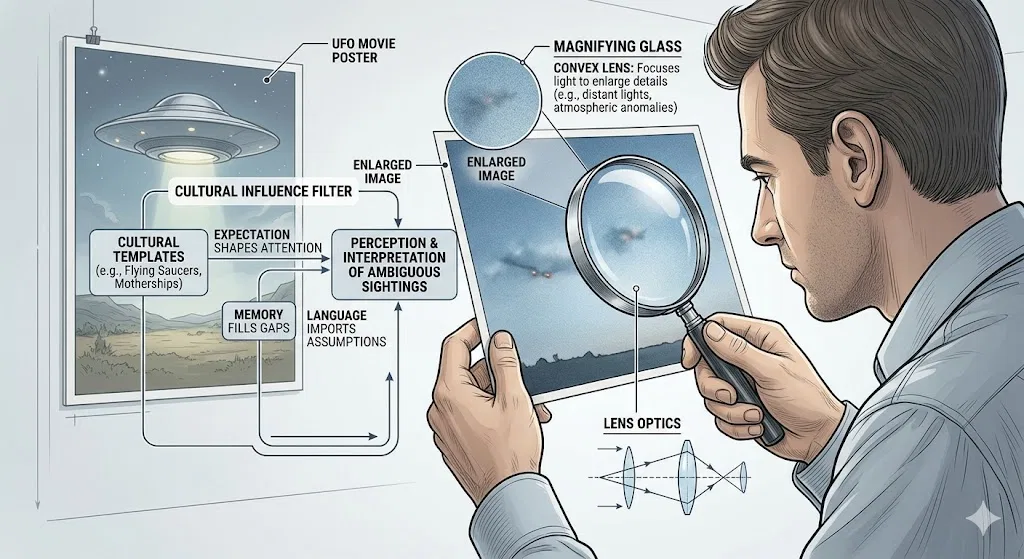
Sceptics talk about science fiction because UFO reports do not arrive in a cultural vacuum. A witness may genuinely see something puzzling, but the language used to describe it — saucer, mothership, abduction, alien examination, government cover-up — often comes from a shared store of images built by pulp magazines, films, television, news coverage and earlier UFO stories. The sceptical claim is not simply that witnesses are lying or “copying films”. It is that perception, memory and interpretation are shaped by available cultural templates, especially when the original stimulus is distant, brief, ambiguous or poorly recorded.
This matters because it separates two questions that are often blurred together: “Did someone see something?” and “What story did the sighting become?” Official investigations have repeatedly found ordinary explanations for many reports and insufficient evidence for extraterrestrial technology, while still leaving some cases unresolved because the data are too limited. NASA’s 2023 UAP study, for example, reported no conclusive evidence in peer-reviewed literature for an extraterrestrial origin, while stressing that many reports lack the high-quality data needed for firm identification.[NASA Science]science.nasa.govScience Independent Study Team ReportScience Independent Study Team Report
Cultural templates as an explanation
A cultural template is a ready-made pattern for making sense of an uncertain experience. In UFO history, the template might be the “flying saucer”, the “black triangle”, the alien medical examination, the secret crash retrieval, or the idea that officials know more than they admit. Sceptics use this concept because UFO reports often contain two layers: an observation layer, such as lights, shapes, movement or radar returns, and a meaning layer, in which the object becomes a craft, visitor, weapon, warning or cover-up.
The point is strongest when the reported details resemble stories already circulating in popular culture. The “flying saucer” image itself is a classic example. Kenneth Arnold’s 1947 sighting helped launch the modern UFO era, but the press label “flying saucer” quickly became more influential than the exact form Arnold described. Once that phrase entered public language, it gave later witnesses, editors and illustrators a memorable shape to reach for. The image then became self-reinforcing: reports fed the media, the media standardised the image, and the image shaped later expectations.
Sceptical writers often describe this as a feedback loop rather than a one-way act of invention. Science fiction did not create every unusual sky report, but it helped supply the visual grammar through which ambiguous reports could be narrated. That grammar is especially powerful because UFO sightings are often fleeting. A person may see a light for seconds, at night, at distance, without a fixed reference point. By the time the event is retold, the description may include comparison, inference and memory reconstruction as well as direct observation.
The UK release of Ministry of Defence UFO files gave sceptics a practical archive for this argument. A National Archives research guide summarising official conclusions stated that about 90% of UFO reports proved plausibly related to ordinary phenomena, and that further extensive study was not justified in the expectation that science would be advanced.[National Archives]cdn.nationalarchives.gov.ukOpen source on nationalarchives.gov.uk. When later file releases showed spikes of public reporting around media moments, commentators such as David Clarke argued that popular science-fiction films and television could prime people to notice and report ambiguous sky events as UFOs.[Universe Today]universetoday.comreport ufo sightings coincide with popular sci fi films tvreport ufo sightings coincide with popular sci fi films tv
This does not mean viewers hallucinated entire events after watching a film. The more careful sceptical claim is subtler: popular culture can change the threshold for noticing, reporting and interpreting. A bright planet, aircraft landing light, satellite, balloon or meteor may be seen in any era. What changes is the story a witness finds plausible, and the confidence with which a mundane ambiguity becomes a UFO narrative.
Why the filter is not just “people saw it in a film”
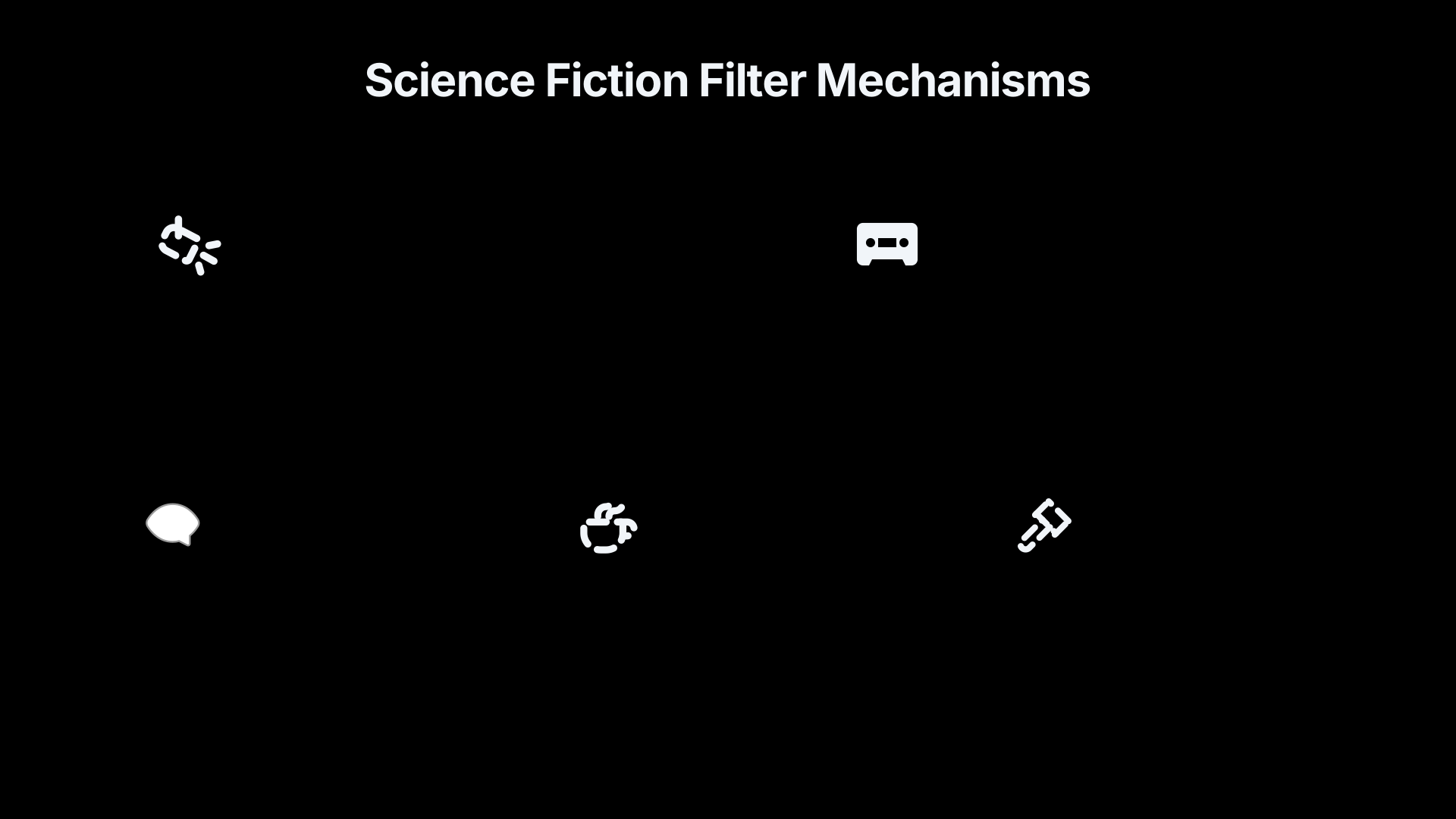
The science-fiction filter works through several ordinary human processes. None requires bad faith.
Expectation shapes attention. People notice what they are prepared to notice. In a period of public UFO excitement, ambiguous lights may be more readily interpreted as unusual rather than ignored as aircraft or stars.
Memory fills gaps. A brief sighting rarely leaves a perfect record. Retellings, drawings, interviews and media exposure can stabilise details that were initially uncertain. This is not unique to UFOs; it is a general feature of human memory.
Language imports assumptions. Calling something a “craft” is already a step beyond seeing a light or shape. Calling it a “mothership” or “probe” imports an entire science-fiction framework.
Social reinforcement matters. Once a sighting is discussed in a family, local press report, UFO group, online forum or documentary, witnesses may encounter similar cases and vocabulary that help organise their own experience.
This is why sceptics often prefer psychological and sociological explanations over a simple accusation of hoaxing. Research on people who report UFO or alien-abduction experiences has not generally supported the lazy stereotype that they are simply irrational or attention-seeking. A Harvard Gazette report on Susan Clancy’s work, for instance, described subjects who believed they had been abducted and often interpreted sleep disturbance, panic, scars or other puzzling experiences through the alien-abduction frame.[Harvard Gazette]news.harvard.eduGazette Starship memories: — Harvard GazetteGazette Starship memories: — Harvard Gazette A Psychology Today summary of research on UFO reporters similarly notes that studies have found little evidence of broad psychopathology, while pointing to traits such as openness, fantasy-proneness or richer imaginative lives as relevant to some reports.[Psychology Today]psychologytoday.comthe surprising psychology of ufo reportingthe surprising psychology of ufo reporting
For sceptics, that distinction is important. The science-fiction filter is not a claim that witnesses are foolish. It is a claim that sincere people can use culturally available stories to organise strange experiences, especially when the original evidence is weak, private or ambiguous.
Abduction stories show the filter most clearly
The abduction subgenre is where the science-fiction filter becomes easiest to see, because the reports often contain elaborate narrative elements: missing time, beings with large eyes, medical procedures, telepathic communication, hybrid children, warnings about nuclear war or environmental destruction. These are not just sightings; they are stories with structure, characters and recurring scenes.
The Betty and Barney Hill case became the foundational modern abduction narrative. Their reported 1961 experience later became widely known through John G. Fuller’s 1966 book The Interrupted Journey and subsequent media treatment. Sceptics have long argued that some details in the Hill case, especially Barney Hill’s hypnotically recovered description of an alien with striking eyes, may have been influenced by science-fiction imagery already on television. Martin Kottmeyer’s much-cited sceptical argument connected aspects of Barney’s account to “The Bellero Shield”, an episode of The Outer Limits broadcast shortly before Barney’s hypnosis sessions.[Skeptical Inquirer]skepticalinquirer.orgSkeptical Inquirer The Eyes that SpokeSkeptical Inquirer The Eyes that Spoke
The Hill case also shows why the issue is contested. Believers point to the couple’s sincerity, the emotional force of the account and the difficulty of reducing the whole episode to television influence. Sceptics reply that sincerity is not the same as accuracy, especially when hypnosis, dreams, anxiety, prior cultural images and later media amplification are involved. The question is not whether the Hills deliberately invented a story, but how an extraordinary account could grow through memory, therapy, suggestion and culture.
Later abduction narratives strengthened sceptical interest in false memory, sleep paralysis and guided recall. Sleep paralysis is a well-documented state in which a person may wake unable to move and experience vivid sensory impressions, including a sensed presence.[arXiv]arxiv.orgarXiv Sleep Paralysis: phenomenology, neurophysiology and treatmentarXiv Sleep Paralysis: phenomenology, neurophysiology and treatment In a culture saturated with alien imagery, sceptics argue, such frightening experiences can be interpreted as alien visitation rather than demons, ghosts, intruders or other culturally familiar figures.
Hypnosis is another flashpoint. Some abduction accounts emerged or became more detailed during hypnotic regression, a method that can increase confidence without guaranteeing accuracy. A 1996 psychological discussion of alleged alien abductions linked such reports to false memories, hypnosis and fantasy-proneness, while noting how imagined alien encounters can take on convincing detail under suggestive conditions.[JSTOR]jstor.orgOpen source on jstor.org. Sceptics therefore treat many abduction accounts less as evidence of spacecraft and more as evidence of how powerful narrative, memory and expectation can be when combined.
Ordinary causes and unresolved cases
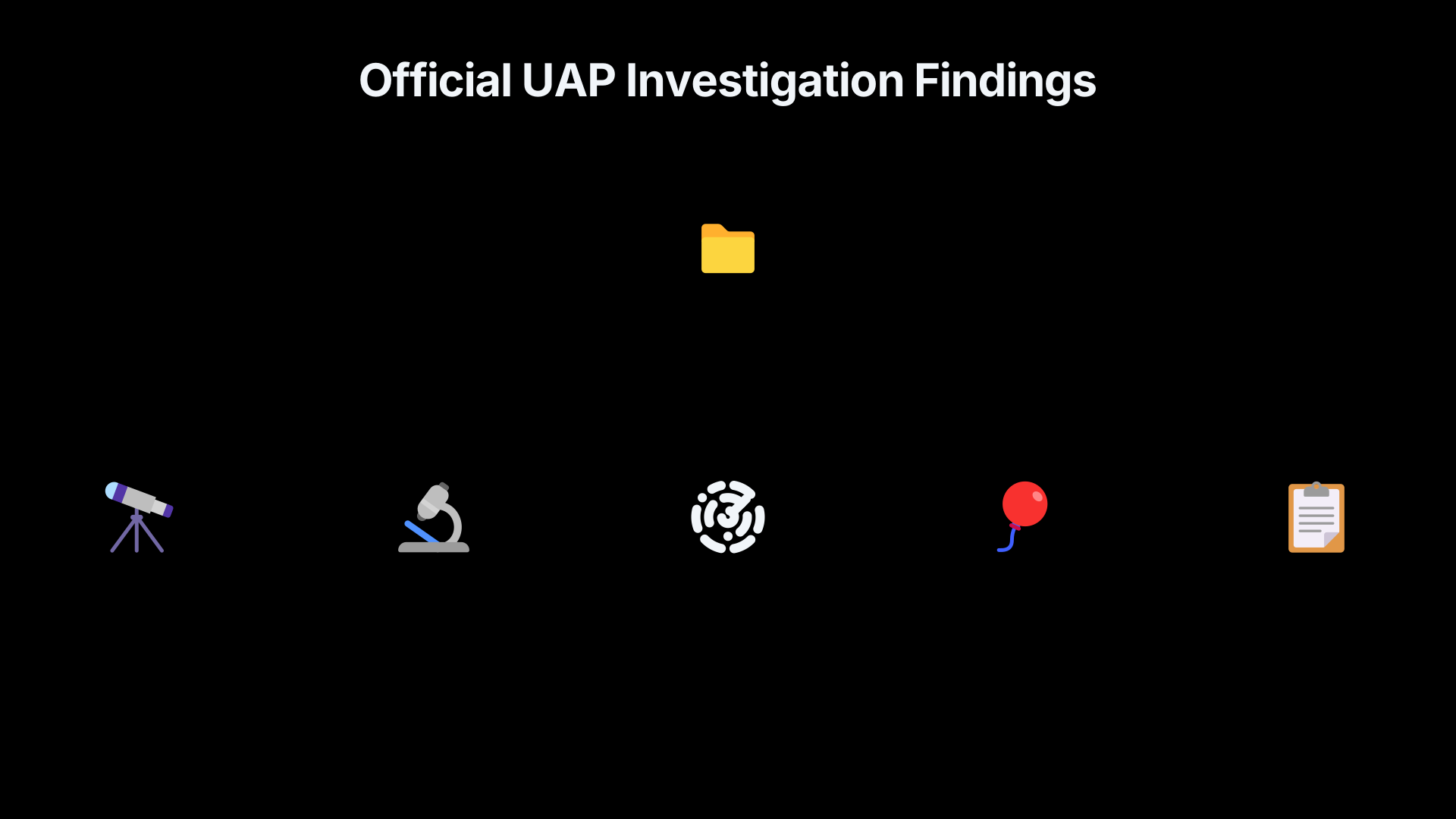
Sceptics usually begin with a practical observation: most UFO reports that receive enough information to investigate turn out to have ordinary or at least non-extraterrestrial explanations. These include aircraft, drones, balloons, satellites, meteors, astronomical objects, sensor artefacts, military activity, atmospheric phenomena, hoaxes and mistakes about distance or speed. The US National Archives notes that Project Blue Book, the US Air Force’s long-running UFO investigation, was closed in 1969 and its records declassified, making it a major source for reviewing how official investigators handled cases.[National Archives]archives.govNational Archives Project BLUE BOOKNational Archives Project BLUE BOOK
Modern UAP reviews have largely preserved that pattern. NASA’s FAQ says there are no data supporting the idea that UAP are evidence of alien technologies and emphasises that sightings often involve very limited data.[NASA Science]science.nasa.govOpen source on nasa.gov. The Pentagon’s All-domain Anomaly Resolution Office, in its historical review, reported no evidence that US government or academic investigations had validated any sighting as extraterrestrial, and no evidence that companies possessed or reverse-engineered off-world technology.[U.S. Department of War]media.defense.govDOPSR 2024 0263 AARO HISTORICAL RECORD REPORT VOLUMEDOPSR 2024 0263 AARO HISTORICAL RECORD REPORT VOLUME
The sceptical reading of science fiction sits on top of this evidential pattern. If most resolved cases are ordinary, and if no verified extraterrestrial hardware has emerged, then science-fiction motifs in testimony become suspect as interpretations rather than observations. A witness who reports “a silent triangular craft” may have seen something real in the sky; the sceptical question is whether “craft” and “triangular UFO” are conclusions supplied by culture, not facts directly established by the sighting.
At the same time, unresolved cases do exist. AARO’s public imagery page includes cases resolved as balloons, cases closed as not anomalous and cases still unresolved or undergoing analysis.[AARO]aaro.milOpen source on aaro.mil. This is where careful scepticism differs from blanket dismissal. “Unresolved” does not mean “alien”, but it also does not mean “nothing happened”. It usually means that available evidence is insufficient, incomplete or ambiguous.
The science-fiction filter is therefore most useful as a warning about interpretation, not as a universal explanation. It helps explain why reports take certain narrative forms. It does not, by itself, identify every object, explain every sensor return or settle every case.
The sceptical method: reduce the story before explaining the sighting
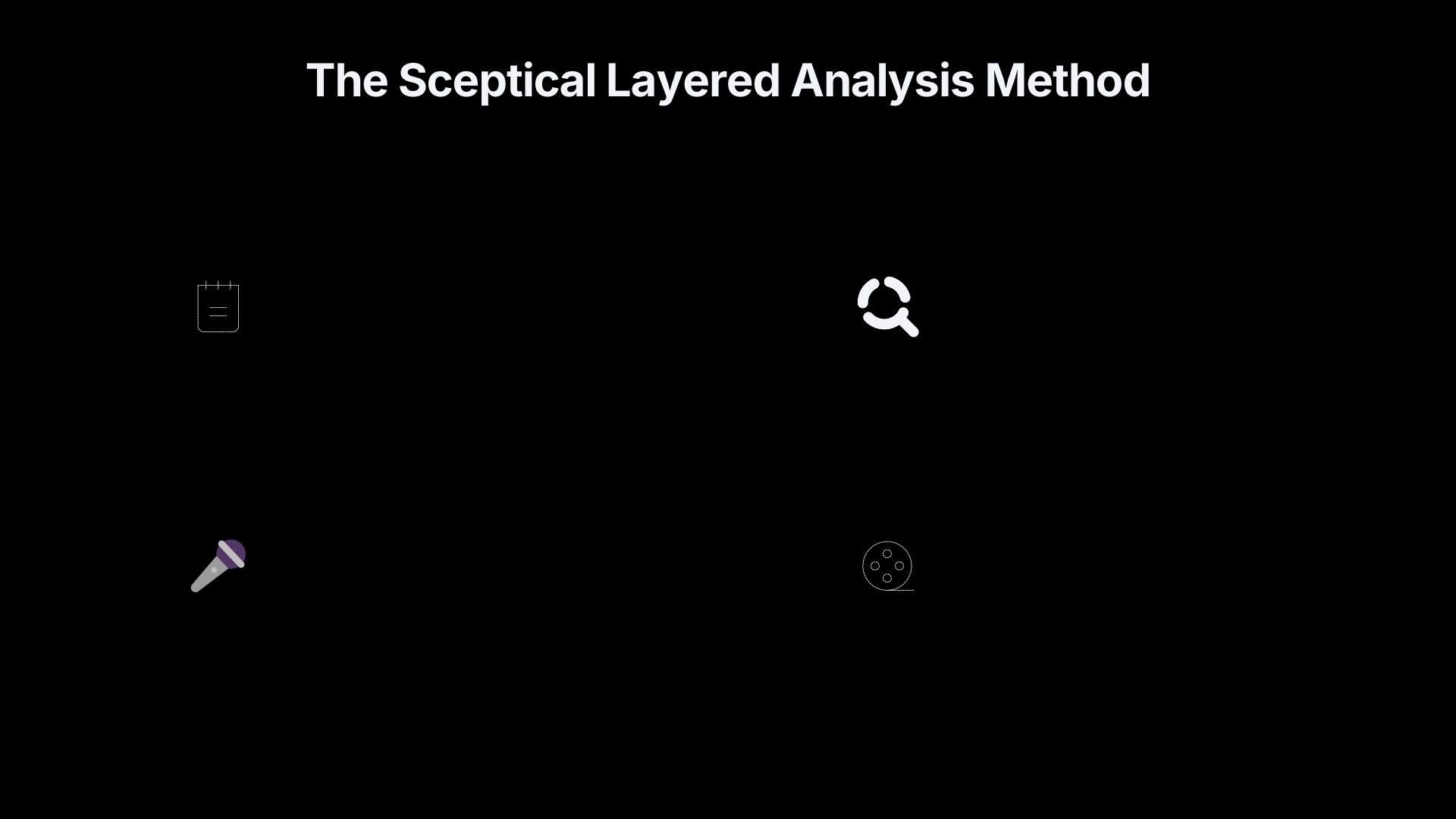
A good sceptical reading usually separates a UFO account into layers.
First comes the raw observation: time, place, direction, duration, weather, number of witnesses, instruments, photographs and independent records. Second comes interpretation: whether the witness believed the object was controlled, artificial, non-human, hostile or secret. Third comes later narrative: press coverage, interviews, documentaries, books, online discussion and changes in the story over time.
This layered method is important because science-fiction influence often enters at the second and third stages. A witness may accurately report seeing a bright, fast-moving light. The alien or secret-technology interpretation may come later, especially after comparison with other stories. Conversely, a case with good multi-sensor data, independent witnesses and a stable early record is less vulnerable to being dismissed purely as cultural expectation.
The UK Ministry of Defence material illustrates the value of this approach. Official files include everything from dramatic witness drawings to routine administrative handling. The same archive can contain sincere reports, misidentifications, public anxiety, bureaucratic caution and occasional unresolved material. David Clarke’s work with the National Archives has emphasised that the files are historically valuable not simply because they contain “mysteries”, but because they reveal how citizens, journalists, officials and investigators translated unusual claims into institutional records.[National Archives]cdn.nationalarchives.gov.ukthe ufo files extractthe ufo files extract
For the reader, the practical takeaway is that a UFO story should not be judged only by its most dramatic version. The strongest sceptical move is often to ask: What was said first? What was added later? Which details are direct observations, and which are interpretations borrowed from familiar UFO lore?
Where sceptical readings can overreach
The science-fiction filter can become too blunt when it treats resemblance as proof of invention. If a witness describes a disc after seeing films with discs, that does not automatically show the report is false. Real experiences are always described using available language. A pilot who says something looked like a “drone” today may not be copying drone fiction; they may simply be using the nearest contemporary comparison.
Sceptics can also overreach by ignoring the emotional and social seriousness of witness testimony. Some people who report UFO experiences are pilots, police officers, military personnel, scientists or ordinary citizens with no obvious incentive to fabricate. Their status does not make an alien explanation true, but it does mean that ridicule is a poor substitute for investigation. NASA’s 2023 report explicitly argued for reducing stigma around UAP reporting so that better data can be collected.[NASA Science]science.nasa.govScience Independent Study Team ReportScience Independent Study Team Report
Another risk is using “science fiction” as a catch-all label for anything strange. Some UFO reports may be better explained by defence secrecy, sensor limitations, aircraft testing, atmospheric effects, commercial drones or simple lack of data than by cultural narrative. The “filter” explains how people interpret uncertainty; it should not replace technical investigation of what was physically present.
There is also a historical caution. Science fiction sometimes anticipates real technologies in broad imaginative form: rockets, satellites, robots, artificial intelligence and video communication all appeared in fiction before becoming ordinary or technically plausible. That does not mean UFO stories are prophetic, but it does mean “it sounds like science fiction” is not a scientific disproof. The stronger sceptical argument is evidential: extraordinary interpretations require strong, independent, testable evidence, and UFO cases rarely provide it.
Why this debate remains central to UFO culture
The science-fiction filter remains central because UFOs are both evidence claims and stories about meaning. One person asks what appeared on radar; another asks why aliens would visit; another asks whether officials are hiding crashed craft; another sees a modern myth about technology, salvation, invasion or cosmic belonging. Sceptics focus on the filter because it explains why UFO accounts so often mirror the hopes and fears of their period.
In the Cold War, UFOs easily became stories of invasion, secret weapons and nuclear anxiety. In the abduction era, they became stories of bodies, reproduction, medical control and hidden trauma. In the current UAP period, they are often framed through drones, sensors, classified programmes, artificial intelligence, national security and disclosure politics. The unknown object changes with the cultural machinery around it.
That does not make UFO reports worthless. It makes them double evidence: sometimes weak evidence about the sky, and often strong evidence about how people interpret the unknown. The sceptical science-fiction filter is most convincing when used as a disciplined tool: identify the original observation, test ordinary explanations, examine how cultural templates shaped the account, and resist turning unresolved cases into ready-made stories.
Its weakness appears when it becomes dismissive certainty. Some cases remain unresolved because the data are poor, not because the answer is culturally obvious. The best sceptical reading therefore does not say, “UFOs are just science fiction.” It says that science fiction has helped teach modern witnesses, journalists and audiences what a UFO is supposed to look like — and that any serious evaluation has to account for that filter before treating the story as evidence of something extraordinary.
Amazon book picks
Further Reading
Books and field guides related to Why Skeptics Talk About Science Fiction. Use these as the next step if you want deeper reading beyond the article.
The Demon-Haunted World
Rating: 4.5/5 from 43 Google Books ratings
Explains critical thinking and extraordinary claims in a UFO-relevant context.
Why People Believe Weird Things
Rating: 4.0/5 from 7 Google Books ratings
Directly relevant to skeptical interpretations of UFO narratives.
eBay marketplace picks
Marketplace Samples
Example marketplace items related to this page. Use the search link to explore similar finds on eBay.
Endnotes
1.
Source: science.nasa.gov
Title: Science Independent Study Team Report
Link:https://science.nasa.gov/wp-content/uploads/2023/09/uap-independent-study-team-final-report.pdf
2.
Source: science.nasa.gov
Link:https://science.nasa.gov/uap/faqs/
3.
Source: news.harvard.edu
Title: Gazette Starship memories: — Harvard Gazette
Link:https://news.harvard.edu/gazette/story/2002/10/starship-memories-2/
4.
Source: arxiv.org
Title: arXiv Sleep Paralysis: phenomenology, neurophysiology and treatment
Link:https://arxiv.org/abs/1704.02342
5.
Source: jstor.org
Link:https://www.jstor.org/stable/1449008
6.
Source: archives.gov
Title: National Archives Project BLUE BOOK
Link:https://www.archives.gov/research/military/air-force/ufos
7.
Source: aaro.mil
Link:https://www.aaro.mil/UAP-Cases/Official-UAP-Imagery/
8.
Source: archives.gov
Link:https://www.archives.gov/research/topics/uaps
9.
Source: archives.gov
Title: do records show proof of ufos
Link:https://www.archives.gov/news/articles/do-records-show-proof-of-ufos
10.
Source: unwritten-record.blogs.archives.gov
Title: project blue book looking to the film record
Link:https://unwritten-record.blogs.archives.gov/2013/09/30/project-blue-book-looking-to-the-film-record/
11.
Source: archives.gov
Link:https://www.archives.gov/research/topics/uaps/moving-images-and-sound
12.
Source: archives.gov
Link:https://www.archives.gov/research/topics/uaps/photographs
13.
Source: jstor.org
Link:https://www.jstor.org/stable/4137923
14.
Source: jstor.org
Link:https://www.jstor.org/stable/j.ctvzxx9sf
15.
Source: science.nasa.gov
Link:https://science.nasa.gov/uap/
16.
Source: war.gov
Title: dod examining [unidentified]({{ ‘unidentified/’ | relative_url }}) anomalous phenomena
Link:https://www.war.gov/News/News-Stories/Article/Article/3965403/dod-examining-unidentified-anomalous-phenomena/
17.
Source: aaro.mil
Title: UAP Records
Link:https://www.aaro.mil/UAP-Records/
18.
Source: time.com
Title: science dr jung the saucers
Link:https://time.com/archive/6888244/science-dr-jung-the-saucers/
19.
Source: cdn.nationalarchives.gov.uk
Link:https://cdn.nationalarchives.gov.uk/documents/aug-2009-research-guide.pdf
20.
Source: universetoday.com
Title: report ufo sightings coincide with popular sci fi films tv
Link:https://www.universetoday.com/articles/report-ufo-sightings-coincide-with-popular-sci-fi-films-tv
21.
Source: cdn.nationalarchives.gov.uk
Link:https://cdn.nationalarchives.gov.uk/documents/final-tranche-of-UFO-files-released.pdf
22.
Source: psychologytoday.com
Title: the surprising psychology of ufo reporting
Link:https://www.psychologytoday.com/us/blog/long-fuse-big-bang/202311/the-surprising-psychology-of-ufo-reporting
23.
Source: skepticalinquirer.org
Title: Skeptical Inquirer The Eyes that Spoke
Link:https://skepticalinquirer.org/newsletter/eyes-that-spoke/
24.
Source: media.defense.gov
Title: DOPSR 2024 0263 AARO HISTORICAL RECORD REPORT VOLUME 1 2024
Link:https://media.defense.gov/2024/Mar/08/2003409233/-1/-1/0/DOPSR-2024-0263-AARO-HISTORICAL-RECORD-REPORT-VOLUME-1-2024.PDF
25.
Source: cdn.nationalarchives.gov.uk
Title: the ufo files extract
Link:https://cdn.nationalarchives.gov.uk/documents/the-ufo-files-extract.pdf
26.
Source: rebartholomew.com
Link:https://rebartholomew.com/articles
27.
Source: skepticalinquirer.org
Link:https://skepticalinquirer.org/wp-content/uploads/sites/29/2019/03/Issue-05-2.pdf
28.
Source: skepticalinquirer.org
Title: surveying belief
Link:https://skepticalinquirer.org/exclusive/surveying-belief/
29.
Source: skepticalinquirer.org
Link:https://skepticalinquirer.org/wp-content/uploads/sites/29/2019/03/SI-ND-18.pdf
30.
Source: skepticalinquirer.org
Title: abductive reasoning
Link:https://skepticalinquirer.org/exclusive/abductive-reasoning/
31.
Source: cdn.nationalarchives.gov.uk
Link:https://cdn.nationalarchives.gov.uk/documents/ufo-files-reveal-behind-the-scenes-of-the-ufo-desk.pdf
32.
Source: cdn.nationalarchives.gov.uk
Link:https://cdn.nationalarchives.gov.uk/documents/mar-2009-highlights-guide.pdf
33.
Source: cdn.nationalarchives.gov.uk
Link:https://cdn.nationalarchives.gov.uk/documents/briefing-guide-12-07-12.pdf
34.
Source: books.google.co.uk
Link:https://books.google.co.uk/books?cad=0&id=PC_6or5kQ9EC&printsec=frontcover&source=gbs_ge_summary_r
35.
Source: dataviz.etublogs.usj.edu.lb
Title: ufos through human eyes how culture and emotion shape what we see
Link:https://dataviz.etublogs.usj.edu.lb/2025/04/11/ufos-through-human-eyes-how-culture-and-emotion-shape-what-we-see/
36.
Source: psychologytoday.com
Title: jung flying saucers and the anxieties our time
Link:https://www.psychologytoday.com/gb/blog/dreaming-in-the-digital-age/202012/jung-flying-saucers-and-the-anxieties-our-time
37.
Source: psychologytoday.com
Link:https://www.psychologytoday.com/us/articles/200303/alien-abductions-the-real-deal
38.
Source: michaelshermer.com
Link:https://michaelshermer.com/sciam-columns/abducted/
39.
Source: mirror.co.uk
Title: national archives ufo files report 1141567
Link:https://www.mirror.co.uk/news/weird-news/national-archives-ufo-files-report-1141567
Additional References
40.
Source: youtube.com
Title: Unidentified Anomalous Phenomena Independent Study Report
Link:https://www.youtube.com/watch?v=TQcqOW39ksk
Source snippet
Neil deGrasse Tyson returns to The Michael Shermer Show to talk UFOs, aliens, government files, eyewitness testimony, and his new book Ta...
41.
Source: youtube.com
Title: UAP Independent Study Event Post-Meeting Media Teleconference (
Link:https://www.youtube.com/watch?v=C3uXUfgSadU
Source snippet
Dr. Diana Walsh Pasulka: Why the Smartest Scientists Believe in UFOs...
Published: May 31, 2023
42.
Source: youtube.com
Title: Dr. Diana Walsh Pasulka: Why the Smartest Scientists Believe in UFOs
Link:https://www.youtube.com/watch?v=pKlrHqJkt38
Source snippet
Kacey Musgraves vs. Mick West: Country star mocks UFO skeptic | Unreported...
43.
Source: youtube.com
Title: Chatter: UFO Culture, with Sarah Scoles
Link:https://www.youtube.com/watch?v=0pK3coF4Sm0
Source snippet
UAP Independent Study Event Post-Meeting Media Teleconference (May 31, 2023)...
Published: May 31, 2023
44.
Source: youtube.com
Link:https://www.youtube.com/watch?v=zm5CfXGmmfA
Source snippet
Interview: Mick West, Identifying UFOs...
45.
Source: researchgate.net
Link:https://www.researchgate.net/publication/405404634_The_Neuroscience_and_psychology_of_alien_abduction_An_extended_review
46.
Source: researchgate.net
Link:https://www.researchgate.net/publication/374373111_UFOs_and_Unidentified_Anomalous_Phenomena_The_NASA_report_1492023_has_found_no_evidence_to_suggest_that_UAPs_are_extraterrestrial_in_origin
47.
Source: facebook.com
Link:https://www.facebook.com/SETIInstitute/posts/a-skeptical-guide-to-ufo-cases-and-claimswith-steven-spielbergs-new-blockbuster-/1395521999289439/
48.
Source: facebook.com
Link:https://www.facebook.com/groups/spacemansluck/posts/3059470764292957/
49.
Source: neuroscigroup.us
Link:https://www.neuroscigroup.us/articles/APT-5-137.php
Topic Tree