Within Abductions
Why Alien Abductions Look Like Examinations
The clinical examination scene turned modern medical anxiety into one of the most recognisable images in abduction lore.
On this page
- The table, lights and restrained body
- Samples, implants and reproductive fears
- How film and television made the room visual
Page outline Jump by section
Introduction
The medical examination room became the defining image of alien abduction stories because it fused two powerful late twentieth-century anxieties: fear of advanced technology and fear of losing control of one’s own body. In classic abduction narratives, the alien craft is often remembered only briefly, while the brightly lit examination chamber dominates the experience. The witness is placed on a table, surrounded by unfamiliar instruments, and subjected to procedures that resemble medicine while lacking medicine’s central promise of care and consent. In this sense, the examination room translated modern concerns about hospitals, surgery, reproduction and scientific authority into a science-fiction setting. Scholars of abduction narratives have argued that these stories transformed contemporary fears into a recognisable science-fiction language, making the clinical room one of the most durable images in UFO culture.[ResearchGate]researchgate.netOpen source on researchgate.net.
 Within the broader relationship between UFOs and science fiction, the examination room matters because it shifted alien encounters away from adventure and towards bodily vulnerability. The central question was no longer what existed in space, but what could be done to a human body by a superior intelligence.
The table, lights and restrained body
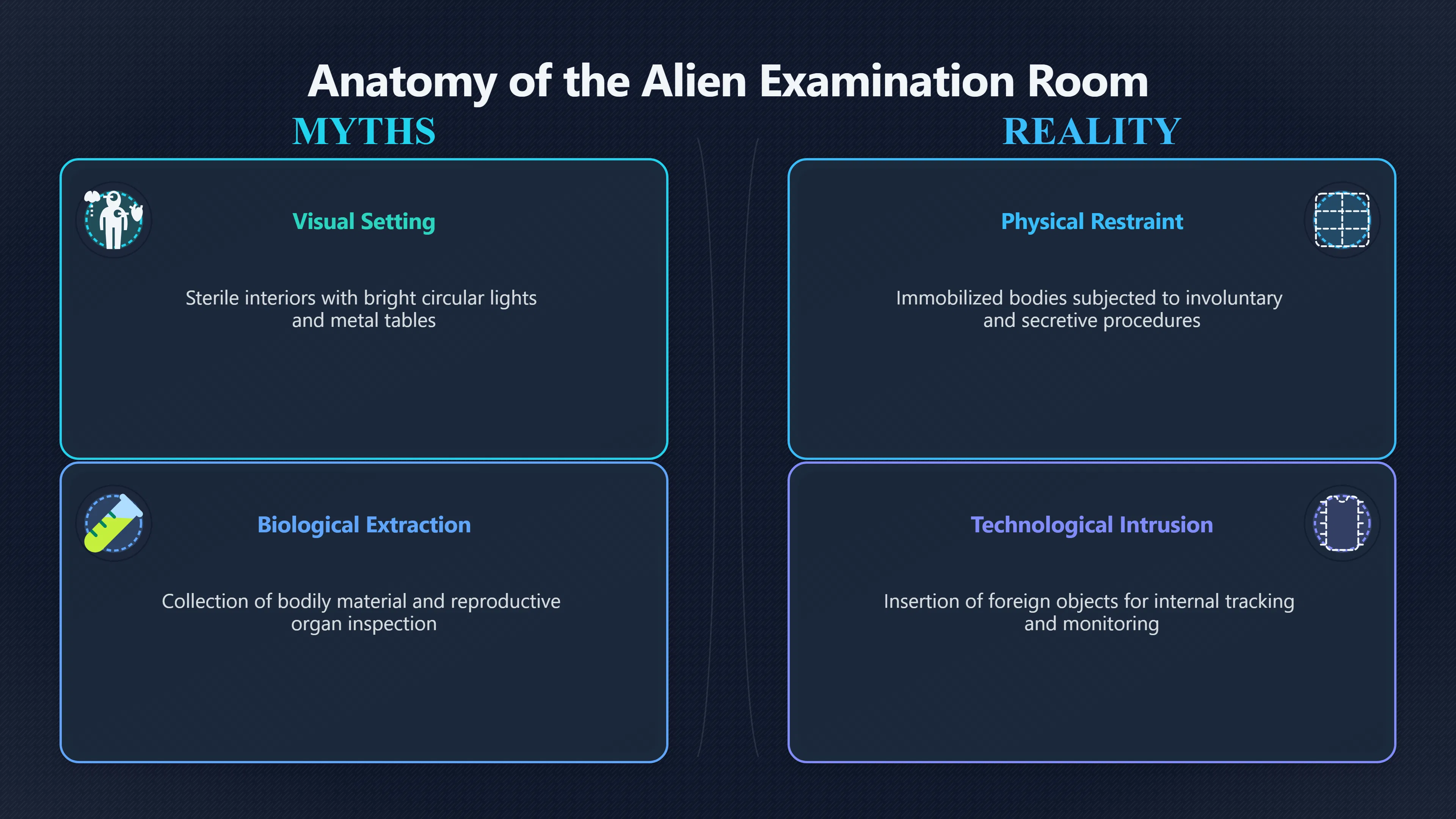
The examination room works as a visual shorthand because it immediately communicates powerlessness. Most accounts place the experiencer on a raised table under intense lighting while small beings move around them performing procedures. The scene resembles a hospital operating theatre, yet lacks doctors, explanations, consent forms or any indication that treatment is intended to help the patient. Instead, the body is treated as an object of investigation. Reports collected by abduction researchers consistently describe the examination phase as involving medical procedures carried out regardless of the witness’s wishes.[Wikipedia]WikipediaAlien abductionAlien abduction
This image gained force because modern medicine had become one of the most technologically complex institutions in everyday life. Ordinary people increasingly encountered scanners, anaesthesia, surgical equipment and specialised medical environments that they could not fully understand. For many, the examination room represented a place where experts controlled the body and where patients surrendered knowledge and agency to technical systems. Roger Luckhurst argues that abduction stories emerged partly from anxieties surrounding an increasingly technological society and transformed those concerns into science-fiction narratives.[ResearchGate]researchgate.netOpen source on researchgate.net.
Critics have also noted how closely many abduction descriptions resemble real medical experiences. Psychiatrist David Forrest observed parallels between reported alien encounters and surgical settings: bright circular lights, altered states of consciousness, immobility, probing instruments, strange figures and a profound loss of bodily control. Whether or not such similarities explain individual reports, they help explain why the examination room became culturally persuasive. It already existed in everyday life as a place where people experienced vulnerability.[Guilford Journals]guilfordjournals.comOpen source on guilfordjournals.com.
Samples, implants and reproductive fears
The examination room became especially memorable because many narratives focus on extraction, sampling and reproduction. Witnesses frequently report that aliens collect bodily material, inspect reproductive organs, remove eggs or sperm, or conduct procedures linked to breeding programmes. These themes transformed ordinary medical concerns into cosmic ones. Instead of worrying about disease or treatment, the abductee fears becoming raw biological material for an unknown purpose.[Wikipedia]WikipediaAlien abductionAlien abduction
The emphasis on reproduction is significant. During the decades when abduction narratives became widely known, public debates about fertility technologies, genetics, reproductive rights and biomedical research were increasingly prominent. Abduction stories reframed these issues through science-fiction imagery. The body became a site of extraction and experimentation, and reproductive capacity became something that could be monitored or appropriated by external powers. Scholars analysing abduction narratives have connected their popularity to broader cultural concerns about memory, trauma, technological intrusion and the boundaries of personal identity.[ResearchGate]researchgate.netOpen source on researchgate.net.
Implants occupy a similar symbolic role. In many accounts, witnesses believe that foreign objects were inserted into their bodies for tracking or monitoring. Whether interpreted literally by believers or symbolically by critics, implants express anxiety about hidden technological control. The fear is not merely physical invasion but permanent surveillance from within. This reflects a broader science-fiction theme in which advanced technology penetrates the body itself rather than remaining outside it.[Wikipedia]WikipediaAlien abductionAlien abduction
The resulting image is distinctive: a person immobilised on a table while unknown beings gather information from the body. Unlike conventional medical treatment, the procedures appear secretive, involuntary and impossible to question. That inversion of medicine’s normal purpose gives the scene much of its emotional power.
How film and television made the room visual
The examination room became central to abduction lore partly because it was easy to visualise and reproduce. A glowing chamber, a metal table and silent figures around a restrained body could be recognised instantly on screen. Once these images circulated through books, television and film, they provided a common template for later stories.
The influence of popular media is visible in both academic analysis and psychological research. Luckhurst argues that abduction narratives became increasingly “science-fictionalised”, drawing on familiar visual conventions through which contemporary fears could be expressed.[ResearchGate]researchgate.netOpen source on researchgate.net.
By the late twentieth century, films, television dramas and UFO documentaries repeatedly presented the examination room as the centrepiece of alien encounters. Productions such as the book and film adaptation of Communion and later television series such as The X-Files helped standardise the look of the abduction scene: sterile interiors, bright lights, surgical instruments and unemotional investigators. These works did not necessarily invent the imagery, but they made it widely recognisable.[ResearchGate]researchgate.netOpen source on researchgate.net.
Psychological researchers studying abduction claims have noted that people often interpret unusual experiences through cultural frameworks already available to them. Discussions of sleep paralysis, hypnotic memory recovery and media exposure suggest that existing science-fiction imagery can shape how experiences are remembered and narrated. In this context, the examination room functions as a ready-made narrative stage on which fears of helplessness, bodily invasion and technological power can be dramatised.[harvard.edu]news.harvard.eduGazette Alien abduction claims examined — Harvard GazetteHarvard GazetteAlien abduction claims examined — Harvard Gazette…
Why the examination room outlasted the flying saucer
The flying saucer explains where the aliens came from. The examination room explains why the encounter feels frightening.
That distinction helps explain why the clinical chamber became the core image of abduction stories. The spacecraft is a vehicle; the examination room is a mechanism of power. It concentrates multiple modern anxieties into a single scene: dependence on experts, loss of bodily autonomy, reproductive vulnerability, technological surveillance and the fear of becoming a specimen rather than a person. Scholars who study abduction narratives often treat these stories not as isolated UFO reports but as cultural expressions of broader concerns about technology, memory, trauma and authority.[ResearchGate]researchgate.netOpen source on researchgate.net.
As a result, the brightly lit examination chamber became more than a detail of UFO lore. It became the visual centre of the modern abduction narrative and one of the most recognisable intersections between science fiction imagery and contemporary social fears.[ResearchGate]researchgate.netOpen source on researchgate.net.

Amazon book picks
Further Reading
Books and field guides related to Relationships betwee d7372c alien abduction imag d04d19 medical room abducti e15c0c. Use these as the next step if you want deeper reading beyond the article.
Abduction: Human Encounters with Aliens
Explores recurring themes of bodily vulnerability and examination.
eBay marketplace picks
Marketplace Samples
Example marketplace items related to this page. Use the search link to explore similar finds on eBay.



Endnotes
1.
Source: researchgate.net
Link:https://www.researchgate.net/publication/298942969_The_science-fictionalization_of_trauma_Remarks_on_narratives_of_alien_abduction
2.
Source: Wikipedia
Title: Alien abduction
Link:https://en.wikipedia.org/wiki/Alien_abduction
3.
Source: researchgate.net
Title: Research Gate(PDF) Alien abduction experiences
Link:https://www.researchgate.net/publication/232553365_Alien_abduction_experiences
4.
Source: news.harvard.edu
Title: Gazette Alien abduction claims examined — Harvard Gazette
Link:https://news.harvard.edu/gazette/story/2003/02/alien-abduction-claims-examined-2/
Source snippet
Harvard GazetteAlien abduction claims examined — Harvard Gazette...
5.
Source: researchgate.net
Link:https://www.researchgate.net/publication/306051127Towards_a_structure_of_feeling_abjection_and_allegories_of_disease_in_science_fiction%27mutation%27_films
Source snippet
August 10, 2016...
Published: August 10, 2016
6.
Source: researchgate.net
Link:https://www.researchgate.net/publication/295648024_Tunnel_vision_Inner_Outer_and_virtual_space_in_science_fiction_films_and_medical_documentaries
Source snippet
May 1, 2008...
Published: May 1, 2008
7.
Source: guilfordjournals.com
Link:https://guilfordjournals.com/doi/pdf/10.1521/jaap.2008.36.3.431
8.
Source: guilfordjournals.com
Link:https://guilfordjournals.com/doi/10.1521/jaap.2008.36.3.431
Additional References
9.
Source: youtube.com
Title: The Abduction of Betty & Barney Hill
Link:https://www.youtube.com/watch?v=V3MjsfuLGYw
Source snippet
The Controversial History of Alien Abductions...
10.
Source: youtube.com
Title: The Controversial History of Alien Abductions
Link:https://www.youtube.com/watch?v=of8igM9WFWc
Source snippet
The Scientific Truth Behind Alien Abductions...
11.
Source: mdpi.com
Title: www.mdpi.com Consuming Desire in Under the Skin
Link:https://www.mdpi.com/2076-0787/9/2/39
Source snippet
Desire in Under the SkinMay 4, 2020...
Published: May 4, 2020
12.
Source: youtube.com
Title: The Scientific Truth Behind Alien Abductions!
Link:https://www.youtube.com/watch?v=-46tDpdx9ZY
Topic Tree