Within UFO Fiction
How Cover Up Fiction Changed UFO Culture
The X-Files helped fuse UFO belief, government secrecy, paranoia, and pop culture into a durable modern mythology.
On this page
- Conspiracy as entertainment
- Government secrecy as plot engine
- Why the formula felt believable
Page outline Jump by section
Introduction
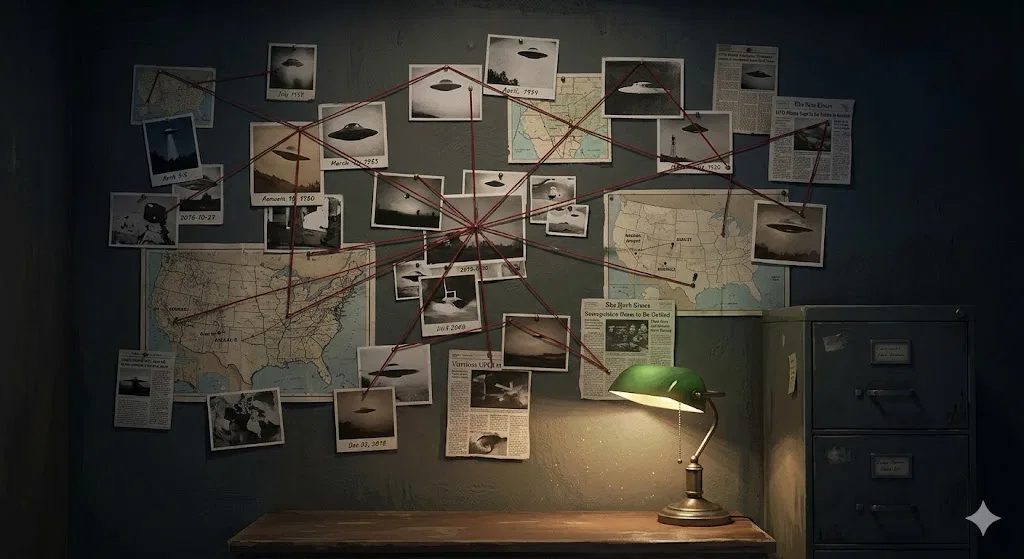
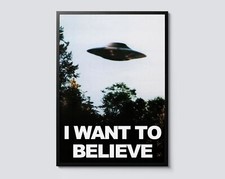
The X-Files changed UFO culture because it made the cover-up feel like the natural habitat of the UFO story. Earlier science fiction had often imagined alien visitors as invaders, explorers or cosmic warnings. Chris Carter’s series placed the greater mystery inside institutions: the FBI basement, military archives, classified laboratories, anonymous informants, sealed files and men in rooms where official truth was quietly manufactured. The show did not invent UFO conspiracy thinking, but it gave it a durable television grammar: “The Truth Is Out There,” “Trust No One,” “Deny Everything,” the “I Want to Believe” poster, and the believer-sceptic pairing of Fox Mulder and Dana Scully. The Smithsonian’s acquisition of X-Files material in 2008 recognised those phrases and props as part of American popular culture, not merely television memorabilia.[Smithsonian Institution]si.eduSmithsonian Institution Smithsonian Wants to Believe!National Museum of…16 Jul 2008 — The “X-Files” main characters and key phrases, including “The Truth Is Out There,” “Trust No One” and…
Its significance within the relationship between UFOs and science fiction is therefore specific. The X-Files did not simply borrow UFO lore; it reorganised it around secrecy. By the 1990s, UFO belief was already entangled with Roswell, Area 51, alleged abductions, Freedom of Information Act searches and distrust after Watergate, Vietnam and Cold War covert operations. The series translated that atmosphere into weekly entertainment. Its risk was also its power: by making suspicion stylish, witty and emotionally satisfying, it helped normalise a way of reading public life in which the absence of evidence can itself seem like evidence of concealment.
Why The X-Files Became the Cover-Up Show
The basic design of The X-Files was unusually well suited to modern UFO mythology. Mulder was not just a man who believed in aliens; he was a federal agent inside the system, convinced that the system was lying. Scully was not just a sceptic; she was a medical doctor and scientist assigned to test, challenge and contain his claims. That structure let the show dramatise the central tension in late twentieth-century UFO culture: the desire to believe and the demand for evidence. The viewer was not asked to choose between a pure crank and a pure rationalist. Instead, the drama came from watching both positions become unstable.
The show’s long-running “mythology” episodes built an alien-government conspiracy across decades of fictional history. In that story world, alien existence, human experimentation, hybridisation, military secrecy and bureaucratic denial were not separate rumours but parts of one hidden architecture. This mattered because much real-world UFO culture had also become accumulative: Roswell, abduction narratives, cattle mutilation claims, Majestic 12 documents, Area 51 rumours and alleged whistle-blowers were repeatedly drawn into one large interpretive frame. David Clarke’s chapter “I want to believe: how UFOs conquered the X-files” places the show directly inside that traffic between UFO folklore and television storytelling.[SHURA]shura.shu.ac.ukSHURA I want to believe: how UFOs conquered the X-filesSHURA I want to believe: how UFOs conquered the X-files
The result was a form of science fiction in which the alien was often less important than the file. A UFO was exciting, but a missing file, a redacted document, an unnamed source or an official denial could be just as dramatic. The monster of the week might be biological, paranormal or technological, but the deeper monster was secrecy itself. This is why The X-Files became more than a show about aliens. It became a show about knowledge under conditions of mistrust.

Conspiracy as Entertainment
The series made conspiracy pleasurable without making it simple. Its appeal lay partly in pattern recognition: a small clue in one episode might connect to a larger plot several seasons later; a background official might turn out to be part of a hidden network; a fragment of testimony might matter more than it first appeared. This rewarded viewers for thinking like investigators. The audience was trained to search for hidden links, to remember unexplained details and to suspect that the official explanation was incomplete.
That was effective television, but it also echoed a broader “popular culture of conspiracy”. Sociologists David Bell and Lee-Jane Bennion-Nixon treated The X-Files as part of a wider turn in which conspiracy became a key popular-culture motif, not merely a fringe political style. Their article’s bibliography places the show alongside work on Jodi Dean’s Aliens in America, Mark Fenster’s Conspiracy Theories: Secrecy and Power in American Culture, Peter Knight’s work on paranoia, and earlier X-Files criticism such as Deny All Knowledge.[Sage Journals]journals.sagepub.comOpen source on sagepub.com.
The show also softened conspiracy through character. Mulder could be obsessive, reckless and wrong in particulars, but he was emotionally legible: his belief was tied to the childhood disappearance of his sister Samantha. Scully’s scepticism was not contempt; it was discipline, professional duty and often moral courage. Their trust in each other gave the conspiracy plot a human centre. A viewer could enjoy paranoid structures without feeling that the show had abandoned emotional realism.
That is one reason the formula became so durable. The conspiracy did not need to be plausible in every detail; it needed to feel narratively coherent. Secret elites, hidden technology, abducted bodies, medical tests, military bases and selective assassinations supplied a vocabulary through which scattered fears could be organised. The pleasure came from the suggestion that confusion itself had a hidden order.
Government Secrecy as Plot Engine
The X-Files worked because it understood secrecy as a machine that produces stories. A direct alien encounter can be dramatic once; a cover-up can generate endless episodes. Every denial, destroyed record, dead witness or compromised superior becomes another turn of the engine. The show’s recurring Cigarette Smoking Man embodied this logic: not a monster from space, but a human official whose power came from access, concealment and plausible deniability.
This reflected a real tension in UFO history. Official investigations have often concluded that they found no evidence of extraterrestrial vehicles, while still leaving a residue of unresolved cases. The US Air Force’s Project Blue Book, for example, concluded that no investigated UFO showed a threat to national security, no submitted evidence demonstrated technology beyond known science, and no “unidentified” sightings were shown to be extraterrestrial vehicles. Its records were later transferred to the US National Archives for public review.[National Archives]archives.govNational Archives Project BLUE BOOKNational Archives Project BLUE BOOK
For sceptics, that kind of conclusion is a reason to lower confidence in alien claims. For cover-up mythology, however, it can be read differently: if records exist, if names are redacted, if some cases remain unidentified, then perhaps the truth has been hidden elsewhere. The X-Files dramatised that interpretive fork. It repeatedly turned institutional gaps into narrative fuel.
The same tension persists in newer UAP discussions. NASA’s public FAQ states that there are no data supporting UAP as evidence of alien technologies, while also stressing that most sightings involve limited data and are difficult to explain scientifically.[NASA Science]science.nasa.govScience UAP FAQsScience UAP FAQs This careful scientific position — “unexplained does not mean extraterrestrial” — is difficult to dramatise. The X-Files chose the more dramatic path: unexplained phenomena usually pointed towards a deeper human secret.
That choice made the show compelling, but it also reveals its cultural risk. In scientific inquiry, missing evidence is a problem to be solved by better observation. In cover-up fiction, missing evidence is often a clue that someone removed it. The two habits of thought can look similar at first — both ask questions, both distrust easy answers — but they lead in different directions.

Why the Formula Felt Believable
The show’s cover-up myth felt believable because it was built from recognisable materials rather than pure fantasy. Viewers did not need to believe in alien colonists to recognise the reality of classified programmes, Cold War secrecy, intelligence abuses, medical scandals, military testing, corporate influence and political lying. The X-Files fused extraordinary UFO claims with ordinary institutional mistrust.
Mark Fenster’s work is useful here because it resists treating all conspiracy theory as merely pathological. His account argues that conspiracy theory is also a cultural practice: a way of narrating politics, power and secrecy, sometimes with democratic or populist impulses and sometimes with dangerous, racist or anti-democratic effects.[SSRN]papers.ssrn.comOpen source on ssrn.com. The X-Files sat exactly in that ambiguous zone. It made suspicion of concentrated power feel morally serious, while also making suspicion itself addictive.
Three features made the show’s UFO conspiracy especially persuasive as fiction:
It mixed official style with gothic atmosphere. The FBI badges, autopsy rooms, classified files and procedural interviews gave the show an institutional texture. The dark corridors, forests, basements and anonymous warehouses gave it mythic dread. The blend let fantasy borrow authority from bureaucracy.
It made scepticism part of the myth rather than its enemy. Scully’s presence meant the viewer heard rational objections inside the story. When she could not fully explain what happened, the mystery felt stronger. The show did not need to defeat scepticism from outside; it absorbed scepticism into the plot.
It used partial revelation. The conspiracy was never simply exposed. It unfolded through fragments, reversals and betrayals. That made the audience’s knowledge feel hard-won, but it also meant the mythology could continually defer proof. In UFO culture, this resembles the way each new alleged document, testimony or disclosure can promise a final revelation that never quite arrives.
The danger is not that viewers automatically become conspiracists after watching. The evidence for a simple one-step persuasion effect is weak. A 2018 peer-reviewed study titled “‘These Are Just Stories, Mulder’” exposed participants to The X-Files material and found no positive persuasive effect on endorsement of conspiracy theories; across two studies, the authors found no evidence that viewing directly increased conspiracy belief, though people with stronger conspiracy mentality tended to enjoy the material more and find it more plausible.[Oxford University Research Archive]ora.ox.ac.ukOpen source on ox.ac.uk.
That finding matters. The cultural effect of The X-Files is better understood as normalisation, vocabulary and emotional rehearsal, not simple brainwashing. The show offered a stylish language for suspicion. People already inclined towards distrust could recognise themselves in Mulder. People inclined towards scepticism could recognise themselves in Scully. The programme’s genius was that both could watch the same episode and feel addressed.
The “Trust No One” Problem
The most memorable slogans of The X-Files were deliberately provocative. “The Truth Is Out There” expresses hope: reality exists, and it may be discoverable. “I Want to Believe” is more vulnerable: belief is not certainty, but desire. “Trust No One” is darker. It turns inquiry into permanent suspicion.
Chris Carter has himself reflected on the change in atmosphere around those slogans. In response to the 2021 US UAP report, Vanity Fair summarised Carter’s New York Times argument as a warning against reading too much into inconclusive UFO material in an era of proliferating conspiracy theories. The article notes Carter’s own contrast between the 1990s, when he thought there was still a more shared reality, and the present, where catchphrases such as “Trust No One” feel less playful and more socially consequential.[Vanity Fair]vanityfair.comOpen source on vanityfair.com.
That is the key critique-risk of the show’s legacy. In the 1990s, the series could treat distrust as cool, lonely, romantic and rebellious. In a later media environment shaped by algorithmic feeds, political disinformation, anti-vaccine movements, QAnon and deep institutional polarisation, the same posture can become more corrosive. The problem is not asking whether governments lie; they sometimes do. The problem is turning suspicion into a total worldview in which every correction is propaganda, every absence is concealment, and every expert is either naive or compromised.
The X-Files was often smarter than that. Scully’s role matters because she prevented the show from becoming pure credulity. Yet the emotional weighting frequently favoured Mulder’s intuition. The show repeatedly made him wrong in detail but right in spirit: the official story was usually incomplete, and hidden forces usually existed. As drama, that is satisfying. As a civic habit, it is risky.
How It Changed UFO Culture
The show helped shift the centre of popular UFO imagination from sightings to systems. Earlier UFO stories often asked, “What did the witness see?” The X-Files made the follow-up question feel just as important: “Who already knows, and why are they hiding it?” That change aligned perfectly with a late twentieth-century UFO culture increasingly built around documents, whistle-blowers, military bases, alleged black projects and hidden archives.
This did not happen in isolation. UFO conspiracy theories were already circulating through books, newsletters, radio, conventions and early internet communities. But The X-Files gave them mainstream style. It placed ideas once associated with fringe subcultures into prime-time television, wrapped in high production values, emotional chemistry and prestige genre storytelling. The Smithsonian’s recognition of the show’s catchphrases and props reflects how thoroughly that imagery entered public memory.[Smithsonian Institution]si.eduSmithsonian Institution Smithsonian Wants to Believe!National Museum of…16 Jul 2008 — The “X-Files” main characters and key phrases, including “The Truth Is Out There,” “Trust No One” and…
The show also changed how later fiction handled mystery. Its influence can be seen in the prestige “mytharc” structure: clues, hidden organisations, internal mythology, coded symbols and season-spanning revelations. In UFO-related storytelling, the alien encounter became less a single event than a gateway into institutions. The crash site, the hangar, the file cabinet, the medical lab and the compromised agency became as iconic as the flying saucer.
For real UFO discourse, the effect is more complicated. The X-Files helped keep public interest alive, but it also made the cover-up frame feel almost automatic. When official bodies now discuss UAP in cautious terms — limited data, unresolved cases, no confirmed alien technology — many listeners receive that language through decades of fiction in which cautious official language was exactly how concealment sounded. NASA’s emphasis on better data and scientific tools therefore competes not only with poor evidence, but with a highly successful cultural script.[NASA Science]science.nasa.govScience UAP FAQsScience UAP FAQs
The Durable Myth
The modern cover-up myth endures because it offers three things at once: mystery, moral clarity and participation. Mystery supplies the unknown object or hidden programme. Moral clarity supplies villains who conceal the truth. Participation invites the audience to investigate, decode and distrust. The X-Files refined that combination better than almost any other science-fiction television series.
Its best defence is that it never presented belief as simple. The Mulder-Scully partnership kept faith and scepticism in conversation. The “I Want to Believe” poster is not the same as “I Know”. It is an image of longing, not proof. That ambiguity is why the show remains richer than many of the conspiracy narratives it helped popularise.
Its sharpest criticism is that longing can outrun evidence. The show’s fictional world rewarded the conviction that secret truth lies behind official reality. In the real world, some secrets are real, some institutions do lie, and some official explanations are incomplete. But that does not make every UFO gap a suppressed revelation. The strongest scientific and archival sources continue to distinguish unresolved observations from evidence of extraterrestrial technology.[National Archives]archives.govNational Archives Project BLUE BOOKNational Archives Project BLUE BOOK
The lasting importance of The X-Files is therefore not that it proved anything about UFOs. It showed how UFO belief could become a modern mythology of secrecy: emotionally compelling, endlessly expandable, institutionally suspicious and perfectly adapted to an age of files, leaks, archives and screens. In the long feedback loop between UFOs and science fiction, The X-Files was the moment when the cover-up became the story.
Amazon book picks
Further Reading
Books and field guides related to How Cover-Up Fiction Changed UFO Culture. Use these as the next step if you want deeper reading beyond the article.
Passport to Magonia
Provides historical context for how UFO narratives evolve into modern myths.
The United States of Paranoia
Explains how conspiracy narratives became embedded in American culture, matching the article's core theme.
eBay marketplace picks
Marketplace Samples
Example marketplace items related to this page. Use the search link to explore similar finds on eBay.
Endnotes
1.
Source: archives.gov
Title: National Archives Project BLUE BOOK
Link:https://www.archives.gov/research/military/air-force/ufos
2.
Source: science.nasa.gov
Title: Science UAP FAQs
Link:https://science.nasa.gov/uap/faqs/
3.
Source: papers.ssrn.com
Link:https://papers.ssrn.com/sol3/papers.cfm?abstract_id=1119378
4.
Source: science.nasa.gov
Title: uap independent study team final report
Link:https://science.nasa.gov/wp-content/uploads/2023/09/uap-independent-study-team-final-report.pdf
5.
Source: science.nasa.gov
Link:https://science.nasa.gov/uap/
6.
Source: archives.gov
Title: project blue book 50th anniversary
Link:https://www.archives.gov/news/articles/project-blue-book-50th-anniversary
7.
Source: fox.com
Link:https://www.fox.com/watch-sitemap-1.xml
8.
Source: ia800109.us.archive.org
Link:https://ia800109.us.archive.org/24/items/conspiracy-theories-michael-butter-peter-knight-routledge-handbook-of-conspiracy/%28Conspiracy%20Theories%29%20Michael%20Butter%2C%20Peter%20Knight%20-%20Routledge%20Handbook%20Of%20Conspiracy%20Theories-Routledge_Taylor%20%26%20Francis%20Group%20%282020%29.pdf
9.
Source: si.edu
Title: Smithsonian Institution Smithsonian Wants to Believe!
Link:https://www.si.edu/newsdesk/releases/smithsonian-wants-believe-national-museum-american-history-acquires-x-files-collection
Source snippet
National Museum of...16 Jul 2008 — The “X-Files” main characters and key phrases, including “The Truth Is Out There,” “Trust No One” and...
10.
Source: shura.shu.ac.uk
Title: SHURA I want to believe: how UFOs conquered the X-files
Link:https://shura.shu.ac.uk/31823/
11.
Source: journals.sagepub.com
Link:https://journals.sagepub.com/doi/pdf/10.1111/j.1467-954X.2000.tb03524.x
12.
Source: ora.ox.ac.uk
Link:https://ora.ox.ac.uk/objects/uuid%3A64b07192-fe13-41e4-8723-f44a46563870
13.
Source: vanityfair.com
Link:https://www.vanityfair.com/hollywood/2021/06/x-files-creator-wants-you-to-chill-out-on-the-conspiracy-theories
14.
Source: Wikipedia
Title: UFO conspiracy theories
Link:https://en.wikipedia.org/wiki/UFO_conspiracy_theories
15.
Source: Wikipedia
Title: Project Blue Book
Link:https://en.wikipedia.org/wiki/Project_Blue_Book
16.
Source: Wikipedia
Title: Dana Scully
Link:https://en.wikipedia.org/wiki/Dana_Scully
17.
Source: Wikipedia
Title: Fox Mulder
Link:https://en.wikipedia.org/wiki/Fox_Mulder
18.
Source: shura.shu.ac.uk
Title: Clarke Want To Believe(AM)
Link:https://shura.shu.ac.uk/31823/9/Clarke-WantToBelieve%28AM%29.pdf
19.
Source: si.edu
Title: will real uncle sam please stand
Link:https://www.si.edu/sidedoor/will-real-uncle-sam-please-stand
20.
Source: journals.sagepub.com
Link:https://journals.sagepub.com/doi/10.1177/1527476417742974
21.
Source: aph.gov.au
Title: Preliminary Assessment UAP 20210625
Link:https://www.aph.gov.au/-/media/Estimates/fadt/supp2122/add_info/Preliminary-Assessment-UAP-20210625.pdf
22.
Source: x-files.fandom.com
Title: Fox Mulder
Link:https://x-files.fandom.com/wiki/Fox_Mulder
23.
Source: cdn.nationalarchives.gov.uk
Link:https://cdn.nationalarchives.gov.uk/documents/briefing-guide-12-07-12.pdf
24.
Source: britannica.com
Title: Project Blue Book
Link:https://www.britannica.com/topic/Project-Blue-Book
25.
Source: vanityfair.com
Title: x files creator wants you to chill out on the conspiracy theories
Link:https://www.vanityfair.com/hollywood/2021/06/x-files-creator-wants-you-to-chill-out-on-the-conspiracy-theories?srsltid=AfmBOoqJfZd2BCdRk1p942wScHLdDaW3p3h-Ysimwn2gx4uoJP72ehVc
26.
Source: skyatnightmagazine.com
Title: area 51
Link:https://www.skyatnightmagazine.com/space-science/area-51
27.
Source: authorcarlara.com
Title: The X-Files
Link:https://www.authorcarlara.com/post/the-x-files
Additional References
28.
Source: dni.gov
Link:https://www.dni.gov/index.php/newsroom/reports-publications/reports-publications-2021/3550-preliminary-assessment-unidentified-aerial-phenomena
29.
Source: nsa.gov
Link:https://www.nsa.gov/portals/75/documents/news-features/declassified-documents/ufo/usaf_fact_sheet_95_03.pdf
30.
Source: science.gov
Link:https://www.science.gov/topicpages/s/syndrome%2Bfosters%2Bconspiracy
31.
Source: youtube.com
Title: The X-Files Mythology All Makes Perfect Sense, Actually
Link:https://www.youtube.com/watch?v=LYQ0Um9VlhM
Source snippet
Chris Carter and David Duchovny Reflect on The X-Files and More...
32.
Source: youtube.com
Title: Chris Carter and David Duchovny Reflect on The X-Files and More
Link:https://www.youtube.com/watch?v=4JsP84Kzz3k
Source snippet
The X-Files: Implanted Memories (Documentary)...
33.
Source: youtube.com
Link:https://www.youtube.com/watch?v=fSCo8bh77P0
Source snippet
The X-Files: The Lone Gunmen (Documentary)...
34.
Source: youtube.com
Title: The X-Files: Implanted Memories (Documentary)
Link:https://www.youtube.com/watch?v=V-SA61fWg3c
Source snippet
Chris Carter interview on X-Files and The Lone Gunmen (2001)...
35.
Source: medium.com
Link:https://medium.com/dans-media-digest/the-x-files-re-examined-1x1-pilot-fc59acba5562
36.
Source: researchgate.net
Link:https://www.researchgate.net/publication/374373111_UFOs_and_Unidentified_Anomalous_Phenomena_The_NASA_report_1492023_has_found_no_evidence_to_suggest_that_UAPs_are_extraterrestrial_in_origin
37.
Source: archivesfoundation.org
Link:https://archivesfoundation.org/documents/50-years-ago-government-stops-investigating-ufos/
Topic Tree