Within Saucer Shape
Why UFO Toys Still Look Like Saucers
Saucer toys endured because the shape was cheap to manufacture, easy to recognise, and visually playful.
On this page
- Why symmetry helped toy makers
- How lights domes and aliens sold the fantasy
- Why other UFO shapes made weaker toys
Page outline Jump by section
Introduction
The flying saucer survived in toy shops long after many supposedly more realistic UFO designs faded because it was an unusually effective commercial shape. A saucer could be recognised instantly, moulded cheaply in plastic, decorated with a few lights and a dome, and understood by children without explanation. While science-fiction films and UFO enthusiasts experimented with triangles, cylinders, spheres and other craft designs, toy makers kept returning to the disc because it was simple, playful and visually iconic. The result was that the saucer stopped being merely a reported UFO shape and became a consumer product in its own right, appearing in toys, models, novelty lamps, signs, lunch boxes and amusement-park attractions. The shape endured not because it matched every UFO claim, but because it worked exceptionally well as a piece of design.[Ultimate Pop Culture]ultimatepopculture.fandom.comUltimate Pop Culture Flying saucer | Ultimate Pop Culture Wiki | FandomUltimate Pop Culture Flying saucer | Ultimate Pop Culture Wiki | Fandom
Why Symmetry Helped Toy Makers
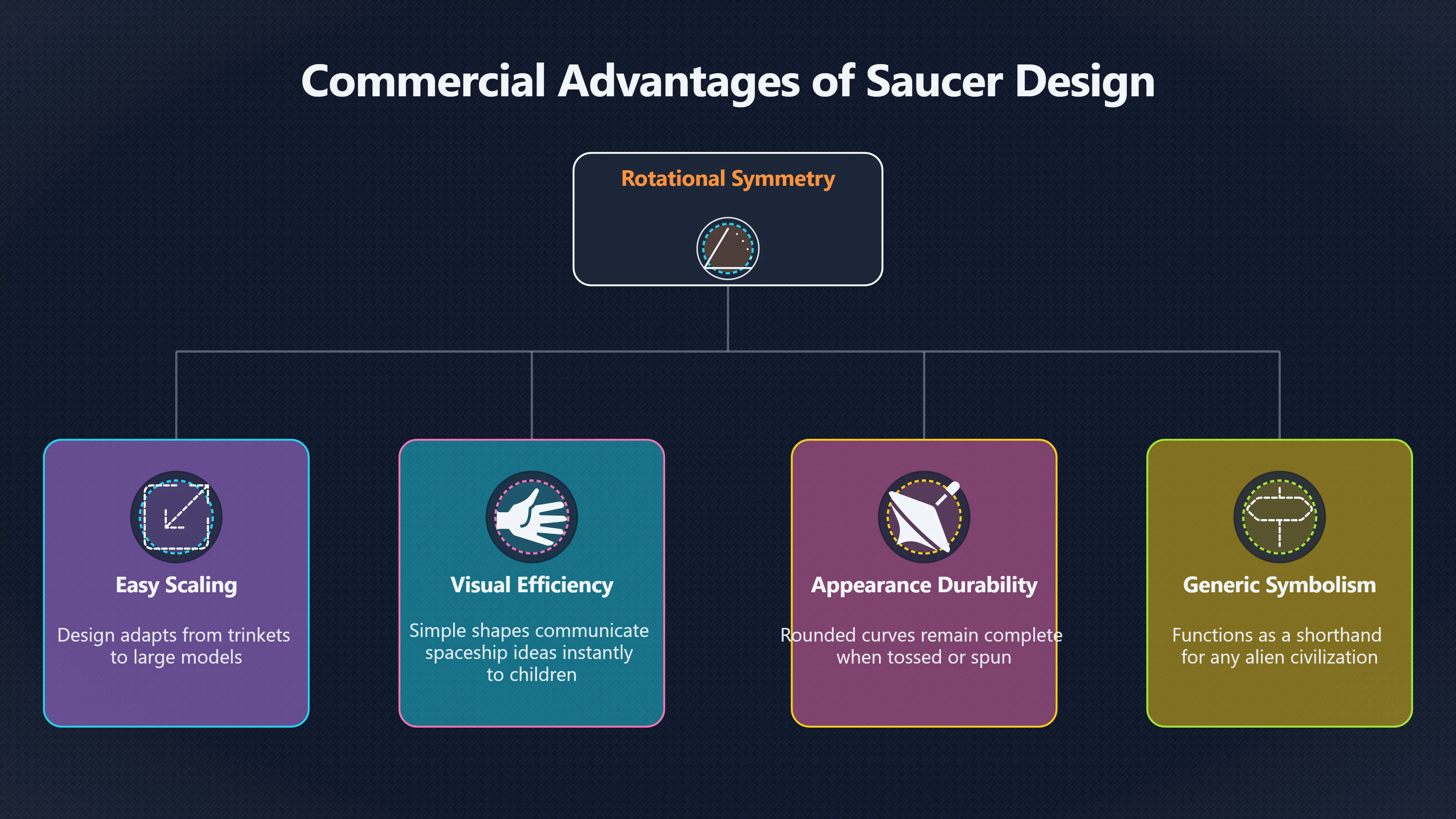
The classic saucer offered manufacturers a practical advantage that many alternative UFO shapes lacked: rotational symmetry. A circular disc can be moulded from relatively simple parts, assembled quickly and viewed from any angle without looking wrong. For inexpensive mass-market toys, this mattered.
A saucer also scaled easily. The same basic design could appear as:
- A pocket-sized plastic trinket.
- A model kit.
- A spinning flying toy.
- A battery-powered novelty with flashing lights.
- A decorative sign or ornament.
Designers did not need to explain what the object represented. A child could draw a circle with a dome and immediately communicate “spaceship” or “alien craft”. Few other UFO shapes achieved the same visual efficiency.
The commercial value of that instant recognition grew from the wider cultural success of the “flying saucer” image that emerged after the 1947 UFO wave. Even though witness reports described many different forms, the public increasingly associated UFOs with a simple disc silhouette.[time.com]time.comThis Is Why People Think UFOs Look Like 'Flying Saucers'OnThe fascination grew to include an incident on July 7, when a New Mexico rancher found what was initially thought to be a crashed flying…
Another advantage was durability of appearance. Triangular craft, rocket-like vehicles or highly detailed science-fiction ships often depended on a specific orientation. A saucer looked complete whether viewed from the side, above or below. That made it forgiving as a toy, especially when tossed, spun or displayed.
How Lights, Domes and Aliens Sold the Fantasy
Toy companies rarely sold a saucer as a mysterious aerial phenomenon. They sold a fantasy package built around recognisable visual cues.
The basic disc became a platform for features that immediately suggested extraterrestrial adventure:
- A transparent dome hinted at alien pilots.
- Rings of coloured lights suggested advanced technology.
- Metallic finishes implied futuristic materials.
- Small green alien figures provided characters and stories.
These additions were inexpensive but powerful. A child did not need detailed knowledge of UFO lore to understand the narrative. The toy itself communicated the idea of visitors from another world.
This visual language also connected smoothly with decades of science-fiction films, television programmes, comic books and advertising. Once audiences repeatedly saw saucers paired with aliens, the shape became shorthand for extraterrestrial life. A toy company could therefore rely on a shared cultural vocabulary instead of creating an entirely new design identity.[Ultimate Pop Culture]ultimatepopculture.fandom.comUltimate Pop Culture Flying saucer | Ultimate Pop Culture Wiki | FandomUltimate Pop Culture Flying saucer | Ultimate Pop Culture Wiki | Fandom
Importantly, the saucer balanced mystery with friendliness. Many serious UFO depictions aimed to look technological, secretive or even threatening. Toys generally benefit from appearing playful. The rounded disc, smooth curves and glowing lights softened the concept and made it suitable for children’s products.

Why Other UFO Shapes Made Weaker Toys
Many alternative UFO forms appeared in reports, books and science-fiction stories, but they often lacked the advantages that made saucers commercially resilient.
Triangles and military-looking craft
Large black triangles became prominent in some later UFO discussions, yet they resembled experimental aircraft or stealth technology more than fantasy vehicles. Their sharp angles and dark appearance could seem less playful and less distinctive on a toy shelf. A black triangle without context often looked like an aeroplane rather than an alien craft.
Cylinders, cigars and spheres
These shapes appeared in numerous UFO accounts, but they lacked strong visual personality. A sphere could resemble a ball. A cylinder might look like a rocket component. Neither immediately communicated “alien spaceship” as effectively as a domed disc.
Detailed science-fiction starships
Film and television franchises produced countless memorable spacecraft, but highly detailed designs often belonged to specific fictional universes. Their popularity depended on continued audience attachment to a particular story. The saucer, by contrast, functioned as a generic symbol. It could represent any alien civilisation, any mystery and any science-fiction adventure.
That flexibility helped it survive changing trends. Even when new spacecraft designs became fashionable, the saucer remained the easiest visual shorthand for UFOs in general.
From UFO Report to Consumer Icon
The lasting success of saucer toys reveals a broader relationship between UFO culture and science fiction. The disc shape gradually detached itself from the original reports that inspired it and became a cultural symbol. As the image spread through media, it gained commercial advantages that reinforced its survival.
A toy manufacturer did not need to ask whether a saucer reflected actual witness descriptions. The important question was whether customers recognised it. Because the answer was usually yes, the shape continued to appear in products decade after decade.
That commercial durability explains why toy aisles, souvenir shops and novelty catalogues often preserved the classic saucer long after public discussions of UFOs had diversified into many other forms. The saucer was not merely a UFO shape anymore. It had become one of popular culture’s most efficient and recognisable visual brands.

Amazon book picks
Further Reading
Books and field guides related to Why UFO Toys Still Look Like Saucers. Use these as the next step if you want deeper reading beyond the article.
The UFO Experience
Explains how the flying saucer became embedded in public understanding of UFOs and popular culture.
American Cosmic
Explores how UFO imagery and beliefs become cultural products, helping explain why saucer imagery persists in toys and merchandise.
The Flying Saucers are Real
Captures the era that cemented the saucer as the iconic UFO shape.
Passport to Magonia
Connects flying saucer imagery to broader folklore traditions and cultural storytelling.
eBay marketplace picks
Marketplace Samples
Example marketplace items related to this page. Use the search link to explore similar finds on eBay.
Endnotes
1.
Source: time.com
Title: This Is Why People Think UFOs Look Like ‘Flying Saucers’On
Link:https://time.com/3930602/first-reported-ufo/
Source snippet
The fascination grew to include an incident on July 7, when a New Mexico rancher found what was initially thought to be a crashed flying...
2.
Source: ultimatepopculture.fandom.com
Title: Ultimate Pop Culture Flying saucer | Ultimate Pop Culture Wiki | Fandom
Link:https://ultimatepopculture.fandom.com/wiki/Flying_saucer
3.
Source: en-academic.com
Title: Academic Dictionaries and Encyclopedias Flying saucer
Link:https://en-academic.com/dic.nsf/enwiki/7231124
4.
Source: turtledove.fandom.com
Title: Flying saucer | Turtledove | Fandom
Link:https://turtledove.fandom.com/wiki/Flying_saucer
Additional References
5.
Source: backthenhistory.com
Title: www.backthenhistory.com The History of the Frisbee | Back Then History
Link:https://www.backthenhistory.com/articles/the-history-of-the-frisbee
Source snippet
History of the Frisbee | Back Then HistoryDecember 8, 2020...
Published: December 8, 2020
6.
Source: britannica.com
Title: www.britannica.com [Unidentified]({{ ‘unidentified/’ | relative_url }}) Flying Objects: What We Know | Britannica
Link:https://www.britannica.com/story/unidentified-flying-objects-what-we-know
Source snippet
Flying Objects: What We Know | Britannica...
7.
Source: youtube.com
Link:https://www.youtube.com/watch?v=bf8E1VD_3Cc
Source snippet
UFO? Flying Saucer?... Reflex by Parker Brothers...
8.
Source: britannica.com
Link:https://www.britannica.com/question/What-are-some-common-shapes-or-features-people-report-seeing-in-UFOs
9.
Source: youtube.com
Title: Cool UFO Toys from the 60s, 70s, 80s & 90s!
Link:https://www.youtube.com/watch?v=GXbeV3CWnJM
Source snippet
Vintage 1965 Sky Patrol Flying Saucer made in Japan...
10.
Source: youtube.com
Title: Britains Forgotten Space Toys | Ashens
Link:https://www.youtube.com/watch?v=KFTeZebWs7o
Source snippet
The Mysterious Genius Who Patented the UFO...
11.
Source: youtube.com
Link:https://www.youtube.com/watch?v=r-abMdD_NIQ
Source snippet
Britains Forgotten Space Toys | Ashens...
12.
Source: softschools.com
Title: www.softschools.com Frisbee
Link:https://www.softschools.com/inventions/history/frisbee_history/375/
Source snippet
History of Frisbee...
13.
Source: youtube.com
Title: The Mysterious Genius Who Patented the UFO
Link:https://www.youtube.com/watch?v=xCr2mqR3VN4
Topic Tree