Within Arnold Sighting
Did the Saucer Label Change Sightings?
Once 'flying saucer' entered everyday language, it gave later witnesses a ready-made way to notice and describe the sky.
On this page
- How labels organize perception
- Similar reports after June 1947
- Why feedback loops matter in UFO history
Page outline Jump by section
Introduction
Did the phrase “flying saucer” change what people later reported seeing in the sky? Many historians of UFO culture think it did. The key argument is not that witnesses invented their experiences, but that once a vivid label entered public language it provided a ready-made template for interpreting unusual sights. After Kenneth Arnold’s 1947 report was transformed into the widely repeated phrase “flying saucer”, Americans suddenly had a common image for mysterious aerial objects. Reports of disc-like craft multiplied, and the saucer became the default visual symbol of the UFO age. Historians of journalism, culture and UFO belief often describe this as a feedback loop: reports created an image, the image shaped expectations, and those expectations influenced later reports.[uky.edu]scholars.uky.edujournalism versus the flying saucers assessing the first generatiUniversity of KentuckyJournalism versus the flying saucers: Assessing the first generation of UFO reportage, 1947–1967 - University of Ke…

How Labels Organise Perception
Human beings do not observe the world as blank slates. Psychologists have long noted that language helps people classify and interpret ambiguous experiences. A label can act as a mental shortcut, making certain features stand out while pushing others into the background.
The “flying saucer” label offered exactly such a shortcut. Arnold’s own descriptions were more complicated than the later stereotype. Yet once newspapers popularised the saucer image, witnesses encountering distant lights, reflections, aircraft or unexplained objects had an easy comparison available. Instead of describing an object from scratch, they could say it looked like a saucer, disc or flying plate.[markfox.co.uk]markfox.co.ukMark Fox | Exploring the extraordinaryUFOs and UAPs in the RERC Archive: An Analysis of Twenty-One Unpublished Cases | Mark FoxJuly 28, 2023…
This mattered because many aerial observations are inherently uncertain. Observers often see objects briefly, at a distance, without clear size or reference points. In such situations, familiar cultural categories help organise perception. The saucer label therefore functioned not merely as a description but as a framework for noticing and reporting unusual events.[University of Kentucky]scholars.uky.edujournalism versus the flying saucers assessing the first generatiUniversity of KentuckyJournalism versus the flying saucers: Assessing the first generation of UFO reportage, 1947–1967 - University of Ke…
Within the broader relationship between UFOs and science fiction, the process is especially important. Science-fiction magazines, films and illustrations already featured futuristic vehicles and exotic technologies. Once “flying saucer” became a household term, it linked ambiguous real-world observations to a growing stock of imagined spacecraft. The boundary between observation and cultural expectation became more porous.[University of Kentucky]scholars.uky.edujournalism versus the flying saucers assessing the first generatiUniversity of KentuckyJournalism versus the flying saucers: Assessing the first generation of UFO reportage, 1947–1967 - University of Ke…
Why So Many Similar Reports Appeared After June 1947
One of the most striking features of UFO history is how rapidly saucer-shaped reports spread after Arnold’s sighting received national attention.
Contemporary accounts and later historical summaries note that hundreds of reports followed within weeks. Many of these described objects that were circular, disc-like or saucer-shaped, even though Arnold himself did not provide the neat disc image that later dominated popular culture.[wikipedia.org]WikipediaKenneth Arnold UFO sightingKenneth Arnold UFO sighting
Several mechanisms may explain this pattern:
- Shared vocabulary: Witnesses suddenly possessed a widely understood term for unusual aerial phenomena.
- Selective attention: People became more likely to notice odd lights or aircraft because newspapers were discussing them daily.
- Memory shaping: When recounting a confusing event, witnesses could fit details into the familiar saucer framework.
- Reporting incentives: Journalists often highlighted saucer-like elements because they matched the established story and attracted readers.[uky.edu]scholars.uky.edujournalism versus the flying saucers assessing the first generatiUniversity of KentuckyJournalism versus the flying saucers: Assessing the first generation of UFO reportage, 1947–1967 - University of Ke…
The result was a degree of standardisation. Before 1947, strange aerial reports existed but lacked a single dominant image. After the saucer label spread, many reports converged on a recognisable shape. Researchers examining later UFO archives frequently note the recurring use of terms such as “saucer”, “disc” and “round object”, even though many other shapes continued to be reported.[Mark Fox | Exploring the extraordinary]markfox.co.ukMark Fox | Exploring the extraordinaryUFOs and UAPs in the RERC Archive: An Analysis of Twenty-One Unpublished Cases | Mark FoxJuly 28, 2023…

The Witness Loop in Action
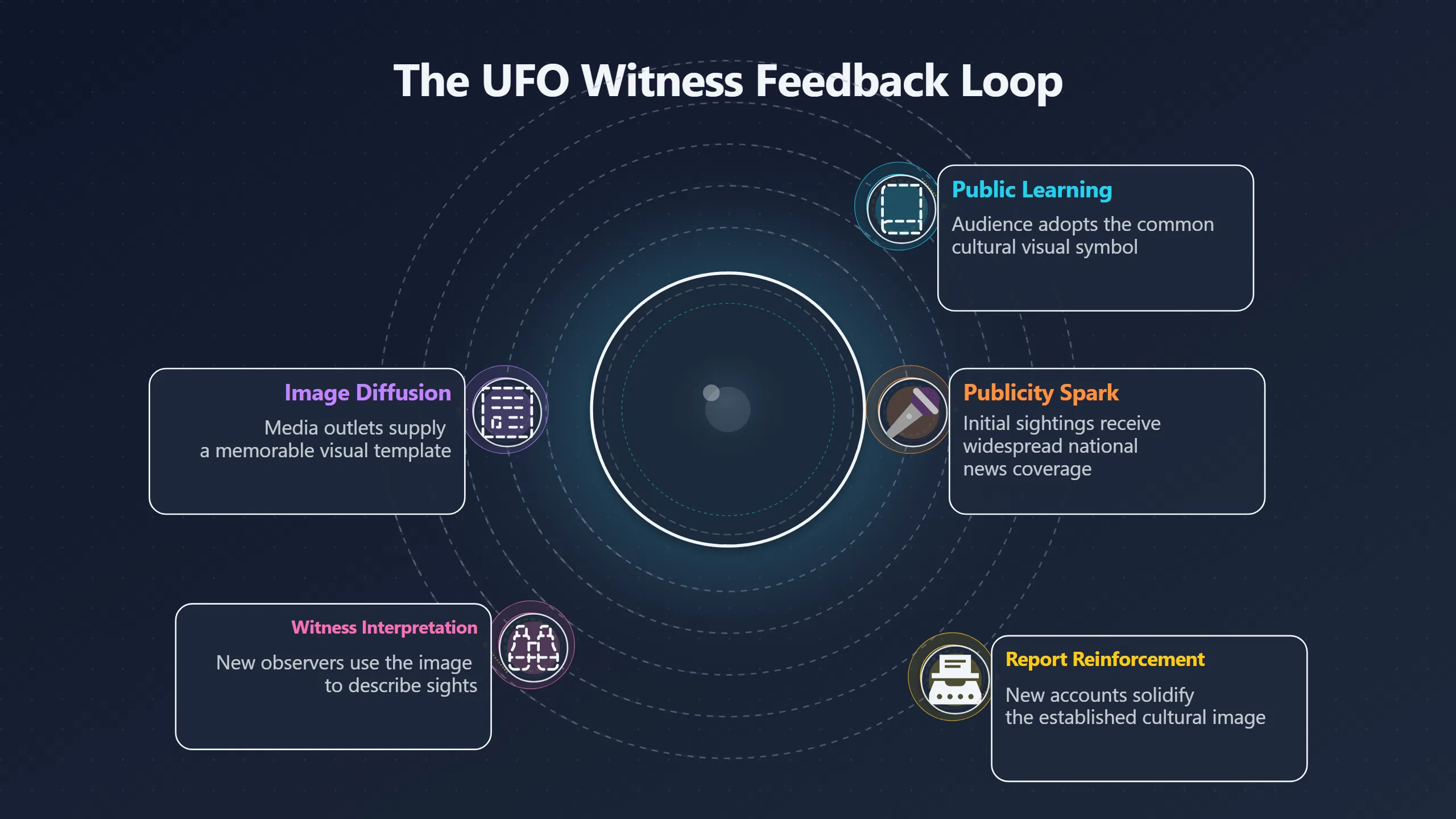
The feedback process can be imagined as a simple cycle.
- A sighting receives publicity.
- Media coverage supplies a memorable image.
- The public learns that image.
- New witnesses use the image when interpreting unusual observations.
- Their reports reinforce the image for the next audience.
This does not require fraud or deliberate invention. A witness may genuinely report what seems most consistent with an uncertain visual experience. The important point is that perception and description are influenced by available cultural categories.[University of Kentucky]scholars.uky.edujournalism versus the flying saucers assessing the first generatiUniversity of KentuckyJournalism versus the flying saucers: Assessing the first generation of UFO reportage, 1947–1967 - University of Ke…
The extraordinary public awareness of flying saucers illustrates how powerful the cycle became. Surveys discussed in the Condon Report found that awareness of the term reached remarkably high levels in the United States. Within months of the original reports, the subject was already known to the overwhelming majority of adults, providing a common language through which later experiences could be interpreted.[NCAS Files]files.ncas.orgFiles Condon Report, Section IINCAS FilesCondon Report, Section II: Summary of the Study…
Once such a vocabulary becomes widespread, witnesses do not merely report a phenomenon; they report it through a pre-existing cultural lens.
Why Feedback Loops Matter in UFO History
The significance of the saucer label extends beyond one phrase. It offers a model for understanding how UFO traditions evolve.
Historians increasingly emphasise that UFO culture developed through interaction between witnesses, journalists, investigators, popular entertainment and science-fiction imagery. The press did not simply record reports; it helped create the categories through which reports were understood. Scholars of UFO journalism argue that news organisations played a central role in establishing and perpetuating the flying-saucer image, often blurring the line between reporting and popular entertainment.[University of Kentucky]scholars.uky.edujournalism versus the flying saucers assessing the first generatiUniversity of KentuckyJournalism versus the flying saucers: Assessing the first generation of UFO reportage, 1947–1967 - University of Ke…
This perspective also helps explain why UFO descriptions change over time. Different eras emphasise different images. The classic metallic saucer became dominant after 1947, while later decades added new motifs such as triangular craft, black helicopters and technologically sophisticated unidentified aerial phenomena. In each case, widely circulated images provided witnesses with interpretive frameworks.[Mark Fox | Exploring the extraordinary]markfox.co.ukMark Fox | Exploring the extraordinaryUFOs and UAPs in the RERC Archive: An Analysis of Twenty-One Unpublished Cases | Mark FoxJuly 28, 2023…
The enduring lesson of the “flying saucer” is therefore not simply that a famous label was born. It is that language can shape observation. Once the saucer entered everyday speech, it gave generations of witnesses a common way to notice, remember and describe mysterious things in the sky. That witness loop became one of the defining mechanisms through which modern UFO culture—and its close relationship with science-fiction imagery—developed.[uky.edu]scholars.uky.edujournalism versus the flying saucers assessing the first generatiUniversity of KentuckyJournalism versus the flying saucers: Assessing the first generation of UFO reportage, 1947–1967 - University of Ke…
Amazon book picks
Further Reading
Books and field guides related to Relationships betwee d7372c kenneth arnold sauce 924867 saucer witness feedb b199fc. Use these as the next step if you want deeper reading beyond the article.

UFOs : Generals, Pilots, and Government Officials Go on the R...
Provides real-world cases that illustrate witness interpretation issues.
eBay marketplace picks
Marketplace Samples
Example marketplace items related to this page. Use the search link to explore similar finds on eBay.
Endnotes
1.
Source: wired.com
Title: how ufo sightings became an american obsession
Link:https://www.wired.com/story/how-ufo-sightings-became-an-american-obsession
Source snippet
The period following his sighting saw a surge in UFO sightings across the U.S. This surge, or "flap," is linked to societal fears of inva...
3.
Source: markfox.co.uk
Link:https://markfox.co.uk/spirituality/ufos-and-uaps-in-the-rerc-archive-an-analysis-of-twenty-one-unpublished-cases/
Source snippet
Mark Fox | Exploring the extraordinaryUFOs and UAPs in the RERC Archive: An Analysis of Twenty-One Unpublished Cases | Mark FoxJuly 28, 2023...
Published: July 28, 2023
4.
Source: reddit.com
Title: Where did the classic concept of UFOs originate?
Link:https://www.reddit.com/r/AskHistorians/comments/kfg9c6
Source snippet
Where did the classic concept of UFOs originate?...
5.
Source: history.com
Title: Kenneth Arnold
Link:https://www.history.com/topics/folklore/kenneth-arnold
Source snippet
Kenneth Arnold - UFO, 1947 & Flying Saucer | HISTORY...
6.
Source: Wikipedia
Title: Kenneth Arnold UFO sighting
Link:https://en.wikipedia.org/wiki/Kenneth_Arnold_UFO_sighting
7.
Source: wired.com
Title: 0624first flying saucer sighting
Link:https://www.wired.com/2011/06/0624first-flying-saucer-sighting
Source snippet
Outer Space?On June 24, 1947, pilot Kenneth Arnold sighted a series of unidentified flying objects near Mount Rainier, Washington, markin...
Published: June 24, 1947
8.
Source: files.ncas.org
Title: Files Condon Report, Section II
Link:https://files.ncas.org/condon/text/sec-ii.htm
Source snippet
NCAS FilesCondon Report, Section II: Summary of the Study...
9.
Source: reddit.com
Link:https://www.reddit.com/r/UFOs/comments/sxc5xl
Source snippet
proof that the concept of extraterrestrial flying saucers preceded the Kenneth Arnold UFO sighting in 1947February 20, 2022...
Published: February 20, 2022
10.
Source: scholars.uky.edu
Title: journalism versus the flying saucers assessing the first generati
Link:https://scholars.uky.edu/en/publications/journalism-versus-the-flying-saucers-assessing-the-first-generati/
Source snippet
University of KentuckyJournalism versus the flying saucers: Assessing the first generation of UFO reportage, 1947–1967 - University of Ke...
Additional References
11.
Source: space.com
Title: www.space.com Flying Saucers Turn 64! A Look Back at the Origin of UFOs | Space
Link:https://www.space.com/12066-flying-saucers-turn-64-ufos-origins.html
Source snippet
Saucers Turn 64! A Look Back at the Origin of UFOs | SpaceJune 23, 2011...
Published: June 23, 2011
12.
Source: youtube.com
Title: Kenneth Arnold UFO Sighting The First UFOs
Link:https://www.youtube.com/watch?v=xLuHgsXGpqc
Source snippet
Ep. 2 | Flying Saucer UFOs | [Roswell]({{ 'roswell/' | relative_url }}), Kenneth Arnold, McMinnville, Rex Heflin | The Basement Office...
13.
Source: airandspaceforces.com
Title: www.airandspaceforces.com USA F and the UFOs | Air & Space Forces Magazine
Link:https://www.airandspaceforces.com/article/0611ufo/
Source snippet
and the UFOs | Air & Space Forces MagazineJune 1, 2011...
Published: June 1, 2011
14.
Source: youtube.com
Link:https://www.youtube.com/watch?v=z25NfZ0Ea9c
Source snippet
Wilhelm Reich versus The Flying Saucers with James Reich...
15.
Source: en.wikisource.org
Title: The Report on Unidentified Flying Objects/Chapter 1
Link:https://en.wikisource.org/wiki/The_Report_on_Unidentified_Flying_Objects/Chapter_1
Source snippet
Wikisource, the free online library...
16.
Source: frontier.watch
Title: war.gov UFO Release 01 — 162 docs, fully transcribed — frontier.watch
Link:https://frontier.watch/ufo/release-1/doc/38_143685_box7_incident_summaries
17.
Source: youtube.com
Title: Wilhelm Reich versus The Flying Saucers with James Reich
Link:https://www.youtube.com/watch?v=IK5d6dzbhm8
18.
Source: project1947.com
Link:https://www.project1947.com/fig/projsauc.htm
Source snippet
1947 - 1949: PROJECT SAUCERApril 27, 1949...
Published: April 27, 1949
Topic Tree