Within Radio Rumors
When Repetition Started Sounding Like Proof
Repetition made early UFO reports feel corroborated even when similarity came from the media label rather than the sightings.
On this page
- Why repetition is not verification
- How headlines made different sightings look alike
- How witnesses adopted saucer like language
Page outline Jump by section
Introduction
In the first years of the flying saucer era, repeated reports often felt like evidence in themselves. If dozens of people in different towns claimed to have seen “flying saucers”, it seemed reasonable to conclude that something real must be behind the stories. Yet repetition and verification are not the same thing. A key mechanism in early UFO culture was that reports became linked by a shared label, even when the original sightings were vague, inconsistent or potentially unrelated.
 This mattered because UFO belief developed alongside mass media and science-fiction imagery. Once newspapers, radio broadcasts and wire services began using the phrase “flying saucer”, new observations were interpreted through that framework. Repetition created the impression of independent confirmation, while the reports themselves often shared little more than a common name.[National Air and Space Museum]airandspace.si.edu1947 year flying saucerNational Air and Space Museum1947: Year of the Flying Saucer | National Air and Space MuseumJune 24, 2022…
Why Repetition Is Not Verification
When people hear the same claim repeatedly, they often treat familiarity as a sign of reliability. In the 1947 saucer wave, this effect operated on a national scale.
A genuine corroboration requires multiple observations that independently point to the same event or object. Early saucer reports rarely met that standard. Witnesses were usually describing different objects, seen in different places, under different conditions. What linked them was not necessarily the phenomenon itself but the language used to describe it.
The distinction is important. If one pilot reports an unusual object and a second pilot independently observes the same object, the two reports can strengthen each other. But if hundreds of people report different lights, aircraft, reflections or unexplained aerial events after hearing about “flying saucers” in the news, the growing number of reports does not automatically confirm a single explanation.
The early UFO wave blurred this distinction. As reports accumulated, many people interpreted quantity as quality. The growing pile of stories appeared to function as evidence even though the reports were often disconnected from one another. This gave UFO culture an appearance of self-confirmation: each new sighting seemed to validate earlier sightings simply because it resembled them in name.[National Air and Space Museum]airandspace.si.edu1947 year flying saucerNational Air and Space Museum1947: Year of the Flying Saucer | National Air and Space MuseumJune 24, 2022…
How Headlines Made Different Sightings Look Alike
The transformation began almost immediately after Kenneth Arnold’s famous 1947 sighting.[youtube.com]youtube.comWhere Did The Term 'Flying Saucer' Come From? | Mossback's NorthwestKenneth Arnold UFO Sighting, 1947…
Arnold later insisted that he had not originally described the objects as literal saucers. According to historical accounts, he compared their motion to saucers skipping across water. Newspaper and wire-service reports quickly condensed this description into the more vivid image of “flying saucers”. Within a day, the phrase had spread nationwide through press syndication and radio coverage.[National Air and Space Museum]airandspace.si.edu1947 year flying saucerNational Air and Space Museum1947: Year of the Flying Saucer | National Air and Space MuseumJune 24, 2022…
This seemingly small change had large consequences.
Once editors had a memorable label, reports that might otherwise have appeared unrelated could be grouped together under a single category. Headlines encouraged readers to see a pattern before they examined the details. A bright light, an unusual aircraft shape, a distant reflection or a fleeting aerial object could all become another “flying saucer” story.
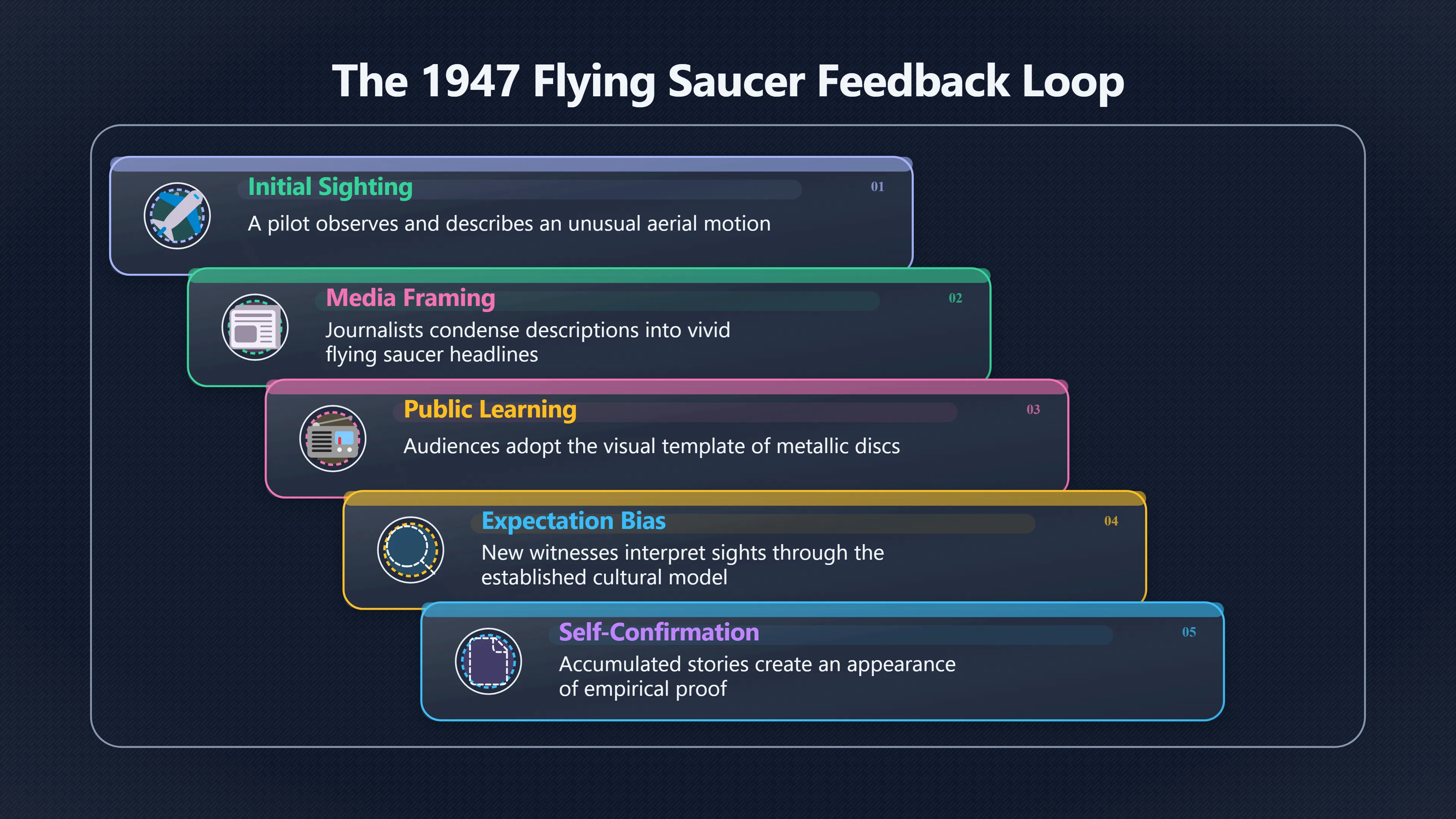
The result was a feedback loop:

- A strange sighting was reported. 2. Journalists framed it as a flying saucer report.[airandspace.si.edu]airandspace.si.edu1947 year flying saucerNational Air and Space Museum1947: Year of the Flying Saucer | National Air and Space MuseumJune 24, 2022… 3. Audiences learned what a flying saucer supposedly looked like.[airandspace.si.edu]airandspace.si.edu1947 year flying saucerNational Air and Space Museum1947: Year of the Flying Saucer | National Air and Space MuseumJune 24, 2022…
- New sightings were interpreted through that expectation.
- Additional reports reinforced the impression that the original reports had been correct.
The similarity therefore existed partly at the level of media presentation. Reports appeared more consistent than they actually were because newspapers and radio programmes translated diverse observations into the same familiar category.[National Air and Space Museum]airandspace.si.edu1947 year flying saucerNational Air and Space Museum1947: Year of the Flying Saucer | National Air and Space MuseumJune 24, 2022…
How Witnesses Adopted Saucer-Like Language
Media influence did not stop with headlines. It also affected how witnesses described their own experiences.
People rarely observe unusual events in a conceptual vacuum. When confronted with something unexpected, they rely on existing cultural models to explain what they saw. In 1947 and the years that followed, “flying saucer” became one of those models.
A witness who saw an indistinct object might previously have described it as a light, a disc, a flash or an unknown aircraft. After the term entered popular culture, the same witness had a ready-made description available. The label carried visual expectations: metallic discs, circular craft and advanced machines moving at extraordinary speed.
This process did not require dishonesty. Witnesses could sincerely report what they believed they had seen. The influence occurred at the level of interpretation and memory. Once a cultural template existed, observations were more likely to be organised around that template.
The mechanism resembled the way science-fiction imagery spread through mid-twentieth-century culture. Magazine covers, radio dramas and popular stories had already familiarised audiences with advanced vehicles from other worlds. When the phrase “flying saucer” arrived, it connected real-world reports to images that many people already recognised. As a result, later sightings often sounded increasingly alike even when the underlying experiences may have differed.[National Air and Space Museum]airandspace.si.edu1947 year flying saucerNational Air and Space Museum1947: Year of the Flying Saucer | National Air and Space MuseumJune 24, 2022…
Why the Pattern Was So Persuasive
The persuasive power of repeated saucer reports came from a combination of factors rather than any single dramatic piece of evidence.
- Reports appeared to come from independent witnesses.
- Radio and newspaper networks spread stories rapidly across large distances.
- A simple, memorable label made different accounts seem related.
- Witnesses increasingly described unusual sights using the same vocabulary.
- The growing number of reports created an impression of accumulating proof.
To many observers, this looked like corroboration. If thousands of people were reporting flying saucers, surely something must be there. Yet the apparent agreement often reflected a shared cultural framework as much as a shared observation.
That mechanism helps explain why early UFO culture expanded so quickly. Repetition generated credibility, credibility encouraged more reports, and those reports in turn reinforced the sense that the phenomenon had already been established. Within the wider relationship between UFOs and science fiction, this was one of the most important ways a media-created image acquired the appearance of empirical confirmation.[si.edu]airandspace.si.edu1947 year flying saucerNational Air and Space Museum1947: Year of the Flying Saucer | National Air and Space MuseumJune 24, 2022…

Amazon book picks
Further Reading
Books and field guides related to When Repetition Started Sounding Like Proof. Use these as the next step if you want deeper reading beyond the article.
The Demon-Haunted World
Rating: 4.5/5 from 43 Google Books ratings
Directly addresses why repetition can be mistaken for proof.
The Flying Saucers are Real
Represents the type of repeated narrative discussed on the page.
eBay marketplace picks
Marketplace Samples
Example marketplace items related to this page. Use the search link to explore similar finds on eBay.




Endnotes
1.
Source: airandspace.si.edu
Title: 1947 year flying saucer
Link:https://airandspace.si.edu/stories/editorial/1947-year-flying-saucer
Source snippet
National Air and Space Museum1947: Year of the Flying Saucer | National Air and Space MuseumJune 24, 2022...
Published: June 24, 2022
2.
Source: wired.com
Title: 0624first flying saucer sighting
Link:https://www.wired.com/2011/06/0624first-flying-saucer-sighting
Source snippet
Outer Space?On June 24, 1947, pilot Kenneth Arnold sighted a series of [unidentified]({{ 'unidentified/' | relative_url }}) flying objects near Mount Rainier, Washington, markin...
Published: June 24, 1947
3.
Source: airandspace.si.edu
Link:https://airandspace.si.edu/stories/editorial/study-flying-saucer-sightings
4.
Source: youtube.com
Title: Where Did The Term ‘Flying Saucer’ Come From? | Mossback’s Northwest
Link:http://www.youtube.com/watch?v=ap0whDDDU1Y
Source snippet
Kenneth Arnold UFO Sighting, 1947...
5.
Source: youtube.com
Link:http://www.youtube.com/watch?v=OarL8ymktIE
Source snippet
How We Invented the Flying Saucer...
Additional References
6.
Source: youtube.com
Link:http://www.youtube.com/watch?v=NFoSOcY4rTk
Source snippet
UFO mass media psychology mass hysteria history Unexplained Mass Hysteria | The Strangest Cases in History Echoing Screams...
7.
Source: youtube.com
Link:https://www.youtube.com/watch?v=z25NfZ0Ea9c
Source snippet
Kenneth Arnold UFO Sighting The First UFOs - Jimmy Akin's Mysterious World...
10.
Source: youtube.com
Title: Kenneth Arnold UFO Sighting The First UFOs
Link:https://www.youtube.com/watch?v=xLuHgsXGpqc
Source snippet
The First UFO Sighting In America | UFOs: The Lost Evidence...
11.
Source: youtube.com
Title: How We Invented the Flying Saucer
Link:http://www.youtube.com/watch?v=cd1xNWMWNVk
Source snippet
Ep. 2 | Flying Saucer UFOs | Roswell, Kenneth Arnold, McMinnville, Rex Heflin | The Basement Office...
12.
Source: youtube.com
Title: The First UFO Sighting In America | UFOs: The Lost Evidence
Link:https://www.youtube.com/watch?v=MJp-YR34XBs
Source snippet
UFOs The True Story of Flying Saucers (1956)...
13.
Source: en-academic.com
Title: Academic Dictionaries and Encyclopedias Flying saucer
Link:https://en-academic.com/dic.nsf/enwiki/7231124
14.
Source: youtube.com
Link:https://www.youtube.com/watch?v=lLiXZojGudQ
Topic Tree