Within Saucer Shape
Why UAP Still Looks Like a Saucer
Official terms such as UFO and UAP widened the category, but popular imagery kept returning to the saucer icon.
On this page
- How official categories widened the evidence problem
- Why public images stayed narrower than reports
- The gap between data language and cultural shorthand
Page outline Jump by section
Introduction
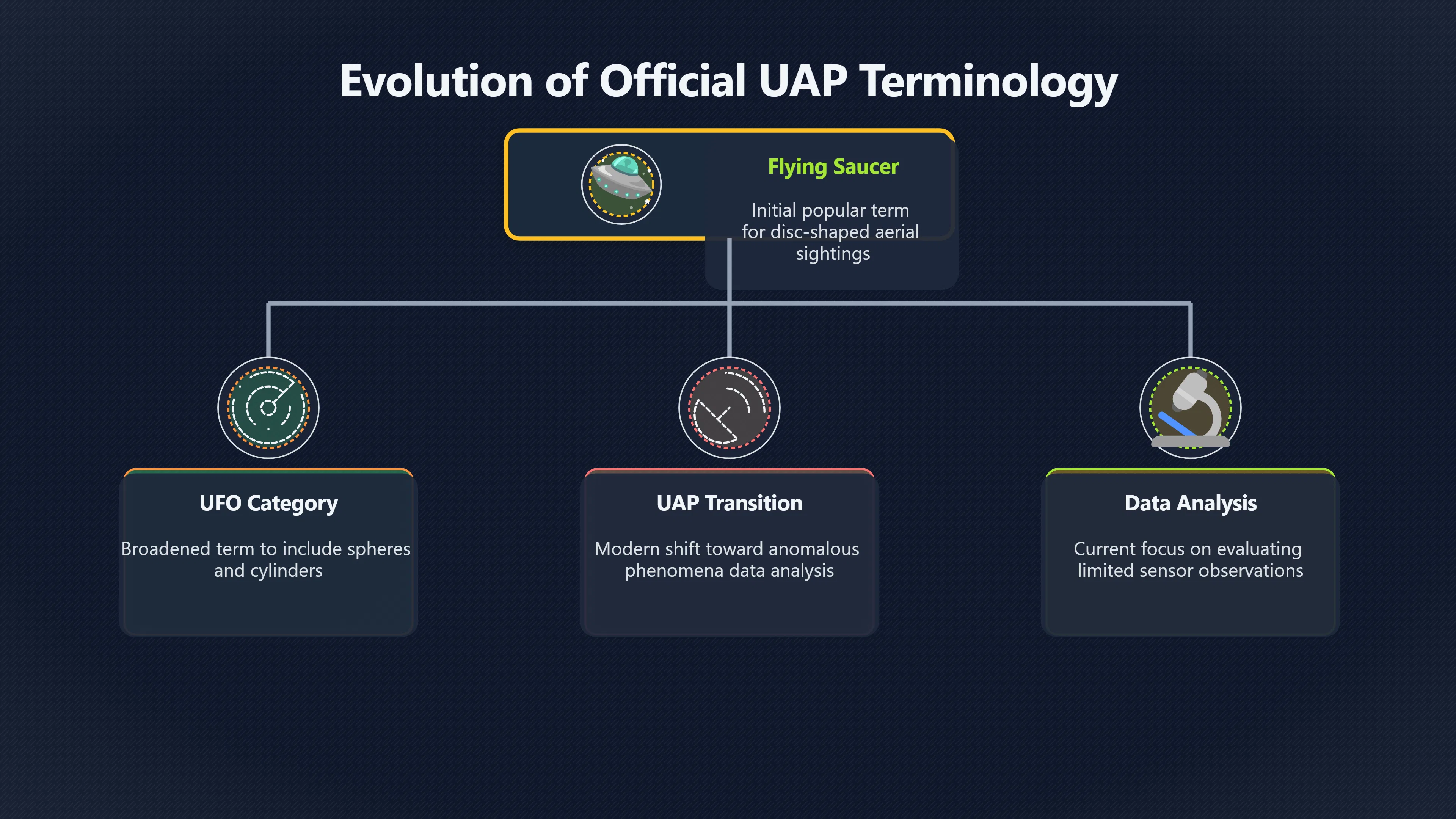
Official terminology was supposed to solve a problem that the phrase “flying saucer” created. From the 1950s onward, military investigators, scientists and government agencies increasingly recognised that reports of unusual objects in the sky described many different shapes, lights, radar returns and sensor anomalies. The category itself was broad, so the language became broader as well: “flying saucer” gave way to “UFO” (unidentified flying object), and more recently to “UAP” (unidentified anomalous phenomena). Yet the saucer never disappeared from public imagination.
 The reason is that official language and popular culture were solving different problems. Governments wanted a neutral category for uncertain observations. Popular culture wanted a memorable image. As a result, the shift from saucers to UFOs and then UAPs widened the official evidence problem, but it did not replace the visual shorthand that films, television, advertising and science fiction had already established.[NASA Science]science.nasa.govScience UAP FAQsNASA ScienceUAP FAQs - NASA ScienceMay 8, 2026…
How Official Categories Widened the Evidence Problem
The move away from “flying saucer” began surprisingly early. After the first great wave of sightings in 1947, investigators found that witnesses reported discs, spheres, cylinders, lights, triangles and objects with no clear shape at all. The United States Air Force therefore adopted the term “unidentified flying object”, partly because “flying saucer” implied a specific form that many reports did not match. Edward J. Ruppelt, who led Project Blue Book, explicitly argued that the saucer label was misleading because sightings involved “objects of every conceivable shape”.[Ultimate Pop Culture]ultimatepopculture.fandom.comOpen source on fandom.com.
This bureaucratic shift reflected a governance problem. Investigators were not trying to classify one type of craft; they were trying to manage reports that might involve aircraft, balloons, astronomical objects, equipment errors or genuinely unexplained observations. The category had to remain open enough to include all possibilities. Records preserved in British and American archives similarly show that official investigations dealt with a wide range of reports and potential explanations rather than a single recurring vehicle design.[The National Archives]nationalarchives.gov.ukThe National Archives UFO reportsThe National ArchivesUFO reports - The National Archives…
The modern transition from UFO to UAP pushed this logic even further. NASA and the US government’s All-domain Anomaly Resolution Office describe UAP as a data-analysis problem involving limited observations and uncertain evidence. The emphasis is on collecting and evaluating information, not on assuming any particular object shape or origin. NASA’s current language even broadens the concept beyond the older focus on aerial sightings alone.[NASA Science]science.nasa.govScience UAP FAQsNASA ScienceUAP FAQs - NASA ScienceMay 8, 2026…
In policy terms, the evolution from saucer to UFO to UAP represents an attempt to remove assumptions from the vocabulary. The category became more abstract precisely because investigators wanted fewer built-in conclusions.
Why Public Images Stayed Narrower Than Reports
While official terminology became broader, public imagery moved in the opposite direction. Most people never read military reports or scientific assessments. They encountered UFOs through magazine covers, comic books, films, television programmes, toys and advertisements.
A saucer offered several advantages as a cultural symbol:
- It could be recognised instantly, even in silhouette.
- It looked unlike conventional aircraft.
- It was easy for artists to reproduce repeatedly.
- It suggested advanced technology without requiring technical explanation.
- It could represent mystery, humour, danger or wonder depending on context.
The result was a powerful feedback loop. Even when news stories used the newer term “UFO”, illustrations often showed a classic disc-shaped craft. Audiences therefore learned to associate the broader category with one specific image. The word changed, but the picture remained.
Science fiction reinforced this tendency. Many influential films and television programmes adopted disc-shaped spacecraft because they were visually distinctive and already familiar to audiences. Once a symbol becomes culturally efficient, it can survive long after the original terminology that inspired it.

The Gap Between Data Language and Cultural Shorthand
The persistence of the saucer reveals a larger gap between administrative language and cultural language.
Government agencies use categories designed to minimise bias. A UAP report might involve a drone, atmospheric phenomenon, sensor artefact, balloon, aircraft or an unresolved event. The terminology deliberately avoids privileging any explanation. NASA’s current guidance stresses that the challenge is insufficient data rather than evidence for a particular type of object.[NASA Science]science.nasa.govScience UAP FAQsNASA ScienceUAP FAQs - NASA ScienceMay 8, 2026…
Popular culture works differently. It rewards symbols that communicate quickly. A newspaper headline can say “UAP”, but a cartoonist can convey the same subject instantly with a silver disc and a ring of lights. The image functions like a logo. It compresses decades of stories about aliens, secrecy, Cold War anxieties and space-age imagination into a single visual cue.
This explains why official rebranding efforts have had limited impact on public imagery. Changing a category label is relatively easy. Replacing an established cultural icon is much harder. The saucer became detached from the evidence base and acquired its own symbolic life.
Why UAP Still Looks Like a Saucer
The modern UAP era demonstrates the durability of this cultural shorthand. Official reports increasingly discuss sensor data, classification systems, flight characteristics and uncertainty. Many contemporary cases involve objects that are not described as saucers at all. Some are lights, some are radar tracks, and some remain too poorly documented for reliable shape estimates. Recent government summaries likewise contain a wide variety of reported object types rather than a dominant disc-shaped pattern.[New York Post]nypost.comThe "all-domain anomaly resolution office" (AARO) identified 21 reports as "true anomalies" needing further investigation. Most sightings…
Yet when newspapers illustrate stories about UAP, when social media users make memes, or when entertainment media references unexplained aerial phenomena, the image that most often appears is still the classic flying saucer. The icon survives because it performs a cultural function that official terminology cannot. “UAP” is a category for investigation. The saucer is a symbol for imagination.
That distinction helps explain one of the enduring relationships between UFOs and science fiction. Scientific and governmental language continually expands to accommodate uncertainty and complexity. Popular culture continually compresses that complexity back into a small set of memorable images. Among those images, none has proved more resilient than the flying saucer.

Amazon book picks
Further Reading
Books and field guides related to Why UAP Still Looks Like a Saucer. Use these as the next step if you want deeper reading beyond the article.

UFOs : Generals, Pilots, and Government Officials Go on the R...
Bridges UFO and UAP discussions for contemporary readers.
The Demon-Haunted World
Rating: 4.5/5 from 43 Google Books ratings
Addresses how public images differ from evidence.
eBay marketplace picks
Marketplace Samples
Example marketplace items related to this page. Use the search link to explore similar finds on eBay.

Endnotes
1.
Source: science.nasa.gov
Title: Science UAP FAQs
Link:https://science.nasa.gov/uap/faqs/
Source snippet
NASA ScienceUAP FAQs - NASA ScienceMay 8, 2026...
Published: May 8, 2026
2.
Source: nasa.gov
Title: www.nasa.gov NASA Yesterday
Link:https://www.nasa.gov/
3.
Source: ultimatepopculture.fandom.com
Link:https://ultimatepopculture.fandom.com/wiki/Unidentified_flying_object
4.
Source: nationalarchives.gov.uk
Title: The National Archives UFO reports
Link:https://www.nationalarchives.gov.uk/explore-the-collection/explore-by-time-period/postwar/ufo-reports/
Source snippet
The National ArchivesUFO reports - The National Archives...
5.
Source: nypost.com
Link:https://nypost.com/2024/11/14/us-news/pentagon-says-nearly-two-dozen-ufo-sightings-cant-be-explained-true-anomalies/
Source snippet
The "all-domain anomaly resolution office" (AARO) identified 21 reports as "true anomalies" needing further investigation. Most sightings...
Additional References
6.
Source: youtube.com
Title: HISTORY of UFOs
Link:https://www.youtube.com/watch?v=5xoYR0YjGh8
Source snippet
Kenneth Arnold UFO Sighting The First UFOs - Jimmy Akin's Mysterious World...
7.
Source: youtube.com
Title: Replay! NASA’s Release of the Unidentified Anomalous Phenomena Report
Link:https://www.youtube.com/watch?v=nuBMnluJfs0
Source snippet
UAP data released: Astrophysicist Avi Loeb breaks down declassified records | FOX 10 Talks...
8.
Source: youtube.com
Link:https://www.youtube.com/watch?v=ur0QX1eGCQI
Source snippet
Unidentified Anomalous Phenomena Independent Study Report...
9.
Source: youtube.com
Title: Whistleblowers Speak! | Alien Documentary | UAP: Unidentified Aerial Phenomena
Link:https://www.youtube.com/watch?v=TOWsN2CSPpc
Source snippet
The Report on Unidentified Flying Objects By Edward Ruppelt. FULL Audiobook...
10.
Source: youtube.com
Link:https://www.youtube.com/watch?v=oL3hwFyXm20
Source snippet
Ultimate 1950s Flying Saucer, UFO, and Alien Encounter Movies...
11.
Source: youtube.com
Title: Where Did The Term ‘Flying Saucer’ Come From? | Mossback’s Northwest
Link:https://www.youtube.com/watch?v=ap0whDDDU1Y
Source snippet
Kenneth Arnold UFO Sighting The First UFOs - Jimmy Akin's Mysterious World...
12.
Source: youtube.com
Link:https://www.youtube.com/watch?v=sSY6NB6m2PU
Source snippet
Kenneth Arnold UFO Sighting The First UFOs - Jimmy Akin's Mysterious World...
13.
Source: youtube.com
Title: free e-book FLYING SAUCERS ARE REAL, Donald E. Keyhoe
Link:https://www.youtube.com/watch?v=pfhx6adH2pE
Source snippet
8th July 1947: First flying saucer as [Roswell]({{ 'roswell/' | relative_url }}) Army Air Base reports debris of a 'flying disc'...
Published: July 1947
14.
Source: youtube.com
Title: The Evolution of UAP Craft Shapes Through History!
Link:https://www.youtube.com/watch?v=7HGYGiJH0-E
Source snippet
A Month of Hollywood Legends | The Day the Earth Stood Still (1951) Original Klaatu Flying Saucer...
15.
Source: youtube.com
Title: History of UFO and alien encounters | Prof. Greg Eghigian
Link:https://www.youtube.com/watch?v=XAqOUoUIJWA
Source snippet
Project Blue Book: The Government's Failed War on Flying Saucers | Curious History...
Topic Tree