Within Games
The UFO conspiracy game that played outside the screen
Majestic used emails, calls, websites, and messages to make a UFO-style conspiracy feel as if it had crossed into ordinary life.
On this page
- Alternate reality gaming and ordinary channels
- Why UFO conspiracies fit messages and documents
- The risk of blurring fiction and reality
Page outline Jump by section
Introduction
Electronic Arts’ Majestic was one of the earliest and most ambitious attempts to turn a UFO-style conspiracy into something that seemed to spill into everyday life. Released in 2001, it was not designed to be played only on a computer screen. Instead, the game contacted players through emails, telephone calls, websites, instant messages and voicemail, presenting a story in which hidden organisations, secret documents and extraterrestrial conspiracies appeared to be unfolding around them. In the wider relationship between UFOs and science fiction, Majestic is significant because it transformed familiar themes of leaked evidence and government cover-ups into an interactive experience that followed players into ordinary routines. Rather than watching a conspiracy narrative, players were invited to live inside one.[WIRED]wired.comMajestic Invades Your WorldUnlike traditional games, Majestic blurs the line between reality and fiction by using various real-world communication devices such as p…
Alternate reality gaming and ordinary channels
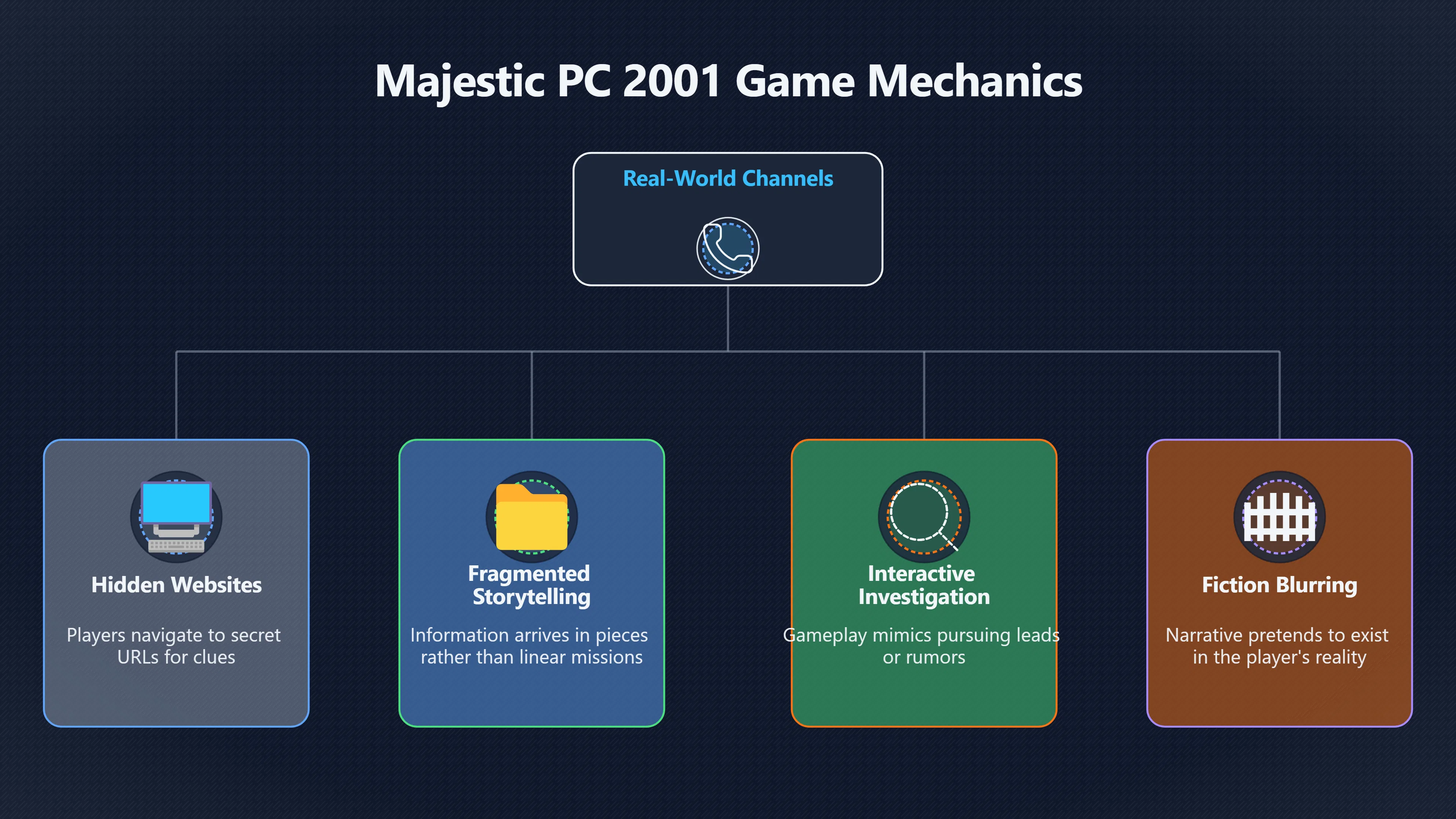
When Majestic launched, Electronic Arts promoted it as something different from conventional online games. Instead of requiring players to log into a virtual world, the game used communication tools that people already associated with real life. Participants might receive a phone call at home, an email containing a clue, or a message directing them to investigate a website that appeared to exist outside the game’s fiction.[WIRED]wired.comMajestic Invades Your WorldUnlike traditional games, Majestic blurs the line between reality and fiction by using various real-world communication devices such as p…
This design placed Majestic among the earliest large-scale examples of what later became known as alternate reality games (ARGs). A defining principle of many ARGs is the idea that “this is not a game”: the narrative pretends to exist in the same reality as the player. Scholars of alternate reality gaming have identified this deliberate blurring of fiction and reality as one of the genre’s core features.[Ulster University]pure.ulster.ac.ukUlster UniversityThe Game Did Not Take Place—This Is Not A Game and blurring the Lines of Fiction - Ulster UniversityApril 20, 2017…
In Majestic, the story revolved around mysterious events, disappearing organisations, hidden information and alleged conspiracies. Clues arrived gradually through different media rather than through a single interface. The result was a form of storytelling that felt closer to investigating a rumour or pursuing a lead than completing a traditional game mission.[WIRED]wired.comMajestic Invades Your WorldUnlike traditional games, Majestic blurs the line between reality and fiction by using various real-world communication devices such as p…
For UFO-themed fiction, this approach was especially effective because it mirrored how many real-world UFO stories circulate. Witness reports, leaked documents, anonymous calls and obscure websites have long been part of UFO culture. Majestic did not merely reference those elements; it recreated them as gameplay.
Why UFO conspiracies fit messages and documents
UFO mythology has often depended on communication rather than direct observation. A major sighting may begin with a witness account, but the story usually expands through reports, recordings, government files, rumours and alleged leaks. The mystery is not only the object in the sky; it is also the question of who knows the truth and who is hiding it.
This made UFO conspiracies unusually compatible with the communication tools used by Majestic. An email from an unknown source feels similar to a leaked document. A late-night phone message resembles the testimony of a frightened witness. A hidden website echoes the idea of secret archives waiting to be discovered.
The game’s title itself carried associations with UFO conspiracy culture. Many observers noted the connection to “Majestic-12”, the alleged secret committee said to have investigated extraterrestrial evidence after the Roswell incident. Historians and researchers generally regard the Majestic-12 documents as a hoax, but the story remains influential within UFO folklore. By invoking that name, the game immediately connected itself to one of the most famous narratives of hidden government knowledge about aliens.[MetaGames]metagames0.commajestic pc 2001MetaGamesMajestic (PC, 2001) – MetaGamesJanuary 20, 2024…
The structure of Majestic therefore reflected a broader pattern in UFO-related science fiction. Instead of presenting aliens openly, it emphasised fragments, clues and uncertainty. Players assembled meaning from incomplete information, much as conspiracy believers attempt to connect scattered pieces of evidence into a larger story.

The risk of blurring fiction and reality
The same features that made Majestic innovative also raised concerns. The game deliberately encouraged players to treat ordinary communication channels as part of a fictional conspiracy. Calls, messages and websites were designed to feel authentic, creating uncertainty about where the game ended and reality began. Scholars examining alternate reality games have pointed to this tension as one of the genre’s defining characteristics.[Ulster University]pure.ulster.ac.ukUlster UniversityThe Game Did Not Take Place—This Is Not A Game and blurring the Lines of Fiction - Ulster UniversityApril 20, 2017…
For UFO themes, that ambiguity carried particular risks. UFO conspiracies already occupy a cultural space where genuine beliefs, rumours, hoaxes and entertainment frequently overlap. When a game adopts the language of secret evidence and hidden truths, some participants may temporarily suspend the distinction between fictional narrative and real-world claims.
Critics have argued that such designs can encourage habits of interpretation associated with conspiracy thinking. Players are rewarded for finding hidden connections, questioning official explanations and treating fragments of information as clues to a larger secret. Those behaviours are useful within a game, but they resemble the methods used by real conspiracy communities.[Ulster University]pure.ulster.ac.ukUlster UniversityThe Game Did Not Take Place—This Is Not A Game and blurring the Lines of Fiction - Ulster UniversityApril 20, 2017…
Timing also complicated Majestic’s reception. The game launched in 2001 and relied heavily on plots involving mysterious attacks, covert organisations and hidden threats. After the September 11 attacks, the atmosphere surrounding conspiracy narratives changed dramatically. Electronic Arts temporarily suspended parts of the experience, and the game’s commercial momentum weakened. Although several factors contributed to its failure, the changing cultural environment made its playful treatment of paranoia and secret plots more difficult to sustain.[MetaGames]metagames0.commajestic pc 2001MetaGamesMajestic (PC, 2001) – MetaGamesJanuary 20, 2024…
A turning point for interactive UFO myths
Majestic remains important not because it proved any UFO claim, but because it demonstrated a new way of experiencing UFO-inspired fiction. Earlier science-fiction stories asked audiences to imagine secret files and hidden communications. Majestic delivered those files and communications directly to players through everyday technology.
In doing so, it revealed how naturally UFO conspiracy themes fit interactive media. The game transformed familiar motifs—anonymous informants, classified documents, government secrecy and extraterrestrial rumours—into actions that unfolded through daily life. Its lasting significance lies in showing that the UFO myth could move beyond books, films and television and become an experience that appeared to follow the audience wherever their phone rang or their inbox received a new message.[wired.com]wired.comMajestic Invades Your WorldUnlike traditional games, Majestic blurs the line between reality and fiction by using various real-world communication devices such as p…

Amazon book picks
Further Reading
Books and field guides related to The UFO conspiracy game that played outside the screen. Use these as the next step if you want deeper reading beyond the article.
eBay marketplace picks
Marketplace Samples
Live-tested eBay searches with available results related to this page.




Endnotes
1.
Source: wired.com
Title: Majestic Invades Your World
Link:https://www.wired.com/2001/05/majestic-invades-your-world
Source snippet
Unlike traditional games, Majestic blurs the line between reality and fiction by using various real-world communication devices such as p...
2.
Source: taipeitimes.com
Title: Taipei Times`Majestic’ brings reality to game world
Link:https://www.taipeitimes.com/News/worldbiz/archives/2001/08/04/0000097169
Source snippet
Taipei Times...
3.
Source: pure.ulster.ac.uk
Link:https://pure.ulster.ac.uk/en/publications/the-game-did-not-take-placethis-is-not-a-game-and-blurring-the-li-2
Source snippet
Ulster UniversityThe Game Did Not Take Place—This Is Not A Game and blurring the Lines of Fiction - Ulster UniversityApril 20, 2017...
Published: April 20, 2017
4.
Source: metagames0.com
Title: majestic pc 2001
Link:https://metagames0.com/2024/01/20/majestic-pc-2001/
Source snippet
MetaGamesMajestic (PC, 2001) – MetaGamesJanuary 20, 2024...
Published: January 20, 2024
Additional References
5.
Source: youtube.com
Title: Lost Media
Link:https://www.youtube.com/watch?v=Ea_N5BxkbtM
Source snippet
What's An ARG? - Inside A Mind...
6.
Source: youtube.com
Link:https://www.youtube.com/watch?v=yG0oY8obuGU
Source snippet
The Forgotten ARG...
7.
Source: youtube.com
Title: What’s An ARG?
Link:https://www.youtube.com/watch?v=4kUGrYoJDQw
8.
Source: youtube.com
Title: The Forgotten ARG
Link:https://www.youtube.com/watch?v=hLLUxqgcECw
Source snippet
Majestic the forgotten EA game...
Topic Tree