Within Comics
Why UFO Beams Do So Much Storytelling
Beams let artists show invisible power, cause, and consequence in one glance, from abduction to attack.
On this page
- The beam as visible causality
- Abduction, scanning, paralysis, and destruction
- Why one cone of light could replace exposition
Page outline Jump by section
Introduction
One of the most effective visual inventions in UFO comics was not the flying saucer itself but the beam beneath it. A cone of light could instantly answer questions that witness reports often left unresolved: What is the UFO doing? Who is being affected? What happens next? In a medium built from static images, the beam transformed uncertainty into visible action. A reader could see a person lifted into the air, a vehicle frozen in place, a landscape scanned, or a building destroyed, all within a single panel.
 That efficiency explains why UFO beams became a form of comic-book evidence. They were not evidence in a scientific sense. Rather, they functioned as visual proof inside the story world, making cause and effect visible at a glance. Within the broader relationship between UFOs and science fiction, the beam became a shorthand that turned an unexplained object in the sky into an active force with intentions and consequences. Comics depended heavily on such visual conventions because readers had to understand events quickly, often without lengthy captions or dialogue. Research on visual narrative and graphic symbols in comics shows that readers rely on conventionalised visual cues to understand action, movement and causality in static images.[PMC]pmc.ncbi.nlm.nih.govMarch 19, 2015…
The Beam as Visible Causality
The central problem facing comic artists was that many forms of power are invisible. Gravity cannot be seen. Radiation cannot be seen. Electromagnetic effects cannot be seen. Yet a comic panel must show what is happening.
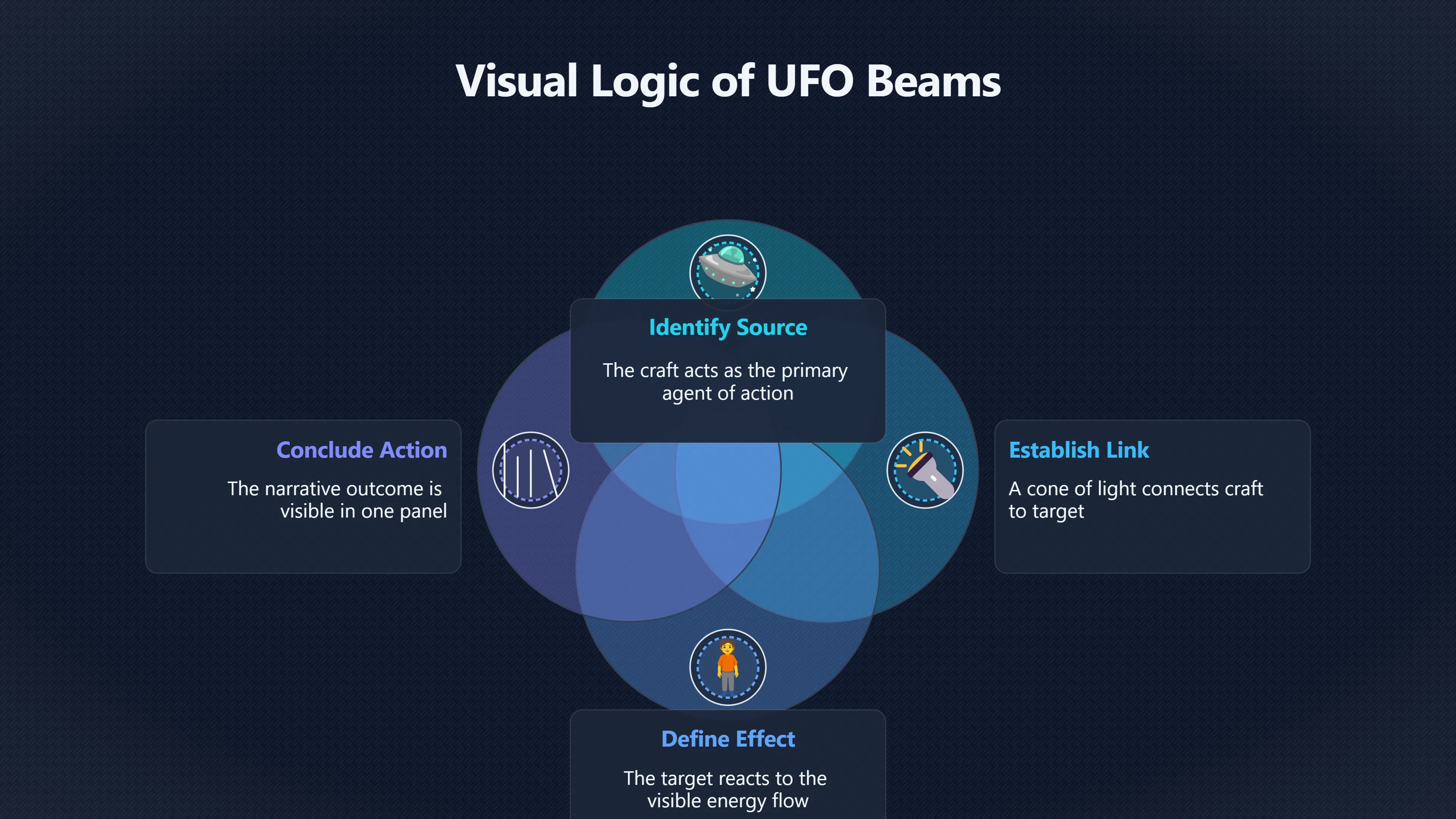
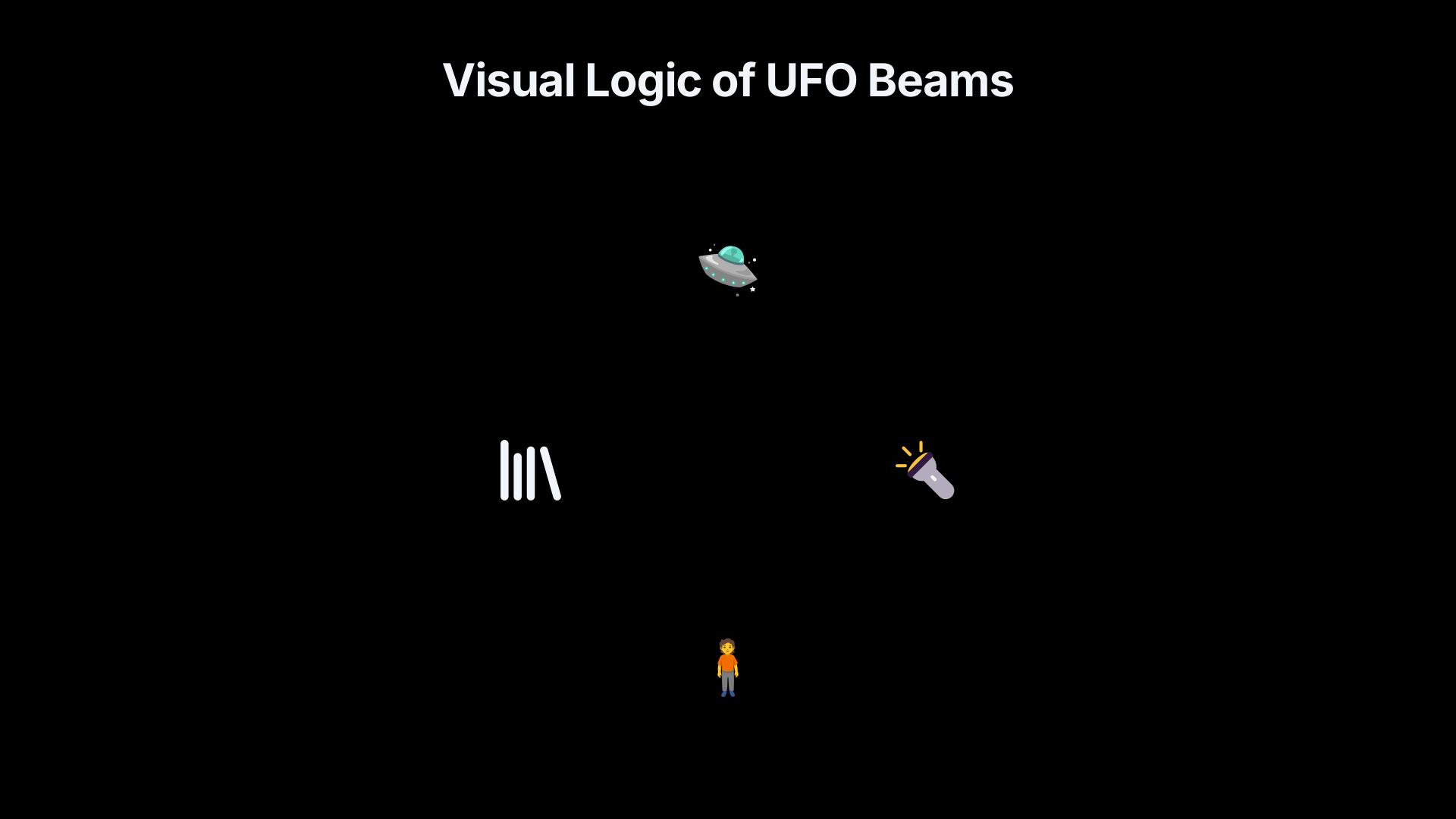
The UFO beam solved this problem elegantly. By drawing a visible column of light between the craft and its target, artists created a direct visual connection between cause and consequence. The reader no longer had to infer that the saucer was responsible; the beam literally linked the two.
This mattered because comics depend on rapid narrative comprehension. Studies of visual narrative have shown that readers organise sequences around clear actions, climaxes and outcomes. Graphic conventions help readers process those relationships more quickly. A beam acts as a visual arrow of causation, identifying the source of an event and its effect simultaneously.[PMC]pmc.ncbi.nlm.nih.govOpen source on nih.gov.
Consider two panels:
- A farmer stands beneath a hovering UFO.
- A farmer stands inside a cone of light extending from a hovering UFO.
The first image suggests a mystery. The second suggests an event already in progress. The beam transforms observation into action.
Because of this, artists could compress several narrative steps into one image. The reader immediately understood that the UFO was interacting with the world rather than merely appearing in it.
Abduction, Scanning, Paralysis and Destruction
Another reason beams became ubiquitous is that a single visual device could represent many different functions.
Abduction
Abduction scenes benefited most from beam imagery. Witness reports often described people disappearing, levitating or being taken aboard craft. In prose, explaining that sequence required several sentences. In comics, a cone of light lifting a human figure upward communicated the entire process instantly.
The beam also solved a practical storytelling problem. Without it, the gap between ground and spacecraft appeared empty. The beam filled that space with visible narrative information, making the transfer of a victim understandable in a single glance.
Stories in UFO-themed comic series repeatedly relied on this approach because it provided a dramatic and readable visual centrepiece. The image of a person suspended within a column of light became one of the most recognisable UFO motifs in popular culture.[Grand Comics Database]comics.orgGrand Comics DatabaseGCD:: Issue:: UFO Flying Saucers (Western, 1968 series) #9 [Gold Key]October 30, 1975…
Scanning and Investigation
A beam could also indicate observation rather than capture. By widening the cone and directing it over a landscape, artists suggested that the craft was analysing terrain, searching for life or gathering information.
This visual choice gave alien visitors apparent purpose. A hovering saucer without a beam might simply be passing by. A saucer projecting light onto the ground appeared to be conducting a mission.
Paralysis and Control
Many UFO narratives described strange effects on people, vehicles or animals. Engines stopped. Witnesses reported temporary immobility. Whether or not such claims were credible, they presented a storytelling challenge.
The beam provided a visible mechanism. A person frozen within a shaft of light immediately appeared to be under external control. The image conveyed power and helplessness simultaneously.
The technique resembled science-fiction concepts such as the “tractor beam”, a fictional force capable of holding or moving objects at a distance. Although tractor beams appeared across science-fiction media, UFO comics adopted similar visual logic because it translated invisible influence into visible action.[Wikipedia]WikipediaTractor beamTractor beam
Destruction
The same cone of light could become a weapon. Narrow it, brighten it, add an explosion at the impact point, and the beam changed from transporter to death ray.
For artists, this versatility was invaluable. The same graphic device could support horror stories, invasion narratives, adventure plots or humorous parodies simply by altering its effect on the target.
Why One Cone of Light Could Replace Exposition
The beam’s greatest advantage was economy.
Comic pages have limited space. Every caption occupies room that could otherwise contain artwork. A visual shorthand that eliminates explanation is therefore extremely valuable.
A beam could answer multiple narrative questions simultaneously:
- What is acting? The UFO.
- What is being affected? The target inside the light.
- How are they connected? Through the beam.
- Is the action beneficial or dangerous? The target’s reaction reveals this.
- Is the event happening now? The active beam indicates an ongoing process.
Without the beam, an artist might need several panels or explanatory text to communicate the same information.
Research into comics and visual language suggests that readers learn conventions that function almost like vocabulary. Motion lines, emanata and other graphic symbols become recognised signs that communicate information beyond literal depiction. UFO beams worked in much the same way. Readers learned that the cone of light represented agency, influence and technological power, even though no such visible phenomenon existed in ordinary experience.[nih.gov]pmc.ncbi.nlm.nih.govMarch 19, 2015…
The beam therefore operated less as a realistic effect and more as a narrative symbol. Its meaning became culturally understood through repetition.
From Ambiguous Sighting to Dramatic Event
Many reported UFO sightings were fundamentally ambiguous. A witness might see an unusual light, a distant object or a brief aerial phenomenon. Such accounts often lacked clear evidence of intention or interaction.
Comics moved in the opposite direction. Their goal was not to preserve uncertainty but to create understandable stories. The beam became the mechanism that accomplished this transformation.
A mysterious light in the sky raises questions. A beam reaching from that light to a human, animal or building appears to answer them. The artist has supplied visible causality where none previously existed.
That is why UFO beams became such powerful comic-book evidence. They converted possibility into action, mystery into narrative, and an unexplained object into an unmistakable agent. In the visual grammar of UFO comics, the beam did far more than illuminate a scene. It explained the scene.
Amazon book picks
Further Reading
Books and field guides related to Why UFO Beams Do So Much Storytelling. Use these as the next step if you want deeper reading beyond the article.
Comics and Sequential Art
Shows how comics depict motion, force, and narrative meaning.
eBay marketplace picks
Marketplace Samples
Example marketplace items related to this page. Use the search link to explore similar finds on eBay.




Endnotes
1.
Source: pmc.ncbi.nlm.nih.gov
Link:https://pmc.ncbi.nlm.nih.gov/articles/4376351/
Source snippet
March 19, 2015...
Published: March 19, 2015
2.
Source: pmc.ncbi.nlm.nih.gov
Link:https://pmc.ncbi.nlm.nih.gov/articles/PMC4076615/
3.
Source: comics.org
Link:https://www.comics.org/issue/255557/
Source snippet
Grand Comics DatabaseGCD:: Issue:: UFO Flying [Saucers]({{ 'saucers/' | relative_url }}) (Western, 1968 series) #9 [Gold Key]October 30, 1975...
Published: October 30, 1975
4.
Source: comics.org
Link:https://www.comics.org/issue/255555/
Source snippet
Grand Comics DatabaseGCD:: Issue:: UFO Flying Saucers (Western, 1968 series) #7...
5.
Source: Wikipedia
Title: Tractor beam
Link:https://en.wikipedia.org/wiki/Tractor_beam
6.
Source: tandfonline.com
Link:https://www.tandfonline.com/doi/abs/10.1080/20445911.2016.1179314
Source snippet
Taylor & Francis OnlineMeaning above the head: combinatorial constraints on the visual vocabulary of comics: Journal of Cognitive Psychol...
Additional References
7.
Source: onlinelibrary.wiley.com
Link:https://onlinelibrary.wiley.com/doi/10.1111/cogs.13377
Source snippet
Wiley Online LibraryThe Meaning of Motion Lines?: A Review of Theoretical and Empirical Research on Static Depiction of Motion - Hacımusa...
8.
Source: reddit.com
Link:https://www.reddit.com/r/AnomalousEvidence/comments/1cinwt2
Source snippet
www.reddit.comHere's a compilation of cases where UFOs used "paralyzing" lights, "solid" lights, "bending" lights, and "tractor beam" lig...
9.
Source: youtube.com
Title: Ancient Aliens in (Comic) Books (by Jack Kirby) || Docuseries-26 by Alex Grand
Link:https://www.youtube.com/watch?v=0JuJNfX-cWE
Source snippet
HISTORY of UFOs - Episode 2 - The 1940s and 1950s - The [Roswell]({{ 'roswell/' | relative_url }}) Incident and [Project Blue Book]({{ 'blue-book/' | relative_url }})...
10.
Source: youtube.com
Title: HISTORY of UFOs
Link:https://www.youtube.com/watch?v=5xoYR0YjGh8
Source snippet
How Hollywood Ruined Aliens...
11.
Source: ultimatepopculture.fandom.com
Title: Ultimate Pop Culture Tractor beam | Ultimate Pop Culture Wiki | Fandom
Link:https://ultimatepopculture.fandom.com/wiki/Tractor_beam
12.
Source: youtube.com
Title: How Hollywood Ruined Aliens
Link:https://www.youtube.com/watch?v=CrnyNgsDFPI
Source snippet
History of Science Fiction Film Part Two...
13.
Source: youtube.com
Title: History of Science Fiction Film Part Two
Link:https://www.youtube.com/watch?v=xErSQUSltyo
Source snippet
Top 10 1950s Golden Age Sci-Fi Movies...
14.
Source: youtube.com
Link:https://www.youtube.com/watch?v=b4EL2D-SXDM
Topic Tree