Within Rockets
Why saucers replaced rockets in UFO culture
The move from ghost rockets to flying saucers changed UFO imagery from projectile weapons to hovering, silent, manoeuvrable craft.
On this page
- What rockets implied about UFO movement
- What saucers added to the imagined machine
- How the two images shaped different explanations
Page outline Jump by section
Introduction
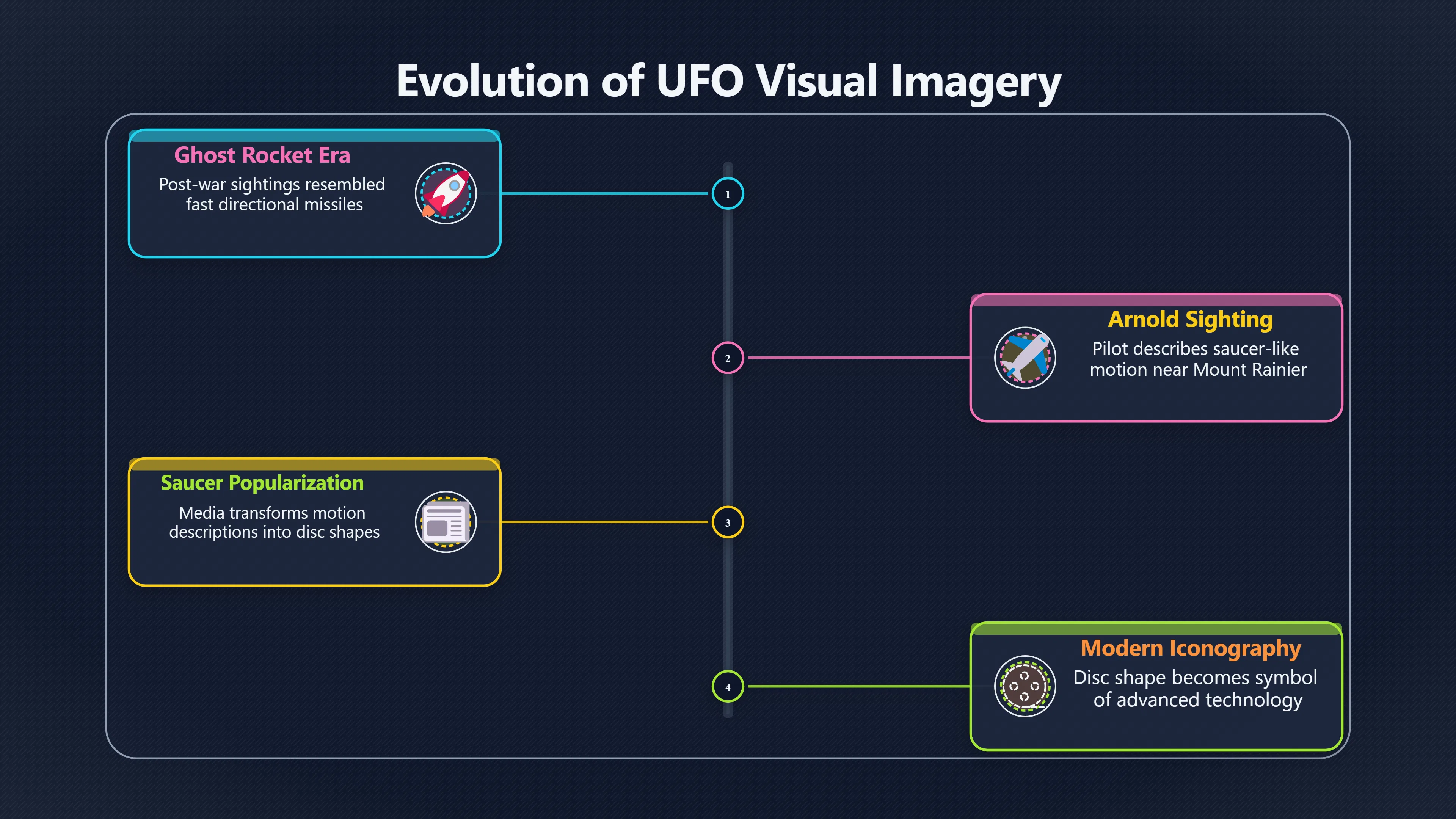
In the immediate post-war years, unidentified aerial objects were often imagined as rockets. The 1946 Scandinavian “ghost rockets” were described as missile-like, fast and directional, fitting a world newly aware of V-2 technology and long-range weapons. Yet after 1947, the dominant image changed. The flying saucer became the defining UFO machine. This shift mattered because it altered what people thought an advanced craft could do. Rockets suggested speed, trajectories and military technology. Saucers suggested hovering, abrupt manoeuvres, silence and control. The new image did not erase rocket-age assumptions; it reworked them into a different vision of technological superiority. The result was one of the most important transformations in the relationship between UFOs and science fiction.[wikipedia.org]WikipediaNazi UFOsNazi UFOs
What rockets implied about UFO movement
The ghost rocket reports of 1946 emerged in a world dominated by recent memories of wartime missile development. Witnesses frequently described elongated, projectile-like objects. Contemporary speculation focused on captured German technology, Soviet testing and secret military programmes rather than extraterrestrial visitors. The image was fundamentally ballistic: a rocket travelled from one place to another along a directed path.[Wikipedia]WikipediaNazi UFOsNazi UFOs
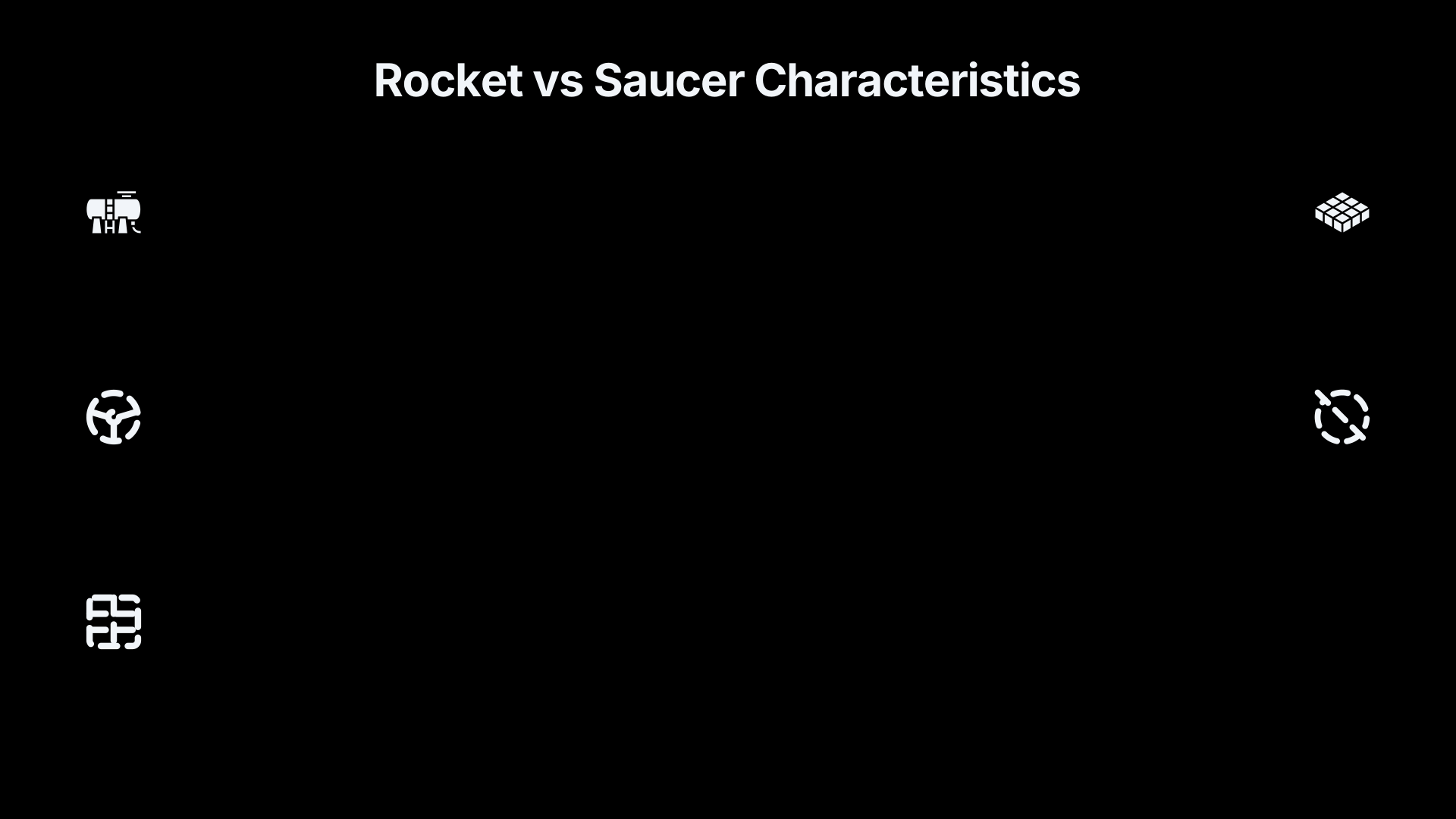
This mattered because rockets carried specific assumptions about motion. A rocket was expected to:
- Move extremely fast in a largely straight line.
- Depend on propulsion and fuel.
- Behave like a weapon or experimental vehicle.
- Travel through the sky rather than remain stationary.
Even when witnesses reported unusual behaviour, the underlying model remained a technological projectile. The mystery was often who had built the machine, not whether the machine followed recognisable engineering principles.[Wikipedia]WikipediaNazi UFOsNazi UFOs
In science-fiction culture of the 1930s and 1940s, this made sense. Rockets were the symbol of advanced technology. Space travel, future warfare and journeys to other planets were commonly depicted through rocket ships. When people imagined unknown craft, they often drew upon the most advanced real machine available as a reference point.
What saucers added to the imagined machine
The turning point came with pilot Kenneth Arnold’s famous sighting near Mount Rainier on 24 June 1947. Arnold described objects moving in an unusual fashion, comparing their motion to a saucer skipping across water. News reports rapidly popularised the phrase “flying saucer”, and within days a new visual image had entered public culture.[history.com]history.comHow the US Air Force Investigated UFOs During the Cold War | HISTORYHow the US Air Force Investigated UFOs During the Cold War | HISTORY…
An important irony is that Arnold’s description referred primarily to movement rather than a perfectly circular shape. Nevertheless, newspapers, readers and later witnesses increasingly imagined disc-shaped craft. The phrase proved more memorable than the original observation.[history.com]history.comHow the US Air Force Investigated UFOs During the Cold War | HISTORYHow the US Air Force Investigated UFOs During the Cold War | HISTORY…
The saucer image introduced several new ideas that rockets did not naturally convey:
- Hovering ability. A disc could appear suspended in the air rather than racing along a trajectory.
- Instant manoeuvrability. Reports increasingly described sharp turns, zig-zag motion and sudden acceleration.
- Silence. Witnesses often expected a rocket to produce noise; saucers were frequently reported as quiet.
- Symmetry and completeness. A disc looked less like a weapon and more like a self-contained vehicle.
- Non-human engineering. Because the shape seemed less tied to known aircraft design, it became easier to imagine extraterrestrial origins.
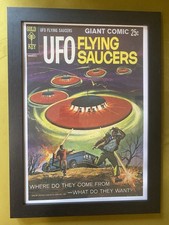
These qualities fit emerging science-fiction ideas about anti-gravity, advanced propulsion and technologies far beyond conventional aviation. The saucer therefore expanded the imaginative possibilities available to UFO narratives.[HISTORY]history.comHow the US Air Force Investigated UFOs During the Cold War | HISTORYHow the US Air Force Investigated UFOs During the Cold War | HISTORY…
Why the saucer fit the early Space Age better
The replacement of rockets by saucers was not a rejection of technological thinking. Instead, it reflected rising expectations about future technology.
The rocket represented the cutting edge of the 1940s. But as public discussion increasingly turned toward space travel, atomic power and futuristic engineering, many people began imagining machines that could surpass the limitations of rockets themselves. The saucer became a visual shorthand for that next stage.
Science-fiction magazines, films and popular illustrations helped reinforce this transition. Rocket ships remained common, but UFO culture increasingly favoured vehicles that appeared capable of extraordinary flight characteristics. A craft that could hover, accelerate instantly and reverse direction seemed more advanced than a missile following a predictable path. In effect, the saucer became the imagined successor to the rocket.[history.com]history.comHow the US Air Force Investigated UFOs During the Cold War | HISTORYHow the US Air Force Investigated UFOs During the Cold War | HISTORY…
The popularity of the disc shape also made UFOs easier to distinguish from ordinary military technology. A witness reporting a rocket-like object might be describing a secret weapon. A witness reporting a metallic disc performing impossible manoeuvres seemed to be describing something fundamentally different.
How the two images shaped different explanations
The contrast between rockets and saucers influenced the kinds of explanations people preferred.
When UFOs were imagined as rockets, discussion often centred on national rivalries, captured German technology and classified military research. The unknown object was usually assumed to belong to a government or military power.[Wikipedia]WikipediaNazi UFOsNazi UFOs
When UFOs were imagined as saucers, alternative explanations became more attractive:
- Visitors from other planets.
- Civilisations possessing radically advanced technology.
- Anti-gravity or unknown propulsion systems.
- Scientific breakthroughs hidden from public knowledge.
This did not eliminate military interpretations. Many observers still suspected secret aircraft projects. However, the saucer image broadened the explanatory field. It encouraged speculation about technologies that appeared qualitatively different from anything known on Earth.[HISTORY]history.comHow the US Air Force Investigated UFOs During the Cold War | HISTORYHow the US Air Force Investigated UFOs During the Cold War | HISTORY…
The distinction can be seen in the language itself. A rocket suggests a destination and a launch. A saucer suggests presence, observation and control. One is primarily a vehicle in transit; the other is a machine that can remain, manoeuvre and interact.

The lasting legacy of the shift
The move from ghost rockets to flying saucers was more than a change in shape. It marked a change in technological imagination. Rocket-like UFOs reflected a world impressed by wartime missiles and emerging aerospace engineering. Flying saucers reflected a world beginning to imagine technologies beyond the rocket age.
That is why the saucer became such a durable symbol in UFO culture and science fiction. It preserved the post-war belief that extraordinary machines might exist, while freeing those machines from the constraints associated with rockets. The imagined UFO was no longer merely a faster projectile. It had become a vehicle capable of doing what conventional technology could not, and that made it a far more powerful icon of the unknown.[history.com]history.comHow the US Air Force Investigated UFOs During the Cold War | HISTORYHow the US Air Force Investigated UFOs During the Cold War | HISTORY…
Amazon book picks
Further Reading
Books and field guides related to Why saucers replaced rockets in UFO culture. Use these as the next step if you want deeper reading beyond the article.
The UFO Experience
Analyzes reported craft characteristics including classic saucer descriptions.
The Flying Saucers are Real
Directly reflects the rise of the saucer image in UFO culture.
The Report on Unidentified Flying Objects
Documents the transition from early rocket-like reports to saucer-era interpretations.
eBay marketplace picks
Marketplace Samples
Live-tested eBay searches with available results related to this page.



Endnotes
1.
Source: Wikipedia
Title: Nazi UFOs
Link:https://en.wikipedia.org/wiki/Nazi_UFOs
2.
Source: history.com
Title: How the US Air Force Investigated UFOs During the Cold War | HISTORY
Link:https://www.history.com/news/u-s-air-force-closes-the-book-on-ufos-45-years-ago
Source snippet
How the US Air Force Investigated UFOs During the Cold War | HISTORY...
3.
Source: unexplained-mysteries.com
Link:https://www.unexplained-mysteries.com/news/267788/the-term-flying-saucer-was-a-misquote
4.
Source: wired.com
Title: how ufo sightings became an american obsession
Link:https://www.wired.com/story/how-ufo-sightings-became-an-american-obsession
Source snippet
The period following his sighting saw a surge in UFO sightings across the U.S. This surge, or "flap," is linked to societal fears of inva...
5.
Source: Wikipedia
Title: The Coming of the Saucers
Link:https://en.wikipedia.org/wiki/The_Coming_of_the_Saucers
6.
Source: airandspace.si.edu
Title: 1947 year flying saucer
Link:https://airandspace.si.edu/stories/editorial/1947-year-flying-saucer
Source snippet
National Air and Space Museum1947: Year of the Flying Saucer | National Air and Space Museum...
7.
Source: crystalinks.com
Title: Ghost Rockets
Link:https://www.crystalinks.com/ghostrockets.html
Source snippet
Crystalinks...
8.
Source: en-academic.com
Title: Flying saucer
Link:https://en-academic.com/dic.nsf/enwiki/7231124
Additional References
9.
Source: youtube.com
Title: UFO’s Are Real: Aliens Sci-Fi Documentary
Link:https://www.youtube.com/watch?v=oM9WfDBRNcg
Source snippet
This selection explores the 1947 Kenneth [Arnold sighting]({{ 'arnold-sighting/' | relative_url }}) that originated the "flying saucer" moniker and examines how 1950s cinema and do...
10.
Source: youtube.com
Link:https://www.youtube.com/watch?v=qkyzeCEIFR4
Source snippet
When NASA Tried to Build a REAL Flying Saucer | NASA's Unexplained Files...
11.
Source: youtube.com
Title: When NASA Tried to Build a REAL Flying Saucer | NASA’s Unexplained Files
Link:https://www.youtube.com/watch?v=uyjaSlGnxZo
Source snippet
EARTH VS THE FLYING SAUCERS Best UFO Clips (1965) Sci-Fi...
12.
Source: reddit.com
Title: Something that I’ve never seen pointed out
Link:https://www.reddit.com/r/UFOs/comments/175s0kn
Source snippet
Something that I've never seen pointed out...
13.
Source: youtube.com
Link:https://www.youtube.com/watch?v=jUzzNL6iCUg
Source snippet
UFOs: The True Story of Flying Saucers (1956)...
14.
Source: youtube.com
Title: Kenneth Arnold UFO Sighting: The First UFOs
Link:https://www.youtube.com/watch?v=xLuHgsXGpqc
Source snippet
Ultimate 1950s Flying Saucer, UFO, and Alien Encounter Movies...
15.
Source: youtube.com
Link:https://www.youtube.com/watch?v=7PwYPC73B3k
Source snippet
UFO's Are Real: Aliens Sci-Fi Documentary...
16.
Source: youtube.com
Link:https://www.youtube.com/watch?v=lLiXZojGudQ
Source snippet
Earth vs. The Flying Saucers (1956)...
17.
Source: youtube.com
Link:https://www.youtube.com/watch?v=xg713GtUUxY
18.
Source: wordorigins.org
Title: flying saucer / UFO — Wordorigins.org
Link:https://www.wordorigins.org/big-list-entries/flying-saucer
Topic Tree