Within Invasion Films
When Martian Machines Beat Modern Weapons
The 1953 film moved alien invasion into modern America, where advanced machines exposed the limits of bombs, aircraft and command rooms.
On this page
- From Victorian invasion to Cold War America
- Military confidence under pressure
- Why familiar landscapes made panic bigger
Page outline Jump by section
Introduction
The 1953 film The War of the Worlds marked a decisive shift in how alien invasion was imagined on screen. H. G. Wells’s original novel had exposed the vulnerability of the British Empire at the height of its confidence. George Pal and Byron Haskin’s film updated that idea for Cold War America, relocating the invasion to contemporary California and confronting audiences with a more unsettling question: what if the most technologically powerful nation on Earth could not defend itself? The film’s Martian machines do not merely attack cities. They systematically demonstrate the inadequacy of tanks, aircraft, artillery and even atomic weapons. In doing so, the film became one of the clearest examples of how science fiction transformed UFO-era anxieties into a story about military failure, technological surprise and the limits of modern power.[edg.imfdb.org]edg.imfdb.orgWar of the Worlds, The (1953War of the Worlds, The (1953

From Victorian Invasion to Cold War America
Wells’s 1898 novel was already a story about military humiliation. British forces, accustomed to colonial dominance, found themselves facing a superior enemy whose technology rendered familiar tactics ineffective. The 1953 adaptation preserved that central idea while moving it into the political and technological landscape of post-war America. Instead of Victorian soldiers confronting tripods, audiences saw scientists, military officers, radar networks and modern aircraft struggling against flying Martian war machines.[sf-encyclopedia.com]sf-encyclopedia.comSF E: War of the WorldsSF E: War of the Worlds
This change mattered because the United States of the early 1950s presented itself as the world’s foremost military power. The Second World War had ended with American industrial and nuclear superiority. Yet the Cold War also generated fears that technological advantages could suddenly disappear. The film channels those fears directly. Its Martian craft possess defensive shields and energy weapons so advanced that every human response appears outdated almost immediately.[Rayford-Publishing]rayfordpublishing.comthe war of the worlds 1953Rayford-PublishingThe War of the Worlds (1953)…
The result was not simply a remake of Wells. It was a reinterpretation aimed at a society living with radar screens, jet aircraft and atomic bombs. By relocating the invasion into recognisably modern America, the film asked viewers to imagine the failure of systems they were told would keep them safe.[edg.imfdb.org]edg.imfdb.orgWar of the Worlds, The (1953War of the Worlds, The (1953
Military Confidence Under Pressure
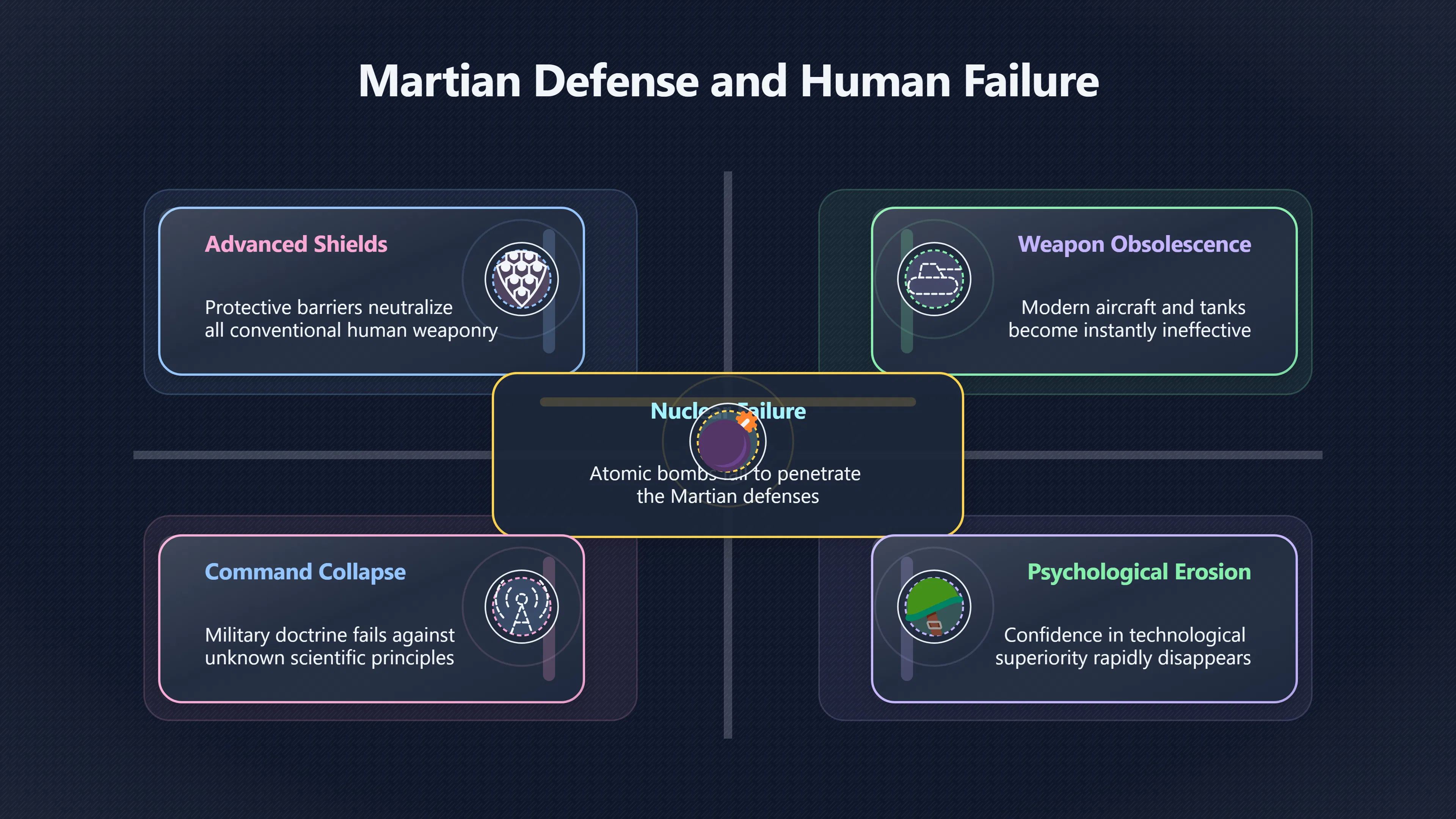
One of the film’s most striking features is the way it stages military defeat. The armed forces respond quickly and with overwhelming force by ordinary standards. Troops establish defensive positions, artillery is deployed and aircraft are sent into action. Yet none of these measures succeeds.
The pattern is important. The film does not portray military leaders as cowardly or incompetent. Instead, it suggests that they are confronting a threat beyond the assumptions on which their technology is based. Human weapons are powerful, but they are designed for conflicts against other human adversaries. The Martians operate according to different scientific principles and possess protective shields that neutralise conventional attacks.[Rayford-Publishing]rayfordpublishing.comthe war of the worlds 1953Rayford-PublishingThe War of the Worlds (1953)…
Several aspects of the military failure stand out:
- Technological mismatch: Human weapons function as expected but cannot penetrate Martian defences.
- Rapid obsolescence: Equipment that symbolised modern military power is rendered ineffective within minutes.
- Command uncertainty: Military planning becomes reactive because no existing doctrine explains the enemy’s capabilities.
- Psychological collapse: Confidence in technological superiority erodes as each escalation fails.[rayfordpublishing.com]rayfordpublishing.comthe war of the worlds 1953Rayford-PublishingThe War of the Worlds (1953)…
The film therefore presents a critique of overconfidence rather than a simple disaster scenario. Its tension comes from watching trusted systems fail one after another.
Even the Atomic Bomb Is Not Enough
The most memorable example of this logic is the failure of the atomic bomb. In the early 1950s, nuclear weapons represented the ultimate expression of military power. They were widely viewed as the final guarantee of national security. The film deliberately undermines that assumption.
When the military resorts to an atomic strike, the audience expects a decisive turning point. Instead, the Martian shield survives. The scene transforms the atomic bomb from a symbol of certainty into evidence of helplessness. Humanity’s strongest weapon proves unable to affect the invaders.[rayfordpublishing.com]rayfordpublishing.comthe war of the worlds 1953Rayford-PublishingThe War of the Worlds (1953)…
For Cold War audiences, this carried obvious implications. The fear was not merely invasion. It was the possibility that future technology might leap beyond existing military capabilities in the same way that the Martians had surpassed human science. In a decade shaped by missile development, nuclear strategy and fears of surprise attack, that idea had considerable emotional power.[Rayford-Publishing]rayfordpublishing.comthe war of the worlds 1953Rayford-PublishingThe War of the Worlds (1953)…
Why Familiar Landscapes Made Panic Bigger
The film’s effectiveness depends heavily on its setting. Unlike earlier fantasies that placed extraordinary events in distant locations, The War of the Worlds brings destruction into ordinary American environments. Small towns, highways, churches and city streets become battlegrounds.
This choice makes the military failure feel personal. Audiences are not watching a remote frontier collapse. They are watching recognisable modern spaces become vulnerable. California suburbs and urban centres appear within reach of the viewer’s own experience, making the invasion seem less like fantasy and more like a plausible emergency.[fernbyfilms.com]fernbyfilms.commovie review war of the worlds the 1953movie review war of the worlds the 1953
The contrast between familiar surroundings and alien technology also mirrors the structure of many UFO reports from the late 1940s and early 1950s. Reports often described strange objects appearing above everyday landscapes rather than in exotic settings. The film amplifies that pattern by showing advanced machines descending into ordinary communities and instantly overwhelming local authority. The shock comes from the collision between normal life and incomprehensible technology.[edg.imfdb.org]edg.imfdb.orgWar of the Worlds, The (1953War of the Worlds, The (1953
As the invasion spreads, military installations, command centres and public infrastructure all appear unable to restore order. The viewer is encouraged to imagine that no location is truly secure. This broadens the meaning of military failure from a battlefield problem into a societal one.
Alien Superiority and the UFO Imagination
Within the wider relationship between UFOs and science fiction, The War of the Worlds helped establish a powerful image: the alien craft as a technological challenge that human institutions might not be able to meet. The film’s flying Martian machines differ from the saucers of many UFO stories, but they perform a similar cultural function. They embody a level of scientific advancement that makes existing military assumptions seem fragile.[sf-encyclopedia.com]sf-encyclopedia.comSF E: War of the WorldsSF E: War of the Worlds
This idea became highly influential in later invasion cinema. Rather than depicting extraterrestrials as monsters that could be defeated through courage alone, the film suggested that alien visitors might possess capabilities so advanced that modern armies would appear primitive by comparison. That possibility resonated with audiences already living through rapid technological change and recurring public fascination with mysterious objects in the sky.
The lasting significance of the film lies not simply in its special effects or its Martian designs. It lies in the way it transformed military failure into a central theme of alien invasion. By showing tanks, aircraft, command rooms and even nuclear weapons falling short, The War of the Worlds invited viewers to imagine a future in which technological superiority no longer belonged to humanity. In the UFO-infused culture of the 1950s, that was a deeply unsettling possibility.[fernbyfilms.com]fernbyfilms.commovie review war of the worlds the 1953movie review war of the worlds the 1953
Amazon book picks
Further Reading
Books and field guides related to Relationships betwee d7372c hollywood invasion s 2182e1 war worlds military 758185. Use these as the next step if you want deeper reading beyond the article.
The War of the Worlds
The foundational text behind the film and its military-failure themes.
Starship Troopers
Rating: 4.0/5 from 52 Google Books ratings
Extends themes of warfare, technology and alien conflict.
eBay marketplace picks
Marketplace Samples
Example marketplace items related to this page. Use the search link to explore similar finds on eBay.

Endnotes
1.
Source: edg.imfdb.org
Title: War of the Worlds, The (1953)
Link:https://edg.imfdb.org/wiki/War_of_the_Worlds%2C_The_%281953%29
2.
Source: sf-encyclopedia.com
Title: SF E: War of the Worlds
Link:https://sf-encyclopedia.com/entry/war_of_the_worlds
3.
Source: rayfordpublishing.com
Title: the war of the worlds 1953
Link:https://www.rayfordpublishing.com/post/the-war-of-the-worlds-1953
Source snippet
Rayford-PublishingThe War of the Worlds (1953)...
4.
Source: waroftheworlds.fandom.com
Title: The War of the Worlds (1953 film)
Link:https://waroftheworlds.fandom.com/wiki/The_War_of_the_Worlds_%281953_film%29
Source snippet
War Of The Worlds Wiki | Fandom...
5.
Source: fernbyfilms.com
Title: movie review war of the worlds the 1953
Link:https://www.fernbyfilms.com/2019/06/12/movie-review-war-of-the-worlds-the-1953/
Additional References
6.
Source: youtube.com
Link:https://www.youtube.com/watch?v=Qj_6H0PLoec
Source snippet
The War of the Worlds (1953): 10 Behind-the-Scenes Secrets...
7.
Source: youtube.com
Link:https://www.youtube.com/watch?v=LBIg_Szk5M4
Source snippet
The War of the Worlds (1953): The Banned Alternate Ending and Hidden Secrets...
8.
Source: youtube.com
Link:https://www.youtube.com/watch?v=wRGD_KZsoPo
Source snippet
War of the worlds (1953) Dropping the nuke...
9.
Source: m.youtube.com
Link:https://m.youtube.com/watch?v=7ocTXuUrqEc
Source snippet
The War of the Worlds (1953): The Banned Ending They Hid for Over 70 Years...
10.
Source: youtube.com
Link:https://www.youtube.com/watch?v=s3gjrqUwMUw
Topic Tree