Within UFO Fiction
How Headlines Turn Lights Into Legends
News coverage can turn uncertain sky reports into memorable narratives by choosing labels, images, and dramatic frames.
On this page
- Naming the unknown
- Why simple images travel fastest
- How media frames influence later reports
Page outline Jump by section
Introduction
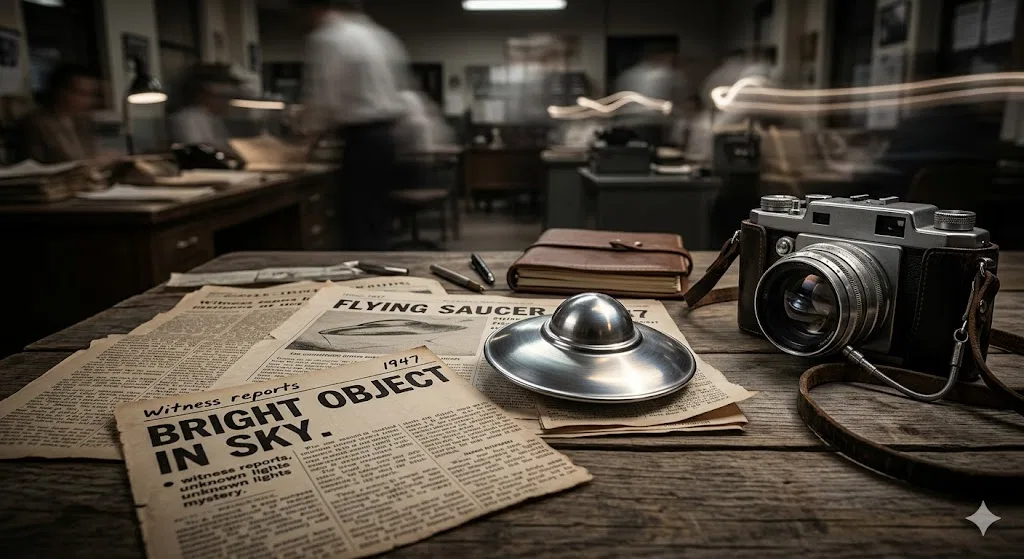
Headlines can turn a UFO sighting from an uncertain observation into a durable story. A witness may report lights, motion, distance, glare, speed or a shape that was hard to judge; the press then has to compress that uncertainty into a few memorable words. Once a label such as “flying saucer”, “mystery drone”, “alien craft” or “UFO hotspot” is attached, it does more than describe the report. It gives later readers a picture, a genre and a set of expectations.
This matters for the relationship between UFOs and science fiction because journalism often supplies the bridge between observation and myth. A strange light becomes news; news becomes a repeatable image; the image feeds films, books and television; those stories then influence what later witnesses and editors notice. Official records still distinguish between unidentified reports and evidence of extraterrestrial craft, but public memory often remembers the headline first. The result is a feedback loop in which media framing can make the unknown feel more coherent, dramatic and science-fictional than the underlying evidence allows. National Air and Space Museum+2af.mil[airandspace.si.edu]airandspace.si.eduNational Air and Space Museum1947: Year of the Flying SaucerJune 24, 2022 — 24 Jun 2022 — We will never know exactly what private pilot K…
Naming the unknown
The most famous example is the birth of the “flying saucer”. Kenneth Arnold’s 24 June 1947 sighting near Mount Rainier helped launch the modern UFO era, but the cultural afterlife of the report depended heavily on the phrase that followed it. The Smithsonian’s National Air and Space Museum notes that later reports used the words “flying saucer”, and Time summarises the familiar problem: Arnold described a skipping motion “like a saucer” rather than simply reporting a neat saucer-shaped object. Once newspapers had a compact phrase, the report became easy to repeat, cartoon, parody and visualise.[National Air and Space Museum]airandspace.si.eduNational Air and Space Museum1947: Year of the Flying SaucerJune 24, 2022 — 24 Jun 2022 — We will never know exactly what private pilot K…
That label did several things at once. It made the sighting less technical and more pictorial. It replaced a difficult observation of speed, distance and motion with a household object everyone could imagine. It also created a template that other reports could be sorted into. “Flying saucer” was not just a description; it was a headline-ready category. A reader did not need to understand aviation, optics or military technology to picture a disc in the sky.
The speed of the 1947 wave shows how powerful a label can be. Ted Bloecher’s later study of the 1947 UFO wave drew on hundreds of cases and newspaper references, while other summaries of the period note that press coverage helped the reports spread rapidly across the United States in late June and early July. By 6 July 1947, accounts of “flying saucers” had become national news rather than isolated local oddities.[princeton.edu]kirkmcd.princeton.edubloecher 67bloecher 67
The mechanism is simple but important: a headline converts ambiguity into a name. Once named, the phenomenon feels less like a scattered set of observations and more like a single thing moving through history. That is also how science fiction works. It gives recurring forms to otherwise abstract fears and hopes: the saucer, the ray, the mothership, the probe, the invasion fleet. News headlines did not invent all of those images, but they helped make one of them public property.
Why simple images travel fastest
A sighting report is usually messy. It may contain estimates made under poor viewing conditions: a bright object against a dark sky, a point of light with no clear distance cue, a fast-moving reflection, a balloon, aircraft, drone, satellite, planet or weather effect. Official investigations have repeatedly stressed that data quality is often poor, and the U.S. Air Force’s Project Blue Book ended with 701 reports still classified as “unidentified” out of 12,618, not as proof of alien craft but as cases unresolved after available analysis.[af.mil]af.milUnidentified Flying Objects and Air Force Project Blue BookOf a total of 12,618 sightings reported to Project Blue Book, 701 remained "un…
Headlines have the opposite requirement. They need a quick visual hook. “Several observers report a bright moving object under uncertain atmospheric and observational conditions” is accurate but unmemorable. “Flying saucer” travels. “Glowing orb” travels. “Black triangle” travels. “Mystery object” travels. The simpler the image, the easier it is for newspapers, television graphics, thumbnails and social posts to repeat it.
This helps explain why UFO culture often converges on a few standard shapes even though reports themselves vary widely. The public does not remember every witness estimate or investigation caveat. It remembers the repeatable icon. The saucer became the cleanest mid-century icon because it looked technological but unfamiliar: not quite an aircraft, not quite a rocket, and therefore available for science fiction to claim.
Modern UAP coverage uses a similar shorthand. In recent official and journalistic language, “orb”, “tic-tac”, “cube”, “triangle” and “drone” often serve as narrative anchors. AARO’s public imagery pages, for example, describe some unresolved cases cautiously, including physical objects whose features are judged unremarkable or not yet conclusively attributed. News coverage, by contrast, often foregrounds the most vivid label because that is what makes a reader stop.[AARO]aaro.milOpen source on aaro.mil.
The image can survive even when the explanation changes. Roswell is an obvious case in the wider UFO tradition: early press excitement over a “flying disc” became part of a much larger mythology, even though later official accounts identified the recovered material as connected to balloon projects rather than an alien crash. The key point for this page is not to relitigate Roswell, but to notice the media mechanism: once a dramatic object-name enters circulation, later corrections rarely travel with the same force as the first image.
How frames turn sightings into plots
A headline does not merely name an object. It also suggests what kind of story the reader is entering. “Pilot sees unknown object” invites one kind of attention; “alien craft stalks skies” invites another. The same raw event can be framed as a safety issue, a military mystery, a scientific puzzle, a local curiosity, a joke, a conspiracy, a hoax or an omen. Each frame tells readers what to fear, doubt, laugh at or investigate.
Three recurring frames matter most in the UFO and science-fiction feedback loop:
The invasion frame. In the early Cold War, strange objects in the sky could be read through fears of enemy technology, rockets, atomic power and surprise attack. This frame made UFO reports feel politically urgent even when the evidence was thin. The CIA’s 1953 Robertson Panel arose in the context of public concern and official anxiety about reports overwhelming communication channels, and it recommended reducing public interest through education rather than treating sightings as confirmed hostile craft.[cia.gov]cia.govOpen source on cia.gov.
The visitation frame. Science fiction had already trained audiences to imagine intelligent life arriving by vehicle. When headlines use words such as “craft”, “visitors” or “alien technology”, they move beyond identification and imply agency. A light is no longer just a light; it becomes an object with pilots, purpose and origin. AARO’s 2024 historical report and Reuters’ coverage of it both emphasise that U.S. investigations found no evidence of extraterrestrial technology, yet popular narratives of recovered craft and reverse engineering have persisted partly because they are story-shaped.[AARO]aaro.milOpen source on aaro.mil.
The cover-up frame. Once official denial, secrecy or classification enters the story, headlines can make absence of evidence feel like evidence of suppression. This frame is especially durable because it converts uncertainty into a plot about hidden knowledge. It also borrows heavily from science-fiction and thriller conventions: secret bases, missing files, whistleblowers, classified projects and technologies too dangerous for public release.
These frames are not always false in every detail. Governments do classify military information; witnesses sometimes see real objects they cannot identify; some cases remain unresolved. The problem comes when the frame outruns the evidence. A headline can make a report sound like the opening scene of a film before investigators have established whether the object was a balloon, aircraft, sensor artefact, planet, drone or something genuinely anomalous.

How media frames influence later reports
Media coverage can affect later UFO reports in two main ways: it changes what people look for, and it changes how they describe what they think they saw. This does not mean witnesses are lying. It means perception and memory are social. People interpret ambiguous experiences using the language and images available to them.
The 1947 wave is the cleanest historical example. After Arnold’s report became nationally famous, saucer reports multiplied. Some were likely hoaxes, some misidentifications, some sincere observations, and some remain historically unresolved. What matters here is that the public now had a ready-made category. A person who might previously have said “odd light” or “strange aircraft” could now say “flying saucer”, and the report would be instantly legible.[kirkmcd.princeton.edu]kirkmcd.princeton.edubloecher 67bloecher 67
Social research on UFO reporting supports the idea that sightings are not only individual events but also social events. Sociologist Ron Westrum’s work treated a UFO report as the result of someone seeing something unusual, being motivated to report it and having an opportunity to do so; later research has examined how social factors shape reporting patterns. A 2023 study in the Journal of Scientific Exploration tested claims about UFO-reporting increases during the COVID-19 pandemic precisely because earlier work had suggested that social conditions can affect reporting behaviour.[ResearchGate]researchgate.netOpen source on researchgate.net.
Psychology also matters. A study indexed by PubMed found that more intense UFO experiences were more often sleep-related, and that among UFO experiencers, intensity correlated with fantasy proneness and unusual sensory experiences. That does not explain every sighting, and it does not justify dismissing all witnesses. It does show why a responsible headline should avoid turning a subjective or ambiguous experience into a settled science-fiction plot.[PubMed]pubmed.ncbi.nlm.nih.govOpen source on nih.gov.
The later effect can be cumulative. A headline introduces a label; fiction gives it scenes, motives and designs; future witnesses borrow parts of that vocabulary; journalists then encounter reports that already sound like the fiction the culture knows. The loop is not a simple hoax machine. It is a cultural sorting machine, making some descriptions easier to say, remember and publish than others.
The photograph, sketch and thumbnail problem
UFO stories are unusually dependent on images, yet the images often carry more certainty than the evidence supports. A blurred light, cropped video, witness sketch or archival photograph can become the face of a case even when the underlying data are weak. The National Archives keeps Project Blue Book photographs and related records, but an image in an archive is not the same thing as proof of an extraordinary explanation. It is evidence that a report existed and was investigated.[National Archives]archives.govOpen source on archives.gov.
Media images have to work quickly. They are chosen because they are recognisable, dramatic or emotionally suggestive. A classic saucer silhouette tells readers “UFO” before they read a sentence. A grainy military video tells readers “secret evidence”. A night-sky orb tells readers “mystery”. These images may be legitimate illustrations, but they can quietly narrow the reader’s imagination. Instead of asking “what possible causes fit this observation?”, the reader is nudged towards “what is this object hiding?”
This is where science fiction and journalism most visibly overlap. Science fiction depends on strong silhouettes: the saucer, the tripod, the starship, the hovering light over a road. News media, especially online, also rewards strong silhouettes. The practical result is that simple visual forms become cultural defaults. They are not necessarily the most accurate forms; they are the forms that reproduce best.
NASA’s 2023 UAP work is useful because it pushes in the opposite direction. Its public summary emphasised rigorous, evidence-based study, better data acquisition and reduced stigma around reporting. Coverage of the report also stressed that the problem is not a shortage of dramatic stories but a shortage of calibrated, reliable, comparable data.[nasa.gov]science.nasa.govOpen source on nasa.gov.
Why correction rarely catches the legend
The first headline has a structural advantage. It arrives when curiosity is highest, when details are incomplete and when the story is easiest to dramatise. Corrections and explanations arrive later, usually with less novelty and less emotional force. “Mystery object explained as balloon” is less shareable than “mysterious object baffles officials”, even when the explanation is the more important information.
This is one reason UFO stories often retain a double life. In official or technical settings, a case may be unresolved, explained, low-information or unsuitable for firm conclusions. In public culture, the same case may live on as a legend, a meme, a film reference or evidence in a much larger conspiracy story. Project Blue Book’s closure, the Condon Report’s conclusions and later Pentagon statements did not end UFO culture because official classification and cultural meaning are different things.[af.mil]af.milUnidentified Flying Objects and Air Force Project Blue BookOf a total of 12,618 sightings reported to Project Blue Book, 701 remained "un…
Corrections also face a genre problem. Science fiction has taught audiences that authorities in UFO stories often deny the truth, hide evidence or misunderstand the witness. That can make sceptical explanations sound, to some readers, like part of the expected plot. A media ecosystem that repeatedly frames UFOs as secrets can unintentionally make later debunking harder to accept.
The better lesson is not that journalists should avoid UFO stories. It is that they should separate observation from interpretation. A report can be newsworthy because it involves aviation safety, military sensors, public concern, official investigation or unusual testimony. It does not need to be inflated into an alien story to matter.
Better headlines for uncertain skies
A responsible UFO headline does not have to be dull. It can still be clear, vivid and readable while preserving uncertainty. The difference lies in whether the wording reports what is known or smuggles in a conclusion.
A stronger headline usually does four things:
- Names the evidence type. “Pilot reports bright object” is more precise than “craft appears”.
- Keeps uncertainty visible. “Unidentified” means not yet identified, not automatically extraordinary.
- Avoids genre-loaded shortcuts. Words such as “alien”, “mothership” or “invasion” should require evidence, not merely atmosphere.
- Leaves room for ordinary explanations. Balloons, drones, aircraft, satellites, planets, camera artefacts and weather phenomena are not boring afterthoughts; they are often central to the investigation.
This distinction is especially important now that “UAP” has partly replaced “UFO” in official language. The newer term can help reduce pop-culture baggage, but it can also be used as a prestige upgrade for the same old sensational stories. A headline that says “UAP” while implying aliens has not become more scientific; it has only changed costume.
The healthiest coverage treats UFOs as reports to be investigated, not plots to be completed. That approach still leaves space for mystery. It simply refuses to turn every light into a legend before the evidence has caught up.
Amazon book picks
Further Reading
Books and field guides related to How Headlines Turn Lights Into Legends. Use these as the next step if you want deeper reading beyond the article.

UFOs : Generals, Pilots, and Government Officials Go on the R...
Shows media influence on public understanding of reports.
eBay marketplace picks
Marketplace Samples
Example marketplace items related to this page. Use the search link to explore similar finds on eBay.



Endnotes
1.
Source: af.mil
Link:https://www.af.mil/About-Us/Fact-Sheets/Display/Article/104590/unidentified-flying-objects-and-air-force-project-blue-book/
Source snippet
Unidentified Flying Objects and Air Force Project Blue BookOf a total of 12,618 sightings reported to Project Blue Book, 701 remained "un...
2.
Source: reuters.com
Link:https://www.reuters.com/technology/space/pentagon-ufo-report-says-most-sightings-ordinary-objects-phenomena-2024-03-08/
3.
Source: time.com
Title: This Is Why People Think UFOs Look Like ‘Flying Saucers’On
Link:https://time.com/3930602/first-reported-ufo/
4.
Source: kirkmcd.princeton.edu
Title: bloecher 67
Link:https://kirkmcd.princeton.edu/JEMcDonald/bloecher_67.pdf
5.
Source: Wikipedia
Title: 1947 flying disc craze
Link:https://en.wikipedia.org/wiki/1947_flying_disc_craze
6.
Source: archives.gov
Title: do records show proof of ufos
Link:https://www.archives.gov/news/articles/do-records-show-proof-of-ufos
7.
Source: aaro.mil
Link:https://www.aaro.mil/UAP-Cases/Official-UAP-Imagery/
8.
Source: cia.gov
Link:https://www.cia.gov/readingroom/docs/CIA-RDP79B00752A000300100010-4.pdf
9.
Source: Wikipedia
Title: Robertson Panel
Link:https://en.wikipedia.org/wiki/Robertson_Panel
10.
Source: aaro.mil
Link:https://www.aaro.mil/Portals/136/PDFs/AARO_Historical_Record_Report_Vol_1_2024.pdf
11.
Source: researchgate.net
Link:https://www.researchgate.net/publication/249721922_Social_Intelligence_About_Anomalies_The_Case_of_UFOs
12.
Source: archives.gov
Link:https://www.archives.gov/research/topics/uaps/photographs
13.
Source: archives.gov
Title: National Archives Project BLUE BOOK
Link:https://www.archives.gov/research/military/air-force/ufos
14.
Source: science.nasa.gov
Link:https://science.nasa.gov/uap/
15.
Source: colorado.edu
Title: condon report cu boulders historic ufo study
Link:https://www.colorado.edu/coloradan/2021/11/05/condon-report-cu-boulders-historic-ufo-study
16.
Source: Wikipedia
Title: Kenneth Arnold UFO sighting
Link:https://en.wikipedia.org/wiki/Kenneth_Arnold_UFO_sighting
17.
Source: Wikipedia
Title: UFO reports and atomic sites
Link:https://en.wikipedia.org/wiki/UFO_reports_and_atomic_sites
18.
Source: Wikipedia
Title: Project Blue Book
Link:https://en.wikipedia.org/wiki/Project_Blue_Book
19.
Source: Wikipedia
Title: Psychosocial UFO hypothesis
Link:https://en.wikipedia.org/wiki/Psychosocial_UFO_hypothesis
20.
Source: Wikipedia
Title: Condon Committee
Link:https://en.wikipedia.org/wiki/Condon_Committee
21.
Source: Wikipedia
Title: All domain Anomaly Resolution Office
Link:https://en.wikipedia.org/wiki/All-domain_Anomaly_Resolution_Office
22.
Source: aaro.mil
Link:https://www.aaro.mil/
23.
Source: aaro.mil
Link:https://www.aaro.mil/Congressional-Press-Products/
24.
Source: science.nasa.gov
Title: uap independent study team final report
Link:https://science.nasa.gov/wp-content/uploads/2023/09/uap-independent-study-team-final-report.pdf
25.
Source: researchgate.net
Link:https://www.researchgate.net/publication/398611298_The_Unidentified_Aerial_Phenomena_between_Sociocultural_Perception_and_the_Mass_Psychogenic_Illness
26.
Source: researchgate.net
Link:https://www.researchgate.net/publication/373255814Reliability_of_UFO_Witness_Testimony_in_Extreme_Close_Encounters_Abductees[Contactees
27.
Source: researchgate.net
Link:https://www.researchgate.net/publication/341443875_Aliens_and_Unidentified_Aerial_Phenomena
28.
Source: cia.gov
Link:https://www.cia.gov/readingroom/document/cia-rdp81r00560r000100030027-0
29.
Source: cia.gov
Link:https://www.cia.gov/readingroom/document/cia-rdp81r00560r000100010002-9
30.
Source: cia.gov
Title: DOC 0005517565
Link:https://www.cia.gov/readingroom/docs/DOC_0005517565.pdf
31.
Source: cia.gov
Link:https://www.cia.gov/readingroom/document/cia-rdp81r00560r000100010001-0
32.
Source: archives.gov
Title: rg collections
Link:https://www.archives.gov/research/topics/uaps/rg-collections
33.
Source: archives.gov
Title: project blue book 50th anniversary
Link:https://www.archives.gov/news/articles/project-blue-book-50th-anniversary
34.
Source: war.gov
Link:https://www.war.gov/medialink/ufo/061226/release_03/documents/CIA-UAP-002_Scientific-Advisory-Panel-on-Unidentified-Flying-Objects_Report_1952-1953.pdf
35.
Source: war.gov
Link:https://www.war.gov/medialink/ufo/061226/release_03/documents/CIA-UAP-016-Sightings_of_Unidentified_Flying_Ojbects_in_Ladakh_Nepal_Sikkim_and_Bhutan.pdf
36.
Source: archive.org
Link:https://archive.org/download/aliensinskies00unit/aliensinskies00unit.pdf
37.
Source: history.com
Title: Kenneth Arnold
Link:https://www.history.com/articles/kenneth-arnold
38.
Source: history.com
Title: Project Blue Book
Link:https://www.history.com/articles/project-blue-book
39.
Source: airandspace.si.edu
Link:https://airandspace.si.edu/stories/editorial/1947-year-flying-saucer
Source snippet
National Air and Space Museum1947: Year of the Flying SaucerJune 24, 2022 — 24 Jun 2022 — We will never know exactly what private pilot K...
Published: June 24, 2022
40.
Source: theguardian.com
Title: new ufo report pentagon
Link:https://www.theguardian.com/world/2024/nov/15/new-ufo-report-pentagon
41.
Source: pubmed.ncbi.nlm.nih.gov
Link:https://pubmed.ncbi.nlm.nih.gov/8282933/
42.
Source: theguardian.com
Link:https://www.theguardian.com/world/2023/sep/14/ufo-nasa-research-chief-announcement
43.
Source: theguardian.com
Link:https://www.theguardian.com/world/2024/mar/08/pentagon-ufo-report-hiding-aliens
44.
Source: pmc.ncbi.nlm.nih.gov
Link:https://pmc.ncbi.nlm.nih.gov/articles/PMC10798873/
45.
Source: pmc.ncbi.nlm.nih.gov
Link:https://pmc.ncbi.nlm.nih.gov/articles/PMC12679345/
46.
Source: britannica.com
Title: Project Blue Book
Link:https://www.britannica.com/topic/Project-Blue-Book
47.
Source: cdn.nationalarchives.gov.uk
Link:https://cdn.nationalarchives.gov.uk/documents/briefing-guide-12-07-12.pdf
48.
Source: osi.af.mil
Title: project blue book part 1 ufo reports
Link:https://www.osi.af.mil/News/Features/Display/Article/2302429/project-blue-book-part-1-ufo-reports/
Additional References
49.
Source: youtube.com
Link:https://www.youtube.com/watch?v=bretHCA89bQ
Source snippet
Ep. 2 | Flying Saucer UFOs | Roswell, Kenneth Arnold, McMinnville, Rex Heflin | The Basement Office...
50.
Source: youtube.com
Link:https://www.youtube.com/watch?v=TPpQnSKucvw
Source snippet
8th July 1947: First flying saucer as Roswell Army Air Base reports debris of a 'flying disc'...
Published: July 1947
51.
Source: youtube.com
Link:https://www.youtube.com/watch?v=z25NfZ0Ea9c
Source snippet
Project Blue Book: The Government's Failed War on Flying Saucers | Curious History...
52.
Source: youtube.com
Link:https://www.youtube.com/watch?v=0jyvCrvVWNc
Source snippet
Unexplained in the Desert | LEGEND OF THE ROSWELL CRASH | Full Paranormal Documentary...
53.
Source: youtube.com
Link:https://www.youtube.com/watch?v=TV0Xm9ZgiKQ
Source snippet
PART 2 THE FBI FILES FLYING DISCS 1947 WHAT ELSE DID THEY FIND...
Published: July 1947
54.
Source: youtube.com
Title: Ep05 UFO: The Origin of Flying Saucers (The Socio-Psychological Model)
Link:https://www.youtube.com/watch?v=_f6HzL0Nh2g
Source snippet
8th July 1947: First flying saucer as Roswell Army Air Base reports debris of a 'flying disc'...
Published: July 1947
55.
Source: youtube.com
Title: HISTORY of UFOs and ALIENS
Link:https://www.youtube.com/watch?v=dnNJMAHprys
Source snippet
BW - EP129—011: Radio, Roswell And The Flying Saucer Craze...
56.
Source: youtube.com
Title: Where Did The Term ‘Flying Saucer’ Come From? | Mossback’s Northwest
Link:https://www.youtube.com/watch?v=ap0whDDDU1Y
Source snippet
Kenneth Arnold UFO Sighting The First UFOs - Jimmy Akin's Mysterious World...
57.
Source: youtube.com
Title: Kenneth Arnold UFO Sighting The First UFOs
Link:https://www.youtube.com/watch?v=xLuHgsXGpqc
Source snippet
1st UFO Encounter Podcast - Pilot Kenneth Arnold, June 24, 1947...
Published: June 24, 1947
58.
Source: youtube.com
Link:https://www.youtube.com/watch?v=sSY6NB6m2PU
Source snippet
Kenneth Arnold UFO Sighting The First UFOs - Jimmy Akin's Mysterious World...
Topic Tree