Within Pulp Roots
The pulp mystery closest to saucer culture
The Shaver Mystery turned Amazing Stories into a bridge between pulp entertainment, hidden technology claims and believer testimony.
On this page
- Richard Shaver, Ray Palmer and hidden underground machines
- Reader letters, belief and circulation controversy
- Why June 1947 made the overlap hard to ignore
Page outline Jump by section
Introduction
Among the many strange currents running through pre-1947 science-fiction magazines, none blurred the line between fiction and testimony more dramatically than the Shaver Mystery. Published in Amazing Stories under editor Ray Palmer, the series presented Richard Shaver’s tales of ancient underground civilisations, hidden machines and malevolent subterranean beings not simply as entertainment but as reports based on real experiences. Readers were encouraged to treat the stories as possible revelations rather than straightforward fiction. That ambiguity mattered. Long before flying saucers became a national news story, the Shaver Mystery created a publishing model in which extraordinary claims, personal testimony, editorial endorsement and reader participation mixed together. When the UFO wave erupted in June 1947, many of the cultural habits associated with later saucer belief were already visible in miniature.[pulpfest.com]pulpfest.comThe AMAZING Story: The Forties — “Gimme Bang-Bang” – Pulp FestThe AMAZING Story: The Forties — “Gimme Bang-Bang” – PulpFestMarch 6, 2026…

Richard Shaver, Ray Palmer and hidden underground machines
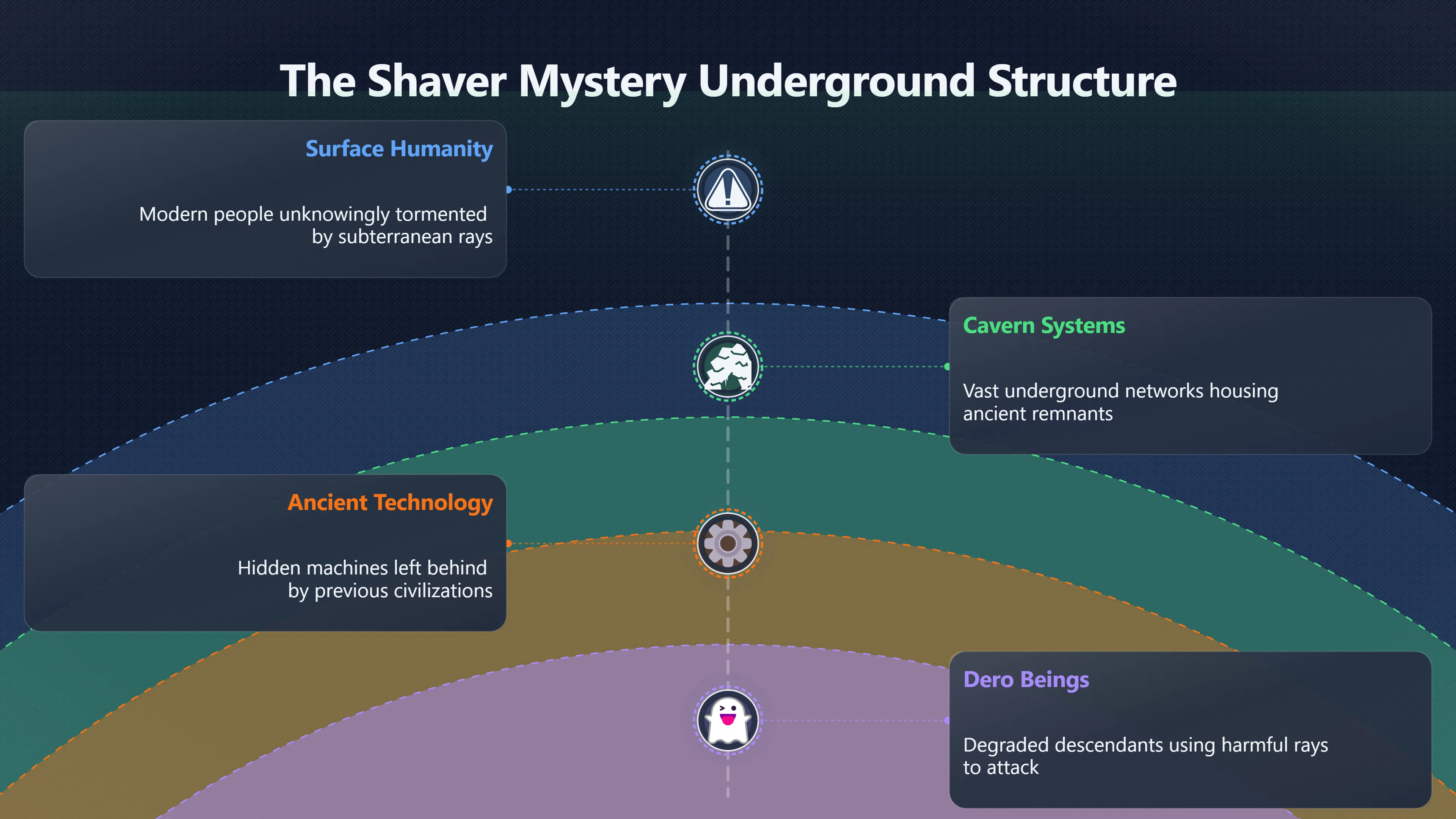
The Shaver Mystery began when Richard Shaver, a factory worker and aspiring writer, sent unusual material to Amazing Stories. He claimed that remnants of an ancient civilisation had retreated underground long ago, leaving behind advanced technologies. According to Shaver, degraded descendants known as “Deros” used hidden machines and harmful rays to torment humanity from vast cavern systems beneath the Earth.[thelivingmoon.com]thelivingmoon.comKenneth ArnoldFirst Flying Saucer Sighting June 1947…
Editor Ray Palmer recognised something unusual in the submission. Rather than publishing it as ordinary fiction, he heavily revised and promoted it as material that might contain genuine revelations. The resulting story, “I Remember Lemuria”, appeared in 1945 and triggered an extraordinary response. Palmer continued publishing Shaver material and related stories, increasingly presenting the mystery as something readers should investigate rather than merely enjoy.[pulpfest.com]pulpfest.comThe AMAZING Story: The Forties — “Gimme Bang-Bang” – Pulp FestThe AMAZING Story: The Forties — “Gimme Bang-Bang” – PulpFestMarch 6, 2026…
This was the crucial innovation. Earlier pulp magazines had encouraged speculation about future science, lost worlds and alien life, but the Shaver Mystery invited readers to ask a different question: what if these stories were true? Palmer repeatedly blurred editorial categories, presenting alleged evidence, correspondence and commentary alongside narrative material. The result was neither conventional journalism nor conventional fiction. It occupied an unstable middle ground that would later become familiar in UFO culture.[pulpfest.com]pulpfest.comThe AMAZING Story: The Forties — “Gimme Bang-Bang” – Pulp FestThe AMAZING Story: The Forties — “Gimme Bang-Bang” – PulpFestMarch 6, 2026…
Reader letters turned a story into a movement
The most important feature of the Shaver Mystery may not have been the stories themselves but the reaction they generated. Readers flooded Amazing Stories with letters claiming personal experiences that seemed to support Shaver’s claims. Some described strange lights, mysterious voices, harmful rays or encounters with unexplained phenomena. Palmer published many of these accounts, creating the impression that independent witnesses were confirming the mystery.[thelivingmoon.com]thelivingmoon.comKenneth ArnoldFirst Flying Saucer Sighting June 1947…
This feedback loop transformed the magazine. Instead of a one-way relationship between writer and audience, readers became participants. Personal testimony acquired a status almost equal to fictional narrative. Claims were rarely subjected to rigorous verification, yet their accumulation created a sense of collective evidence. The magazine increasingly resembled a forum for believers as much as a science-fiction publication.[thelivingmoon.com]thelivingmoon.comKenneth ArnoldFirst Flying Saucer Sighting June 1947…
The circulation impact was dramatic. Contemporary accounts report that Amazing Stories rose from roughly 125,000 copies per issue before the Shaver phenomenon to figures approaching or exceeding 200,000 copies as reader interest surged. The success encouraged Palmer to devote large amounts of editorial space to the mystery and to recruit additional writers to contribute related material.[pulpfest.com]pulpfest.comThe AMAZING Story: The Forties — “Gimme Bang-Bang” – Pulp FestThe AMAZING Story: The Forties — “Gimme Bang-Bang” – PulpFestMarch 6, 2026…
Yet the same process generated criticism. Some readers and commentators worried that the magazine was encouraging vulnerable people to treat fantasy as reality. One published critic warned that readers might accept the claims as factual and pointed to letters describing underground radiations and mysterious aerial phenomena as evidence that the boundary between fiction and belief had become dangerously unclear.[thelivingmoon.com]thelivingmoon.comKenneth ArnoldFirst Flying Saucer Sighting June 1947…

Why June 1947 made the overlap hard to ignore
The timing of the Shaver Mystery’s peak proved historically significant. In June 1947, Amazing Stories published an issue devoted entirely to Shaver-related material. It appeared during the high-water mark of Palmer’s campaign to present the mystery as something more than fiction.[pulpfest.com]pulpfest.comThe AMAZING Story: The Forties — “Gimme Bang-Bang” – Pulp FestThe AMAZING Story: The Forties — “Gimme Bang-Bang” – PulpFestMarch 6, 2026…
That same month, Kenneth Arnold reported seeing nine unusual objects near Mount Rainier on 24 June 1947, an event widely regarded as the beginning of the modern flying-saucer era. Newspapers across the United States suddenly filled with reports of strange craft in the sky.[Wikipedia]WikipediaFlight 105 UFO sightingFlight 105 UFO sighting
The coincidence did not go unnoticed. Palmer quickly connected himself to the emerging saucer story and later became deeply involved in UFO publishing. For observers looking back, June 1947 became a symbolic moment when two previously separate streams—science-fiction pulp culture and public UFO testimony—appeared to converge. A magazine that had spent years publishing hidden-world claims, mysterious rays and reader witness reports reached its most intense phase just as the flying-saucer phenomenon entered national consciousness.[wikipedia.org]WikipediaRaymond A. PalmerRaymond A. Palmer
The overlap did not mean that UFO reports were caused by the Shaver Mystery, nor that saucer witnesses were simply repeating pulp fiction. The more important point is cultural. Palmer had already demonstrated that extraordinary claims could be sustained through a mixture of narrative storytelling, editorial advocacy and reader testimony. When flying saucers arrived as a public controversy, a ready-made model existed for treating astonishing reports as both entertainment and possible evidence.[Wikipedia]WikipediaRaymond A. PalmerRaymond A. Palmer
The pulp mystery closest to saucer culture
The Shaver Mystery occupies a distinctive place in the relationship between science fiction and UFO belief because it was not merely a fictional precursor. It actively challenged the boundary between invention and witness testimony. Readers were encouraged to contribute experiences, editors hinted at hidden truths, and circulation rewards favoured ever greater ambiguity.[pulpfest.com]pulpfest.comThe AMAZING Story: The Forties — “Gimme Bang-Bang” – Pulp FestThe AMAZING Story: The Forties — “Gimme Bang-Bang” – PulpFestMarch 6, 2026…
Later UFO culture would repeatedly use similar mechanisms: witness narratives, collections of personal reports, claims of suppressed knowledge, hidden technologies and communities built around shared belief. The Shaver Mystery did not invent all of these elements, but it assembled them inside a mass-market magazine before the flying-saucer boom began. In that sense it was the pulp phenomenon that came closest to functioning like an early UFO movement while still appearing on the science-fiction rack.[wikipedia.org]WikipediaRaymond A. PalmerRaymond A. Palmer

Amazon book picks
Further Reading
Books and field guides related to Relationships betwee d7372c pulp scifi ufo roots 18b6cc shaver mystery ufo b 6f8167. Use these as the next step if you want deeper reading beyond the article.
The Man from Mars
Explains how Palmer, Amazing Stories, the Shaver Mystery and early flying-saucer culture became intertwined.
The Hidden World Volume One
Centers on the Deros, underground civilizations and the core mythology behind the Shaver Mystery.
The Coming of the Saucers
Directly connects Ray Palmer's Shaver-era publishing world to post-1947 UFO belief and reporting.
Flying Saucers—Serious Business
Captures the culture of early UFO belief that emerged from the same milieu the Shaver Mystery helped shape.
eBay marketplace picks
Marketplace Samples
Live-tested eBay searches with available results related to this page.




Endnotes
1.
Source: pulpfest.com
Title: The AMAZING Story: The Forties — “Gimme Bang-Bang” – Pulp Fest
Link:https://pulpfest.com/2026/03/06/the-amazing-story-the-forties-gimme-bang-bang-2/
Source snippet
The AMAZING Story: The Forties — “Gimme Bang-Bang” – PulpFestMarch 6, 2026...
Published: March 6, 2026
2.
Source: Wikipedia
Title: Raymond A. Palmer
Link:https://en.wikipedia.org/wiki/Raymond_A._Palmer
3.
Source: thelivingmoon.com
Title: Kenneth Arnold
Link:https://www.thelivingmoon.com/49ufo_files/03files2/1945_Ray_Palmer.html
Source snippet
First Flying Saucer Sighting June 1947...
Published: June 1947
4.
Source: Wikipedia
Title: Flight 105 UFO sighting
Link:https://en.wikipedia.org/wiki/Flight_105_UFO_sighting
5.
Source: shavertron.com
Title: Man Who Invented Flaying Saucers
Link:https://www.shavertron.com/manwho.html
Source snippet
Man Who Invented Flaying Saucers...
Additional References
6.
Source: reddit.com
Link:https://www.reddit.com/r/conspiracy/comments/jzpw3g
Source snippet
www.reddit.comAliens, Extra-terrestrial or inner terrestrial? Some notes on the subject of the hollow earth and demonic beings trapped th...
7.
Source: youtube.com
Link:https://www.youtube.com/watch?v=LDREY4CHk0c
Source snippet
The Shaver Mystery Richard Shaver Ray Palmer The Devil’s Agent: The True Untold Story of Richard Sharpe Shaver and The Hollow Earth Cult...
8.
Source: youtube.com
Link:https://www.youtube.com/watch?v=3PZfYQ15Co0
Source snippet
Richard Shaver Mystery | Ray Palmer (1977)...
9.
Source: youtube.com
Title: The Shaver Mystery: Science Fiction’s first controversy
Link:https://www.youtube.com/watch?v=1CB0xOwVcSE
Source snippet
The Devil’s Agent: The True Untold Story of Richard Sharpe Shaver and The Hollow Earth Cult...
10.
Source: reddit.com
Link:https://www.reddit.com/r/UFOs/comments/opp75d
Source snippet
Rare first issue of Fate magazine (Spring 1948) - The first major publication outside of newspapers to feature "flying saucers"...
11.
Source: davidhalperin.net
Link:https://www.davidhalperin.net/the-shaver-mystery-richard-shaver-ray-palmer-and-the-quest-for-lemuria-part-3/
12.
Source: youtube.com
Title: Secrets of the Shaver Mystery
Link:https://www.youtube.com/watch?v=FRHOj4-_kAM
Source snippet
The Shaver Mystery: Science Fiction's first controversy...
13.
Source: books.google.com
Title: The Coming of the Saucers: A Documentary Report on Sky Objects that Have
Link:https://books.google.com/books/about/The_Coming_of_the_Saucers.html?id=Fux7V5ROz-sC
Source snippet
Kenneth Albert Arnold, Ray Palmer - Google Books...
14.
Source: oona13.com
Link:https://oona13.com/archive/image/5767
Source snippet
Amazing Stories June 1947 – The Shaver Mystery Underground Dero Cave Cover | OONA 13...
Published: June 1947
15.
Source: en.wikisource.org
Title: Amazing Stories/Volume 21/Number 06
Link:https://en.wikisource.org/wiki/Amazing_Stories/Volume_21/Number_06
Source snippet
Wikisource, the free online library...
Topic Tree