Within Blue Book
How Official UFO Files Became Fiction Fuel
The public archive gave writers a ready-made texture of case numbers, memoranda, witness reports and official denials.
On this page
- What the declassified archive made visible
- Why case files feel more persuasive than pure invention
- How denials, gaps and redactions support fictional plots
Page outline Jump by section
Introduction
Project Blue Book became valuable to science fiction not because it resolved the UFO question, but because it left behind a vast collection of official-looking mysteries. Once the Air Force files were declassified and transferred to public archives, writers gained access to thousands of pages of case reports, witness statements, photographs, memoranda and investigative summaries. The records carried the authority of government paperwork while preserving uncertainty around many incidents. That combination—bureaucratic detail mixed with unresolved questions—made the archive an unusually rich source of story material. Rather than inventing an entire mythology from scratch, authors could draw on documents that already looked authentic and then imagine what might exist beyond the pages.[National Archives]archives.govNational Archives Project BLUE BOOKNational ArchivesProject BLUE BOOK - Unidentified Flying Objects | National ArchivesJune 25, 2024…

What the declassified archive made visible
When Project Blue Book records entered public custody, readers could examine much more than simple sighting summaries. The archive included chronological case files, administrative correspondence, investigative records and indexes that allowed individual incidents to be traced through official channels. The National Archives describes tens of thousands of pages organised around specific reports and locations, creating a documentary landscape that resembled the raw material of a detective novel.[National Archives]archives.govNational Archives Project BLUE BOOKNational ArchivesProject BLUE BOOK - Unidentified Flying Objects | National ArchivesJune 25, 2024…
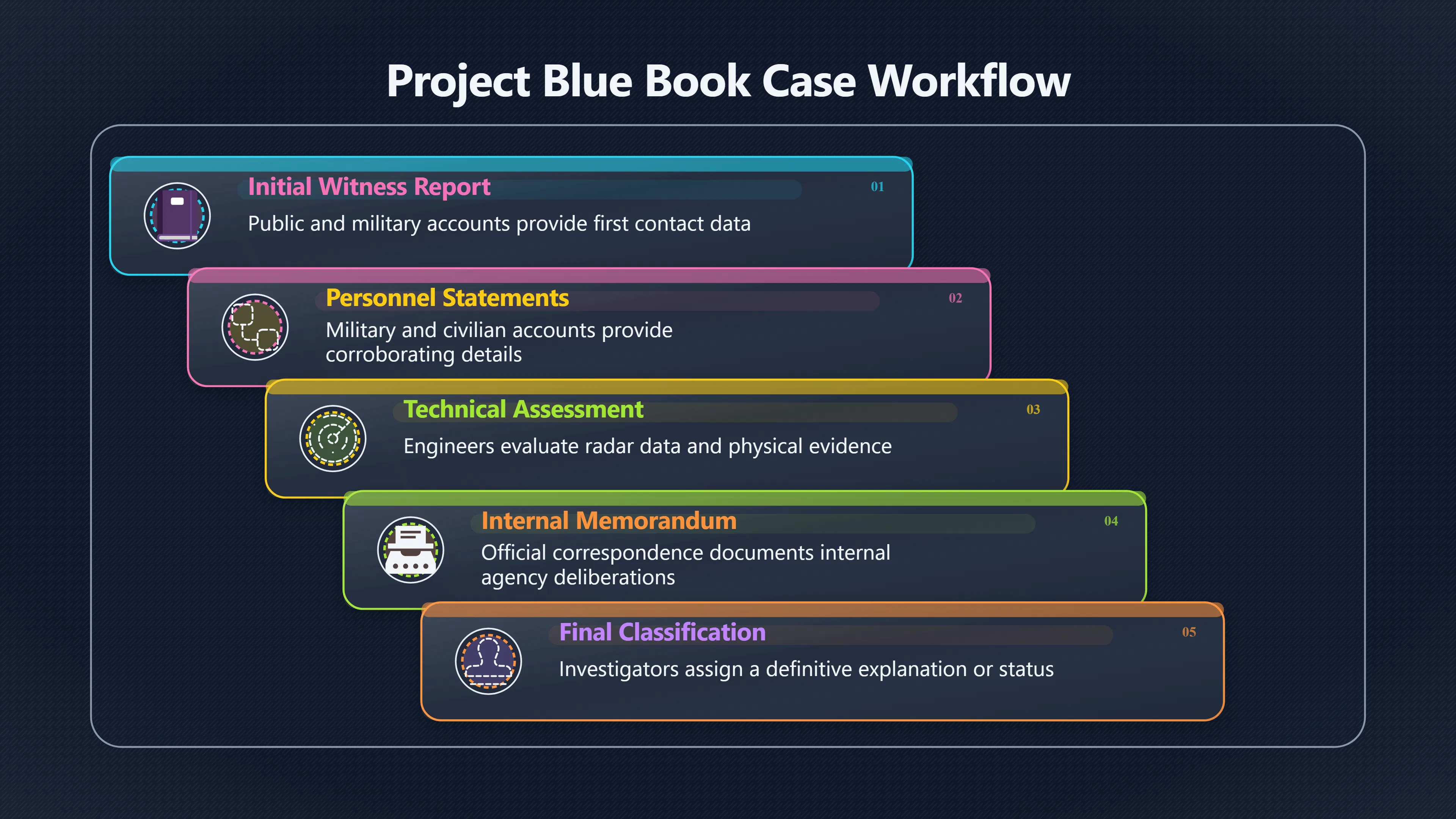
For science-fiction writers, the attraction was not merely the sightings themselves. The files revealed how institutions reacted to unexplained events. A typical case might include:
- An initial witness report.
- Statements from military personnel or civilians.
- Technical assessments.
- Internal memoranda.
- A final classification or explanation.
This structure supplied a ready-made narrative framework. Instead of beginning with an alien encounter, a writer could begin with a file folder, a case number or a forgotten report. The story then emerged through investigation, discovery and reinterpretation.
The accessibility of the archive expanded this creative potential. Digitised collections and searchable databases now allow readers to browse thousands of declassified documents, search by location or keyword, and follow specific incidents through multiple records. The archive effectively became a publicly available library of plot seeds.[theprojectbluebookarchive.org]theprojectbluebookarchive.orgThe Project Blue Book ArchiveThe Project Blue Book Archive
Why case files feel more persuasive than pure invention
A fictional account often becomes more convincing when it borrows the language and structure of real institutions. Blue Book files provided exactly that texture.
Official reports tend to contain dates, signatures, classifications, technical descriptions and procedural language. Even when the contents are uncertain, these features create an impression of authenticity. Readers encounter not just a claim but a documented claim. A report stating that investigators interviewed witnesses, examined photographs and reached an inconclusive result feels different from a completely invented narrative.
Science-fiction authors learned to replicate this documentary style. Stories increasingly appeared as collections of reports, recovered files, intelligence briefings and investigative dossiers. The dramatic question shifted from “Did aliens arrive?” to “What does this file really mean?” The Blue Book archive demonstrated how suspense could be generated through paperwork itself.
The effect is especially powerful because many Blue Book cases end without dramatic conclusions. The archive contains numerous ordinary explanations, but it also contains reports that remained unresolved. The existence of officially designated “unidentified” cases allowed fiction writers to operate in a space between certainty and speculation. The government had not confirmed extraordinary explanations, yet it had not eliminated every mystery either.[National Archives]archives.govNational Archives Project BLUE BOOKNational ArchivesProject BLUE BOOK - Unidentified Flying Objects | National ArchivesJune 25, 2024…
How denials, gaps and redactions support fictional plots
The most useful elements of the archive were often not the reported sightings but the absences surrounding them.
Official investigations routinely produce incomplete records. Witnesses may disagree. Evidence may be missing. Pages may be sanitised or partially redacted. Explanations may appear unsatisfying. These characteristics are frustrating for historians but invaluable for fiction.
Three recurring features proved especially adaptable:
Official denial. Many Blue Book conclusions rejected extraterrestrial interpretations. In fiction, such denials can become narrative obstacles. Characters suspect that the official explanation conceals a deeper truth.
Missing information. Some files lack decisive evidence. Writers can imagine what was never recorded, lost or deliberately removed.
Contradictory interpretations. Different investigators sometimes viewed the same incident differently. Fiction can transform those disagreements into conflicts between agencies, scientists or witnesses.
Because the archive already contains real examples of uncertainty, fictional embellishment can be attached to an existing documentary foundation. The reader sees a plausible institutional record before encountering the speculative element.
The archive as a catalogue of narrative triggers
Blue Book documents also supplied recurring motifs that became familiar within science fiction.
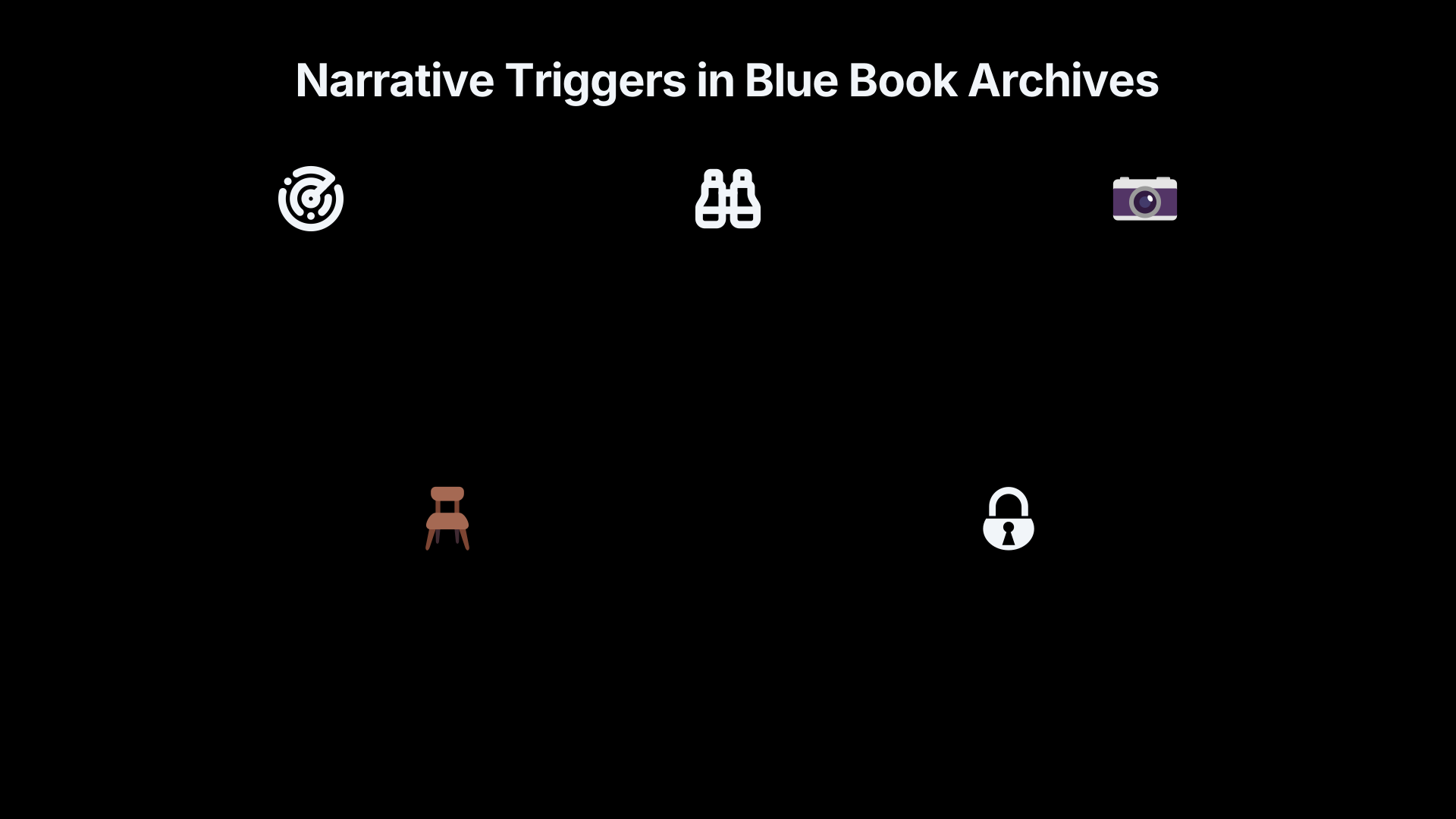
Case files frequently contain elements such as:
- Radar contacts that do not match visual observations.
- Pilot or military witness testimony.
- Multiple independent observers.
- Physical traces or photographs.
- Investigative disagreements.
- Sudden closure of an inquiry.
Each element functions as a narrative trigger. A writer can ask what happens if the unexplained object truly was extraordinary, if investigators suppressed a discovery, or if an overlooked document changes the meaning of a decades-old case.
Importantly, the archive offers these motifs in documentary form rather than as folklore. The reports look like evidence, even when they do not prove anything. That appearance of evidence is what gives many UFO-inspired science-fiction stories their distinctive tone. They read less like fantasy and more like investigations into a hidden reality.
From public records to fictional worlds
The broader significance of the declassified Blue Book archive lies in how it blurred the boundary between historical record and imaginative storytelling. The files provided factual artefacts—dates, locations, interviews, classifications and conclusions—that could be quoted, adapted or reinterpreted. Yet they also preserved ambiguity. The Air Force’s official position was that no evidence demonstrated extraterrestrial visitors, but the archive’s unresolved cases ensured that questions remained.[National Archives]archives.govNational Archives Project BLUE BOOKNational ArchivesProject BLUE BOOK - Unidentified Flying Objects | National ArchivesJune 25, 2024…
For science fiction, that combination was ideal. A fully solved archive would have offered little room for invention. A completely fabricated mythology would have lacked documentary weight. Blue Book occupied the middle ground: a genuine government record set filled with enough uncertainty to invite narrative expansion. The result was a durable source of fiction fuel, where case numbers, memoranda, witness reports and official denials became building blocks for stories about hidden knowledge, secret investigations and possibilities that official files never quite closed.
Amazon book picks
Further Reading
Books and field guides related to Relationships betwee d7372c project blue book 07c262 blue book story mate 09b658. Use these as the next step if you want deeper reading beyond the article.
Passport to Magonia
Explores how unexplained reports evolve into folklore and narratives.
Endnotes
1.
Source: archives.gov
Title: National Archives Project BLUE BOOK
Link:https://www.archives.gov/research/military/air-force/ufos
Source snippet
National ArchivesProject BLUE BOOK - Unidentified Flying Objects | National ArchivesJune 25, 2024...
Published: June 25, 2024
2.
Source: theprojectbluebookarchive.org
Title: The Project Blue Book Archive
Link:https://www.theprojectbluebookarchive.org/
3.
Source: theprojectbluebookarchive.org
Title: www.theprojectbluebookarchive.org The Project Blue Book Archive
Link:https://www.theprojectbluebookarchive.org/archive
Source snippet
Project Blue Book Archive...
4.
Source: youtube.com
Title: Project Blue Book
Link:https://www.youtube.com/watch?v=jjinS2lZAsY
Source snippet
Garrett M. Graff — UFO - with David Ignatius...
5.
Source: bluebookfiles.org
Link:https://bluebookfiles.org/doc/17637
Source snippet
Project Blue Book ArchiveProject Blue Book Archive — Declassified UFO Documents 1947-1969...
6.
Source: bluebookfiles.org
Link:https://bluebookfiles.org/doc/13994
Source snippet
Project Blue Book ArchiveProject Blue Book Archive — Declassified UFO Documents 1947-1969...
7.
Source: disclosdex.com
Title: Project BLUE BOOK
Link:https://disclosdex.com/links/project-blue-book-national-archives
Source snippet
National Archives Records Guide | DisclosdexJune 25, 2024...
Published: June 25, 2024
Additional References
8.
Source: reddit.com
Link:https://www.reddit.com/r/UAP/comments/1rspczs/the_3_declassified_unknowns_from_project_blue/
Source snippet
3 declassified "Unknowns" from Project Blue Book: When physical trace evidence and radar data completely defied the official explanations...
9.
Source: youtube.com
Title: HISTORY of UFOs
Link:https://www.youtube.com/watch?v=5xoYR0YjGh8
Source snippet
DECLASSIFIED CIA and KGB FILES Shocking intelligence cases that shouldn't have existed! | Sleep...
10.
Source: legalclarity.org
Title: Legal Clarity National Archives UFO Records: Accessing Project Blue Book
Link:https://legalclarity.org/national-archives-ufo-records-accessing-project-blue-book/
Source snippet
National Archives UFO Records: Accessing Project Blue Book - LegalClarity...
11.
Source: cia.gov
Title: www.cia.gov EXTRACT S FROM SSU FILES | CIA FOIA (foia.cia.gov)
Link:https://www.cia.gov/readingroom/document/cia-rdp81-00706r000100260045-4
Source snippet
FROM SSU FILES | CIA FOIA (foia.cia.gov)April 10, 1947...
Published: April 10, 1947
12.
Source: youtube.com
Title: 25 Declassified Government Projects That Sound Like Science Fiction
Link:https://www.youtube.com/watch?v=JaqduCP5yVo
Source snippet
HISTORY of UFOs - Episode 2 - The 1940s and 1950s - The [Roswell]({{ 'roswell/' | relative_url }}) Incident and Project Blue Book...
13.
Source: commons.wikimedia.org
Title: File:Project Blue Book report
Link:https://commons.wikimedia.org/wiki/File%3AProject_Blue_Book_report_-_1952-08-8756976-Case_Files_of_Individual_Sightings.pdf
Source snippet
1952-08-8756976-Case Files of Individual Sightings.pdf - Wikimedia CommonsAugust 1, 1952...
Published: August 1, 1952
14.
Source: youtube.com
Title: Garrett M. Graff — UFO
Link:https://www.youtube.com/watch?v=8tLX00F5LgQ
Source snippet
25 Declassified Government Projects That Sound Like Science Fiction...
15.
Source: xfiles.agency
Title: www.xfiles.agency X-Files
Link:https://www.xfiles.agency/
Source snippet
www.xfiles.agencyX-Files - Unidentified Aerial Phenomena...
16.
Source: youtube.com
Link:https://www.youtube.com/watch?v=Z3Fd2SJufn4
Topic Tree