Within UFO Fiction
Are UFO Encounters Old Myths in New Clothes?
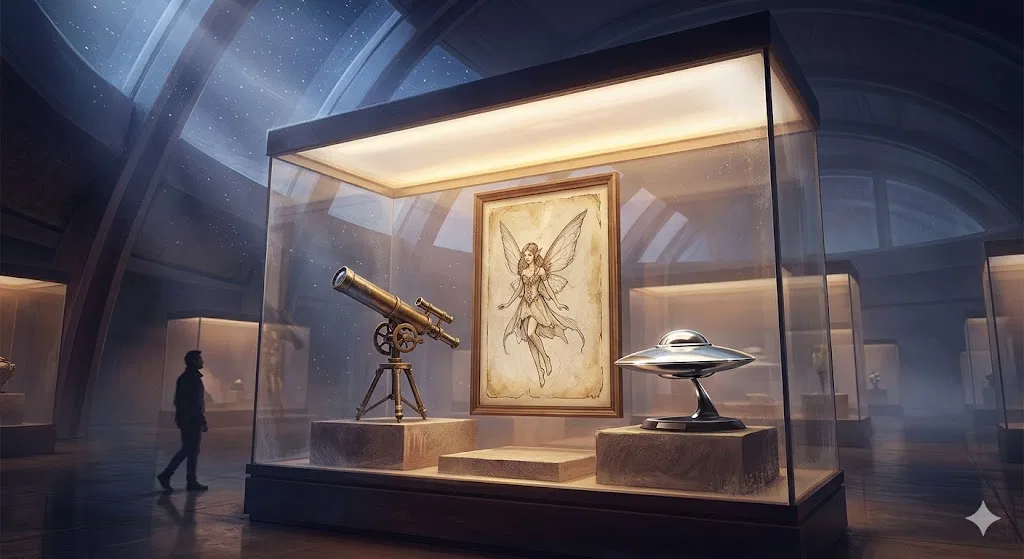
Modern alien encounters often echo older stories about fairies, angels, demons, sky beings, and mysterious visitors.
On this page
- Older visitor traditions
- Technology as a modern skin
- Where folklore comparison helps and misleads
Page outline Jump by section
Introduction
Alien encounter stories are not simply science fiction plots leaking into real life, and they are not just ancient fairy tales with spaceships pasted on. They sit in the overlap between older folklore and modern technological imagination. Across centuries, people have told stories about strange lights in the sky, otherworldly visitors, missing time, journeys to hidden realms, uncanny beings, miraculous warnings and frightening intrusions into bedrooms. Modern UFO culture gives those older story patterns a new vocabulary: craft become spacecraft, shining beings become extraterrestrials, magic paralysis becomes technological restraint, and enchanted journeys become abductions.
This matters for understanding the relationship between UFOs and science fiction because science fiction did not create the basic encounter pattern from nothing. It supplied a modern “skin” for older narrative roles: the visitor from beyond, the warning from the heavens, the secret realm, the chosen witness and the violated boundary between ordinary life and the unknown. Folklore comparison helps explain why UFO stories feel both futuristic and strangely familiar.
Older Visitor Traditions
Long before “flying saucers” entered popular language in 1947, people already had story frameworks for interpreting strange presences from above, outside or elsewhere. Angels, demons, fairies, spirits, hidden peoples, prophetic signs and miraculous lights all offered ways to describe encounters that seemed to break normal rules. The details varied by religion, region and period, but the underlying narrative problem was similar: something appears from beyond ordinary social life, interacts with a human witness, and leaves behind fear, wonder, confusion or revelation.
Folklorists are interested in this because UFO accounts often behave like living tradition rather than like fixed doctrine. They circulate through testimony, rumours, press reports, drawings, interviews, local memory, popular books, television and online forums. The Library of Congress explicitly treats UFOs and flying saucers as part of American folk culture, noting that such stories appear not only in media but also in ethnographic collections of ordinary people’s accounts. One example it highlights is a West Virginia hunting story in which a witness described an unexplained light and then cautiously framed it as something that could be called a UFO. The important point is not that the sighting was “really” alien; it is that the witness reached for a culturally available category to make sense of an ambiguous experience.[The Library of Congress]loc.govUFOs and Aliens Among Us | Life on Other Worlds | Articles and Essays | Finding Our Place in the Cosmos: From Galileo to Sagan and Beyond…
Older fairy and spirit traditions offer especially close comparisons with alien encounter narratives. Folklore about fairies often includes sudden appearances, luminous beings, missing time, bodily marks, strange music, altered states, abduction to another realm, warnings not to reveal what happened, and uncertainty about whether the event was physical, visionary or dreamlike. UFO abduction stories often contain comparable structures: an ordinary person is taken from a familiar place, enters an uncanny space, meets non-human beings, undergoes examination or instruction, and returns changed, confused or unable to account for elapsed time.
The comparison is not that fairies “were aliens” or aliens “are fairies”. It is that both traditions organise extraordinary experience through available cultural language. A medieval or early modern witness might describe a hidden people, a saintly apparition or a demonic presence. A twentieth-century witness, surrounded by rockets, satellites, science fiction cinema, nuclear anxiety and space-age journalism, is more likely to describe extraterrestrials, spacecraft, implants, beams and advanced instruments.

Technology as a Modern Skin
The strongest folklore link is not a one-to-one match between fairies and aliens. It is the way modern encounter stories translate old motifs into technological form. The “otherworld” becomes outer space. The enchanted vehicle becomes a craft. The wand, charm or spell becomes a ray, scanner, implant or medical instrument. The supernatural command becomes telepathic communication. The hidden realm beneath hills, across water or beyond the sky becomes an interstellar base, mothership or secret installation.
This technological translation is especially clear in alien abduction narratives. Research on UFO-abduction stories has noted that they are largely a late twentieth-century and early twenty-first-century phenomenon shaped by the growing presence of sophisticated technology in everyday life. Kimberly Ball’s study of UFO-abduction narratives argues that these stories imagine a hyper-technological future entering intimate spaces: the home, the body and even the mind. In that sense, the abducting alien functions not only as a visitor from space but as a figure for anxieties about machines, medical intervention, reproductive technology and loss of bodily control.[ocf.berkeley.edu]ocf.berkeley.eduOpen source on berkeley.edu.
This is where science fiction becomes central. Science fiction provides the images that make the technological skin plausible: laboratories, spacecraft interiors, emotionless intelligences, biological engineering, hybrid beings, artificial reproduction and communication without speech. Ball’s analysis notes that aliens in abduction narratives are often imagined as emotionally cold or machine-like, with the familiar “grey” alien sometimes discussed as robotic, cloned or engineered. That quality connects the alien not just to older demons or fairies, but to modern fears about dehumanising technology.[ocf.berkeley.edu]ocf.berkeley.eduOpen source on berkeley.edu.
The UK National Archives’ UFO files show how flexible this modern mythic language can be. Its material on reported alien encounters includes correspondence about crashed craft, claims of being brought to Earth against one’s will, sketches of alien abductors, Men in Black encounters, peaceful telepathic aliens and reports in which time appeared to stand still. These examples show UFO lore as a mixed narrative field: part bureaucratic file, part science-fiction imagery, part personal testimony, and part contemporary legend.[The National Archives]nationalarchives.gov.ukThe National Archives UFO reportsThe National ArchivesUFO reports - The National Archives…
That flexibility also explains why UFO stories travelled so easily across national cultures. The Folklore Society’s description of David Clarke and Andrew Robinson’s work on British flying saucer belief notes that saucer-related beliefs began in the United States in 1947, reached Europe from around 1950, and then acquired a distinctly British flavour through newspapers, magazines, television, clubs, photographs and witness drawings. “Contactees” in Britain emulated American stories about people who met and communicated with space people, but the imported myth became embedded in local beliefs and media habits.[folklore-society.com]folklore-society.comFlying Saucery: How UFOs Landed in the British IslesFlying Saucery: How UFOs Landed in the British Isles
Why Bedroom Encounters Feel Older Than Space Travel
Some alien abduction stories are most plausibly read through a second folklore pathway: sleep paralysis and nightmare tradition. Sleep paralysis occurs when a person becomes conscious while the body remains temporarily immobilised during a sleep-wake transition. It can involve fear, a sensed presence, pressure on the chest, buzzing or humming, lights, bodily vibrations and vivid hallucinations. Those features have been interpreted in many cultural settings as attacks by witches, hags, demons, spirits or other night visitors.
Susan Blackmore’s discussion of alien abduction and sleep paralysis sets out the overlap directly. She describes typical sleep paralysis episodes as involving paralysis, fear, a sensed presence, buzzing or humming noises, strange lights and sometimes an entity that appears to sit on, shake, strangle or prod the sleeper. She then notes that sleep paralysis has been linked with older traditions such as the Old Hag of Newfoundland and hag-riding in England, before asking whether alien abduction may be a modern sleep paralysis myth.[Dr Susan Blackmore]susanblackmore.ukDr Susan Blackmore Microsoft WordDr Susan Blackmore Microsoft Word
Harvard Gazette coverage of research by Susan Clancy, Richard McNally and others makes a similar point in more psychological terms. It summarises abduction stories in which people wake paralysed, see flashing lights, hear buzzing, feel bodily sensations, encounter grey or green beings, and later interpret the experience as alien intrusion. The same article explains sleep paralysis as a normal disruption between dreaming and waking, and reports that about a quarter of people worldwide have experienced it, with a smaller proportion experiencing the full combination of visual, auditory and tactile hallucinations.[Harvard Gazette]news.harvard.eduGazette Alien abduction claims explained — Harvard GazetteGazette Alien abduction claims explained — Harvard Gazette
Folklore comparison is useful here because it does not require every account to be dismissed as “just a dream”. Instead, it shows how raw experiences are interpreted. A terrifying night episode may be neurologically similar across cultures, but the story attached to it changes. In one setting the intruder may be a witch, demon, ghost or hag. In another, especially after decades of alien-abduction media, the same sensations may be organised into a story of greys, beams, paralysis and medical procedures.
This mechanism also helps explain why abduction stories often feel intimate rather than astronomical. The beings do not usually behave like explorers landing openly on Earth. They enter bedrooms, cars, lonely roads and liminal spaces. They touch bodies, manipulate memory, violate privacy and speak in riddles. Those are old supernatural story functions wearing late modern equipment.

Where Folklore Comparison Helps and Misleads
Folklore comparison helps most when it explains patterns rather than proves origins. It can show why certain motifs keep recurring, why ambiguous experiences become culturally recognisable stories, and why UFO narratives often blend wonder, fear, revelation and bodily vulnerability. It also helps separate two different questions that are often confused: whether a sighting has an identifiable physical cause, and how people narrate the experience afterwards.
The Library of Congress makes this distinction in practice by treating UFO stories as part of twentieth-century American meaning-making, not merely as claims awaiting technical verification. Its discussion places flying saucers alongside media, Cold War fear, folk testimony and sceptical scientific assessment, showing that UFOs became culturally important even when their physical interpretation remained uncertain or contested.[The Library of Congress]loc.govUFOs and Aliens Among Us | Life on Other Worlds | Articles and Essays | Finding Our Place in the Cosmos: From Galileo to Sagan and Beyond…
Folklore also helps explain why UFOs blend so easily with religion and apocalypse. In a Library of Congress folklife interview from the 1970s, one speaker discussed ghosts, flying saucers, government knowledge, the end of time, outer space, the heavens and angels in the same conversational field. That kind of mixing is not sloppy thinking; it is how vernacular belief often works. People draw from several explanatory traditions at once when ordinary categories fail.[The Library of Congress]blogs.loc.govOpen source on loc.gov.
The danger is overreach. Similarity is not identity. A modern alien abduction story may resemble fairy abduction, demonic visitation or sleep paralysis folklore, but resemblance alone does not prove that all such stories have the same cause. Some UFO reports concern lights, aircraft, balloons, atmospheric effects or classified technology rather than beings. Some are jokes, hoaxes or media inventions. Some are sincere but mistaken. Some remain unresolved because the evidence is too poor, not because they are mythic survivals.
It is also misleading to treat folklore as a synonym for falsehood. Folklore is not “nonsense people used to believe”. It is a way communities transmit stories, warnings, memories, jokes, fears and interpretations. A story can be folkloric and still be socially important, emotionally truthful or connected to a real experience. The folklore question is not simply “Did it happen?” but “Why did this form of story make sense to this person, in this place, at this moment?”
The Science-Fiction Feedback Loop
The folklore roots of alien encounters become especially visible once science fiction enters the loop. Older traditions provide deep structures: descent from above, otherworldly visitors, chosen witnesses, hidden knowledge, bodily transformation and journeys beyond ordinary time. Science fiction supplies the modern furniture: saucers, rockets, stars, laboratories, telepathy, mutation, hybrids, implants and government secrecy.
David Clarke’s work on UFO legends and The X-Files shows how this feedback loop operates in popular culture. His study notes that the early seasons of the series drew on contemporary UFO legends including alien abduction, missing time, nasal implants, human-alien hybrids, cover-ups and alien autopsy stories. The show did not invent those motifs, but it broadcast them to an international audience and made them easier for later witnesses, fans and sceptics to recognise.[SHURA]shura.shu.ac.ukOpen source on shu.ac.uk.
This means UFO encounter stories are not simply downstream from fiction. They are part of a circulating culture in which testimony, folklore, official secrecy, journalism, films, television and books continually reshape one another. A reported encounter may inspire a magazine article; the article may influence a film; the film may give later witnesses a vocabulary; later testimony may then be cited as “documented accounts” for new fiction.
That circulation is why modern alien encounters can seem both novel and ancient. They are modern because their surface belongs to the Space Age: craft, extraterrestrials, scanning beams and biological experiments. They are old because their narrative engine belongs to a much longer human habit of telling stories about visitors from beyond the known world who cross a boundary, disturb ordinary life, and leave the witness asking what kind of reality they have entered.
The Useful Takeaway
UFO encounters are not best understood as either “ancient myths with new names” or “pure science fiction mistaken for fact”. The more useful view is layered. At the deepest level are persistent human story patterns about strange visitors, luminous signs, hidden realms and altered time. At the cultural level are religious, folk and local traditions that teach people what kinds of beings can appear and what such appearances might mean. At the modern level are science fiction, aerospace technology, medicine, Cold War secrecy, television and the internet, all supplying new imagery and narrative logic.
That layered view preserves the strangeness of the stories without making them all prove the same thing. It explains why a UFO encounter can sound like a fairy abduction, a religious vision, a nightmare, a medical ordeal and a science-fiction scene at once. It also clarifies why the relationship between UFOs and science fiction is so powerful: science fiction did not replace folklore. It became one of the main ways modern culture continues to do folklore.
Amazon book picks
Further Reading
Books and field guides related to Are UFO Encounters Old Myths in New Clothes?. Use these as the next step if you want deeper reading beyond the article.
Passport to Magonia
Directly argues that modern UFO encounters share patterns with older folklore, fairy lore, and supernatural traditions.
Operation Trojan Horse
Examines parallels between UFO reports, folklore, religious visions, and recurring encounter traditions.
Wonders in the Sky
Explores reports of strange aerial phenomena across centuries, connecting historical accounts with modern UFO narratives.
The Lure of the Edge
Places UFO belief and encounter stories within broader cultural, religious, and myth-making frameworks.
eBay marketplace picks
Marketplace Samples
Live-tested eBay searches with available results related to this page.



Endnotes
1.
Source: loc.gov
Title: The Library of Congress
Link:https://www.loc.gov/collections/finding-our-place-in-the-cosmos-with-carl-sagan/articles-and-essays/life-on-other-worlds/ufos-and-aliens-among-us
Source snippet
UFOs and Aliens Among Us | Life on Other Worlds | Articles and Essays | Finding Our Place in the Cosmos: From Galileo to Sagan and Beyond...
2.
Source: ocf.berkeley.edu
Link:https://www.ocf.berkeley.edu/~culturalanalysis/volume9/pdf/ball.pdf
3.
Source: folklore-society.com
Title: Flying Saucery: How UFOs Landed in the British Isles
Link:https://www.folklore-society.com/event/flying-saucery-how-ufos-landed-in-the-british-isles/
4.
Source: news.harvard.edu
Title: Gazette Alien abduction claims explained — Harvard Gazette
Link:https://news.harvard.edu/gazette/story/2005/09/alien-abduction-claims-explained/
5.
Source: shura.shu.ac.uk
Link:https://shura.shu.ac.uk/31823/9/Clarke-WantToBelieve%28AM%29.pdf
6.
Source: archives.gov
Link:https://www.archives.gov/research/topics/uaps
7.
Source: archives.gov
Link:https://www.archives.gov/research/topics/uaps/moving-images-and-sound
8.
Source: time.com
Title: science dr jung the saucers
Link:https://time.com/archive/6888244/science-dr-jung-the-saucers/
9.
Source: nationalarchives.gov.uk
Title: The National Archives UFO reports
Link:https://www.nationalarchives.gov.uk/explore-the-collection/explore-by-time-period/postwar/ufo-reports/
Source snippet
The National ArchivesUFO reports - The National Archives...
10.
Source: susanblackmore.uk
Title: Dr Susan Blackmore Microsoft Word
Link:https://www.susanblackmore.uk/wp-content/uploads/2017/05/Abduction-by-Aliens-or-Sleep-Paralysis.pdf
11.
Source: blogs.loc.gov
Link:https://blogs.loc.gov/folklife/2024/07/and-a-fire-come-out-at-night-ufos-space-exploration-and-folklife/
12.
Source: nationalarchives.gov.uk
Link:https://www.nationalarchives.gov.uk/help-with-your-research/research-guides/ufos/
13.
Source: cdn.nationalarchives.gov.uk
Link:https://cdn.nationalarchives.gov.uk/documents/the-ufo-files-extract.pdf
14.
Source: cdn.nationalarchives.gov.uk
Link:https://cdn.nationalarchives.gov.uk/documents/briefing-guide-12-07-12.pdf
15.
Source: blogs.loc.gov
Title: hy brasil the supernatural island
Link:https://blogs.loc.gov/maps/2020/06/hy-brasil-the-supernatural-island/
16.
Source: ask.loc.gov
Link:https://ask.loc.gov/science/faq/409587
17.
Source: tile.loc.gov
Link:https://tile.loc.gov/storage-services/service/mss/mss85590/042/042.pdf
18.
Source: contemporarylegend.co.uk
Link:https://contemporarylegend.co.uk/tag/aliens/
19.
Source: shura.shu.ac.uk
Link:https://shura.shu.ac.uk/9397/
Additional References
20.
Source: youtube.com
Title: Tewksbury Public Library: The Legends of Changelings & Evil Faeries
Link:https://www.youtube.com/watch?v=ccX2RL–VqI
Source snippet
The Basement: Joshua Cutchin | Fairies, Bigfoot, and the Connection Nobody Saw Coming...
21.
Source: youtube.com
Title: Passport to [Magonia]({{ ‘magonia/’ | relative_url }}): UFOs, Folklore, and Parallel Worlds – Jacques Vallée
Link:https://www.youtube.com/watch?v=0l8oBAM3s54
Source snippet
Tewksbury Public Library: The Legends of Changelings & Evil Faeries...
22.
Source: youtube.com
Link:https://www.youtube.com/watch?v=B5Y3CvPUIF8
Source snippet
Fairies and Aliens: The Missing Link...
23.
Source: researchgate.net
Link:https://www.researchgate.net/publication/216661363_God%27s_Descending_in_Clouds_Flying_Saucers_Anthropological_Approaches_to_UFOs_in_the_Religious_Register
24.
Source: dreamstudies.org
Link:https://dreamstudies.org/abduction-encounters-sleep-paralysis-and-the-extraordinary/
25.
Source: governmentattic.org
Link:https://www.governmentattic.org/13docs/UFOsRelatedSubjBiblio_Catoe_1969.pdf
26.
Source: indigogroup.co.uk
Link:https://www.indigogroup.co.uk/edge/fairies.htm
27.
Source: reddit.com
Link:https://www.reddit.com/r/mythology/comments/1tlqdyk/can_ufo_lore_and_related_stuff_be_considered/
28.
Source: waterstones.com
Link:https://www.waterstones.com/book/flying-saucers/c-g-jung/9780415278379
29.
Source: abebooks.co.uk
Link:https://www.abebooks.co.uk/9780710086969/Flying-Saucers-Modern-Myth-Things-0710086962/plp
Topic Tree