Within Pulp Roots
How Amazing Stories trained readers for UFOs
Amazing Stories helped turn rockets, alien worlds and future machines into familiar newsstand material before the saucer era.
On this page
- Why a monthly science fiction magazine mattered
- Scientifiction, rockets and journeys beyond Earth
- How newsstand repetition shaped expectations
Page outline Jump by section
Introduction
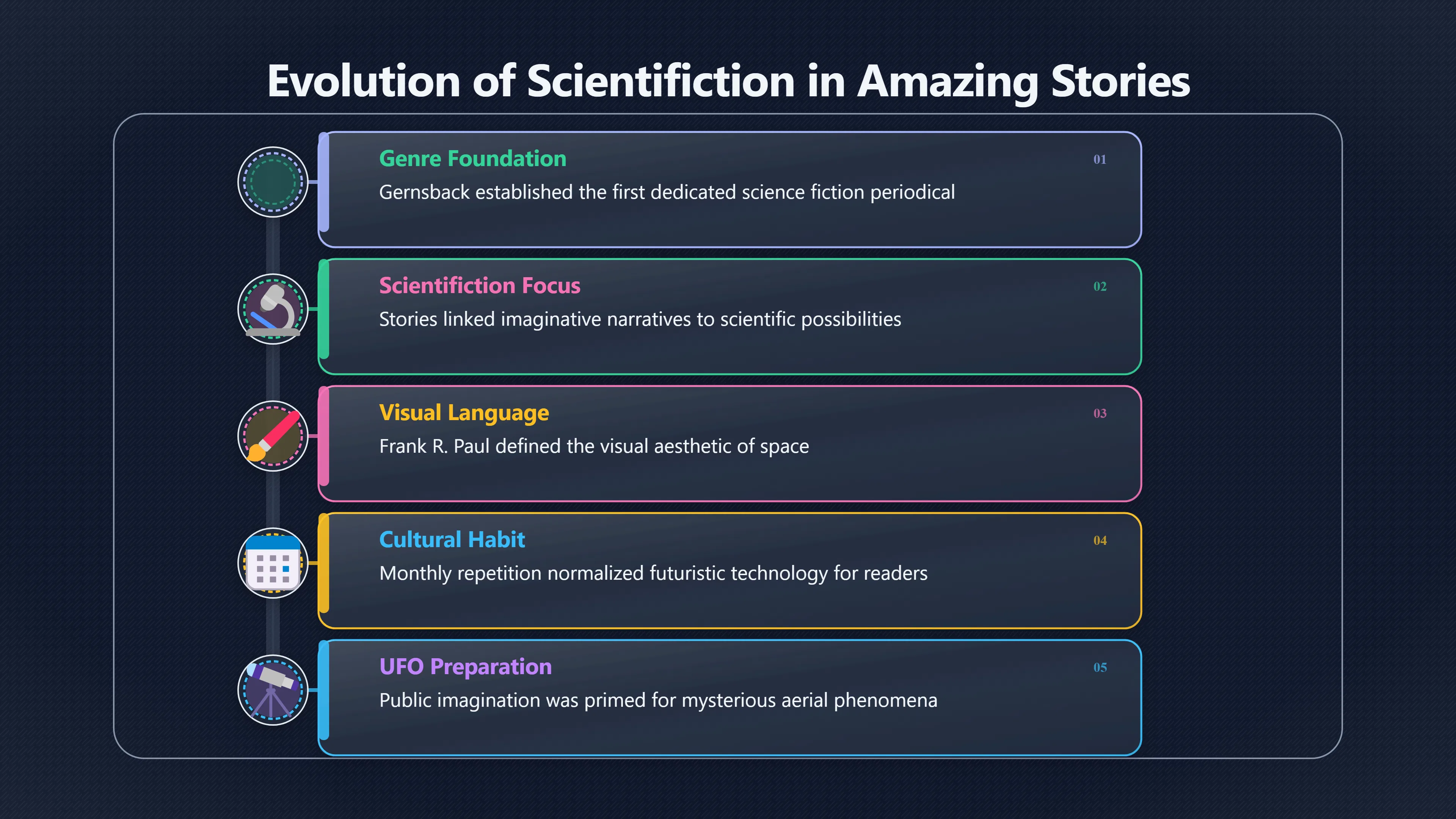
Before flying saucers became headline news in 1947, many readers had already spent years imagining journeys beyond Earth. A major reason was Amazing Stories, launched by Hugo Gernsback in 1926 as the first magazine devoted entirely to science fiction, or what he called “scientifiction”. Unlike earlier novels that readers encountered occasionally, Amazing Stories appeared on newsstands month after month, turning rockets, alien worlds and interplanetary travel into a regular part of popular entertainment.[The British Interplanetary Society]bis-space.comThe British Interplanetary SocietyFrom Amazing Stories to the BIS: 100 Years of “Scientifiction” - The British Interplanetary SocietyMarc… Britannica](https://www.britannica.com/topic/Amazing-Stories)
 This routine mattered. The magazine did more than publish stories about space. It created a habit of expecting new visions of future technology every month. In the decades before the modern UFO era, that steady exposure helped familiarise readers with the idea that the skies might contain engineered craft, unknown civilisations and technologies beyond current human capabilities.[The British Interplanetary Society]bis-space.comThe British Interplanetary SocietyFrom Amazing Stories to the BIS: 100 Years of “Scientifiction” - The British Interplanetary SocietyMarc… Britannica](https://www.britannica.com/art/science-fiction/Mass-markets-and-juvenile-science-fiction)
Why a monthly science fiction magazine mattered
Science-fiction stories existed long before 1926. Readers could find them in books by Jules Verne or H. G. Wells, and occasional examples appeared in general-interest magazines. What changed with Amazing Stories was concentration and repetition. Gernsback gathered stories about scientific possibilities into a dedicated publication that arrived regularly on newsstands.[The British Interplanetary Society]bis-space.comOpen source on bis-space.com. The Public’s Radio](https://thepublicsradio.org/npr/before-sci-fi-was-everywhere-this-pioneering-magazine-championed-scientifiction/)
That seemingly simple publishing decision had important cultural consequences.
- Readers no longer encountered speculative space travel as an occasional literary curiosity.
- Newsstands presented futuristic technology as a recurring category of entertainment.
- Young readers could follow a continuing stream of stories about rockets, distant planets and advanced inventions.
- A community of fans began to form around shared expectations about humanity’s future in space.[The British Interplanetary Society]bis-space.comThe British Interplanetary SocietyFrom Amazing Stories to the BIS: 100 Years of “Scientifiction” - The British Interplanetary SocietyMarc… Britannica](https://www.britannica.com/art/science-fiction/Mass-markets-and-juvenile-science-fiction)
The magazine’s influence extended beyond fiction. Histories of the science-fiction field repeatedly note that Amazing Stories helped transform scattered works into a recognisable genre with its own readership, writers and visual identity.[Encyclopedia Britannica]britannica.comEncyclopedia Britannica Amazing Stories | American magazine | BritannicaEncyclopedia Britannica Amazing Stories | American magazine | Britannica
Scientifiction, rockets and journeys beyond Earth
Gernsback promoted scientifiction as entertainment linked to scientific possibility. In his editorials, he argued that imaginative stories could educate readers about science while encouraging them to think about future technologies and exploration beyond Earth.[The British Interplanetary Society]bis-space.comOpen source on bis-space.com. The Public’s Radio](https://thepublicsradio.org/npr/before-sci-fi-was-everywhere-this-pioneering-magazine-championed-scientifiction/)
The contents of Amazing Stories reflected that ambition. Early issues mixed classic scientific romances with newer tales of Martians, distant worlds, invisible technologies and future inventions. Readers repeatedly encountered narratives built around travel through space rather than remaining confined to Earth.[The British Interplanetary Society]bis-space.comThe British Interplanetary SocietyFrom Amazing Stories to the BIS: 100 Years of “Scientifiction” - The British Interplanetary SocietyMarc… Stories](https://amazingstories.com/2017/01/amazing-histories-april-1926-dawn-scientifiction/)
This was significant because real spaceflight did not yet exist. The first issue appeared more than three decades before Yuri Gagarin’s orbital flight. For readers in the 1920s and 1930s, journeys to other planets belonged entirely to imagination. Yet the magazine presented such journeys so frequently that they became familiar rather than extraordinary.[The British Interplanetary Society]bis-space.comOpen source on bis-space.com. The Public’s Radio](https://thepublicsradio.org/npr/before-sci-fi-was-everywhere-this-pioneering-magazine-championed-scientifiction/)
The effect can be seen in the magazine’s long-term influence. The British Interplanetary Society notes that Amazing Stories inspired readers who later became involved in serious discussions of rocketry and spaceflight. The publication acted not merely as entertainment but as a bridge between imagination and technological aspiration.[The British Interplanetary Society]bis-space.comThe British Interplanetary SocietyFrom Amazing Stories to the BIS: 100 Years of “Scientifiction” - The British Interplanetary SocietyMarc…
Frank R. Paul and the visual reality of space travel
Words alone did not create this sense of familiarity. The artwork of Frank R. Paul was equally important.
Paul’s covers and illustrations filled issues of Amazing Stories with giant spacecraft, alien landscapes, futuristic cities and technological marvels. His images gave visual form to concepts that had never been seen in reality. Readers did not have to imagine every detail for themselves; month after month they could see spaceships travelling between worlds and machines operating in unfamiliar environments.[The British Interplanetary Society]bis-space.comThe British Interplanetary SocietyFrom Amazing Stories to the BIS: 100 Years of “Scientifiction” - The British Interplanetary SocietyMarc… of Illustrators](https://societyillustrators.org/award-winners/frankrpaul/)
The Society of Illustrators describes Paul as a pioneering artist who helped define the visual language of science fiction. His work established many of the images that later generations associated with space travel and advanced technology.[Society of Illustrators]societyillustrators.orgSociety of IllustratorsFrank R. Paul – Hall of Fame 2025 - Society of Illustrators…
For future UFO culture, this visual training was important. Readers became accustomed to the idea that strange craft could exist above Earth, even if the exact shapes differed from the flying saucers that would later dominate popular imagination.[The British Interplanetary Society]bis-space.comThe British Interplanetary SocietyFrom Amazing Stories to the BIS: 100 Years of “Scientifiction” - The British Interplanetary SocietyMarc… of Illustrators](https://societyillustrators.org/award-winners/frankrpaul/)
How newsstand repetition shaped expectations
The most important contribution of Amazing Stories was not a single famous story or illustration. It was repetition.
Every issue reinforced the same broad message: the universe was larger than Earth, technology would continue advancing, and travel between worlds could eventually become possible. Over time, these ideas became familiar cultural assumptions rather than isolated fantasies.[The British Interplanetary Society]bis-space.comOpen source on bis-space.com. The Public’s Radio](https://thepublicsradio.org/npr/before-sci-fi-was-everywhere-this-pioneering-magazine-championed-scientifiction/)
This process worked in several ways:
Normalising technological wonder. Readers repeatedly encountered inventions that exceeded current engineering, making radical technological possibilities seem worth considering rather than dismissing outright.[The British Interplanetary Society]bis-space.comThe British Interplanetary SocietyFrom Amazing Stories to the BIS: 100 Years of “Scientifiction” - The British Interplanetary SocietyMarc… Britannica](https://www.britannica.com/topic/Amazing-Stories)
Making space a destination. Other planets appeared not as distant astronomical objects but as places characters could visit, explore and inhabit.[The British Interplanetary Society]bis-space.comThe British Interplanetary SocietyFrom Amazing Stories to the BIS: 100 Years of “Scientifiction” - The British Interplanetary SocietyMarc… Stories](https://amazingstories.com/2017/01/amazing-histories-april-1926-dawn-scientifiction/)
Creating expectations about discovery. Stories frequently suggested that humanity’s knowledge remained incomplete and that remarkable things might still be found beyond familiar horizons.[The British Interplanetary Society]bis-space.comOpen source on bis-space.com. The Public’s Radio](https://thepublicsradio.org/npr/before-sci-fi-was-everywhere-this-pioneering-magazine-championed-scientifiction/)
Providing a vocabulary for the unknown. By the time reports of mysterious aerial phenomena entered public debate in the late 1940s, many readers already possessed a repertoire of imagined spacecraft, alien visitors and advanced technologies.[The British Interplanetary Society]bis-space.comThe British Interplanetary SocietyFrom Amazing Stories to the BIS: 100 Years of “Scientifiction” - The British Interplanetary SocietyMarc… of Illustrators](https://societyillustrators.org/award-winners/frankrpaul/)
How Amazing Stories trained readers for UFOs
The relationship between Amazing Stories and later UFO culture was indirect rather than causal. The magazine did not predict flying saucers, nor did it provide evidence that UFO reports were real. Instead, it helped shape the cultural environment in which such reports would be interpreted.
When newspapers began discussing strange objects in the sky after 1947, the idea of extraterrestrial craft was not entirely new to many readers. For two decades, pulp magazines had been presenting space travel as a recurring subject of entertainment and speculation. The unknown sky had already been populated with machines, explorers and distant worlds in the public imagination.[The British Interplanetary Society]bis-space.comThe British Interplanetary SocietyFrom Amazing Stories to the BIS: 100 Years of “Scientifiction” - The British Interplanetary SocietyMarc…
That is why Amazing Stories occupies a distinctive place in the history linking science fiction and UFO culture. Its greatest achievement was not inventing space travel as a fictional theme. It was turning space travel into a monthly habit, making extraordinary journeys beyond Earth feel familiar long before anyone claimed to see a flying saucer.[The British Interplanetary Society]bis-space.comThe British Interplanetary SocietyFrom Amazing Stories to the BIS: 100 Years of “Scientifiction” - The British Interplanetary SocietyMarc… Britannica](https://www.britannica.com/topic/Amazing-Stories)
Amazon book picks
Further Reading
Books and field guides related to Relationships betwee d7372c pulp scifi ufo roots 18b6cc amazing stories spac 217726. Use these as the next step if you want deeper reading beyond the article.
The Science Fiction Encyclopedia
Provides context on pulp themes, aliens, spacecraft and future technology.
eBay marketplace picks
Marketplace Samples
Live-tested eBay searches with available results related to this page.


Endnotes
1.
Source: britannica.com
Title: Encyclopedia Britannica Amazing Stories | American magazine | Britannica
Link:https://www.britannica.com/topic/Amazing-Stories
2.
Source: britannica.com
Title: Encyclopedia Britannica Science fiction
Link:https://www.britannica.com/art/science-fiction/Mass-markets-and-juvenile-science-fiction
Source snippet
Encyclopedia BritannicaScience fiction - Futuristic, Imagination, Technology | BritannicaMarch 1, 2026...
Published: March 1, 2026
3.
Source: encyclopedia.com
Title: www.encyclopedia.com Astounding Science Fiction | Encyclopedia.com
Link:https://www.encyclopedia.com/media/encyclopedias-almanacs-transcripts-and-maps/astounding-science-fiction
Source snippet
Science Fiction | Encyclopedia.comMay 14, 2026...
Published: May 14, 2026
4.
Source: youtube.com
Title: Hugo Gernsback
Link:http://www.youtube.com/watch?v=2CnS-ZNvRDs
Source snippet
Frank R. Paul 1920s Cover Art...
5.
Source: youtube.com
Title: [Frank R Paul]({{ ‘frank-r-paul/’ | relative_url }}): Father of Science Fiction Art
Link:http://www.youtube.com/watch?v=OOnhl23FBpw
Source snippet
AMAZING STORIES - WikiVidi Documentary...
6.
Source: youtube.com
Title: AMAZING STORIES
Link:http://www.youtube.com/watch?v=n27svLRW_ms
Source snippet
magazine history Hugo Gernsback Hugo Gernsback - Pulp! Amazing Stories - Extra Sci Fi Extra History...
7.
Source: bis-space.com
Link:https://www.bis-space.com/from-amazing-stories-to-the-bis-100-years-of-scientifiction/
Source snippet
The British Interplanetary SocietyFrom Amazing Stories to the BIS: 100 Years of “Scientifiction” - The British Interplanetary SocietyMarc...
8.
Source: thepublicsradio.org
Link:https://thepublicsradio.org/npr/before-sci-fi-was-everywhere-this-pioneering-magazine-championed-scientifiction/
Source snippet
TPR: The Public's RadioBefore sci-fi was everywhere, this pioneering magazine championed 'scientifiction' - TPR: The Public's RadioApril...
9.
Source: amazingstories.com
Title: amazing histories april 1926 dawn scientifiction
Link:https://amazingstories.com/2017/01/amazing-histories-april-1926-dawn-scientifiction/
Source snippet
Amazing StoriesAmazing Histories, April 1926: The Dawn of Scientifiction - Amazing StoriesJanuary 16, 2017...
Published: april 1926
10.
Source: societyillustrators.org
Link:https://societyillustrators.org/award-winners/frankrpaul/
Source snippet
Society of IllustratorsFrank R. Paul – Hall of Fame 2025 - Society of Illustrators...
Additional References
11.
Source: reddit.com
Link:https://www.reddit.com/r/masseffect/comments/1693fnl
Source snippet
"Hugo Gernsback" was the founder of the earliest sci-fi periodical in the US, *Amazing Stories*.September 3, 2023...
Published: September 3, 2023
12.
Source: artshelp.com
Title: www.artshelp.com The Art And History Of Science Fiction Book Covers
Link:https://www.artshelp.com/the-art-and-history-of-science-fiction-book-covers/
Source snippet
Art And History Of Science Fiction Book Covers...
13.
Source: worldradiohistory.com
Title: www.worldradiohistory.com AMAZIN G STORIES: Gernsback’s Si Fi magazine
Link:https://www.worldradiohistory.com/Amazing-Stories.htm
Source snippet
STORIES: Gernsback's SiFi magazine...
14.
Source: reddit.com
Link:https://www.reddit.com/r/sciencefiction/comments/m23jz1
Source snippet
stories sci fi magazine released its first issue today, back in 1926, with April date.March 10, 2021...
Published: March 10, 2021
15.
Source: reddit.com
Link:https://www.reddit.com/r/sciencefiction/comments/cz5f8p
Source snippet
first issue of Amazing Stories Magazine (April 1926) Cover art by Frank R. PaulSeptember 3, 2019...
Published: September 3, 2019
16.
Source: sites.lib.jmu.edu
Title: From the Collection: Astounding Stories – Pulp Magazines
Link:https://sites.lib.jmu.edu/pulpmagazines/2015/07/15/from-the-collection-astounding-stories/
Source snippet
July 15, 2015...
Published: July 15, 2015
17.
Source: youtube.com
Link:http://www.youtube.com/watch?v=YYkcfCO-KRY
Source snippet
Frank R Paul: Father of Science Fiction Art...
18.
Source: sf-encyclopedia.com
Title: SF E: Amazing Stories
Link:https://sf-encyclopedia.com/entry/amazing
Source snippet
SFE: Amazing StoriesMarch 9, 2026...
Published: March 9, 2026
19.
Source: reddit.com
Link:https://www.reddit.com/r/sciencefiction/comments/o9ra6p
Source snippet
STORIES PULP SCI FI MAGAZINE COVERSJune 28, 2021...
Published: June 28, 2021
20.
Source: youtube.com
Link:http://www.youtube.com/watch?v=6GnFUgqIHsM
Source snippet
Pulp Magazines in the 1920s...
Topic Tree