Within UFO Fiction
Before Saucers, People Imagined Mars
Ideas about canals, life on Mars, and alien civilizations helped prepare the ground for later UFO interpretations.
On this page
- Canals and intelligent Martians
- Astronomy, speculation, and fiction
- How Mars shaped alien expectations
Page outline Jump by section
Introduction
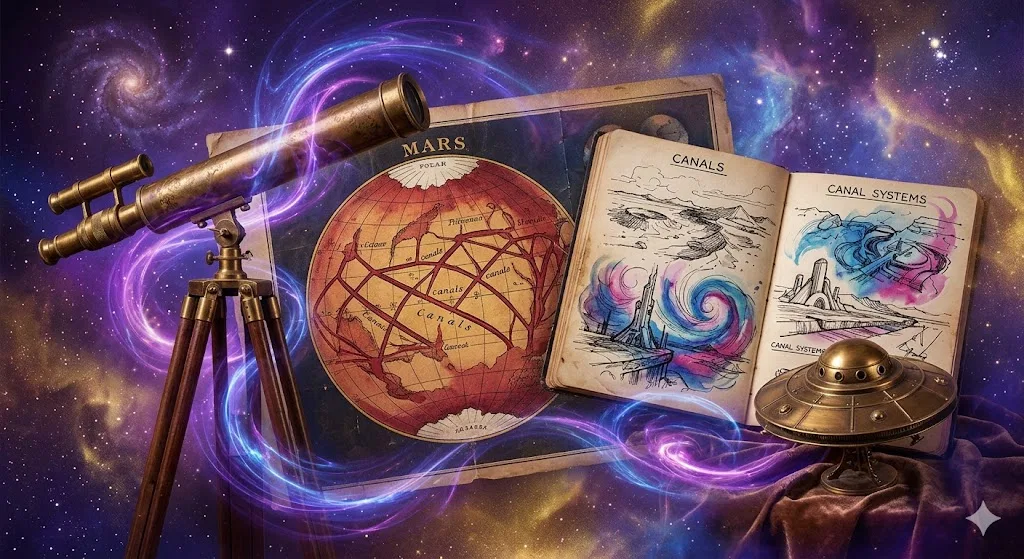
Before people spoke of “flying saucers”, many already had a working image of intelligent extraterrestrials: Martians living on a nearby, ageing world, fighting drought with immense engineering works. That image came from a late nineteenth- and early twentieth-century blend of telescopic observation, translation, popular astronomy, newspaper culture and fiction. The famous “canals” of Mars were not real artificial waterways, but the idea that they might be signs of a civilisation helped make alien intelligence feel close, technological and plausible long before the modern UFO era began.[loc.gov]loc.govSeeing and Interpreting Martian Oceans and CanalsOne of Lowell's central arguments was that the structure of the canals he and other astr…
That matters for the relationship between UFOs and science fiction because the flying saucer did not arrive in an empty imaginative space in 1947. It entered a culture already used to thinking that other planets might host advanced beings, that those beings might be older than humanity, and that astronomical puzzles could be read as evidence of technology. Mars supplied an early template: aliens were not just monsters or spirits, but possible engineers, observers, invaders, neighbours and rivals.
Canals Made Mars Look Engineered
The canal story began with real astronomy, not pure fantasy. During the favourable opposition of Mars in 1877, the Italian astronomer Giovanni Schiaparelli mapped linear-looking features on the planet and called them “canali”, a word better understood as channels. In English-language discussion, however, “canali” became “canals”, a term that strongly suggested artificial construction. The Library of Congress and Adler Planetarium both emphasise that this translation helped shift the public meaning of the markings from uncertain surface features towards possible engineering.[loc.gov]loc.govSeeing and Interpreting Martian Oceans and CanalsOne of Lowell's central arguments was that the structure of the canals he and other astr…
Percival Lowell then turned a suggestive word into a full planetary drama. From his observatory in Flagstaff, Arizona, he argued that the lines were an organised system built by intelligent Martians to carry water from the polar caps across a drying planet. His books, including Mars in 1895, Mars and Its Canals in 1906 and Mars as the Abode of Life in 1908, gave the claim a persuasive narrative shape: Mars was old, arid and inhabited by a civilisation advanced enough to respond to planetary crisis with global infrastructure.[Space]space.comTracing the Canals of Mars: An Astronomer's ObsessionOct 6, 2011 — In his day, Lowell was far and away the most influential populari…
The point was not merely that Mars might contain life. The more powerful idea was that Mars showed signs of purposeful large-scale design. Lowell’s argument treated straightness, regularity and planetary organisation as evidence of mind. The Library of Congress summarises his central claim as the view that the canal structure was something “only intelligent life forms could produce”; that logic made Mars an early training ground for interpreting ambiguous visual evidence as alien technology.[loc.gov]loc.govSeeing and Interpreting Martian Oceans and CanalsOne of Lowell's central arguments was that the structure of the canals he and other astr…
The canal theory also fitted the engineering imagination of its age. The Suez Canal had opened in 1869, the Panama Canal was a major project of the period, and newspapers were accustomed to discussing vast technological schemes. Recent research on Australian newspaper coverage shows that late nineteenth-century readers did not simply absorb canal claims passively; they discussed them through humour, scepticism, engineering analogies and arguments about observational authority. That mix of fascination and doubt is important: Martian civilisation was not a single belief imposed from above, but a public negotiation over what science, instruments and imagination could legitimately infer.[arXiv]arxiv.orgOpen source on arxiv.org.

Astronomy, Speculation and Fiction Reinforced Each Other
The Martian civilisation idea spread because it sat at the boundary between science and storytelling. Astronomers had a visible object to discuss; newspapers had a dramatic hook; fiction writers had a ready-made world. Mars was close enough to be observed through telescopes, similar enough to Earth to invite comparison, and strange enough to support speculation. A pre-space-age survey by Barrie W. Jones notes that belief in life on Mars was widespread in the nineteenth century, including the idea that dark regions might be vegetation; the canal saga was only the most famous expression of a broader habit of reading Mars as a living world.[arXiv]arxiv.orgarXiv Mars Before the Space AgearXiv Mars Before the Space Age
Fiction quickly turned these possibilities into memorable scenarios. The Library of Congress notes that ideas about Martian civilisation were already circulating before Lowell’s best-known canal writings, giving authors motifs they could develop into stories about advanced planetary societies. H. G. Wells’s The War of the Worlds, first serialised in 1897, did not need to reproduce Lowell’s canals in detail; it used the broader premise of a dying, more advanced Mars to imagine invasion from a neighbouring world.[loc.gov]loc.govOpen source on loc.gov.
Edgar Rice Burroughs’s Barsoom stories show the other major route: Mars as adventure world rather than invasion threat. A Princess of Mars and its sequels drew on the picture of a desert planet shaped by canals, ancient races, environmental decline and heroic conflict. Specialist discussion of Burroughs’s Mars notes that his fictional waterways were explicitly tied to “the famous Martian waterways, or canals” known from earthly astronomy, turning speculative observation into world-building machinery.[Tim Major]timjmajor.comTim Major Edgar Rice Burroughs and the Martian canalsTim Major Edgar Rice Burroughs and the Martian canals
These stories did not simply repeat scientific claims. They translated the canal myth into emotional and narrative patterns that later UFO culture would also use:
- The older civilisation: Martians were often imagined as more ancient than humans, sometimes wiser, sometimes exhausted, sometimes predatory.
- The technological signature: A strange line, flash, signal or structure could be read as evidence of non-human intelligence.
- The planetary crisis: Mars was a warning world, its inhabitants driven by scarcity, decline or desperation.
- The near neighbour: Unlike distant stars, Mars was close enough to make contact, invasion or signalling feel imaginable.
By the time flying saucers became headline news after Kenneth Arnold’s 1947 sighting, popular culture had already practised the basic move of turning ambiguous sky-related phenomena into stories about advanced visitors. The object changed from canal to craft, but the interpretive habit had older roots.
Why the Canal Myth Felt Plausible
The canal myth endured because it combined weak evidence with strong plausibility cues. Mars had polar caps that appeared to change with the seasons, visible dark and light markings, and a reddish colour that made it seem both Earth-like and alien. In the limited telescopic conditions of the period, observers could disagree sincerely about what they saw. Some drew straight lines; others saw diffuse patches; others doubted the lines altogether. The uncertainty made room for interpretation.[arXiv]arxiv.orgarXiv Mars Before the Space AgearXiv Mars Before the Space Age
Lowell’s version also gave the observations a coherent mechanism. If Mars was drying, if the polar caps contained water, and if the dark regions changed seasonally, then canals could seem to explain how a civilisation survived. The argument was wrong, but it had the shape of an explanation rather than a random fantasy. It connected visible features to motive, motive to engineering, and engineering to intelligence.[teachastronomy.com]teachastronomy.comOpen source on teachastronomy.com.
Mainstream scientists were not uniformly persuaded. The AP’s review of David Baron’s 2025 book The Martians stresses that Lowell’s claims captivated the public even though many scientists remained sceptical. That division helped the story travel: it could be reported as a live controversy, defended as bold science, mocked as overreach, and used by fiction writers without needing final proof.[AP News]apnews.comOpen source on apnews.com.
The eventual collapse of the canal theory also matters. Better observations and spacecraft data showed that the imagined canal network was not an artificial Martian infrastructure. Mariner 4’s 1965 fly-by revealed a much thinner atmosphere and a cratered surface, while later orbital mapping, especially Mariner 9, helped end the classical canal picture. The falsehood of the canals does not make them culturally irrelevant; it makes them a clear example of how scientific uncertainty, visual ambiguity and popular expectation can join into a durable alien myth.[arXiv]arxiv.orgarXiv Mars Before the Space AgearXiv Mars Before the Space Age
How Mars Prepared Later Alien Expectations
The pre-saucer Martian imagination shaped later UFO expectations less by providing a specific vehicle shape than by establishing a set of assumptions about extraterrestrial intelligence. It taught audiences that alien life might be technological, that astronomical puzzles might contain hidden signs of design, and that the boundary between observation and speculation could be exciting rather than embarrassing.
This is one reason early UFO interpretations so quickly became extraterrestrial interpretations. A strange moving object in the sky did not automatically have to be read as a craft from another world; it could be a balloon, aircraft, meteor, hoax, weapon, mirage or unknown atmospheric event. But by the mid-twentieth century, readers already knew a story in which the heavens contained intelligent neighbours and technology beyond human norms. Mars had helped make that story legible.
The Martian model also gave science fiction a way to make aliens modern. Earlier imagined beings from the sky could be angelic, demonic, magical or mythic. Lowellian Mars made them infrastructural. They built systems, solved environmental problems, managed planetary resources and possibly watched Earth. That technological framing is central to later UFO culture, where the question is usually not just “what is that light?” but “what kind of craft, propulsion, intelligence or civilisation could produce it?”
The comparison is not exact. Martian civilisation stories usually concerned a known planet and imagined societies on its surface; flying saucer stories centred on objects entering Earth’s airspace. But the underlying mechanism is similar: people used available cultural images to interpret ambiguous evidence. In the canal era, a line on Mars could become an aqueduct. In the saucer era, a fast light or shape could become a vehicle. In both cases, science fiction did not simply invent belief; it supplied patterns that made belief narratively available.
The Useful Lesson Is Not “Science Fiction Caused UFOs”
The canal episode is sometimes reduced to a simple moral about mistranslation or gullibility. That is too thin. Schiaparelli’s “canali” mattered, but the larger story involved telescopic limits, public trust in astronomy, the prestige of engineering, newspaper circulation, imperial-era infrastructure projects, environmental fears and fiction’s appetite for inhabited worlds. Recent scholarship on newspaper responses underlines that audiences could be amused, sceptical and fascinated at the same time.[arXiv]arxiv.orgOpen source on arxiv.org.
For UFO history, the better lesson is about cultural readiness. By 1947, the public did not need to invent the extraterrestrial hypothesis from scratch. Popular science and fiction had already normalised several ideas: nearby worlds might be inhabited; alien societies might be older and more advanced; technology might betray their presence; and official or expert interpretation might lag behind public imagination. The flying saucer became a new symbol, but it entered a much older mental landscape.
Mars was therefore one of the main bridges between nineteenth-century astronomical speculation and twentieth-century UFO mythology. Its imagined canals gave alien intelligence a map, a motive and a technological signature. Even after the canals disappeared from serious science, the expectation they helped build remained: somewhere above or beyond Earth, there might be another civilisation, and the first sign of it might be a puzzling thing seen at a distance.
Amazon book picks
Further Reading
Books and field guides related to Before Saucers, People Imagined Mars. Use these as the next step if you want deeper reading beyond the article.
Cosmos
Explores astronomy, extraterrestrial life, and how scientific ideas influence culture.
The Demon-Haunted World
Rating: 4.5/5 from 43 Google Books ratings
Helps explain how observations, speculation, and popular narratives can create enduring beliefs.
The War of the Worlds
Directly reflects the era when Mars and intelligent Martians shaped public expectations about extraterrestrial life.
eBay marketplace picks
Marketplace Samples
Live-tested eBay searches with available results related to this page.



Endnotes
1.
Source: loc.gov
Link:https://www.loc.gov/collections/finding-our-place-in-the-cosmos-with-carl-sagan/articles-and-essays/life-on-other-worlds/seeing-and-interpreting-martian-oceans-and-canals/
Source snippet
Seeing and Interpreting Martian Oceans and CanalsOne of Lowell's central arguments was that the structure of the canals he and other astr...
2.
Source: arxiv.org
Title: arXiv Mars Before the Space Age
Link:https://arxiv.org/abs/0811.2700
3.
Source: space.com
Link:https://www.space.com/13197-mars-canals-water-history-lowell.html
Source snippet
Tracing the Canals of Mars: An Astronomer's ObsessionOct 6, 2011 — In his day, Lowell was far and away the most influential populari...
4.
Source: lowell.edu
Title: percival lowells search for life on mars
Link:https://lowell.edu/percival-lowells-search-for-life-on-mars/
Source snippet
Percival Lowell's Search for Life on MarsPercival Lowell's groundbreaking study of Mars canals in the 1890s sought evidence of intelligen...
5.
Source: arxiv.org
Link:https://arxiv.org/abs/2603.23563
6.
Source: arxiv.org
Link:https://arxiv.org/abs/2603.22906
7.
Source: loc.gov
Link:https://www.loc.gov/static/collections/finding-our-place-in-the-cosmos-with-carl-sagan/articles-and-essays/life-on-other-worlds/envisioning-martian-civilizations.html
8.
Source: teachastronomy.com
Link:https://www.teachastronomy.com/textbook/Life-in-the-Universe/Lowell-and-Canals-on-Mars/
9.
Source: youtube.com
Title: The canals of Mars
Link:https://www.youtube.com/watch?v=ChJKQMiNC2c
Source snippet
Percival Lowell...
10.
Source: youtube.com
Title: Percival Lowell
Link:https://www.youtube.com/watch?v=UvmoKv1BOAw
Source snippet
Does The Canals Of Mars Prove The Existence Of Martians? | NASA's Unexplained Files...
11.
Source: timjmajor.com
Title: Tim Major Edgar Rice Burroughs and the Martian canals
Link:https://timjmajor.com/2013/07/26/edgar-rice-burroughs-and-the-martian-canals/
12.
Source: apnews.com
Link:https://apnews.com/article/477c27190ce06e411d010017b7dbfd07
13.
Source: facebook.com
Link:https://www.facebook.com/groups/spacehipsters/posts/25267328256218719/
14.
Source: Wikipedia
Title: Percival Lowell
Link:https://en.wikipedia.org/wiki/Percival_Lowell
15.
Source: Wikipedia
Link:https://en.wikipedia.org/wiki/Barsoom
16.
Source: Wikipedia
Title: The War of the Worlds
Link:https://en.wikipedia.org/wiki/The_War_of_the_Worlds
17.
Source: space.stackexchange.com
Title: what is the science behind the canals of mars
Link:https://space.stackexchange.com/questions/12184/what-is-the-science-behind-the-canals-of-mars
18.
Source: amazon.co.uk
Title: Mars and Its Canals
Link:https://www.amazon.co.uk/Mars-Its-Canals-Scholars-Choice/dp/129594393X
Additional References
19.
Source: youtube.com
Link:https://www.youtube.com/watch?v=WcFP7Ifb-KU
Source snippet
The Man who was Obsessed with Mars | History | Mistranslations | Japan | Canals | Percival Lowell...
20.
Source: youtube.com
Link:https://www.youtube.com/watch?v=cStCiyOrJNA
Source snippet
Percival Lowell Mars canals history astronomy fiction The canals of Mars Dave Darling...
21.
Source: reddit.com
Link:https://www.reddit.com/r/WarofTheWorlds/comments/wggyok/anyone_know_if_the_fact_that_hg_wells_choose_mars/
22.
Source: facebook.com
Link:https://www.facebook.com/LANDKAcom/videos/martian-canals/3417959091772205/
23.
Source: erbzine.com
Link:https://www.erbzine.com/mag14/1438.html
24.
Source: instagram.com
Link:https://www.instagram.com/p/DUb5Ae9jP1V/
25.
Source: burroughsbibliophiles.com
Link:https://www.burroughsbibliophiles.com/burger.html
26.
Source: historytoday.com
Link:https://www.historytoday.com/archive/feature/martian-century
27.
Source: gutenberg.org
Link:https://www.gutenberg.org/files/47015/47015-h/47015-h.htm
28.
Source: booksandlookspodcast.com
Link:https://booksandlookspodcast.com/the-martian-craze-how-percival-lowell-invented-canals-on-mars-131/
Topic Tree