Within Comics
Why a Simple Saucer Reads as a UFO
Comic panels turned a few simple shapes into a fast visual signal for UFO arrival, danger, wonder, or contact.
On this page
- The oval, rim, and dome as a visual noun
- Why cheap printing rewarded simple silhouettes
- How angle, scale, and placement changed meaning
Page outline Jump by section
Introduction
Mid-century comics helped turn the flying saucer into one of the most efficient visual symbols in popular culture. A reader could glance at a panel for a fraction of a second and immediately recognise “UFO”, even before reading a caption or speech balloon. That instant recognition did not come from realism. It came from a visual mechanism: artists reduced the idea of an unidentified spacecraft to a few simple graphic elements that survived small panels, cheap printing and fast-paced storytelling.
 Within the broader relationship between UFOs and science fiction, comics were especially important because they transformed a debated phenomenon into a stable visual noun. An oval disc, a rim and a dome became enough to signal alien arrival, mystery, danger or contact. Once readers learned that shorthand, artists could change its size, angle and position to create entirely different meanings without changing the basic symbol.[National Air and Space Museum]airandspace.si.edu1947 year flying saucerNational Air and Space Museum1947: Year of the Flying Saucer | National Air and Space MuseumJune 24, 2022…
The Oval, Rim and Dome as a Visual Noun
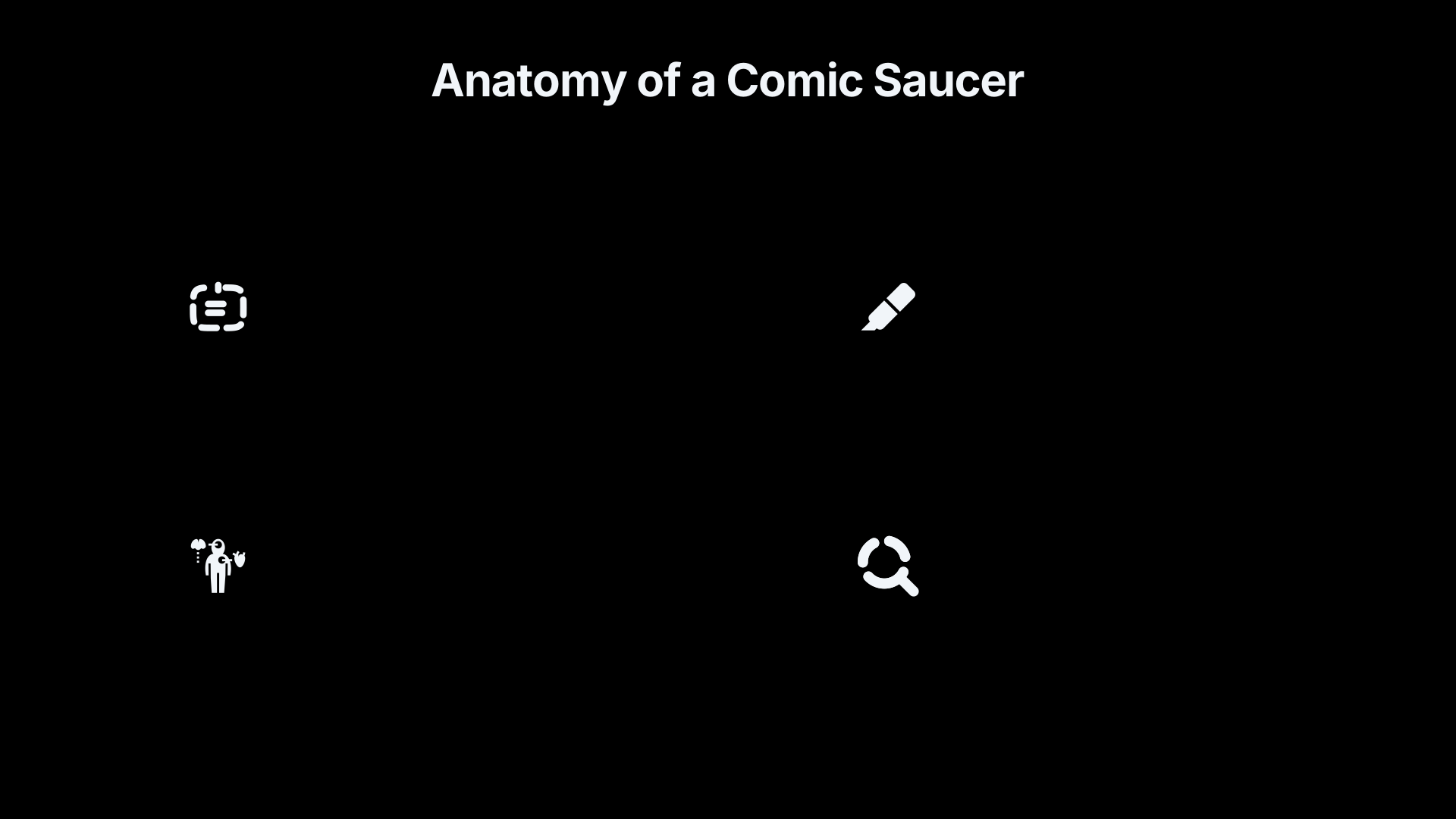
The power of the comic-book saucer lay in reduction. Unlike detailed spacecraft designs, a saucer could be recognised even when drawn with only a handful of lines. The essential formula was remarkably simple:
- An oval or flattened disc for the main body.
- A darker rim suggesting thickness.
- A small dome suggesting a cockpit or observation bubble.
Together, these elements created a silhouette that remained identifiable whether the craft appeared large or tiny, near or distant. Because the shape was symmetrical and geometrically simple, readers could recognise it almost instantly.
This mattered because comics rely heavily on visual hierarchy. Readers scan pages quickly, and artists must communicate meaning before the eye moves on. A distinctive silhouette performs that task more efficiently than a complex design. Repetition across many panels and stories reinforced the association until the saucer itself became a recognised symbol rather than merely a vehicle.[Comics Devices Library]comicsdevices.comComics Devices Library Flow | Comics Devices LibraryComics Devices Library Flow | Comics Devices Library
The symbol also benefited from the popularity of the phrase “flying saucer” after the 1947 Kenneth Arnold sighting. Although Arnold’s original description was more complicated than the classic disc shape, newspapers popularised the saucer label, and visual culture followed. Comics adopted the simplest interpretation because it was easy to draw and impossible to miss. National Air and Space Museum+2National Air and Space Museum[airandspace.si.edu]airandspace.si.edu1947 year flying saucerNational Air and Space Museum1947: Year of the Flying Saucer | National Air and Space MuseumJune 24, 2022…
Why Cheap Printing Rewarded Simple Silhouettes
Many mid-century comics were printed on inexpensive paper using coarse printing processes. Fine details could disappear, blur or fill with ink. Artists therefore favoured bold shapes that remained legible under poor reproduction conditions.
The saucer was ideal for this environment. Its outline remained clear even when:
- Panels were very small.
- Ink lines thickened during printing.
- Colours shifted or faded.
- Backgrounds became visually crowded.
A more elaborate spacecraft might lose important details, but a saucer could be reduced almost to a logo. Readers did not need technical information about propulsion systems, wings or engines. The silhouette alone carried the meaning.
This printing reality encouraged standardisation. Once artists discovered that a disc-and-dome design reproduced reliably, the same shape appeared repeatedly across science-fiction anthologies, adventure comics and newspaper strips. Repetition strengthened recognition, and recognition made the symbol even more useful. The process became self-reinforcing: the simpler the image, the faster it communicated, and the faster it communicated, the more often artists reused it.[Comics Devices Library]comicsdevices.comComics Devices Library Flow | Comics Devices LibraryComics Devices Library Flow | Comics Devices Library
How Angle, Scale and Placement Changed Meaning
The remarkable feature of the saucer symbol was that artists could alter its narrative meaning without changing its basic form.
A distant saucer near the top of a panel suggested mystery. Readers saw something unusual before the characters did. The craft became a visual clue rather than an active participant.
A large saucer dominating the foreground suggested threat. The same oval shape suddenly appeared enormous and overwhelming, making humans seem vulnerable by comparison.
A saucer hovering directly above a house, road or farm transformed an ordinary setting into an encounter scene. The contrast between familiar landscapes and an unfamiliar object created much of the panel’s emotional effect.
Artists also used tilt strategically. A perfectly horizontal saucer implied hovering and observation. A sharply angled saucer implied movement, pursuit or escape. Because the shape was so simple, even a small change in orientation could dramatically alter how the reader interpreted the scene.
These choices worked because comics guide the eye through composition and placement. Position within the panel influences how readers interpret importance, danger and motion. The saucer’s simplicity allowed artists to exploit those compositional tools efficiently.[Comics Devices Library]comicsdevices.comComics Devices Library Flow | Comics Devices LibraryComics Devices Library Flow | Comics Devices Library
Making Static Images Feel Alive
A UFO in a comic panel could not actually move, so artists relied on visual conventions to imply motion and energy. The saucer’s clean geometry made it especially compatible with these techniques.
Speed lines trailing behind a disc suggested rapid flight. Radiating lines around the craft suggested power, vibration or sudden appearance. Motion lines helped readers infer both direction and speed, even though the image itself remained static. Research on visual narratives shows that such graphic conventions improve understanding of movement and help viewers interpret implied motion.[wiley.com]onlinelibrary.wiley.comWiley Online LibraryThe Meaning of Motion Lines?: A Review of Theoretical and Empirical Research on Static Depiction of Motion - Hacımusa…
The saucer shape amplified the effect because it offered a clear reference point. Readers could immediately distinguish the object from the motion indicators surrounding it. A more irregular design would have produced visual clutter; the saucer’s simplicity made the added effects easy to read.
As a result, artists could communicate several ideas simultaneously in a single image: a craft, its direction, its speed and its intention. The reader decoded the message almost automatically.

Why the Mechanism Endured
The comic-book saucer became durable because it balanced ambiguity and certainty. It represented an unidentified object, yet it was immediately identifiable as a UFO. That paradox made it a perfect storytelling tool.
Readers did not need to know who was inside, where it came from or what it wanted. The symbol itself supplied enough information to trigger expectations of contact, invasion, discovery or wonder. Comics therefore helped transform the flying saucer from a reported phenomenon into a visual language.
Once established, the shorthand travelled beyond comics into toys, advertising, television, films and later popular UFO imagery. But comics provided a particularly efficient proving ground. Their need for rapid visual communication rewarded a design that could be recognised in an instant, and the oval disc with a dome proved almost impossible to improve upon. National Air and Space Museum+2si.edu[airandspace.si.edu]airandspace.si.edu1947 year flying saucerNational Air and Space Museum1947: Year of the Flying Saucer | National Air and Space MuseumJune 24, 2022…
Amazon book picks
Further Reading
Books and field guides related to Why a Simple Saucer Reads as a UFO. Use these as the next step if you want deeper reading beyond the article.
The Encyclopedia of Science Fiction
Provides context for recurring UFO and spacecraft imagery.
Understanding Comics
Explains visual shorthand, symbols, and instant recognition in comics.
eBay marketplace picks
Marketplace Samples
Example marketplace items related to this page. Use the search link to explore similar finds on eBay.

Endnotes
1.
Source: onlinelibrary.wiley.com
Link:https://onlinelibrary.wiley.com/doi/full/10.1111/cogs.13377
Source snippet
Wiley Online LibraryThe Meaning of Motion Lines?: A Review of Theoretical and Empirical Research on Static Depiction of Motion - Hacımusa...
2.
Source: centros.edu.xunta.es
Title: Centros Xunta
Link:https://centros.edu.xunta.es/cpidofeal/comic/2elementsofacomic.htm
3.
Source: si.edu
Title: Toy, Flying Saucer, Buck Rogers | Smithsonian Institution
Link:https://www.si.edu/object/nasm_A19970682000
4.
Source: airandspace.si.edu
Title: 1947 year flying saucer
Link:https://airandspace.si.edu/stories/editorial/1947-year-flying-saucer
Source snippet
National Air and Space Museum1947: Year of the Flying Saucer | National Air and Space MuseumJune 24, 2022...
Published: June 24, 2022
5.
Source: comicsdevices.com
Title: Comics Devices Library Flow | Comics Devices Library
Link:https://comicsdevices.com/flow/
6.
Source: airandspace.si.edu
Title: reports ufos 1947 [roswell]({{ ‘roswell/’ | relative_url }}) incident
Link:https://airandspace.si.edu/stories/editorial/reports-ufos-1947-roswell-incident
Source snippet
National Air and Space MuseumReports of UFOs: 1947 Roswell Incident | National Air and Space Museum...
7.
Source: Wikipedia
Title: Flying saucer
Link:https://en.wikipedia.org/wiki/Flying_saucer
Additional References
8.
Source: sciencedirect.com
Link:https://www.sciencedirect.com/science/article/pii/S0006899315000293
Source snippet
The notion of the motion: The neurocognition of motion lines in visual narratives - ScienceDirect...
9.
Source: comicory.com
Title: Comic Book Paneling — A Complete Guide to Panel Design | Comicory
Link:https://www.comicory.com/blog/paneling-in-comics
Source snippet
Comic Book Paneling — A Complete Guide to Panel Design | Comicory...
10.
Source: youtube.com
Title: Can You Draw Aliens With The Loomis Method? | Comics
Link:https://www.youtube.com/watch?v=Cp4W4Ypky60
Source snippet
The UFO Comic Anthology - my Top 10 peculiar moments...
11.
Source: ojs.uhnsugriwa.ac.id
Link:https://ojs.uhnsugriwa.ac.id/index.php/lg/article/view/5491
Source snippet
es: Les-Guet'sNovember 14, 2025...
Published: November 14, 2025
12.
Source: researchgate.net
Link:https://www.researchgate.net/publication/395676767_Whoosh_visual_depictions_of_direction_speed_and_temporality_a_corpus_analysis_of_motion_events_in_global_comics
Source snippet
micsSeptember 19, 2025...
Published: September 19, 2025
13.
Source: reddit.com
Title: www.reddit.com The Kenneth Arnold sighting
Link:https://www.reddit.com/r/HighStrangeness/comments/16k55n0
Source snippet
Kenneth Arnold sightingSeptember 16, 2023...
Published: September 16, 2023
14.
Source: youtube.com
Title: Mastering Panel Composition
Link:https://www.youtube.com/watch?v=sSecXc1Xy7E
Source snippet
Can You Draw Aliens With The Loomis Method? | Comics - Manga - Fundamentals...
15.
Source: comicsineducation.com
Title: COMICS IN EDUCATIONThe Language of Comics
Link:https://www.comicsineducation.com/the-language-of-comics.html
Source snippet
COMICS IN EDUCATION...
16.
Source: youtube.com
Title: How to Make Comics
Link:https://www.youtube.com/watch?v=yCNYfH5dxr0
Source snippet
Mastering Panel Composition...
17.
Source: hogonext.com
Title: How to Draw Comic Book Action
Link:https://hogonext.com/how-to-draw-comic-book-action/
Source snippet
May 17, 2025...
Published: May 17, 2025
Topic Tree