Within UFO Fiction
Why UFOs Mean So Many Different Things
UFO stories endure because they can hold invasion fear, rescue fantasy, cosmic loneliness, distrust, wonder, and absurdity at once.
On this page
- Invasion, rescue, and loneliness
- Comedy, spirituality, and wonder
- Why flexible meaning keeps the myth alive
Page outline Jump by section
Introduction
UFOs endure because they are unusually good containers for contradictory feelings. Within science fiction, a flying saucer can be an invasion craft, a rescue ship, a religious sign, a joke, a secret weapon, a bureaucratic embarrassment, or a lonely signal from a wider cosmos. The object itself is often thinly evidenced or unresolved; the meaning attached to it is dense. That is why UFO stories can survive official scepticism, scientific uncertainty and changing media fashions. They offer a screen onto which people project fears of attack, hopes of salvation, distrust of authority, longing for contact, and the absurd comedy of not knowing what is really going on.
This does not mean every UFO witness is simply “imagining” a story. It means that unidentified things in the sky become culturally powerful when science fiction supplies possible plots for them. Official bodies have repeatedly stressed that unexplained reports are not proof of extraterrestrial craft: the US Air Force’s Project Blue Book concluded that its investigated UFO reports showed no evidence of extraterrestrial vehicles, and NASA’s independent UAP study found no conclusive peer-reviewed evidence for an extraterrestrial origin. Yet the myth remains alive because uncertainty is exactly where hopes and fears can gather.[National Archives]archives.govNational Archives Project BLUE BOOKNational ArchivesProject BLUE BOOK - Unidentified Flying ObjectsAugust 15, 2016 —:(1) no UFO reported, there has been no evidence submit…
Invasion, rescue, and loneliness
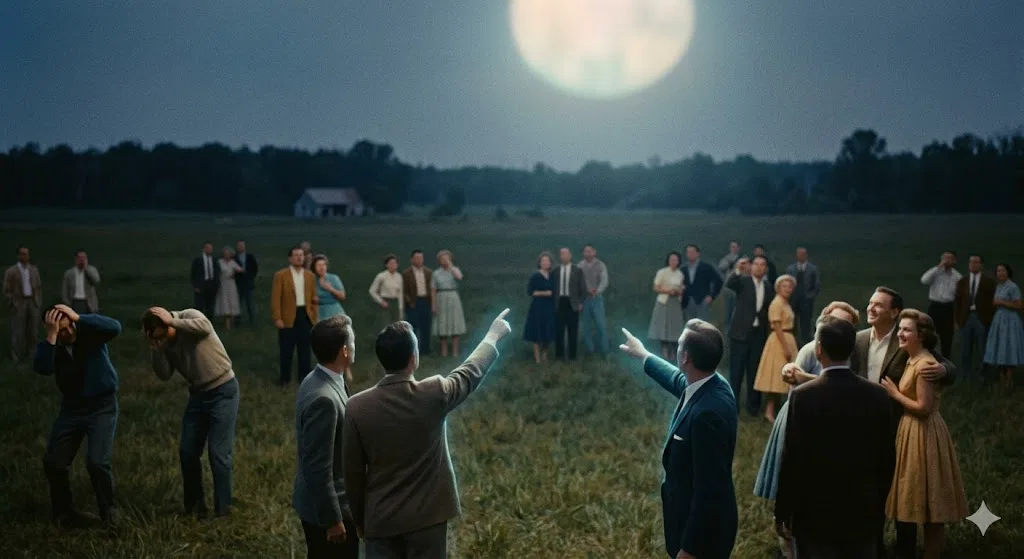
The same UFO image can point in opposite emotional directions. A disc descending from the sky may look like rescue in one story and conquest in another. Science fiction did not invent those responses, but it gave them vivid forms: the alien invader, the benevolent visitor, the hidden watcher, the cosmic messenger, the government cover-up, the chosen contactee, and the ordinary person suddenly forced to confront a universe larger than human society.
The invasion reading grew especially strong after the Second World War. UFOs became prominent at the same time as rockets, nuclear weapons, jet aircraft and Cold War secrecy were changing what the sky meant. The Library of Congress links flying saucer culture to older speculation about life on other worlds, while also noting that Cold War fear helped make alien visitors a potent cultural image. In that setting, science-fiction invasion stories did not merely entertain; they gave public anxiety a shape. The threat might be Soviet technology, nuclear war, mass conformity, hidden infiltration, or simply the dread that humanity was no longer in control of its own inventions.[The Library of Congress]loc.govOpen source on loc.gov.
That is why UFOs work so well as invasion symbols. They appear from above, cross borders without permission, and seem to expose the limits of national defence. A conventional enemy can be mapped, named and negotiated with. A UFO is more disturbing because it may be enemy, accident, misperception, secret aircraft, hoax, natural phenomenon or something genuinely unknown. Science fiction turns that ambiguity into narrative energy: the saucer becomes the perfect sign of the enemy one cannot identify.
But the rescue fantasy is just as important. The 1950s contactee movement often imagined extraterrestrials not as monsters but as morally advanced “Space Brothers” warning humanity about nuclear danger and spiritual decline. Sociologist Christopher Bader notes that early contact claims in the 1950s differed sharply from later frightening abduction narratives; they were often hopeful, prophetic and reformist rather than traumatic. George Adamski’s famous Venusian-contact stories, for example, presented aliens as bearers of peace, wisdom and cosmic instruction, however doubtful his claims appeared to sceptics.[Chapman University Digital Commons]digitalcommons.chapman.eduOpen source on chapman.edu.
This hopeful UFO is a science-fiction cousin of the rescuing alien: not the creature that destroys the city, but the visitor who sees humanity’s self-destructive habits from a wiser vantage point. The fantasy is not simply “aliens will save us”. It is more revealing than that. It imagines that someone outside human politics might finally judge humanity clearly, confirm that we matter, and show us how not to ruin ourselves.
Loneliness gives both invasion and rescue stories their deeper pull. A universe with no one else in it can feel empty; a universe with others in it can feel terrifying. UFO stories allow both feelings to exist at once. The unknown object is frightening because it may mean we are vulnerable, but thrilling because it may mean we are not alone. That double meaning is central to the relationship between UFOs and science fiction: the same light in the sky can be a warning, a greeting, a mirror, or a wound in the ordinary world.

Comedy, spirituality, and wonder
UFOs are not only frightening or solemn. They also invite comedy, absurdity and spiritual awe because their basic premise is unstable: an extraordinary event appears in an ordinary setting, and human institutions struggle to respond. A farmer, pilot, police officer, child, scientist, soldier or conspiracy theorist may all see the same strange object and produce completely different stories about it. Science fiction has repeatedly mined that gap between cosmic grandeur and human confusion.
Comedy works because UFO belief already contains awkward contrasts. The imagery can be majestic — silent craft, impossible speeds, cosmic visitors — while the evidence often arrives through blurry photographs, confused testimony, contradictory accounts and mundane explanations. Popular culture has exploited this tension in everything from affectionate alien comedies to workplace-style stories about abductee support groups. Even when such works are playful, they depend on a serious underlying fact: UFOs expose how odd human meaning-making can look when people face the unknown.[Vanity Fair]vanityfair.comOpen source on vanityfair.com.
That absurdity does not necessarily destroy the myth. In some ways, it strengthens it. A UFO story can be mocked and believed, enjoyed and doubted, feared and turned into a costume or a joke. Few modern myths are so flexible. The flying saucer can appear in horror, children’s fiction, satire, religion, conspiracy thrillers, government hearings, stand-up comedy, advertising and internet memes without losing recognisability.
The spiritual side is equally persistent. Carl Jung’s 1950s study of flying saucers treated them less as hardware than as a “modern myth” — a sign that people were using sky phenomena to express psychic and collective tensions. Jung was not primarily trying to prove or disprove alien spacecraft; he was interested in why the saucer image had become meaningful at that historical moment. That approach remains useful because it explains why UFO stories often feel religious even when framed in technological language.[PhilPapers]philpapers.orgJUNFSA 2JUNFSA 2
UFO religions and contact movements make the link explicit. Some groups interpret extraterrestrials as saviours, teachers, judges or higher beings. Others fold UFOs into older esoteric ideas about hidden masters, ascension, cosmic law or planetary transformation. Contemporary religion scholars have noted that UFO belief can provide community, revelation, cosmological meaning and a framework for interpreting extraordinary experiences — functions often associated with religion, even when believers describe their ideas as scientific or post-religious.[CDAMM]cdamm.orgExtraterrestrial/UFO ReligionExtraterrestrial/UFO Religion
Science fiction helps translate that spiritual longing into images a technological society can accept. Angels become astronauts. Revelation becomes disclosure. Heaven becomes deep space. Prophecy becomes a warning from advanced beings about nuclear weapons, climate collapse, artificial intelligence or moral decay. The language changes, but the emotional structure is familiar: someone beyond us knows the truth, and contact would reveal what humanity really is.
Wonder is the gentlest version of this impulse. Films such as Close Encounters of the Third Kind matter because they place UFO contact between spectacle and longing. The encounter is not only about aliens arriving; it is about ordinary people being drawn towards a mystery that reorganises their lives. In that mode, the UFO is not a threat to be defeated or a doctrine to be obeyed. It is an opening: proof, in story form, that the everyday world may be thinner and stranger than it appears.[PopMatters]popmatters.comPop Matters Close Encounters of the Third KindPop Matters Close Encounters of the Third Kind
Distrust turns the sky into a cover-up story
A UFO does not only raise the question “What was that?” It often raises the more socially charged question “Who knows, and what are they hiding?” This is where UFO stories connect especially strongly with science-fiction conspiracy plots. The unidentified object becomes less important than the imagined system around it: secret bases, classified files, military witnesses, suppressed evidence, staged denials, or elites preparing for truths the public cannot handle.
There are reasons this theme has force. Governments really have hidden aerospace projects. Military secrecy really does shape what the public can know. Official investigations really have left some cases unresolved. At the same time, official uncertainty is not the same as proof of extraterrestrial visitation. Project Blue Book collected thousands of reports but found no evidence that UFOs represented extraterrestrial vehicles, while NASA’s UAP work emphasises limited data quality and the need to move from sensational claims towards better observation.[National Archives]archives.govNational Archives Project BLUE BOOKNational ArchivesProject BLUE BOOK - Unidentified Flying ObjectsAugust 15, 2016 —:(1) no UFO reported, there has been no evidence submit…
The gap between “not fully explained” and “therefore alien” is where science fiction often enters. Fiction supplies the missing architecture: the secret committee, the recovered craft, the silenced witness, the hidden war, the archive that would change history if opened. The X-Files made this structure iconic for a late twentieth-century audience, but it drew on a much older UFO habit: treating ambiguity as evidence that the real story is being withheld.[Wikipedia]WikipediaUFO conspiracy theoriesUFO conspiracy theories
This distrust can be politically and emotionally satisfying. It turns confusion into agency: if the truth is hidden, then someone knows it; if someone knows it, then the world is not random; if the world is not random, then the believer’s suspicion becomes a form of insight. That is one reason disclosure narratives are so durable. As The Atlantic observed in 2026, promises of imminent UFO disclosure have recurred for decades; the expectation itself has become part of the myth’s machinery.[The Atlantic]theatlantic.comThe Atlantic The Truth Is Still Out ThereThe Atlantic The Truth Is Still Out There
Science fiction amplifies this machinery because it understands that secrecy is dramatic. A weather balloon is not a satisfying plot. A misidentified aircraft may be true, but it rarely feels meaningful. A cover-up, by contrast, gives every absence a role. Missing data becomes suppression. Official caution becomes deception. Contradiction becomes proof of a deeper layer. The UFO screen can therefore hold not just fear of aliens, but fear of institutions — and hope that institutions might finally be forced to confess.
Abduction stories make private fear cosmic
Alien abduction narratives show how UFOs can absorb intimate fears as well as public ones. Unlike invasion stories, abduction accounts often focus on bedrooms, bodies, memory gaps, medical procedures, paralysis, helplessness and violation. The scale is cosmic, but the fear is personal. The alien is not merely attacking Earth; it is entering the home, the body and the mind.
Psychological and sleep research offers important context here. Sleep paralysis can involve temporary inability to move, vivid sensory experiences and a felt presence, which can be terrifying and culturally interpreted in different ways. Harvard-linked research into alien-abduction claims found that people recalling alleged abductions could show physiological stress responses, even while researchers explored explanations such as sleep-related hallucinations, suggestibility and memory formation rather than literal extraterrestrial kidnapping.[arXiv]arxiv.orgarXiv Sleep Paralysis: phenomenology, neurophysiology and treatmentarXiv Sleep Paralysis: phenomenology, neurophysiology and treatment
This matters because it avoids two lazy extremes. One extreme treats all abduction narrators as simply mad or dishonest. The other treats distressing experience as proof of alien intervention. A more careful reading recognises that people can have real fear, real memories, real bodily sensations and real life changes without the interpretation being literally true. Wired’s account of Susan Clancy’s work captured this middle ground: many alleged abductees were psychologically normal, often found the experience meaningful, and drew on cultural material already available in popular media.[WIRED]wired.comRegret Is Alien to UFO AbducteesRegret Is Alien to UFO Abductees
Science fiction provides the symbolic vocabulary for that interpretation. Medical aliens, sterile rooms, missing time, implants and hybridisation plots do not float free of culture; they echo anxieties about hospitals, sexuality, surveillance, reproductive control, experimentation, technology and loss of bodily autonomy. That does not mean every abduction story is copied from a film or television programme. It means that when people try to explain an overwhelming experience, UFO culture offers a ready-made cosmic grammar.
The emotional power of abduction stories lies in their mixture of terror and significance. To be chosen by aliens may be horrifying, but it also means one’s suffering has a cosmic explanation. The story turns private dread into a plot with agents, motives and hidden knowledge. That is one reason abduction narratives remain culturally memorable even when evidence for literal abduction is weak.
Why flexible meaning keeps the myth alive
UFOs remain culturally powerful because they are not locked to one message. A vampire usually means predation, immortality, sexuality or contagion. A robot often raises questions about labour, intelligence and control. A UFO can mean almost anything, provided it begins with a rupture in ordinary explanation. That flexibility makes it one of science fiction’s most reusable modern symbols.
The mechanism is simple but powerful:
- Uncertainty creates space. A distant light, radar trace, anecdote or leaked document often contains too little information to settle the question.
- Science fiction supplies possible plots. Invasion, rescue, experiment, exile, surveillance, disclosure and first contact are already familiar.
- Personal and public anxieties choose among those plots. A Cold War audience may see infiltration; a spiritually hungry audience may see guidance; a distrustful audience may see cover-up; a lonely audience may see contact.
- The story feeds back into later sightings. Once a culture knows what a UFO “should” look like or mean, later witnesses and storytellers inherit that template.
This loop helps explain why UFOs can remain potent even when individual claims collapse. If one sighting is explained, the larger myth survives because it was never dependent on one case alone. It is a pattern for organising uncertainty. The Library of Congress describes UFOs and aliens as part of American folk culture, while modern UAP discussions show that the same material can move between folklore, journalism, official review, scientific caution and entertainment without settling permanently in any one category.[The Library of Congress]loc.govOpen source on loc.gov.
The science-fiction connection is therefore not an embarrassing add-on to UFO culture. It is central to how UFO meaning works. Fiction teaches audiences how to imagine the unknown; UFO reports give fiction the thrill of possible reality; official uncertainty keeps the boundary porous. The result is a myth that can be frightening, hopeful, comic, spiritual and paranoid at the same time.
That is why UFOs mean so many different things. They are less a single belief than a cultural screen: a bright, moving surface on which modern societies project the fear of invasion, the hope of rescue, the ache of cosmic loneliness, the suspicion of hidden power, the desire for wonder, and the absurd possibility that the universe may be stranger than either science or fiction has yet managed to explain.
eBay marketplace picks
Marketplace Samples
Example marketplace items related to this page. Use the search link to explore similar finds on eBay.



Endnotes
1.
Source: archives.gov
Title: National Archives Project BLUE BOOK
Link:https://www.archives.gov/research/military/air-force/ufos
Source snippet
National ArchivesProject BLUE BOOK - Unidentified Flying ObjectsAugust 15, 2016 —:(1) no UFO reported, there has been no evidence submit...
Published: August 15, 2016
2.
Source: science.nasa.gov
Link:https://science.nasa.gov/wp-content/uploads/2023/09/uap-independent-study-team-final-report.pdf
3.
Source: digitalcommons.chapman.edu
Link:https://digitalcommons.chapman.edu/cgi/viewcontent.cgi?article=1002&context=sociology_articles
4.
Source: wired.com
Link:https://www.wired.com/2011/07/alien-mashups
5.
Source: philpapers.org
Title: JUNFSA 2
Link:https://philpapers.org/rec/JUNFSA-2
6.
Source: cdamm.org
Title: Extraterrestrial/[UFO Religion]({{ ‘ufo-religion/’ | relative_url }})
Link:https://www.cdamm.org/articles/extraterrestrial
7.
Source: popmatters.com
Title: Pop Matters Close Encounters of the Third Kind
Link:https://www.popmatters.com/close-encounters-of-the-third-kind-2496194237.html
8.
Source: Wikipedia
Title: Close Encounters of the Third Kind
Link:https://en.wikipedia.org/wiki/Close_Encounters_of_the_Third_Kind
9.
Source: science.nasa.gov
Link:https://science.nasa.gov/uap/faqs/
10.
Source: Wikipedia
Title: UFO conspiracy theories
Link:https://en.wikipedia.org/wiki/UFO_conspiracy_theories
11.
Source: arxiv.org
Title: arXiv Sleep Paralysis: phenomenology, neurophysiology and treatment
Link:https://arxiv.org/abs/1704.02342
12.
Source: news.harvard.edu
Title: Gazette Alien abduction claims examined
Link:https://news.harvard.edu/gazette/story/2003/02/alien-abduction-claims-examined-2/
13.
Source: wired.com
Title: Regret Is Alien to UFO Abductees
Link:https://www.wired.com/2005/10/regret-is-alien-to-ufo-abductees
14.
Source: Wikipedia
Title: Space Brothers (myth)
Link:https://en.wikipedia.org/wiki/Space_Brothers_%28myth%29
15.
Source: Wikipedia
Title: Alien abduction
Link:https://en.wikipedia.org/wiki/Alien_abduction
16.
Source: Wikipedia
Title: The War of the Worlds (1953 film)
Link:https://en.wikipedia.org/wiki/The_War_of_the_Worlds_%281953_film%29
17.
Source: Wikipedia
Title: Project Blue Book
Link:https://en.wikipedia.org/wiki/Project_Blue_Book
18.
Source: Wikipedia
Title: George Adamski
Link:https://en.wikipedia.org/wiki/George_Adamski
19.
Source: Wikipedia
Title: UFOs in fiction
Link:https://en.wikipedia.org/wiki/UFOs_in_fiction
20.
Source: nasa.gov
Title: nasa to release discuss unidentified anomalous phenomena report
Link:https://www.nasa.gov/news-release/nasa-to-release-discuss-unidentified-anomalous-phenomena-report/
21.
Source: archive.org
Link:https://archive.org/stream/ACriticalAppraisalOfGeorgeAdamskiTheManWhoSpokeToTheSpaceBrothers/A%2BCritical%2BAppraisal%2Bof%2BGeorge%2BAdamski%2B-%2BThe%2BMan%2BWho%2BSpoke%2Bto%2Bthe%2BSpace%2BBrothers_djvu.txt
22.
Source: space.com
Title: nasa ufo uap study team first results revealed
Link:https://www.space.com/nasa-ufo-uap-study-team-first-results-revealed
23.
Source: reasons.org
Title: alien encounters fail the test
Link:https://reasons.org/explore/publications/facts-for-faith/alien-encounters-fail-the-test
24.
Source: time.com
Title: science dr jung the saucers
Link:https://time.com/archive/6888244/science-dr-jung-the-saucers/
25.
Source: loc.gov
Link:https://www.loc.gov/collections/finding-our-place-in-the-cosmos-with-carl-sagan/articles-and-essays/life-on-other-worlds/ufos-and-aliens-among-us
26.
Source: vanityfair.com
Link:https://www.vanityfair.com/hollywood/2016/10/people-of-earth-review-ana-gasteyer-interview
27.
Source: theatlantic.com
Title: The Atlantic The Truth Is Still Out There
Link:https://www.theatlantic.com/magazine/2026/06/government-ufo-conspiracy/686935/
28.
Source: facebook.com
Link:https://www.facebook.com/groups/902349343110685/posts/27795459870039601/
29.
Source: loc.gov
Link:https://www.loc.gov/static/collections/finding-our-place-in-the-cosmos-with-carl-sagan/articles-and-essays/life-on-other-worlds/ufos-and-aliens-among-us.html
30.
Source: tile.loc.gov
Link:https://tile.loc.gov/storage-services/master/gdc/gdcebookspublic/20/20/71/54/77/2020715477/2020715477.pdf
31.
Source: epublications.marquette.edu
Link:https://epublications.marquette.edu/cgi/viewcontent.cgi?article=1642&context=english_fac
32.
Source: science.howstuffworks.com
Title: george adamski
Link:https://science.howstuffworks.com/space/aliens-ufos/george-adamski.htm
33.
Source: academicworks.cuny.edu
Link:https://academicworks.cuny.edu/cgi/viewcontent.cgi?article=2395&context=gc_etds
34.
Source: filmkoepel.nl
Title: Close Encounters of the Third Kind
Link:https://filmkoepel.nl/films/close-encounters-of-the-third-kind/
35.
Source: britannica.com
Title: Project Blue Book
Link:https://www.britannica.com/topic/Project-Blue-Book
Additional References
36.
Source: theguardian.com
Link:https://www.theguardian.com/world/2026/jun/12/ufo-uap-files-us-government-release
Source snippet
Critics and [skeptics]({{ 'skeptics/' | relative_url }}) argue the materials lack credible analysis and context, which may encourage conspiracy theories. Former AARO directo...
37.
Source: vox.com
Title: disclosure day steven spielberg movie aliens ufo files
Link:https://www.vox.com/culture/491587/disclosure-day-steven-spielberg-movie-aliens-ufo-files
Source snippet
Studies, including one from theologian Ted Peters, reveal that over 80% of believers across different faiths would not experience a crisi...
38.
Source: youtube.com
Title: Flying Saucers: A Modern Myth Of Things Seen In The Sky
Link:http://www.youtube.com/watch?v=8LEt2jrkdRI
Source snippet
Ufo pop culture reflection human fears psychology Fear of Aliens #shorts Mindful Moments...
39.
Source: youtube.com
Title: History of the UFO Phenomenon #7
Link:http://www.youtube.com/watch?v=xJASCpd5hDQ
Source snippet
Two Aliens - The Genesis of UFO Conspiracy Myths...
40.
Source: youtube.com
Title: Two Aliens
Link:http://www.youtube.com/watch?v=e6CpdIIZsP0
Source snippet
Flying Saucers: A Modern Myth Of Things Seen In The Sky - C.G. Jung - Full UFO Audiobook...
41.
Source: youtube.com
Title: Carl Jung on UFOs: Symbols, Not Spaceships
Link:http://www.youtube.com/watch?v=xKSyMI3W7pA
Source snippet
History of the UFO Phenomenon #7 - "FLYING SAUCERS: A Modern Myth of Things Seen in the Skies"...
42.
Source: youtube.com
Link:http://www.youtube.com/watch?v=njDc8r-J2H0
Source snippet
Carl Jung on UFOs: Symbols, Not Spaceships...
43.
Source: nsa.gov
Link:https://www.nsa.gov/portals/75/documents/news-features/declassified-documents/ufo/usaf_fact_sheet_95_03.pdf
44.
Source: researchgate.net
Link:https://www.researchgate.net/publication/405404634_The_Neuroscience_and_psychology_of_alien_abduction_An_extended_review
45.
Source: academia.edu
Link:https://www.academia.edu/111166558/UFO_Mythologies_Extraterrestrial_Cosmology_and_Intergalactic_Eschatology
Topic Tree