Within Invasion Films
How UFO Files Fed Screen Panic
Official UFO concern gave invasion films a believable pattern of radar alerts, military briefings and unanswered public questions.
On this page
- From sightings to security questions
- Radar rooms and military briefings
- Why uncertainty worked better than proof
Page outline Jump by section
Introduction
Project Blue Book rarely appeared by name in 1950s science-fiction films, yet its influence was visible across the decade’s cinema. The United States Air Force created Project Blue Book in 1952 to investigate unidentified flying objects amid growing public concern and national-security worries. As newspapers reported sightings, radar incidents and official investigations, Hollywood found that audiences already understood a crucial premise: strange objects in the sky might be more than a curiosity. They might signal a security threat. The result was a cycle of invasion and saucer films filled with radar operators, military briefings, intelligence officers and anxious officials trying to interpret incomplete information. Rather than proving that aliens existed, these films borrowed the atmosphere of official uncertainty that surrounded real UFO investigations. That atmosphere helped make screen panic believable.[Origins]origins.osu.eduOrigins The Air Force Investigation into UFOs | OriginsOrigins The Air Force Investigation into UFOs | Origins
How UFO Files Fed Screen Panic
From sightings to security questions
The significance of Project Blue Book was not that it confirmed extraterrestrial visitors. Its importance for cinema was that the United States government treated unexplained aerial reports as matters worth investigating. Blue Book emerged from security concerns during the Cold War, when officials could not automatically dismiss unusual sightings because secret Soviet technology was a genuine possibility. The programme became a public sign that unidentified objects in the sky were connected to defence, intelligence and surveillance rather than merely folklore.[Origins]origins.osu.eduOrigins The Air Force Investigation into UFOs | OriginsOrigins The Air Force Investigation into UFOs | Origins
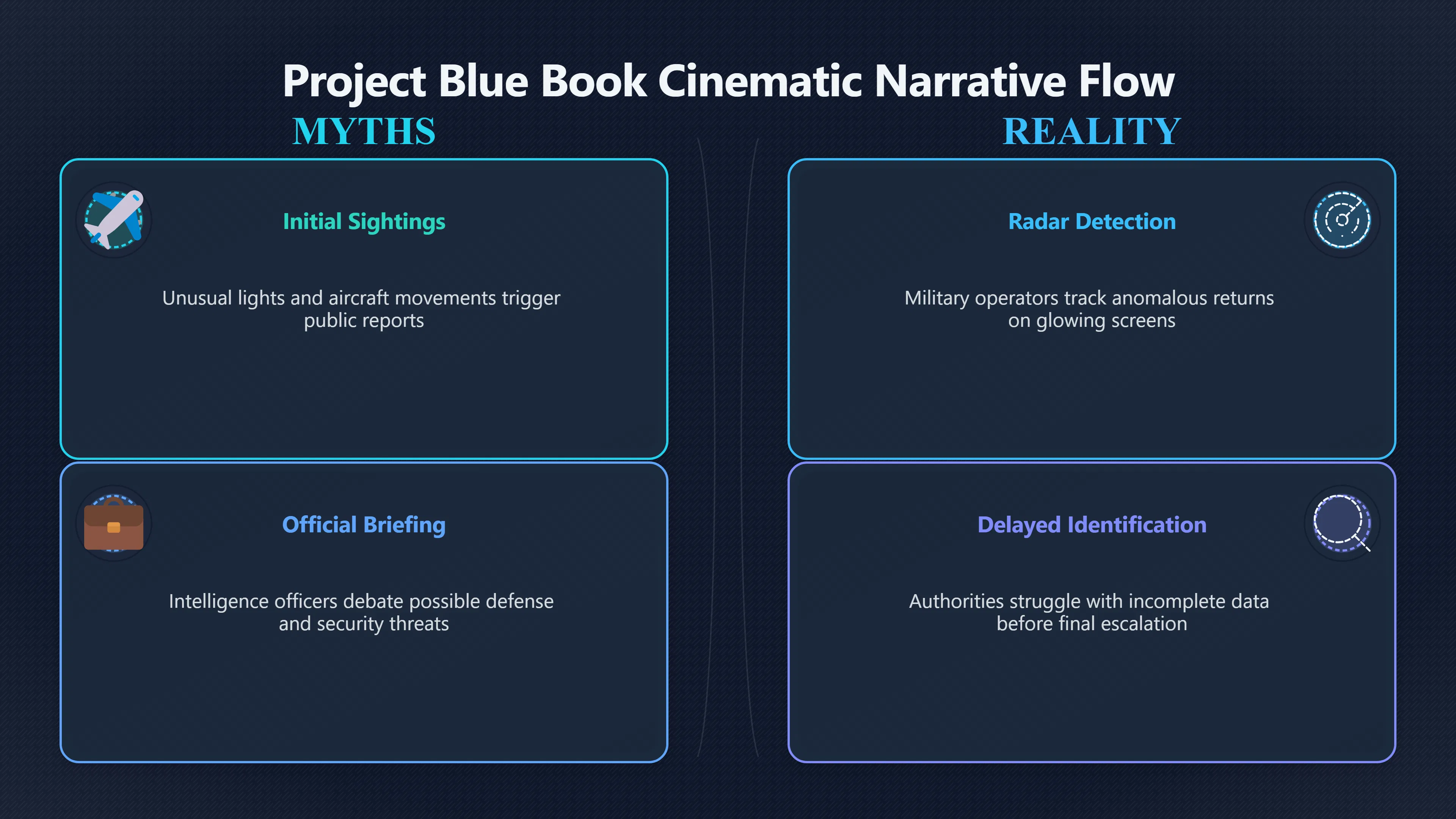
This official attention created a narrative pattern that filmmakers could immediately exploit. A typical 1950s invasion film begins not with direct contact between humans and aliens, but with reports: unusual lights, strange radar returns, unexplained aircraft movements or confused witness testimony. That structure closely resembled the way UFO cases entered public discussion. Audiences had seen newspaper stories describing sightings and investigations, so cinematic reports of mysterious aerial objects felt plausible even when the stories soon moved into fantasy.
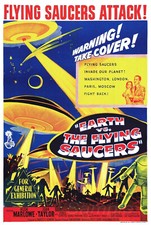
Films such as The War of the Worlds (1953), Earth vs. the Flying Saucers (1956) and numerous lower-budget productions repeatedly presented unknown aerial phenomena as intelligence problems before revealing them as alien threats. The dramatic question was not initially “Are aliens attacking?” but “What are we looking at?” That uncertainty mirrored the real-world logic of UFO investigations.
Radar Rooms and Military Briefings
One of the most recognisable visual conventions of 1950s science fiction was the command centre: radar screens glowing in dark rooms, officers examining reports, telephones ringing and military personnel attempting to assemble fragmentary evidence.
These scenes were effective because radar had become a symbol of national vigilance. During the Cold War, radar networks were associated with bomber detection and early warning systems. At the same time, UFO reports increasingly involved radar observations and discussions of air defence. Project Blue Book itself collected and evaluated reports from military and civilian sources, reinforcing the idea that unexplained aerial objects belonged within a defence framework.[Origins]origins.osu.eduOrigins The Air Force Investigation into UFOs | OriginsOrigins The Air Force Investigation into UFOs | Origins
Hollywood repeatedly translated this environment into visual drama:
- Radar operators detect an anomalous object.
- Military authorities receive conflicting reports.
- Scientists and officers debate possible explanations.
- Conventional aircraft are dispatched.
- Information remains incomplete until the threat escalates.
This formula gave invasion films a procedural quality. The audience watched institutions struggle to understand events rather than merely react to monsters. The emphasis on briefings, maps and surveillance equipment suggested that the danger lay not only in alien technology but also in the limits of human knowledge.
The famous 1952 Washington, D.C., UFO incidents, in which unidentified radar contacts attracted national attention and Air Force responses, helped embed the association between UFOs, radar and official concern in public consciousness. Even when films did not directly reference those events, they drew upon a culture already familiar with stories of unexplained objects appearing on radar screens and provoking government investigation.
Why Uncertainty Worked Better Than Proof
The most important contribution of Project Blue Book anxiety to 1950s cinema was not evidence but ambiguity.
Official investigations rarely produced dramatic conclusions. Most sightings received conventional explanations, while some remained unresolved. That mixture of explanation and uncertainty proved more useful to filmmakers than definitive answers would have been. A mystery that remained partly open invited audiences to imagine possibilities.[Origins]origins.osu.eduOrigins The Air Force Investigation into UFOs | OriginsOrigins The Air Force Investigation into UFOs | Origins
In many invasion films, the suspense comes from delayed identification. Authorities suspect natural phenomena, foreign weapons or observational errors before recognising a larger threat. The audience experiences the same uncertainty as the characters. If an alien invasion had been obvious from the opening scene, much of the tension would disappear.
The dynamic also reflected a broader Cold War mentality. Governments possessed advanced technologies, secret programmes and classified information. Citizens knew investigations were taking place but often lacked access to final answers. Project Blue Book became one visible example of that relationship between public curiosity and official secrecy. Whether or not people believed in extraterrestrial visitors, they understood the feeling that important questions were being examined behind closed doors.
This explains why many of the decade’s most memorable films devoted substantial screen time to investigation rather than action. Scientists analyse evidence. Generals assess reports. Intelligence officials weigh competing explanations. The drama emerges from uncertainty itself.
The Evidence on Screen
The connection between Project Blue Book and 1950s cinema is best understood as a pattern rather than a direct adaptation. Few films attempted to recreate specific Blue Book cases. Instead, they borrowed elements that audiences associated with real UFO investigations:
- Official concern over unexplained aerial phenomena.
- Military involvement in analysing sightings.
- Radar tracking and air-defence monitoring.
- Public reports generating national attention.
- The possibility that unexplained objects might represent a strategic threat.
Historical studies of Blue Book describe it as a product of Cold War security concerns as much as public fascination with extraterrestrials. That same combination appears repeatedly in invasion cinema, where alien craft function simultaneously as scientific mysteries and national-security emergencies.[Origins]origins.osu.eduOrigins The Air Force Investigation into UFOs | OriginsOrigins The Air Force Investigation into UFOs | Origins
The result was a distinctive form of screen realism. Audiences were not asked to believe that aliens certainly existed. They were asked to imagine what might happen if the unexplained reports already appearing in newspapers turned out to have extraordinary consequences. By borrowing the language of investigations, briefings and surveillance, Hollywood transformed official UFO anxiety into one of the defining visual and narrative styles of 1950s science-fiction cinema.
What the Films Revealed About UFO Culture
Project Blue Book’s greatest cinematic legacy was psychological rather than factual. It helped establish the idea that unidentified objects in the sky deserved attention from serious institutions. Once that premise entered public culture, invasion films could build elaborate stories upon it without appearing completely detached from reality.
In the relationship between UFOs and science fiction, this was a crucial development. The flying saucer became more than a fantasy vehicle. It became an object already embedded in public discussion, government investigations and national-security debates. Hollywood amplified that atmosphere, turning bureaucratic uncertainty into suspense and transforming official questions into cinematic panic. The enduring image of anxious officers staring at radar screens while waiting for answers emerged directly from that intersection of UFO investigations and Cold War imagination.[osu.edu]origins.osu.eduOrigins The Air Force Investigation into UFOs | OriginsOrigins The Air Force Investigation into UFOs | Origins
Amazon book picks
Further Reading
Books and field guides related to Relationships betwee d7372c hollywood invasion s 2182e1 blue book screen pan 4a4845. Use these as the next step if you want deeper reading beyond the article.
The Report on Unidentified Flying Objects
Most directly connected major book to Project Blue Book and UFO investigations.
The Flying Saucers are Real
Represents the public debate that helped make Blue Book culturally significant.
eBay marketplace picks
Marketplace Samples
Example marketplace items related to this page. Use the search link to explore similar finds on eBay.


Endnotes
1.
Source: origins.osu.edu
Title: Origins The Air Force Investigation into UFOs | Origins
Link:https://origins.osu.edu/index.php/read/air-force-investigation-ufos
2.
Source: nationalarchives.gov.uk
Title: The National Archives UFOs
Link:https://www.nationalarchives.gov.uk/help-with-your-research/research-guides/ufos/
Source snippet
The National ArchivesUFOs - The National Archives...
3.
Source: disclosdex.com
Title: Project BLUE BOOK
Link:https://disclosdex.com/links/project-blue-book-national-archives
Source snippet
Project BLUE BOOK - National Archives Records Guide | Disclosdex...
Additional References
4.
Source: youtube.com
Title: HISTORY of UFOs
Link:https://www.youtube.com/watch?v=5xoYR0YjGh8
Source snippet
Cinema Secrets You Missed in 1950s Alien Invasion Movies...
5.
Source: youtube.com
Link:https://www.youtube.com/watch?v=jUzzNL6iCUg
Source snippet
HISTORY of UFOs - Episode 2 - The 1940s and 1950s - The [Roswell]({{ 'roswell/' | relative_url }}) Incident and Project Blue Book...
6.
Source: youtube.com
Link:https://www.youtube.com/watch?v=_bLMi1nqDQQ
Source snippet
Cold War Paranoia in Science Fiction: The 27th Day vs. Red Planet Mars...
7.
Source: youtube.com
Title: Project Blue Book: America’s Obsession with UFOs
Link:https://www.youtube.com/watch?v=Xu4oTBBI5UE
Source snippet
Ultimate 1950s Flying Saucer, UFO, and Alien Encounter Movies...
8.
Source: history.navy.mil
Title: Naval History and Heritage Command U-2s, UFOs, and Operation Blue Book
Link:https://www.history.navy.mil/research/library/online-reading-room/title-list-alphabetically/u/u2s-ufos-and-operation-blue-book.html
9.
Source: explore.britannica.com
Title: Cold War Policies, Propaganda, & Speeches
Link:https://explore.britannica.com/study/cold-war-policies-propaganda-and-speeches
Source snippet
Student Center | Britannica.com...
10.
Source: youtube.com
Title: Cold War Paranoia in Science Fiction: The 27th Day vs. Red Planet Mars
Link:https://www.youtube.com/watch?v=Q6yKf54gxTg
Topic Tree