Within Television
Why Seeing UFO Witnesses Changed Belief
Television made UFO witnesses emotionally persuasive by letting viewers judge faces, voices, hesitation, and ordinary settings for themselves.
On this page
- Faces and voices as evidence
- Ordinary people in extraordinary stories
- The limits of sincerity as proof
Page outline Jump by section
Introduction
Television changed UFO belief in a specific and powerful way: it allowed audiences to evaluate witnesses directly. Instead of reading a newspaper quotation or hearing a second-hand account, viewers could watch a person describe an unusual experience in real time. Facial expressions, pauses, uncertainty, emotion and tone of voice became part of the evidence. For many viewers, the question shifted from “Did this happen?” to “Does this person seem genuine?”
 This mechanism was especially important in the broader relationship between UFOs and science fiction. Television often placed ordinary witnesses alongside imagery and narratives that resembled science-fiction stories, yet the witnesses themselves were presented as real people rather than fictional characters. The resulting blend of familiarity and mystery helped make UFO reports feel more plausible and socially acceptable, even when no decisive proof was offered.
Faces and Voices as Evidence
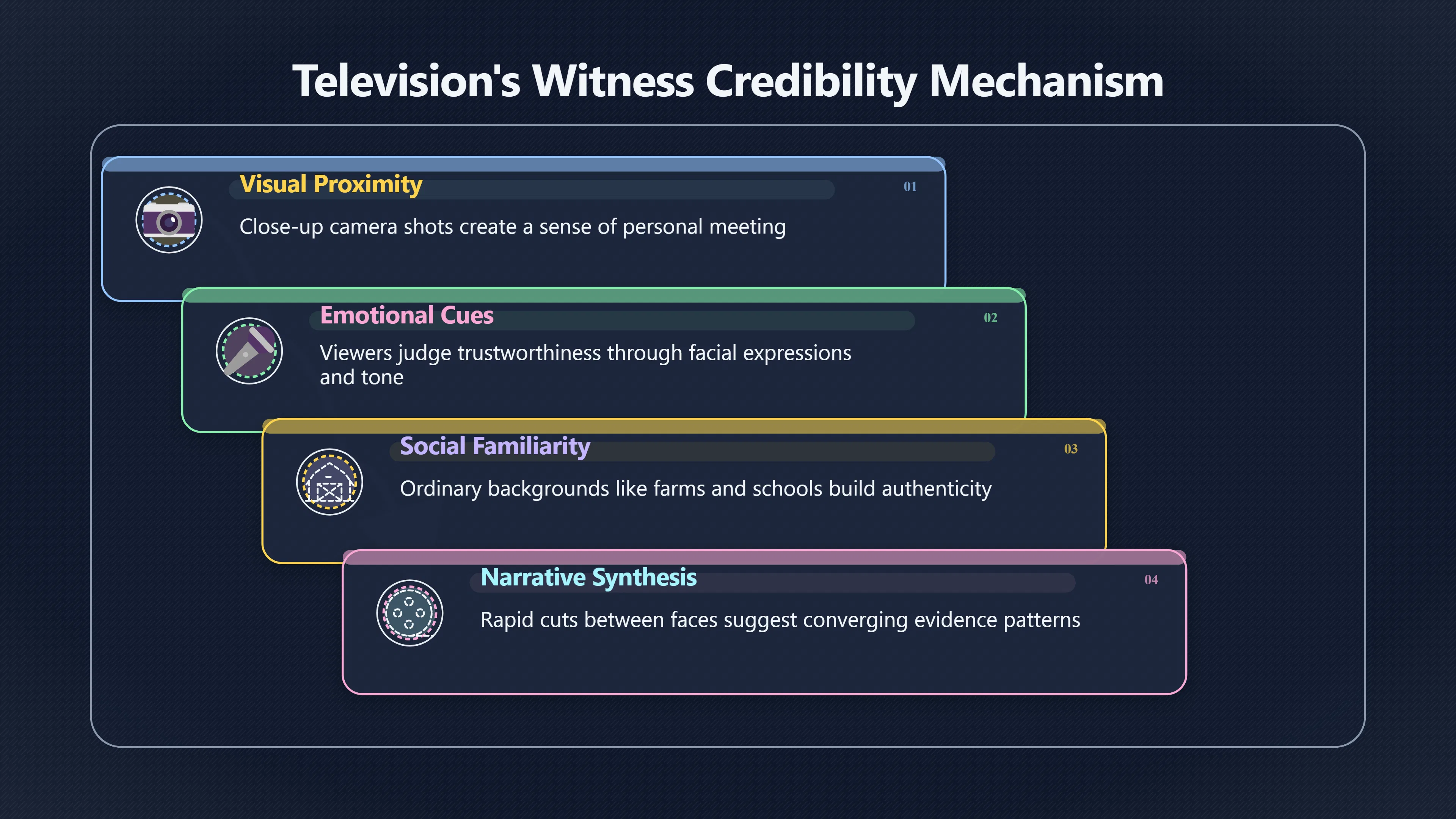
Television’s distinctive contribution was its ability to transform credibility into a visual experience. Human beings routinely judge trustworthiness from facial expressions, speech patterns and emotional behaviour. A televised witness therefore carried information that a written report could not provide.
When UFO witnesses appeared on news programmes, documentaries or television specials, viewers could observe details such as:
- Whether the witness appeared nervous or confident.
- Whether their account remained consistent during questioning.
- Whether their emotional reaction seemed spontaneous.
- Whether they appeared ordinary rather than attention-seeking.
None of these observations establish whether a claim is true. However, they strongly influence how audiences evaluate testimony. Television effectively turned personal credibility into a form of public evidence.
This was particularly important because UFO reports often lacked physical proof. Photographs were frequently disputed, radar evidence was rare, and many sightings involved brief events. In such cases, the witness became the central exhibit. Television magnified that effect by putting the witness’s body language and voice at the centre of the story.
Broadcast formats reinforced the impression. Close-up camera shots, interview settings and conversational questioning encouraged viewers to feel they were meeting the witness personally. The medium created a sense of proximity that newspapers and radio could not easily reproduce.
Ordinary People in Extraordinary Stories
The sincerity effect became even stronger when witnesses appeared to be ordinary citizens with little obvious reason to invent a story.
Television producers frequently highlighted the everyday backgrounds of witnesses: teachers, police officers, farmers, airline personnel, military veterans, parents and children. Presenting witnesses as socially familiar figures encouraged audiences to ask why such people would risk embarrassment by reporting something unusual.
A recurring television pattern involved contrasting extraordinary claims with ordinary settings. A witness might describe a strange object while standing in a suburban garden, a school playground or a rural field. The visual normality of the location often made the account seem less theatrical and more authentic.
Programmes covering mass-sighting events relied heavily on this approach. Rather than focusing solely on alleged craft or photographs, they assembled multiple witnesses whose accounts appeared independent yet similar. Television could rapidly cut between faces and testimonies, creating the impression of converging evidence even when the underlying reports remained difficult to verify.
The famous 1994 Ariel School case in Zimbabwe illustrates why televised witness testimony can remain influential decades later. Numerous children reported seeing unusual beings near their school, and filmed interviews captured their emotional reactions shortly after the event. Subsequent documentaries and television productions repeatedly returned to these recordings because viewers often find the children’s apparent sincerity compelling, regardless of how they interpret the event itself.[Flicks.com.au]flicks.com.auOpen source on com.au.
Television also gave witnesses a social identity. Once an individual appeared on a widely viewed programme, they became a recognised participant in a public mystery. Their story no longer existed only as a local report; it became part of a larger cultural narrative about UFOs.
Why Sincere Witnesses Felt More Convincing Than Fiction
An important irony links UFO television to science fiction. Many television dramas presented alien encounters as entertainment, while documentaries and news specials presented witnesses describing seemingly similar events as reality.
The contrast mattered. A science-fiction drama openly asked viewers to suspend disbelief. A witness interview asked viewers to evaluate a real person.
As a result, sincerity often functioned as a bridge between fiction and belief. Television audiences were already familiar with alien imagery, flying saucers and visitation narratives from popular culture. When apparently sincere individuals described experiences that resembled those narratives, the stories felt culturally recognisable rather than completely implausible.
The mechanism did not require viewers to conclude that extraterrestrials existed. It only required them to think that some witnesses genuinely believed they had experienced something unusual. Once that judgement was made, UFO reports could appear worthy of continued attention.
This helps explain why many television programmes ended with uncertainty rather than resolution. If witnesses seemed honest, the mystery could remain alive even when no definitive explanation emerged.
The Limits of Sincerity as Proof
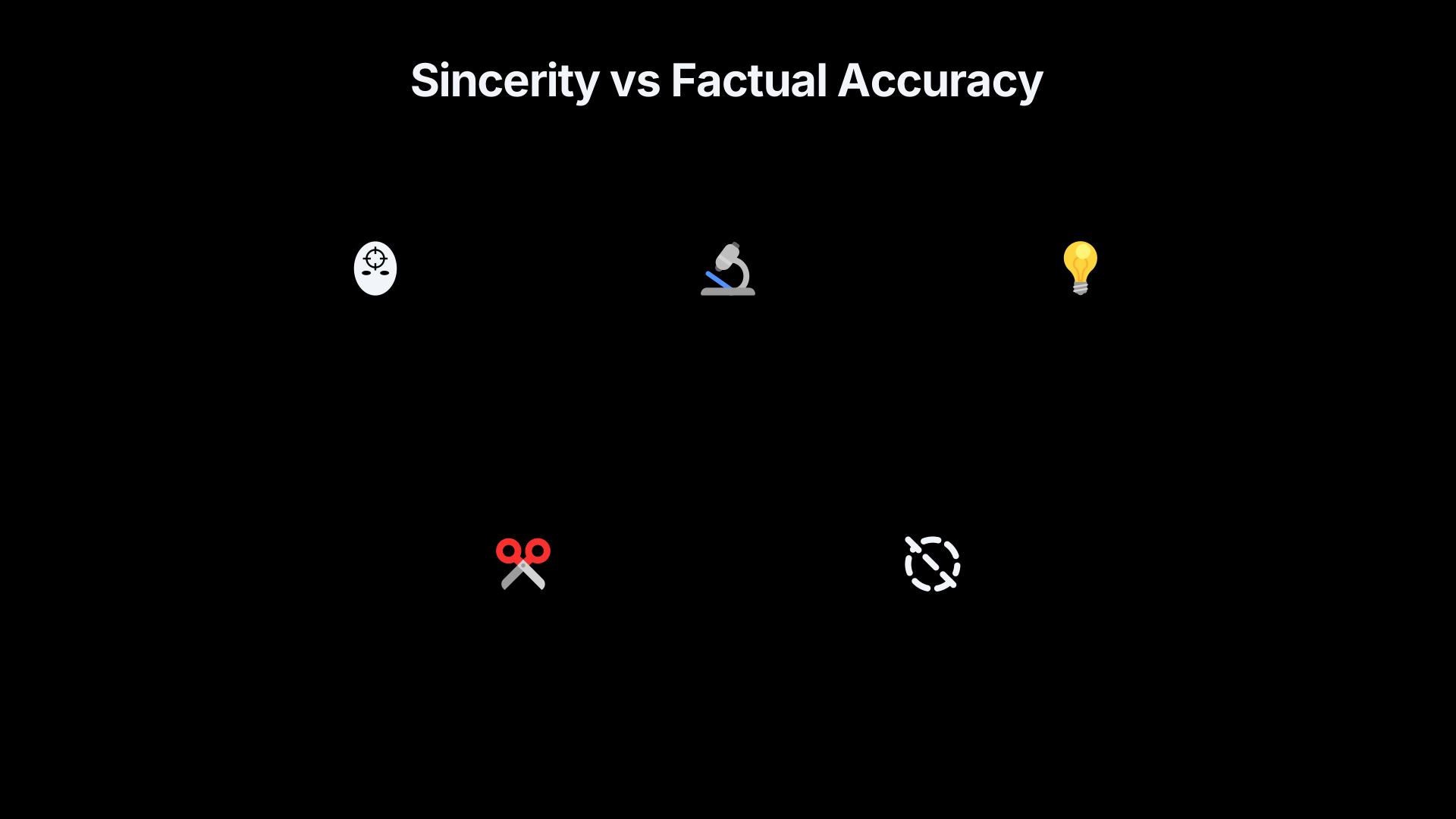
Television’s witness-centred approach also has significant weaknesses. A person can appear truthful and still be mistaken.
Psychological research has repeatedly shown that people are generally poor at detecting deception from appearance alone. Confidence, emotional intensity and sincerity are not reliable indicators of factual accuracy. Witnesses can misinterpret unfamiliar objects, remember events imperfectly or influence one another’s recollections without intending to deceive.
Modern official reviews of UFO reports continue to emphasise this distinction. Investigations frequently conclude that witnesses genuinely observed something unusual while finding insufficient evidence to support extraordinary explanations. Recent Pentagon reviews, for example, report no verified evidence that investigated cases represent extraterrestrial technology, while acknowledging that many reports were submitted in good faith.[WFSU News]wfsu.orgNews Pentagon finds 'no evidence' of alien technology in new UFO report | WFSU NewsWFSU NewsPentagon finds 'no evidence' of alien technology in new UFO report | WFSU NewsMarch 8, 2024
Television can further complicate matters because editing shapes perception. Producers choose which interview segments to include, where to place dramatic pauses, what music to use and how sceptical voices are balanced against believers. A witness may therefore appear more persuasive—or less persuasive—than they would in an unedited conversation.
There is also a selection effect. Television tends to feature witnesses who are articulate, emotionally engaging or visually compelling. Less dramatic accounts may never reach the screen. The public therefore encounters a filtered sample rather than the full range of reports.

Why the Witness Effect Endured
The long-term importance of televised witnesses lies less in proving UFO claims than in normalising them. Viewers repeatedly encountered people who appeared thoughtful, sincere and emotionally invested in their experiences. Over time, this reduced the perception that UFO reports belonged only to cranks or sensationalists.
The result was a subtle cultural shift. Television transformed UFO testimony from an abstract claim into a human encounter. Whether viewers accepted or rejected specific stories, they were encouraged to engage with witnesses as credible individuals describing events they genuinely believed had occurred.
That sincerity effect became one of television’s most influential mechanisms in normalising UFO belief. By allowing audiences to see and hear witnesses for themselves, television made personal testimony feel tangible, emotionally persuasive and worthy of consideration—even when the underlying mystery remained unresolved.
eBay marketplace picks
Marketplace Samples
Live-tested eBay searches with available results related to this page.


Endnotes
1.
Source: flicks.com.au
Link:https://www.flicks.com.au/tv/encounters-miniseries/
2.
Source: news.wfsu.org
Link:https://news.wfsu.org/all-npr-news/2024-03-08/pentagon-finds-no-evidence-of-[alien-technology
Source snippet
WFSU NewsPentagon finds 'no evidence' of alien technology in new UFO report | WFSU NewsMarch 8, 2024...
Published: March 8, 2024
Additional References
3.
Source: youtube.com
Link:https://www.youtube.com/watch?v=zZLqFjG4HSo
Source snippet
Ufo witness interview archival television news history 1973: UFO SPOTTING in WARMINSTER, WILTSHIRE | Nationwide | Weird and Wonderful | B...
4.
Source: youtube.com
Link:https://www.youtube.com/watch?v=G4YCVNZ7WIM
Source snippet
Classic UFO witness interview news broadcast documentary 1960s 1970s UFO's Are Real | FULL MOVIE | Aliens Sci-Fi Documentary Shout! Studios...
5.
Source: youtube.com
Title: World-changing confession: Doctor describes studying live alien | Reality Check
Link:https://www.youtube.com/watch?v=5Zit-08rtkE
Source snippet
“It's Been Kept from the Public”: TV Journalist Ross Coulthart Didn't Believe in UFO's until...
6.
Source: kalw.org
Title: UFO files spanning decades are released by Defense Department | KALW
Link:https://www.kalw.org/npr-news/2026-05-08/ufo-files-spanning-decades-are-released-by-defense-department
Source snippet
UFO files spanning decades are released by Defense Department | KALW...
7.
Source: youtube.com
Title: David Grusch Opening Statement at [Unidentified]({{ ‘unidentified/’ | relative_url }}) Anomalous Phenomena (UAP) Hearing
Link:https://www.youtube.com/watch?v=lcrCMLVk614
Source snippet
World-changing confession: Doctor describes studying live alien | Reality Check...
8.
Source: youtube.com
Title: Travis Walton, allegedly detained by aliens in a UFO, confronted and interviewed
Link:https://www.youtube.com/watch?v=vG1DlYaMTNA
Source snippet
Schoolyard witnesses in mass UFO sighting demand answers | Australian Story...
9.
Source: youtube.com
Title: Schoolyard witnesses in mass UFO sighting demand answers | Australian Story
Link:https://www.youtube.com/watch?v=IhKyQkhOfoM
Source snippet
First interview with Travis Walton after his alien abduction experience, 1975...
10.
Source: youtube.com
Link:https://www.youtube.com/watch?v=rnMSCKZ811Q
Source snippet
Police Officers Describe UFO Encounter (1967)...
11.
Source: youtube.com
Link:https://www.youtube.com/watch?v=BoJmd2MIpOk
Source snippet
David Grusch Opening Statement at Unidentified Anomalous Phenomena (UAP) Hearing...
12.
Source: youtube.com
Link:https://www.youtube.com/watch?v=SjlzeYiGLzc
Source snippet
Travis Walton, allegedly detained by aliens in a UFO, confronted and interviewed...
Topic Tree