Within Friendly Aliens
Why Klaatu Was Not Just an Invader
The Day the Earth Stood Still turned the friendly alien into a cinematic judge of Earth's violence and nuclear recklessness.
On this page
- The saucer arrival as intervention
- The humanoid messenger pattern
- Cold War warning on screen
Page outline Jump by section
Introduction
Klaatu, the visitor from The Day the Earth Stood Still (1951), became one of the most influential examples of the benevolent alien in science-fiction cinema. Unlike the invading monsters and conquerors common in many Cold War films, he arrives not to seize Earth but to warn it. His role helped establish a lasting UFO-related narrative: the advanced extraterrestrial as a moral superior who intervenes because humanity is endangering itself. In the language later associated with UFO contact culture, Klaatu resembles a cinematic “Space Brother” figure—an alien messenger who combines technological superiority with ethical instruction. Through him, the flying saucer becomes not merely a vehicle from another world but a platform for judgement, diplomacy and warning.[Encyclopedia Britannica]britannica.comOpen source on britannica.com.
The Saucer Arrival as Intervention
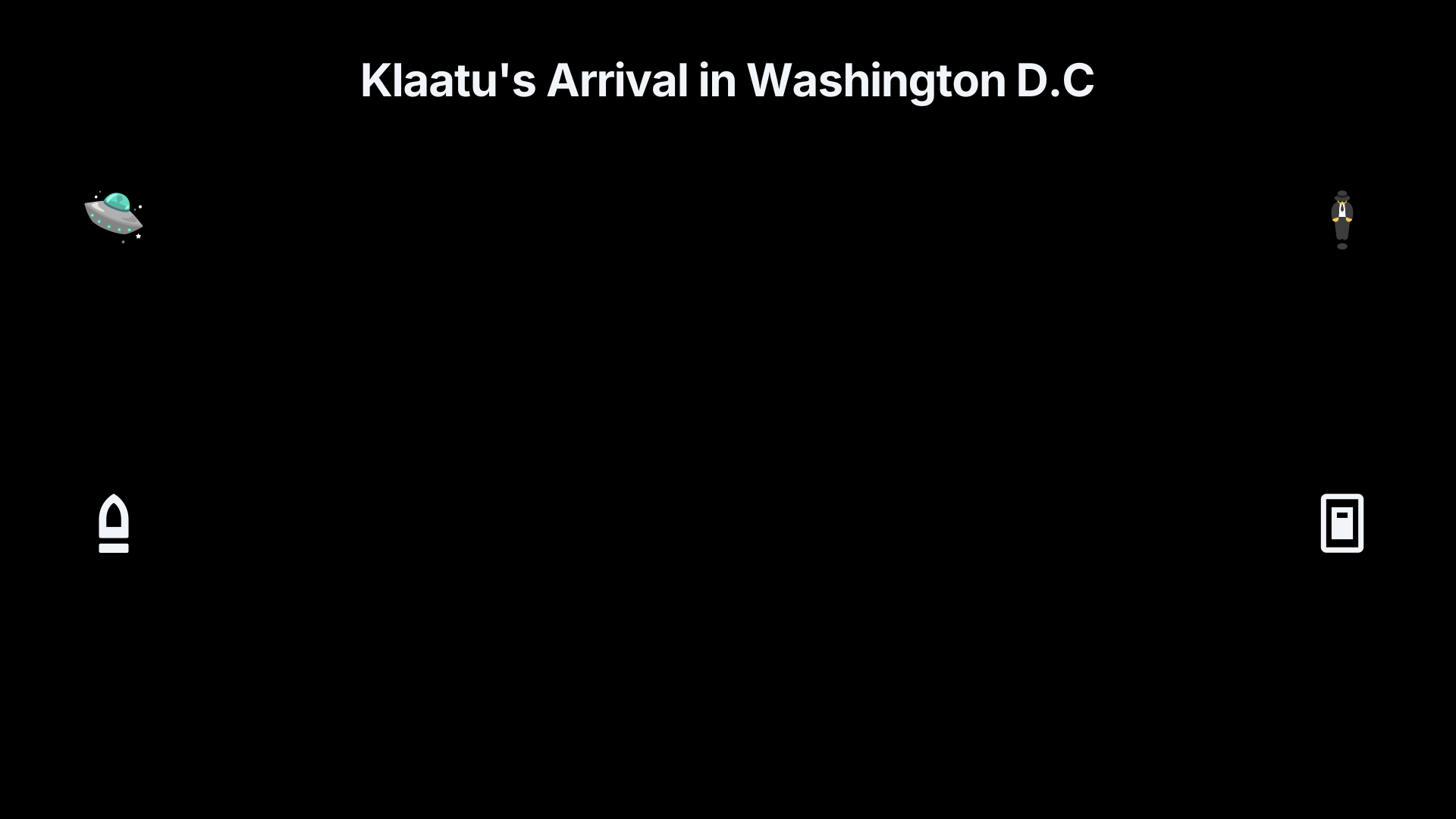
The film’s most famous image is not an attack but a landing. Klaatu’s saucer descends openly in Washington, D.C., placing itself before the world’s political centre rather than striking from concealment. This choice immediately distinguishes him from hostile invaders. He arrives as an emissary seeking communication. When he attempts to present a message, however, fear and military reflexes dominate the response. He is shot within moments of emerging from the craft.[Encyclopedia Britannica]britannica.comOpen source on britannica.com.
That scene established a pattern that would recur throughout later benevolent-contact stories. The drama does not arise from alien aggression but from humanity’s inability to respond rationally to the unfamiliar. Klaatu’s intervention is therefore partly a test. The audience sees that the visitor is calm, restrained and diplomatic, while governments and military authorities react with suspicion and force. The conflict becomes moral rather than military.[Encyclopedia Britannica]britannica.comOpen source on britannica.com.
The film’s famous global power interruption reinforces this role. Klaatu demonstrates overwhelming technological capability yet deliberately limits the display to avoid loss of life. The temporary shutdown is intended as a warning sign rather than an act of conquest. He possesses the power associated with an invading force but chooses restraint, underscoring the idea that advanced civilisation should be accompanied by responsibility.[Encyclopedia Britannica]britannica.comOpen source on britannica.com.
The Humanoid Messenger Pattern
A crucial reason Klaatu became such an enduring model is that he looks and behaves like a human being. Earlier science-fiction often represented extraterrestrials as visibly monstrous. Klaatu instead appears as a calm, articulate man who can walk unnoticed among ordinary citizens. This made the alien messenger relatable and allowed the film to focus on ideas rather than spectacle.[Encyclopedia Britannica]britannica.comOpen source on britannica.com.
His interactions with ordinary people are as important as his conversations with scientists and officials. By living temporarily among humans, he observes everyday life rather than judging Earth solely through governments or military institutions. This narrative choice became a recurring feature of benevolent-contact stories: the visitor studies humanity directly and discovers both its flaws and its potential.
Klaatu also embodies a characteristic feature of the later “Space Brother” archetype. He is neither a conqueror nor a detached scientist. Instead, he occupies the role of moral instructor. He arrives from a civilisation that claims to have solved the problems of aggression and war and offers humanity a choice between continued violence and peaceful coexistence. His authority comes not merely from superior technology but from the claim that his society has achieved a higher ethical order.[Encyclopedia Britannica]britannica.comOpen source on britannica.com.
The contrast between Klaatu and Gort strengthens this message. Klaatu speaks softly, negotiates and reasons. Gort represents irresistible enforcement. Together they suggest a civilisation in which moral persuasion is backed by overwhelming power. The film therefore presents the alien visitor as both teacher and judge, a combination that became highly influential in later UFO-inspired fiction.[Encyclopedia Britannica]britannica.comOpen source on britannica.com.
Cold War Warning on Screen
The historical significance of Klaatu lies in the way he translated Cold War anxieties into an extraterrestrial encounter. Released during the early atomic age, the film reflected fears that humanity’s technological development was outpacing its moral maturity. Encyclopaedia Britannica notes that the film is widely regarded as a classic expression of Cold War and atomic-age concerns.[Encyclopedia Britannica]britannica.comOpen source on britannica.com.
Importantly, Klaatu’s warning is broader than a simple anti-nuclear message. Modern scholarship has pointed out that his central concern is aggressive behaviour itself and the possibility that humanity will carry its violence beyond Earth as its technological reach expands. The danger is not merely a particular weapon but an underlying pattern of destructive conduct.[MDPI]mdpi.comRobert Wise’s The Day the Earth Stood Still (1951) and Interplanetary Emissary Klaatu Are Not Anti-Atomic: A Reassessment of the Film…
His final speech crystallises the film’s moral framework. Klaatu describes an interplanetary order that has eliminated warfare through collective security and automated enforcement. Humanity is offered a stark choice: learn to live peacefully or face exclusion and possible destruction if its aggression threatens other worlds. The speech transforms the alien visitor into a cosmic referee standing above national rivalries.[Reddit]reddit.comKlaatu’s speech from The Day the Earth Stood StillKlaatu’s speech from The Day the Earth Stood Still…
This perspective helped distinguish The Day the Earth Stood Still from invasion narratives of the same era. Rather than portraying aliens as the embodiment of Cold War fears, it used an alien to criticise humanity’s own behaviour. The extraterrestrial became a mirror in which audiences could examine militarism, distrust and the risks of unchecked power.[Encyclopedia Britannica]britannica.comOpen source on britannica.com.
Why Klaatu Endured in UFO-Inspired Science Fiction
Klaatu’s influence extends beyond a single film because he provided a durable model for benevolent contact. He linked the flying saucer to moral instruction, making the extraterrestrial visitor a figure of warning rather than invasion. Later depictions of wise, peaceful or spiritually advanced aliens often echoed elements of his character: the humanoid appearance, the message of planetary responsibility, the concern about humanity’s future and the belief that superior technology should be accompanied by superior ethics.[Encyclopedia Britannica]britannica.comOpen source on britannica.com.
Within the broader relationship between UFO culture and science fiction, Klaatu occupies a pivotal position. He helped popularise the idea that a saucer occupant might arrive as an elder sibling rather than an enemy. The film translated themes that would later appear in contactee narratives—peace, warning and moral advancement—into a mainstream cinematic form. As a result, Klaatu remains one of the clearest examples of the alien as a “Space Brother”: not an invader from the stars, but a visitor who comes to tell humanity that its greatest threat is itself.[britannica.com]britannica.comOpen source on britannica.com.

Amazon book picks
Further Reading
Books and field guides related to Relationships betwee d7372c benevolent aliens 2c6fa7 klaatu space brother 1aa648. Use these as the next step if you want deeper reading beyond the article.
The Man Who Fell to Earth
Another influential portrayal of a non-hostile visitor from another world.
eBay marketplace picks
Marketplace Samples
Example marketplace items related to this page. Use the search link to explore similar finds on eBay.


Endnotes
1.
Source: britannica.com
Link:https://www.britannica.com/topic/The-Day-the-Earth-Stood-Still-film-1951
2.
Source: reddit.com
Title: Klaatu’s speech from The Day the Earth Stood Still
Link:https://www.reddit.com/r/UFOs/comments/15eqt1k
Source snippet
Klaatu’s speech from The Day the Earth Stood Still...
3.
Source: mdpi.com
Link:https://www.mdpi.com/2076-0787/10/4/107
Source snippet
Robert Wise’s The Day the Earth Stood Still (1951) and Interplanetary Emissary Klaatu Are Not Anti-Atomic: A Reassessment of the Film...
4.
Source: reddit.com
Link:https://www.reddit.com/r/movies/comments/129sf0q/the_day_the_earth_stood_still_2008_review_a/
Source snippet
Day the Earth Stood Still 2008 review A valiant attempt to reimagine and reframe The Day the Earth Stood Still, but fails to approach the...
5.
Source: reddit.com
Link:https://www.reddit.com/r/UkraineConflict/comments/11lpv3q
Source snippet
from 1951 The Day The Earth Stood StillMarch 8, 2023...
Published: March 8, 2023
6.
Source: youtube.com
Link:https://www.youtube.com/watch?v=Xh8P4MIaZBA
Source snippet
The Day the Earth Stood Still (1951) - The Sci-Fi Classic That Warned Humanity...
7.
Source: youtube.com
Link:https://www.youtube.com/watch?v=0v1DPRZK99Y
Source snippet
Klaatu's Speech to Mankind | The Day the Earth Stood Still | Movie Clip...
8.
Source: tandfonline.com
Link:https://www.tandfonline.com/doi/full/10.1080/10509208.2023.2278388
Source snippet
Taylor & Francis OnlineFull article: Robert Wise’s The Day the Earth Stood Still (1951) is Not an Alien Invasion Film: A Re-Evaluation of...
9.
Source: imdb.com
Link:https://www.imdb.com/title/tt0043456/plotsummary
Source snippet
Day the Earth Stood Still (1951) - Plot - IMDb...
10.
Source: filmsite.org
Link:https://www.filmsite.org/dayearth2.html
Source snippet
Day the Earth Stood Still (1951)...
Additional References
11.
Source: outsidecontext.com
Title: the day the earth stood still review 1951 2008
Link:https://www.outsidecontext.com/2009/04/22/the-day-the-earth-stood-still-review-1951-2008/
Source snippet
www.outsidecontext.com“The Day the Earth Stood Still” review (1951 & 2008 versions) – Outside ContextApril 22, 2009...
Published: April 22, 2009
12.
Source: youtube.com
Title: Klaatu’s Speech to Mankind | The Day the Earth Stood Still | Movie Clip
Link:https://www.youtube.com/watch?v=yZ9giPwPrZA
Topic Tree