Within Mars Myths
How Channels Became Alien Canals
A translation choice helped turn uncertain Martian markings into a public story about possible alien engineering.
On this page
- What Schiaparelli actually reported
- Why English readers heard artificial canals
- How one word changed the alien question
Page outline Jump by section
Introduction
One of the most influential misunderstandings in the history of extraterrestrial life began with a single word. In 1877, the Italian astronomer Giovanni Schiaparelli mapped faint linear markings on Mars and described them using the Italian term canali, meaning channels or natural passages. Yet in English-language discussions the word was widely rendered as “canals”, a translation that suggested deliberate construction. That shift transformed uncertain telescope observations into apparent evidence of planetary engineering and helped convince many readers that Mars might host an advanced civilisation.[wikipedia.org]WikipediaHistory of Mars observationHistory of Mars observation
 Within a few decades, the idea of Martian canals became one of the most famous examples of how observation, language and imagination can reinforce one another. Long before flying saucers entered popular culture, the canal story helped establish a template for thinking about intelligent aliens as technological beings whose works might be visible from Earth.[Encyclopedia Britannica]britannica.comOpen source on britannica.com.
What Schiaparelli Actually Reported
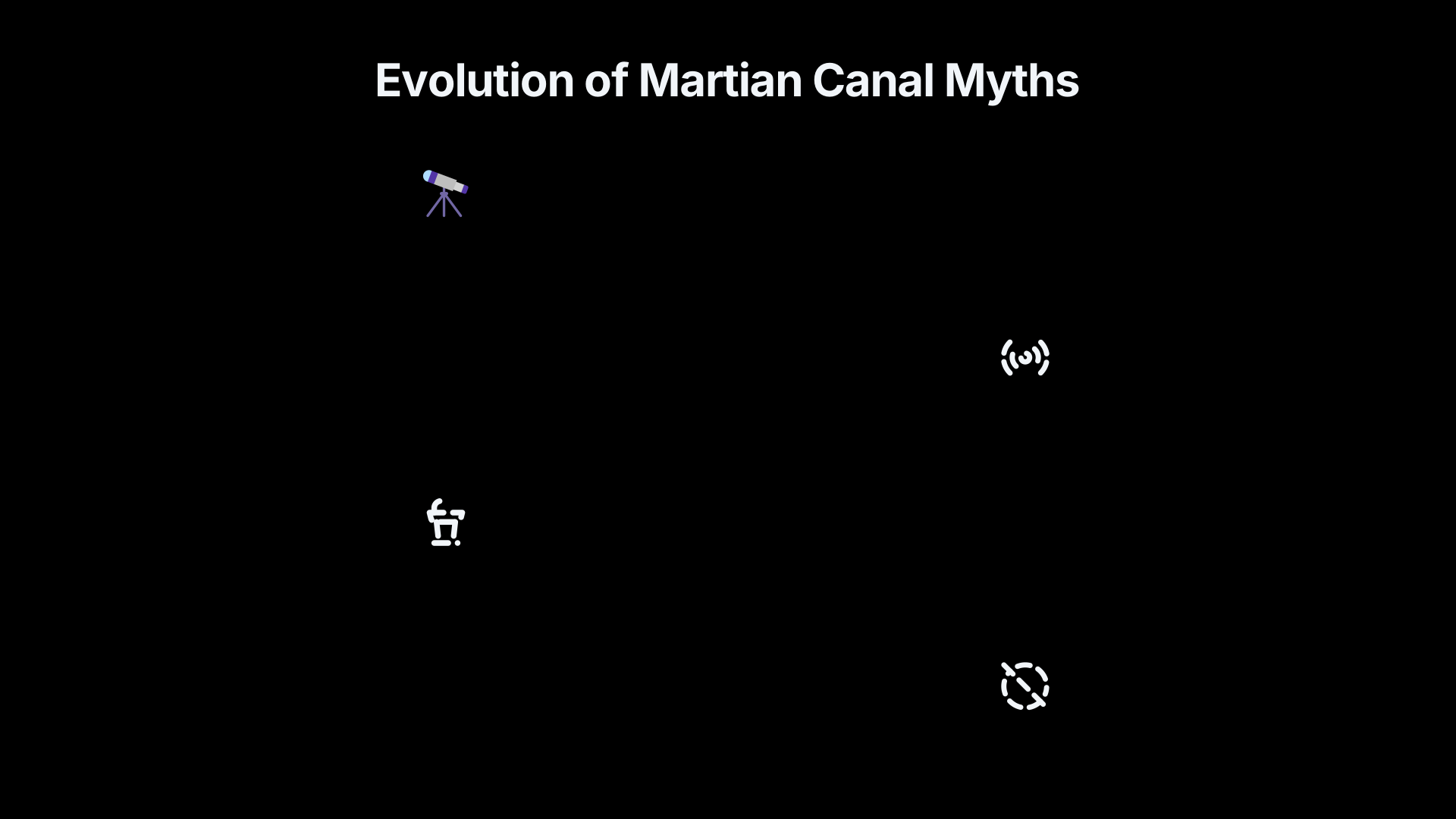
During the favourable opposition of Mars in 1877, Schiaparelli produced some of the most detailed maps yet made of the planet. Among the dark and light regions he recorded were long, narrow linear features that appeared to connect larger surface markings. He called these features canali, a neutral Italian term best translated as “channels”. At the time, he was describing what he believed he saw through a telescope, not proposing evidence of Martian engineers.[britannica.com]britannica.comEncyclopedia Britannica10 Important Dates in Mars History | BritannicaEncyclopedia Britannica10 Important Dates in Mars History | Britannica
This distinction matters because Schiaparelli’s original reports were cautious. The word did not imply artificial construction. In ordinary Italian usage, canali could refer to natural channels as well as waterways. Contemporary accounts note that Schiaparelli did not claim the features had been built by intelligent beings. His observations identified a pattern; they did not provide an explanation for its origin.[Space]space.comTracing the Canals of Mars: An Astronomer's Obsession | SpaceTracing the Canals of Mars: An Astronomer's Obsession | Space…
The features themselves were difficult to observe. Mars appeared as a small disc viewed through nineteenth-century telescopes and Earth’s turbulent atmosphere. Many of the markings lay near the limits of what observers could reliably distinguish. This uncertainty left considerable room for interpretation.[Encyclopedia Britannica]britannica.comOpen source on britannica.com.
Why English Readers Heard Artificial Canals
The crucial change occurred when canali entered English-language astronomy and popular reporting. Instead of “channels”, the term was commonly rendered as “canals”. In English, a canal strongly suggested a human-made structure such as the Suez Canal, completed only a few years earlier and widely celebrated as an engineering triumph.[Encyclopædia Britannica, 11th Edition]britannica11.orgOpen source on britannica11.org.
The translation did not automatically prove intelligent life on Mars, but it changed the question readers asked. A “channel” could be a natural geological feature. A “canal” implied planning, labour and purpose. Once the markings were described in those terms, the possibility of intelligent builders became far easier to imagine.[Encyclopædia Britannica, 11th Edition]britannica11.orgOpen source on britannica11.org.
The timing amplified the effect. The late nineteenth century was an era fascinated by grand infrastructure projects. Newspapers regularly discussed large-scale engineering works, and industrial societies increasingly viewed technological solutions as the answer to environmental challenges. A planet covered by immense canals seemed less like fantasy than it would have in an earlier age.[Space]space.comSeeing Things On Mars: A History of Martian Illusions | SpaceSeeing Things On Mars: A History of Martian Illusions | Space…

How One Word Changed the Alien Question
The translation alone did not create the idea of Martian civilisation. Its importance was that it supplied a conceptual bridge between ambiguous observations and a compelling story.
Once the markings were understood as canals, several assumptions followed naturally:
- Canals require builders.
- Builders imply intelligence.
- A global network implies an organised society.
- Such a society must possess advanced technology.
Those steps were speculative, but each seemed plausible if the previous one were accepted. The result was a shift from asking “What are these markings?” to asking “Who built them?”[Encyclopedia Britannica]britannica.comOpen source on britannica.com.
This was precisely the opening that later advocates of inhabited Mars exploited. The translation transformed a problem of planetary geography into a question about extraterrestrial civilisation. The debate no longer centred solely on surface features; it became a discussion about the nature and capabilities of alien beings.[Space]space.comTracing the Canals of Mars: An Astronomer's Obsession | SpaceTracing the Canals of Mars: An Astronomer's Obsession | Space…
From Channels to a Civilisation
No figure benefited more from this linguistic shift than the American astronomer Percival Lowell. Inspired by reports of the canals, Lowell developed an elaborate theory in which an ageing Martian civilisation had constructed a planet-wide irrigation system to transport water from the polar regions across an increasingly dry world.[Space]space.comTracing the Canals of Mars: An Astronomer's Obsession | SpaceTracing the Canals of Mars: An Astronomer's Obsession | Space…
Lowell’s interpretation went far beyond Schiaparelli’s original observations. He produced maps showing extensive networks, described intersections as “oases”, and argued that only intelligent beings could have created such geometric regularity. Through widely read books and public lectures, he popularised an image of Mars as a technologically sophisticated world struggling against environmental decline.[Space]space.comTracing the Canals of Mars: An Astronomer's Obsession | SpaceTracing the Canals of Mars: An Astronomer's Obsession | Space…
What made the idea powerful was not merely the claim that life existed on Mars. Rather, it presented aliens as engineers solving planetary-scale problems. This image resonated strongly with readers living through an age of industrial expansion and ambitious public works.[Space]space.comSeeing Things On Mars: A History of Martian Illusions | SpaceSeeing Things On Mars: A History of Martian Illusions | Space…
The Reality Behind the Canals
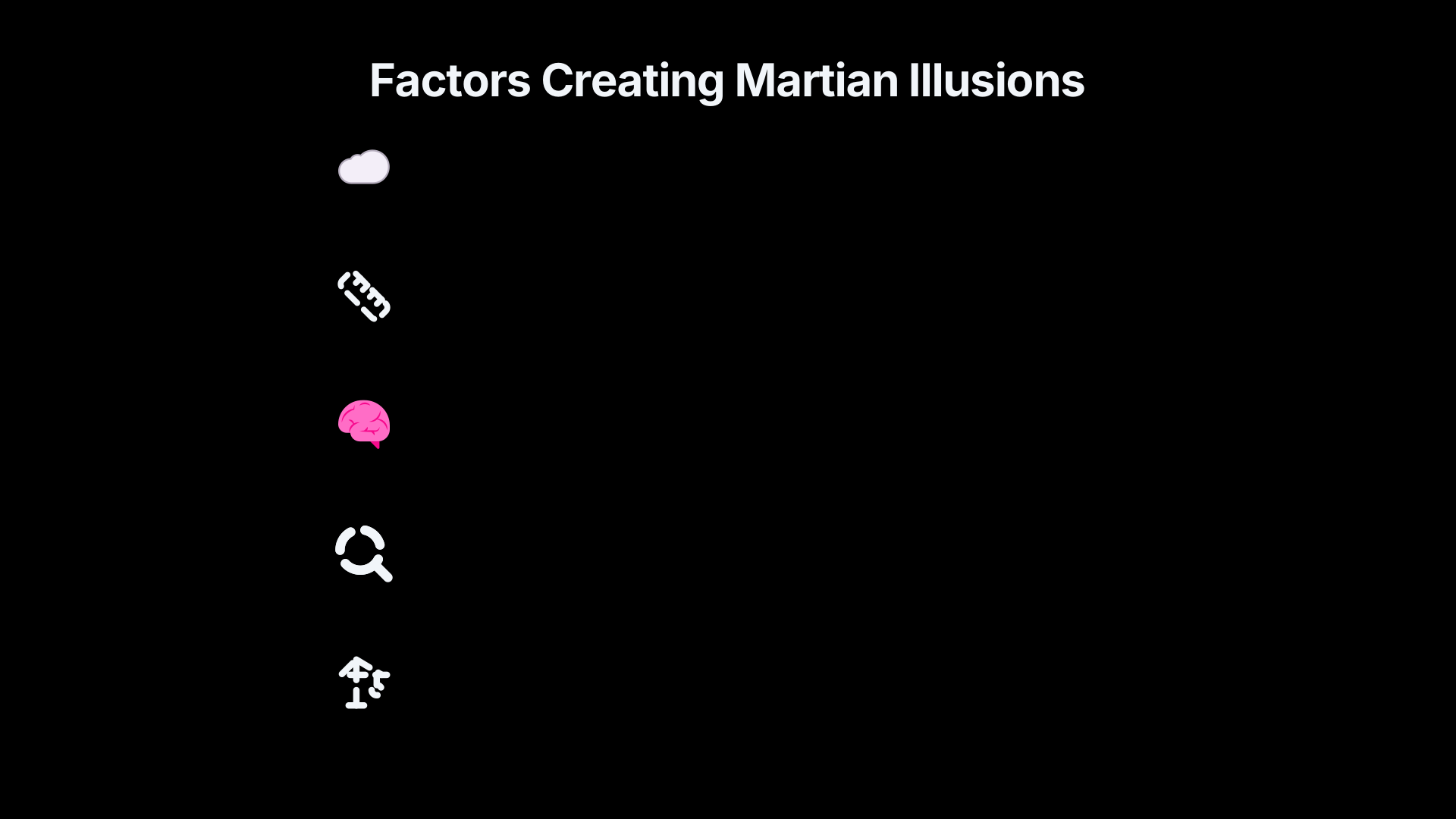
Even while the canal theory gained public attention, many astronomers remained sceptical. Some observers could not see the canals at all. Others reported that the supposed lines appeared irregular, fragmented or inconsistent from one observation to another.[Wikipedia]WikipediaHistory of Mars observationHistory of Mars observation
As observational techniques improved, researchers increasingly concluded that the canal networks were not real structures. Experiments suggested that the human visual system could connect scattered details into apparently straight lines when viewing faint objects near the limits of resolution. The canals were therefore likely a combination of optical effects, observational conditions and pattern recognition by the observer.[britannica.com]britannica.comOpen source on britannica.com.
The issue was settled only in the space age. Close-up photographs returned by spacecraft such as Mariner 4 in 1965 and later missions revealed craters, valleys and varied terrain but no global network of straight channels or artificial waterways. The famous canals vanished when Mars could finally be seen directly rather than inferred through distant telescopic glimpses.[Encyclopedia Britannica]britannica.comOpen source on britannica.com.
Why the Translation Still Matters
The story of canali becoming “canals” remains important because it illustrates how scientific ideas can be shaped by language as much as by observation. Schiaparelli’s original description did not assert the existence of alien engineers. Yet a translation carrying stronger cultural associations encouraged readers to interpret uncertain evidence in technological terms.[Encyclopædia Britannica, 11th Edition]britannica11.orgOpen source on britannica11.org.
Within the broader history of imagined Martian civilisations, this was a pivotal mechanism. A single linguistic choice helped transform faint markings on a distant planet into one of the most enduring visions of extraterrestrial intelligence. Long before the age of UFO reports, it offered a model for how ambiguous observations could become stories about advanced alien technology—a pattern that would reappear repeatedly in later discussions of mysterious phenomena beyond Earth.[britannica.com]britannica.comOpen source on britannica.com.
Amazon book picks
Further Reading
Books and field guides related to Relationships betwee d7372c martian civilization 772d5e canali to canals b2f1ec. Use these as the next step if you want deeper reading beyond the article.
Mars and Its Canals
Directly examines the canal interpretations that grew from the canali translation issue.
The Demon-Haunted World
Rating: 4.5/5 from 43 Google Books ratings
Useful context for understanding how misunderstandings can become accepted narratives.
The War of the Worlds
Shows the cultural impact of beliefs about intelligent Martians.
eBay marketplace picks
Marketplace Samples
Example marketplace items related to this page. Use the search link to explore similar finds on eBay.
Endnotes
1.
Source: Wikipedia
Title: History of Mars observation
Link:https://en.wikipedia.org/wiki/History_of_Mars_observation
2.
Source: britannica.com
Link:https://www.britannica.com/place/canals-of-Mars
3.
Source: space.com
Title: Seeing Things On Mars: A History of Martian Illusions | Space
Link:https://www.space.com/11907-mars-history-martian-illusions-human-delusions.html
Source snippet
Seeing Things On Mars: A History of Martian Illusions | Space...
4.
Source: space.com
Title: Tracing the Canals of Mars: An Astronomer’s Obsession | Space
Link:https://www.space.com/13197-mars-canals-water-history-lowell.html
Source snippet
Tracing the Canals of Mars: An Astronomer's Obsession | Space...
5.
Source: britannica.com
Title: Encyclopedia Britannica10 Important Dates in Mars History | Britannica
Link:https://www.britannica.com/list/10-important-dates-in-mars-history
6.
Source: britannica11.org
Link:https://britannica11.org/article/17-0778-s2/mars
7.
Source: encyclopedia.com
Title: martian canals | Encyclopedia.com
Link:https://www.encyclopedia.com/science/dictionaries-thesauruses-pictures-and-press-releases/martian-canals
Additional References
8.
Source: reddit.com
Title: in 1877 italian astronomer giovanni schiaparelli
Link:https://www.reddit.com/r/wikipedia/comments/1ru8x8y/in_1877_italian_astronomer_giovanni_schiaparelli/
Source snippet
When translated to English, the word "canali" was mistranslated as "canals", which was seen as evidence of life on Mars.March 15, 2026...
Published: March 15, 2026
9.
Source: youtube.com
Link:https://www.youtube.com/watch?v=cStCiyOrJNA
Source snippet
The Biggest Hoax in Astronomy Started With One Italian Astronomer...
10.
Source: youtube.com
Title: This Typo Terrified the World!
Link:https://www.youtube.com/watch?v=DLPWCYM-Fis
Source snippet
Schiaparelli canali Mars canals mistranslation The Biggest Hoax in Astronomy Started With One Italian Astronomer One Word...
11.
Source: youtube.com
Title: The canals of Mars
Link:https://www.youtube.com/watch?v=ChJKQMiNC2c
Source snippet
The Man who was Obsessed with Mars | History | Mistranslations | Japan | Canals | Percival Lowell...
12.
Source: esa.int
Title: European Space Agency ESA
Link:https://www.esa.int/Science_Exploration/Space_Science/Mars_Express/From_canals_to_craters
Source snippet
European Space AgencyESA - From canals to craters...
13.
Source: youtube.com
Title: Elder Fox Documentaries
Link:https://www.youtube.com/watch?v=n–9w6zt9MM
Source snippet
The Most TERRIFYING Space Photo #space #nasa #science AstroKobi...
14.
Source: youtube.com
Title: The Biggest Hoax in Astronomy Started With One Italian Astronomer
Link:https://www.youtube.com/watch?v=3yFVzWLYhpk
Source snippet
This Typo Terrified the World...
15.
Source: raicultura.it
Title: RAI Cultura Giovanni Schiaparelli | Scienza | Rai Cultura
Link:https://www.raicultura.it/scienza/articoli/2019/06/Schiaparelli-e-i-canali-di-Marte-cfdb47bc-889c-4146-90bf-2841a1a3e5da.html
16.
Source: chemeurope.com
Title: www.chemeurope.com Martian_canal
Link:https://www.chemeurope.com/en/encyclopedia/Martian_canal.html
17.
Source: gpedia.com
Title: www.gpedia.com Martian canals
Link:https://www.gpedia.com/en/Martian_canals
Topic Tree