Within UFO Fiction
How Television Made UFOs Everyday Mystery
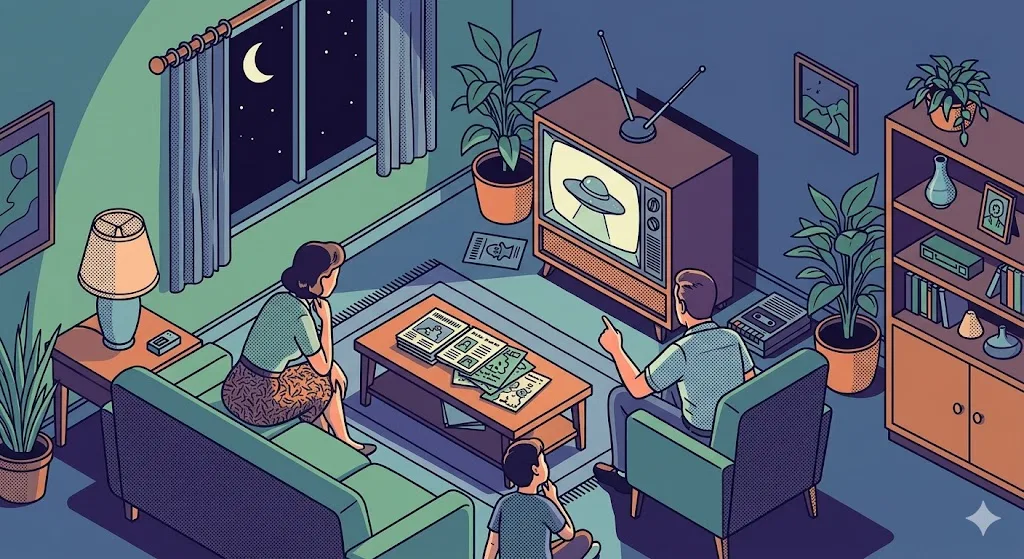
Television brought UFOs into living rooms through documentaries, dramas, news segments, and serialized mystery formats.
On this page
- News and documentary authority
- Serial fiction and weekly suspense
- Why the living room changed belief
Page outline Jump by section
Introduction
Television normalised UFO belief by making the mystery domestic, repeated and emotionally credible. Earlier newspaper reports and cinema science fiction could make flying saucers spectacular; television made them familiar. From official-looking news specials and documentaries to weekly dramas, reenactments and serial conspiracies, UFOs entered the living room as a recurring question rather than a one-off marvel. The important shift was not that television proved alien visitation. Official US Air Force records from Project Blue Book still state that no investigated UFO case showed evidence of extraterrestrial vehicles, and 701 of 12,618 reports remained unidentified rather than solved as alien craft.[National Archives]archives.govNational Archives Project BLUE BOOKNational Archives Project BLUE BOOK
Within the wider relationship between UFOs and science fiction, television became the bridge between report and story. It borrowed the visual grammar of science fiction — saucers, beams, secret bases, alien bodies, government silence — while borrowing the authority of journalism, documentary voiceover, expert interview and case-file drama. The result was a hybrid form: UFOs could be watched as entertainment, discussed as news, and felt as plausible modern folklore.

News and Documentary Authority
Television gave UFOs a special kind of legitimacy because it could stage uncertainty as public evidence. A newspaper could report that witnesses saw lights; television could show the witness’s face, the landscape, the official denial, the sceptical scientist and the dramatic reconstruction in one sitting. That combination mattered. It did not require viewers to accept every claim. It only required them to accept that UFOs were a reasonable topic for serious broadcast attention.
The 1966 Michigan “swamp gas” episode shows how television turned a local UFO flap into a national credibility drama. After widespread sightings in southern Michigan, Air Force consultant J. Allen Hynek suggested that some reports might have involved swamp gas, a phrase that became a public joke and a symbol of official evasiveness. The case drew political attention from Congressman Gerald Ford and helped keep UFOs in the national news cycle. CBS later aired UFO: Friend, Foe or Fantasy? with Walter Cronkite, bringing the dispute into the familiar format of sober network investigation.[Wikipedia]WikipediaMichigan "swamp gas" UFO reportsMichigan "swamp gas" UFO reports
That pattern became central to UFO television: a broadcast could appear sceptical, but still strengthen the sense that there was “something” to investigate. Project Blue Book itself had a similar double effect. The Air Force intended the programme to collect, evaluate and often explain reports; the National Archives notes that Blue Book ran from 1952 until its termination in 1969, after earlier projects Sign and Grudge. Yet the very existence of official forms, files and investigations helped make UFO sightings feel like a recognised category of modern experience.[National Archives]archives.govOpen source on archives.gov.
Television amplified this institutional ambiguity. When viewers saw officials, witnesses and scientists arguing on screen, UFO belief no longer looked only like fringe enthusiasm. It could appear as a civic question: what did the government know, why were explanations contested, and why did ordinary citizens keep reporting strange things? The National Archives’ history of Blue Book notes that officials often believed reports were misidentified known objects, yet the lack of complete certainty led some members of the public to interpret UFOs as signs of extraterrestrial life.[Pieces of History]prologue.blogs.archives.govOpen source on archives.gov.
Documentary and magazine-style programmes also benefited from a recurring production formula. A UFO segment could begin with a witness narrative, move to a map or photograph, introduce an expert, and end without full closure. That lack of closure was not a flaw for television; it was a format. The unresolved ending made UFOs ideal for repeat programming, because each case could feel self-contained while also feeding a larger atmosphere of secrecy and possibility.
Serial Fiction and Weekly Suspense
Fictional television changed UFO belief in a different way: it trained audiences to inhabit UFO mystery over time. A film offered a two-hour encounter; a series made the mystery part of a weekly rhythm. That repetition mattered because UFO mythology is not only about sightings. It is about accumulating hints: a file, a witness, a missing memory, a secret base, a reluctant official, a sceptic who sees too much, a believer who may be right for the wrong reasons.
Late-1970s and early-1980s television created a bridge between case-file realism and science-fiction suspense. Project U.F.O., broadcast on NBC from 1978 to 1979, was loosely based on the real Project Blue Book and presented UFO investigation through a procedural format associated with Jack Webb’s style of documentary-like policing drama.[Wikipedia]WikipediaProject U.F.OProject U.F.O In Search of…, hosted by Leonard Nimoy, placed UFOs alongside Bigfoot, lost civilisations and other mysteries, using interviews, reenactments and voiceover to make speculation feel exploratory rather than purely fictional.[Wikipedia]WikipediaOpen source on wikipedia.org.
This was an important shift in genre. UFO television did not always ask viewers to choose between fact and fiction. Instead, it offered a spectrum: official case drama, speculative documentary, paranormal magazine show, science-fiction thriller. The same living room could receive a network news segment, a dramatised government file and a fictional alien conspiracy within the same broader media diet. Each format reinforced the others by making UFO vocabulary ordinary.
The X-Files became the clearest example of that feedback loop in the 1990s. It did not invent UFO lore, but it gathered abduction narratives, implants, hybrids, secret experiments, cover-ups and alien autopsy rumours into a stylish weekly structure. David Clarke’s study of the series argues that from 1993 onwards it became a conduit through which international audiences encountered the legends, rumours and personal-experience narratives of UFO subculture.[SHURA]shura.shu.ac.ukOpen source on shu.ac.uk.
The show’s slogans mattered almost as much as its plots. “The Truth Is Out There” and “Trust No One” turned UFO belief into a mood: sceptical of institutions, open to hidden evidence, and emotionally invested in unresolved truth. Britannica summarises The X-Files as a science-fiction series that aired on Fox from 1993 to 2002, with revivals in 2016 and 2018, attracted a large cult following and won three Golden Globes for best drama.[Encyclopedia Britannica]britannica.comEncyclopedia Britannica The X-Files | History, Premise, Cast, & FactsEncyclopedia Britannica The X-Files | History, Premise, Cast, & Facts Its reach meant that UFO motifs moved from specialist subculture into mainstream television conversation.
The 1990s also show how fiction, news and public attention could spike together. Media analyst Matthew Nisbet found that cultural fascination with UFOs, measured through New York Times and Washington Post coverage of terms such as UFO, alien abduction and extraterrestrial, reached a historic peak in 1996 and remained high in 1997, boosted by the Roswell anniversary and entertainment products including Independence Day and The X-Files.[Skeptical Inquirer]skepticalinquirer.orgSkeptical Inquirer Cultural Indicators of the Paranormal | Skeptical InquirerSkeptical Inquirer Cultural Indicators of the Paranormal | Skeptical Inquirer Television did not act alone, but it gave the era its serial language.
Why the Living Room Changed Belief
The living room changed UFO belief because television made strange claims socially repeatable. A person did not need to attend a UFO meeting, buy a specialist magazine or read a science-fiction paperback to encounter the topic. UFOs arrived between advertisements, after the evening news, in family viewing slots, on cable reruns and in prestige genre drama. That everyday placement softened the boundary between “fringe claim” and “normal conversation”.
Three mechanisms were especially important.
First, television made witnesses visible. UFO belief often depends less on technical evidence than on whether witnesses seem ordinary, sincere and socially credible. Television is unusually good at presenting sincerity: pauses, emotion, local accents, family settings and uncertainty. Even when evidence is weak, the viewer can feel that a real person’s experience deserves attention.
Second, television borrowed institutional forms. Case numbers, files, radar screens, police-style interviews, military language and expert panels gave UFO stories a bureaucratic texture. This was especially powerful because science fiction had already taught audiences to associate secret projects and classified files with hidden technological truth. Television could therefore turn paperwork into drama.
Third, television rewarded unresolved endings. A scientific investigation seeks closure where possible; television mystery often benefits from ambiguity. Programmes could include a sceptical explanation and still leave viewers with the emotional impression that the case was not fully settled. That structure is well suited to UFO belief, which often grows in the gap between “not identified” and “therefore possibly alien”.
Research on media effects supports the idea that paranormal television can shape belief, though not in a simple one-way fashion. Purdue University reported on work by Glenn Sparks and Will Miller in which the strongest predictor of paranormal belief, after accounting for demographic variables, was whether people watched television programmes regularly featuring paranormal themes. Sparks cautioned that correlation alone cannot prove that such shows cause belief, but also noted that laboratory experiments on exposure to paranormal depictions were consistent with media influence.[Purdue University]purdue.eduUniversity Media messages may encourage paranormal beliefUniversity Media messages may encourage paranormal belief
More focused research on UFO news presentation suggests that framing matters. An experimental study on television news about UFOs found that viewers’ subsequent UFO beliefs were affected by the way the story was presented, including whether scientific authority was used to support or challenge UFO claims.[Purdue University ICS]web.ics.purdue.eduUniversity ICSDOES TV NEWS AFFECT UFO BELIEFS?University ICSDOES TV NEWS AFFECT UFO BELIEFS? This helps explain why documentary tone was so consequential: the same topic could become more credible or less credible depending on how experts, witnesses and doubts were arranged.
The Boundary Between Normalisation and Proof
Television’s role is often misunderstood. Normalising UFO belief does not mean proving UFO claims, and it does not mean every viewer became a believer. It means television made UFO belief culturally available, emotionally legible and socially discussable. A person could reject alien visitation while still knowing the scripts: the hidden file, the unreliable official explanation, the brave witness, the investigator who “wants to believe”, the scientist torn between scepticism and wonder.
That distinction matters because official and scientific sources repeatedly separate unidentified reports from extraterrestrial conclusions. The Air Force’s Project Blue Book fact sheet, preserved by the National Archives, concluded that no evaluated UFO had shown evidence of a national-security threat, technology beyond modern scientific knowledge, or extraterrestrial vehicles.[National Archives]archives.govNational Archives Project BLUE BOOKNational Archives Project BLUE BOOK The Library of Congress frames Carl Sagan’s position as a useful contrast: imaginative speculation about life elsewhere can coexist with rigorous scepticism about claims of alien visitors.[The Library of Congress]loc.govUFOs and Aliens Among Us | Life on Other Worlds | Articles and Essays | Finding Our Place in the Cosmos: From Galileo to Sagan and Beyond…
Television blurred that careful distinction because “unidentified” is dramatically stronger than “explained”. In science, an unidentified object may simply mean insufficient data. In television, it can become the opening scene of a larger story. Science fiction supplied the larger story: hidden visitors, superior technology, cosmic threat, or contact suppressed by earthly authorities.
The most durable effect was therefore not a single belief but a habit of interpretation. Television taught audiences to see UFOs as everyday mystery: close enough to enter the home, strange enough to resist closure, and familiar enough to become part of popular common sense. In the broader relationship between UFOs and science fiction, television was the medium that made the feedback loop continuous. Reports fed programmes, programmes supplied imagery and suspicion, and those images shaped the next generation of reports, dramas and documentaries.
Amazon book picks
Further Reading
Books and field guides related to How Television Made UFOs Everyday Mystery. Use these as the next step if you want deeper reading beyond the article.

UFOs : Generals, Pilots, and Government Officials Go on the R...
Shows how media and authority shape UFO credibility.
The UFO Experience
Explains how UFO reports entered mainstream culture and public discussion.
eBay marketplace picks
Marketplace Samples
Live-tested eBay searches with available results related to this page.


Endnotes
1.
Source: archives.gov
Title: National Archives Project BLUE BOOK
Link:https://www.archives.gov/research/military/air-force/ufos
2.
Source: Wikipedia
Title: Michigan “swamp gas” UFO reports
Link:https://en.wikipedia.org/wiki/Michigan_%22swamp_gas%22_UFO_reports
3.
Source: archives.gov
Link:https://www.archives.gov/news/articles/project-blue-book-50th-anniversary
4.
Source: prologue.blogs.archives.gov
Link:https://prologue.blogs.archives.gov/2019/12/19/saucers-over-washington-the-history-of-project-blue-book/
5.
Source: Wikipedia
Title: Project U.F.O
Link:https://en.wikipedia.org/wiki/Project_U.F.O
6.
Source: Wikipedia
Link:https://en.wikipedia.org/wiki/In_Search_of…_%28TV_series%29
7.
Source: shura.shu.ac.uk
Link:https://shura.shu.ac.uk/31823/9/Clarke-WantToBelieve%28AM%29.pdf
8.
Source: britannica.com
Title: Encyclopedia Britannica The X-Files | History, Premise, Cast, & Facts
Link:https://www.britannica.com/topic/The-X-Files
9.
Source: purdue.edu
Title: University Media messages may encourage paranormal belief
Link:https://www.purdue.edu/uns/html4ever/0105.Sparks.paranormal.html
10.
Source: web.ics.purdue.edu
Title: University ICSDOES TV NEWS AFFECT UFO BELIEFS?
Link:https://web.ics.purdue.edu/~sparks/Quarterly.PDF
11.
Source: loc.gov
Title: The Library of Congress
Link:https://www.loc.gov/collections/finding-our-place-in-the-cosmos-with-carl-sagan/articles-and-essays/life-on-other-worlds/ufos-and-aliens-among-us
Source snippet
UFOs and Aliens Among Us | Life on Other Worlds | Articles and Essays | Finding Our Place in the Cosmos: From Galileo to Sagan and Beyond...
12.
Source: prologue.blogs.archives.gov
Link:https://prologue.blogs.archives.gov/wp-content/uploads/sites/9/2018/03/report.pdf
13.
Source: unwritten-record.blogs.archives.gov
Title: federal theater in los angeles and across america
Link:https://unwritten-record.blogs.archives.gov/2013/10/24/federal-theater-in-los-angeles-and-across-america/
14.
Source: archives.gov
Link:https://www.archives.gov/research/jfk/select-committee-report/part-1c.html
15.
Source: archives.gov
Title: do records show proof of ufos
Link:https://www.archives.gov/news/articles/do-records-show-proof-of-ufos
16.
Source: archives.gov
Title: 1977 annual report
Link:https://www.archives.gov/files/about/history/sources/reports/1977-annual-report.pdf
17.
Source: archives.gov
Link:https://www.archives.gov/files/declassification/iscap/pdf/2014-004-doc01.pdf
18.
Source: archives.gov
Link:https://www.archives.gov/news/articles
19.
Source: archives.gov
Title: 1976 annual report
Link:https://www.archives.gov/files/about/history/sources/reports/1976-annual-report.pdf
20.
Source: Wikipedia
Title: Project Blue Book (TV series)
Link:https://en.wikipedia.org/wiki/Project_Blue_Book_%28TV_series%29
21.
Source: Wikipedia
Title: Project Blue Book
Link:https://en.wikipedia.org/wiki/Project_Blue_Book
22.
Source: Wikipedia
Title: UFO conspiracy theories
Link:https://en.wikipedia.org/wiki/UFO_conspiracy_theories
23.
Source: Wikipedia
Title: Ancient Aliens
Link:https://en.wikipedia.org/wiki/Ancient_Aliens
24.
Source: Wikipedia
Link:https://en.wikipedia.org/wiki/The
25.
Source: Wikipedia
Title: The X Files
Link:https://en.wikipedia.org/wiki/The_X-Files
26.
Source: time.com
Title: ufo aliens book garrett graff interview
Link:https://time.com/6328511/ufo-aliens-book-garrett-graff-interview/
27.
Source: history.com
Title: Project Blue Book
Link:https://www.history.com/articles/project-blue-book
28.
Source: youtube.com
Title: CBS Reports: UFO: Friend, Foe or Fantasy (
Link:https://www.youtube.com/watch?v=0ZAtXM_Dd5E
Source snippet
Wikipedia...
Published: May 10, 1966
29.
Source: youtube.com
Link:https://www.youtube.com/watch?v=BlDLDRT-whU
Source snippet
Project U.F.O. - Opening Credits (Jack Webb Series, 1978-1979)...
30.
Source: youtube.com
Title: Project U.F.O
Link:https://www.youtube.com/watch?v=EAGRBGYBgXA
31.
Source: youtube.com
Title: Project Blue Book
Link:https://www.youtube.com/watch?v=jjinS2lZAsY
Source snippet
'Project Blue Book' Ep. 1 Official Clip | UFO | SHOWTIME Documentary Series - YouTube...
32.
Source: youtube.com
Link:https://www.youtube.com/watch?v=GcOCIabFnLE
Source snippet
Project Blue Book...
33.
Source: youtube.com
Link:https://www.youtube.com/watch?v=hhJb_vlmnaM
Source snippet
Project Blue Book...
34.
Source: skepticalinquirer.org
Title: Skeptical Inquirer Cultural Indicators of the Paranormal | Skeptical Inquirer
Link:https://skepticalinquirer.org/exclusive/cultural-indicators-of-the-paranormal/
35.
Source: skepticalinquirer.org
Link:https://skepticalinquirer.org/2024/08/ancient-aliens-now-extra-cringey/
36.
Source: merriam-webster.com
Link:https://www.merriam-webster.com/dictionary/the
37.
Source: dictionary.cambridge.org
Link:https://dictionary.cambridge.org/dictionary/english/the
38.
Source: en.wiktionary.org
Link:https://en.wiktionary.org/wiki/the
39.
Source: authorcarlara.com
Title: The X-Files
Link:https://www.authorcarlara.com/post/the-x-files
Additional References
40.
Source: youtube.com
Title: UFO Project Blue Book at National Archives Museum
Link:http://www.youtube.com/watch?v=JHeZjJgO9Ns
Source snippet
UFO Friend Foe or Fantasy Walter Cronkite CBS CBS Reports with Walter Cronkite; UFO Friend. Foe or Fantasy,May 10, 1966.mp4 magnant521...
Published: May 10, 1966
41.
Source: youtube.com
Title: Science Fiction’s Influence on UFO Pop Culture
Link:http://www.youtube.com/watch?v=cGtPAOJSTEo
Source snippet
"Walter Cronkite" UFO friend foe fantasy UFO Friend, Foe, or Fantasy - 1966 Documentary ZxrAlienWarrior...
42.
Source: youtube.com
Link:http://www.youtube.com/watch?v=UWpUC-VLSXc
Source snippet
Project Blue Book: Declassified – The True Story of the Lubbock Lights | History...
43.
Source: youtube.com
Title: ‘Project Blue Book’ Ep. 1 Official Clip | UFO | SHOWTIME Documentary Series
Link:https://www.youtube.com/watch?v=W89jh2C2Ry8
Source snippet
Project Blue Book: America's Obsession with UFOs - YouTube...
44.
Source: youtube.com
Title: CBS Reports with Walter Cronkite; UFO Friend. Foe or Fantasy,
Link:http://www.youtube.com/watch?v=rKMFj5m774I
Source snippet
Science Fiction's Influence on UFO Pop Culture - Offworld Episode 29...
Published: May 10, 1966
45.
Source: youtube.com
Title: Project Blue Book: Declassified – The True Story of the Lubbock Lights | History
Link:http://www.youtube.com/watch?v=CIhGAev0ZU4
Source snippet
UFOs History in TV, Movies, and Pop Culture Explained...
46.
Source: youtube.com
Title: Pop Culture’s Impact On UFO’s Ahead Of US Intelligence Report
Link:http://www.youtube.com/watch?v=mx6qhoJ1XLc
Source snippet
Popular Science Fiction and the Genesis of Paranormal Claims (Thomas Holtz)...
47.
Source: youtube.com
Title: Dr. J. Allen Hynek Michigan UFO Sightings Press Conference (
Link:https://www.youtube.com/watch?v=0I47_FAUhGE
Source snippet
UFOs: Seeing Is Believing (2005) - ABC News Special...
Published: March 25, 1966
48.
Source: youtube.com
Title: Project Blue Book: America’s Obsession with UFOs
Link:https://www.youtube.com/watch?v=Xu4oTBBI5UE
Source snippet
Mar. 25, 1966 | Dr. J. Allen Hynek Addresses Michigan UFO Sightings - YouTube...
49.
Source: youtube.com
Title: Popular Science Fiction and the Genesis of Paranormal Claims (Thomas Holtz)
Link:http://www.youtube.com/watch?v=KMv4E8TCL9A
Source snippet
UFO Project Blue Book at National Archives Museum...
Topic Tree