Within UFO Fiction
How Games Turn UFO Myths Into Play
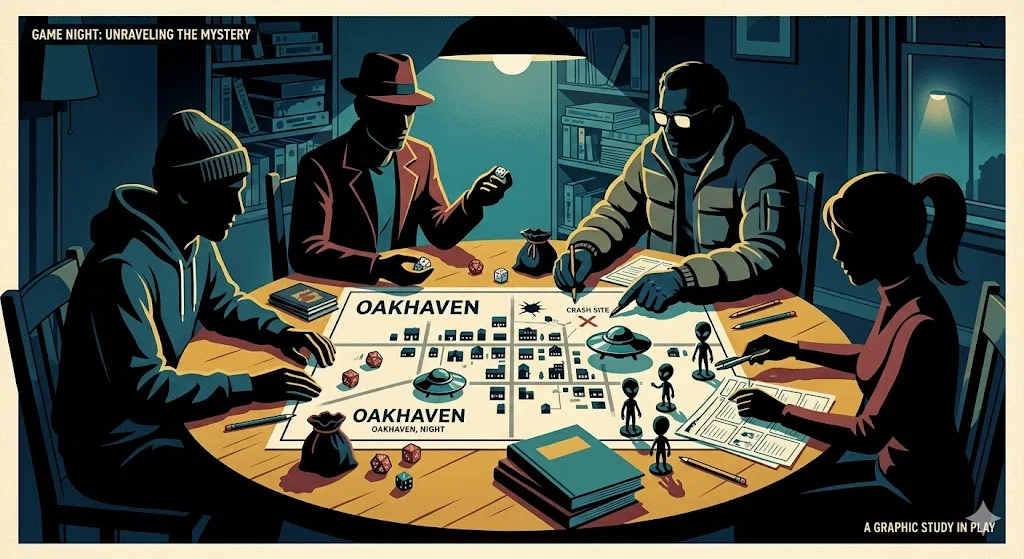
Games let players inhabit UFO roles as investigators, invaders, pilots, or abductees, extending the feedback loop into play.
On this page
- Player roles in UFO stories
- Investigation, invasion, and survival loops
- How play reinforces familiar imagery
Page outline Jump by section
Introduction
Games turn UFO myths from stories people watch into systems people operate. Instead of merely seeing a flying saucer, the player may command the anti-alien defence agency, pilot the craft, invade Earth, investigate an abduction site, or piece together a conspiracy through messages and clues. That is what makes games distinctive in the wider relationship between UFOs and science fiction: they convert familiar images into repeatable actions.
This does not mean games prove anything about UFOs. Official and scientific sources remain careful about that boundary: NASA’s UAP work has stressed that there is no conclusive evidence in peer-reviewed science for an extraterrestrial origin of unidentified anomalous phenomena, while the US Air Force’s Project Blue Book records ended with no evidence that unidentified sightings were extraterrestrial vehicles.[NASA Science]science.nasa.govNASA ScienceIndependent Study Team ReportSeptember 13, 2023 — To date, in the peer-reviewed scientific literature, there is no conclusive… Games matter here for a cultural reason. They teach audiences how UFO stories feel from the inside: as suspicion, escalation, resource pressure, stealth, survival, discovery, or power fantasy.
Player Roles in UFO Stories
The most important change games make to UFO mythology is role assignment. A film can show an investigator, an invader, a pilot, or an abductee; a game can ask the player to become one. That choice changes the myth. UFO lore is no longer only a set of claims about lights, discs, secrecy and aliens. It becomes a playable job.
In XCOM: Enemy Unknown, the player is not a witness looking up at the sky but the commander of a global defence organisation. The official description is explicit about the loop: create a base, research alien technologies, plan combat missions, and control soldiers in battle against an unknown extraterrestrial enemy.[2K Games]2k.comOpen source on 2k.com. This turns a classic UFO narrative into management pressure. The saucer is not just a symbol of mystery; it is a trigger for interception, autopsy, engineering, panic control and tactical loss. The player learns the UFO myth as bureaucracy under attack.
Destroy All Humans! reverses the moral camera. Instead of defending Earth from the saucer, the player becomes the alien Crypto-137, terrorising 1950s Earth, harvesting DNA, using psychic powers, and reducing cities with a flying saucer.[Destroy All Humans]destroyallhumans.thqnordic.comOpen source on thqnordic.com. The result is not belief-building but parody. It makes visible how strongly UFO imagery had fused with 1950s Americana, Cold War paranoia, government secrecy and B-movie invasion comedy. The joke works because the imagery is already familiar: little green men, secret agencies, rural panic, ray guns and the saucer overhead.
Other games shift the role again. They Are Here: Alien Abduction Horror casts the player as a local journalist investigating disturbing events at a remote farm, while the developer’s own description emphasises searching for artefacts, reading records, examining photos, and using camera or video equipment to record evidence.[Steam Store]store.steampowered.comThey Are Here Alien Abduction HorrorThey Are Here Alien Abduction Horror That is the UFO myth as fieldwork horror. The player does not command armies or fire ray guns. They document, trespass, listen, hide and try to survive the feeling that the ordinary countryside has become a staged encounter.
Investigation, Invasion and Survival Loops
The familiar UFO story is often built from a sequence: strange light, witness account, official denial or secrecy, investigation, escalation, encounter. Games preserve that sequence but divide it into loops the player repeats.
The investigation loop is built around evidence. A game gives the player traces: recordings, documents, photographs, locations, anomalous objects, witness statements and hidden links. This pattern suits UFO stories because the subject already lives in the tension between proof and interpretation. A blurry photograph, a locked facility or a missing file is not just decoration; it is the kind of object UFO culture has trained audiences to treat as meaningful.
The invasion loop turns the UFO into a strategic pressure point. Space Invaders did not use modern abduction lore, but it established a durable game grammar for extraterrestrial threat: descending aliens, defensive barriers, repeated waves and rising speed. The modern Arcade Archives description still presents the 1978 Taito game as the “origin” of a landmark shooting game, while historical accounts note that its waves of aliens and defensive structure helped define the fixed-shooter form.[Arcade Archives]arcadearchives.comaca 392aca 392 The aliens’ meaning is simple but powerful: they are coming down, and the player’s task is to hold the line.
The survival loop moves from global defence to bodily vulnerability. In alien abduction horror, the UFO myth is not primarily about geopolitics but helplessness: the farmhouse at night, strange lights, missing people, surveillance, paralysis and the sense that the investigator has entered an environment already controlled by something else. This is where interactive design can intensify a familiar UFO image. A film can show a beam of light entering a room; a game can make the player choose whether to keep filming, hide, search the next room, or run.
The exploration loop is gentler but still relevant. No Man’s Sky presents a galaxy of procedurally generated planets, alien lifeforms, spacecraft, danger and discovery, drawing openly on classic science-fiction adventure.[Steam Store]store.steampowered.comOpen source on steampowered.com. It is not a UFO-investigation game in the narrow sense, but it shows how the same cultural bridge works in the other direction. The unknowable light in the sky becomes the player’s destination. The alien planet is no longer rumour, report or threat; it is terrain.
How Play Reinforces Familiar Imagery
Games reinforce UFO imagery through repetition. A saucer in a film may appear for a few seconds. A saucer in a game may be flown, targeted, upgraded, feared, researched or used as a weapon for hours. The image becomes a tool.
This is why a small portfolio of examples matters more than any single title:
- The saucer as enemy craft: In XCOM-style strategy, the UFO is an operational problem. It appears on a world map, lands, crashes, yields materials, and pushes the player into research and combat. The myth becomes procedural: secrecy, interception and reverse engineering.
- The saucer as player vehicle: In Destroy All Humans!, the saucer is comic empowerment. It turns invasion anxiety into slapstick control, letting the player perform the fantasy that earlier stories assigned to the alien.
- The alien as descending pattern: In Space Invaders, alien threat becomes rhythm. The enemy advances not through dialogue but through movement, sound and shrinking space.
- The encounter as evidence hunt: In abduction horror and conspiracy games, the UFO is partly absent. Its power comes from traces, recordings, ominous sites and the player’s uncertainty about what counts as proof.
- The unknown as destination: In exploration games, the sky is no longer a boundary. The player crosses it, scans alien life, names discoveries and domesticates the cosmic unknown through maps, inventories and travel.
These patterns matter because games do not simply illustrate UFO myths; they train expectations about how such myths work. A player becomes used to the idea that alien contact produces artefacts, secret research, hostile escalation, strange biology, hidden agencies and unlockable truth. Those are science-fiction conventions, but repeated play can make them feel like the natural grammar of UFO storytelling.
Conspiracy Games and the Blurred Edge of Reality
UFO myths have always had a special relationship with documents: leaked memos, redacted files, blurry images, government archives and claims about hidden programmes. Interactive media can exploit that more directly than cinema because it can deliver information through the same channels people use in everyday life.
Electronic Arts’ Majestic is a key example. The Science Fiction Encyclopedia describes it as one of the first alternate reality games, promoted with the phrase “The Game That Plays You”, and designed to blur the line between fiction and reality by intruding into players’ daily lives.[SF Encyclopedia]sf-encyclopedia.comOpen source on sf-encyclopedia.com. Contemporary coverage described the game using phone calls, faxes, instant messages, emails, web pages, PDAs and mobile phones to deliver its conspiracy-thriller story.[WIRED]wired.comMajestic Invades Your WorldThe story begins with mysterious events at a high-tech firm, and players must gather clues, solve puzzles, and uncover answers through fr…
This matters for UFO mythology because the form matched the content. A conspiracy about hidden knowledge becomes more persuasive as a game when clues arrive through apparently ordinary channels. The player is not just reading about secrecy; they are sorting messages, checking websites, comparing clues and asking whether the next communication belongs to the fiction or to real life.
Tabletop role-playing games use a related method with different tools. Delta Green presents itself as a role-playing game of Lovecraftian horror and conspiracy, and its publications include scenarios where UFO mysteries lead to deeper horrors in rural 1990s Tennessee.[DELTA GREEN]delta-green.comOpen source on delta-green.com. Around a table, players do not merely consume a UFO conspiracy; they improvise its consequences. The game master controls fragments of the hidden world, while players test theories, interrogate witnesses, mishandle evidence and decide how much truth their characters can survive.
Why Games Make the Feedback Loop Stronger
The broader relationship between UFOs and science fiction is often described as a feedback loop: reports influence stories, stories influence expectations, and expectations shape later interpretations. Games intensify that loop because they add agency. They do not only show a saucer; they ask what the player will do about it.
This has three effects.
First, games make UFO mythology operational. XCOM’s base management and research systems turn the old idea of recovered alien technology into a sequence of decisions. The player allocates resources, accepts losses and waits for breakthroughs. That gives the myth a practical texture: the hidden laboratory, the autopsy room, the recovered alloy and the global panic meter all become things to manage rather than merely imagine.
Second, games make UFO mythology embodied. In first-person horror, the player’s viewpoint narrows. The question is no longer “What does the government know?” but “What is outside the door?” This is especially effective for abduction imagery, where the traditional fear is not invasion on a battlefield but loss of control in an intimate space: a bedroom, car, farm, road or isolated house.
Third, games make UFO mythology reversible. Destroy All Humans! shows how easily invasion panic becomes alien comedy when the player is put in the saucer. The same symbols remain, but their emotional charge changes. Government agents become targets, the public becomes scenery, and the flying saucer becomes a toy of domination. That reversal reveals how much UFO science fiction depends on point of view.

What Interactive UFO Myths Usually Leave Out
Games are powerful at turning UFO stories into action, but they also simplify. Real unidentified sightings often involve ambiguous data, misperception, sensor limits, ordinary aircraft, atmospheric effects, classified technology, unreliable memory, or unresolved evidence without dramatic closure. Official sources repeatedly stress uncertainty rather than cinematic certainty: NASA’s UAP material emphasises better data and scientific methods, while Project Blue Book’s archival history is about investigation records rather than proof of alien visitation.[NASA Science]science.nasa.govOpen source on nasa.gov.
Games usually need stronger feedback than reality provides. A strategy game rewards research with better weapons. A horror game makes the farmhouse dangerous. A conspiracy game needs the hidden pattern to be discoverable. An arcade shooter needs aliens to arrive in waves. These are satisfying designs, but they can also teach a misleading habit: the expectation that every anomaly must be part of a coherent plot.
That does not make UFO games irresponsible by default. It means their cultural role is closer to myth-making than evidence-gathering. They dramatise the questions people bring to UFOs: Who knows the truth? What if the visitors are hostile? What if the government is lying? What if the witness is alone? What if the object in the sky is not something to identify but something to play?
The Playable Saucer as Science-Fiction Memory
Games have become one of the clearest places to see UFO imagery preserved, remixed and made usable. The flying saucer, the alien invader, the secret base, the abduction site, the classified file and the cosmic frontier all survive because games give them jobs to do.
That is the distinctive contribution of games to the relationship between UFOs and science fiction. They do not merely borrow the mythology; they implement it. A player can defend Earth, invade it, investigate it, escape from it, or leave it behind for unknown planets. Each role keeps the old UFO feedback loop alive, not as a static belief, but as an interactive grammar of suspicion, wonder, threat and discovery.
Amazon book picks
Further Reading
Books and field guides related to How Games Turn UFO Myths Into Play. Use these as the next step if you want deeper reading beyond the article.
Extra Lives: Why Video Games Matter
Explores how games create meaning through participation.
eBay marketplace picks
Marketplace Samples
Example marketplace items related to this page. Use the search link to explore similar finds on eBay.




Endnotes
1.
Source: science.nasa.gov
Link:https://science.nasa.gov/wp-content/uploads/2023/09/uap-independent-study-team-final-report.pdf
Source snippet
NASA ScienceIndependent Study Team ReportSeptember 13, 2023 — To date, in the peer-reviewed scientific literature, there is no conclusive...
Published: September 13, 2023
2.
Source: sf-encyclopedia.com
Link:https://sf-encyclopedia.com/entry/majestic
3.
Source: wired.com
Title: Majestic Invades Your World
Link:https://www.wired.com/2001/05/majestic-invades-your-world
Source snippet
The story begins with mysterious events at a high-tech firm, and players must gather clues, solve puzzles, and uncover answers through fr...
4.
Source: delta-green.com
Link:https://www.delta-green.com/
5.
Source: delta-green.com
Link:https://www.delta-green.com/publications/
6.
Source: science.nasa.gov
Link:https://science.nasa.gov/uap/
7.
Source: archives.gov
Title: National Archives Project BLUE BOOK
Link:https://www.archives.gov/research/military/air-force/ufos
8.
Source: archives.gov
Title: project blue book 50th anniversary
Link:https://www.archives.gov/news/articles/project-blue-book-50th-anniversary
9.
Source: space.com
Title: best alien invasion games
Link:https://www.space.com/best-alien-invasion-games
10.
Source: science.nasa.gov
Link:https://science.nasa.gov/uap/faqs/
11.
Source: youtube.com
Title: XCOM: Enemy Unknown Interactive Gameplay Trailer
Link:https://www.youtube.com/watch?v=uQ3B7XPpPmI
Source snippet
Destroy All Humans! (2020) - Release Trailer | PS4...
12.
Source: youtube.com
Link:https://www.youtube.com/watch?v=0blRcUrAXZo
Source snippet
7 Strangest Unsolved Alien & UFO Mysteries in Video Games...
13.
Source: 2k.com
Link:https://2k.com/games/xcom/enemy-unknown/
14.
Source: destroyallhumans.thqnordic.com
Link:https://destroyallhumans.thqnordic.com/
15.
Source: store.steampowered.com
Title: They Are Here Alien Abduction Horror
Link:https://store.steampowered.com/app/1547540/They_Are_Here_Alien_Abduction_Horror/
16.
Source: arcadearchives.com
Title: aca 392
Link:https://www.arcadearchives.com/en/title/aca-392/
17.
Source: Wikipedia
Title: Space Invaders
Link:https://en.wikipedia.org/wiki/Space_Invaders
18.
Source: store.steampowered.com
Link:https://store.steampowered.com/app/275850/No_Mans_Sky/
19.
Source: reddit.com
Link:https://www.reddit.com/r/rpg/comments/1s5a0cr/delta_green_edition/
20.
Source: Wikipedia
Title: Destroy All Humans! (2005 video game)
Link:https://en.wikipedia.org/wiki/Destroy_All_Humans%21_%282005_video_game%29
21.
Source: Wikipedia
Title: Delta Green
Link:https://en.wikipedia.org/wiki/Delta_Green
22.
Source: Wikipedia
Title: Space Invaders
Link:https://de.wikipedia.org/wiki/Space_Invaders
23.
Source: Wikipedia
Title: Project Blue Book
Link:https://en.wikipedia.org/wiki/Project_Blue_Book
24.
Source: obscuritory.com
Link:https://obscuritory.com/other/majestic/
25.
Source: destroy-all-humans.fandom.com
Link:https://destroy-all-humans.fandom.com/wiki/Saucer
26.
Source: gamicus.fandom.com
Link:https://gamicus.fandom.com/wiki/Majestic
27.
Source: 2k.com
Link:https://2k.com/games/xcom/
28.
Source: youtube.com
Link:https://www.youtube.com/watch?v=jJA4rAUPsiQ
29.
Source: youtube.com
Link:https://www.youtube.com/watch?v=b3BQsCCwo8w
30.
Source: youtube.com
Link:https://www.youtube.com/watch?v=DKLLDJZmxl4
31.
Source: gideonsgaming.com
Title: destroy all humans review the 2020 alien invasion
Link:https://gideonsgaming.com/destroy-all-humans-review-the-2020-alien-invasion/
32.
Source: mobygames.com
Link:https://www.mobygames.com/game/4637/majestic/
33.
Source: britannica.com
Title: Project Blue Book
Link:https://www.britannica.com/topic/Project-Blue-Book
34.
Source: vault.fbi.gov
Link:https://vault.fbi.gov/Project%20Blue%20Book%20%28UFO%29%20/Project%20Blue%20Book%20%28UFO%29%20Part%2001%20%28Final%29/at_download/file
35.
Source: nookgaming.com
Title: Destroy All Humans
Link:https://www.nookgaming.com/destroy-all-humans-review/
36.
Source: museumofplay.org
Title: space invaders
Link:https://www.museumofplay.org/games/space-invaders/
37.
Source: medium.com
Link:https://medium.com/%40pauljones_85805/delta-green-uncovering-the-shadows-in-gaming-7bf10976f48f
Additional References
38.
Source: nsa.gov
Link:https://www.nsa.gov/portals/75/documents/news-features/declassified-documents/ufo/usaf_fact_sheet_95_03.pdf
39.
Source: researchgate.net
Link:https://www.researchgate.net/publication/374373111_UFOs_and_Unidentified_Anomalous_Phenomena_The_NASA_report_1492023_has_found_no_evidence_to_suggest_that_UAPs_are_extraterrestrial_in_origin
40.
Source: reddit.com
Link:https://www.reddit.com/r/gamingsuggestions/comments/14pv8vz/any_video_games_regarding_aliensufos/
41.
Source: facebook.com
Link:https://www.facebook.com/groups/1277721139645865/posts/1820689925348981/
42.
Source: myabandonware.com
Link:https://www.myabandonware.com/game/majestic-10jk
43.
Source: reddit.com
Link:https://www.reddit.com/r/ARG/comments/28sxv5/eas_the_majestic_was_my_first_and_only_arg/
44.
Source: instagram.com
Link:https://www.instagram.com/reel/DNggpTYv6-O/
45.
Source: reddit.com
Link:https://www.reddit.com/r/DeltaGreenRPG/comments/ypdiw3/i_pretty_much_agree_with_majestic_does_this_mean/
46.
Source: startplaying.games
Link:https://startplaying.games/adventure/cm3q0mahm000eqs4xjprbdsgu
47.
Source: reddit.com
Link:https://www.reddit.com/r/Xcom/comments/39kubt/long_wars_learning_cliff/
Topic Tree
Follow this branch
Parent topic
UFO FictionRelated pages 29
- Abduction horror Why abduction horror feels more personal in games
- Majestic ARG The UFO conspiracy game that played outside the screen
- Saucer parody When the player becomes the flying saucer
- Space Invaders How descending aliens became a game grammar
- Unknown worlds When the strange light becomes a destination
- +1 more in sidebar