Within UFO Fiction
What Pulp Sci Fi Gave the UFO Era
Pulp science fiction prepared readers to imagine space visitors, future war, secret weapons, and strange craft before 1947.
On this page
- Space travel before saucer headlines
- Aliens and future war in popular magazines
- How pulp images shaped public expectation
Page outline Jump by section
Introduction
Pulp science fiction did not create the UFO boom of 1947, but it helped prepare the audience that received it. By the time Kenneth Arnold’s Mount Rainier sighting put “flying saucers” into the news, magazine readers had already spent two decades seeing rockets, alien civilisations, future aircraft, interplanetary wars, hidden super-science and strange craft on cheap newsstand paper. The important point is cultural, not evidential: pulp magazines gave readers a visual and narrative vocabulary for imagining unknown things in the sky.[National Air and Space Museum]airandspace.si.edu1947 year flying saucerRainier on June 24, 1947, remains a mystery. He spent the rest of his life trying to explain…
That vocabulary was not a single template. Early pulp spaceships often looked like bloated aeroplanes, ocean liners, rockets, cylinders or fantastic machines rather than the neat saucer of later UFO iconography. Aliens ranged from human-like Martians to monstrous “bug-eyed” creatures. War stories projected ordinary military anxieties into space. Secret-weapon tales made advanced craft feel plausible before they were real. The result was a public imagination already trained to connect the heavens with machines, invasion, discovery and hidden technology.[sf-encyclopedia.com]sf-encyclopedia.comOpen source on sf-encyclopedia.com.
Space Travel Before Saucer Headlines
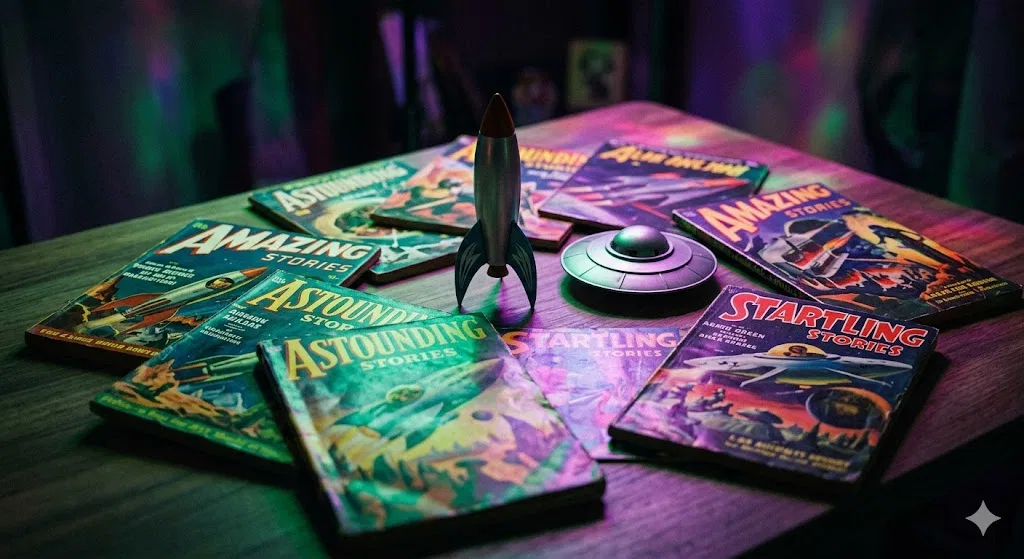
The key pulp milestone was the launch of Amazing Stories in 1926. The Library of Congress describes the magazine as central to the emergence of science fiction as a distinct genre, while The Encyclopedia of Science Fiction calls it the first magazine devoted exclusively to science fiction. Hugo Gernsback framed the new field as “scientifiction”: fiction that entertained while introducing readers to scientific ideas, future technologies and journeys beyond Earth.[The Library of Congress]loc.govThe Library of Congress Not Just Pulp FictionThe Library of Congress Not Just Pulp Fiction
This mattered because Amazing Stories did not merely publish isolated fantasies. It gave them a recurring monthly home. A reader did not need to seek out a hardback novel by H. G. Wells or Jules Verne; the future was available at the newsstand. The first issue mixed older scientific romances with new magazine culture, and later pulps such as Science Wonder Stories, Air Wonder Stories, Wonder Stories, Astounding Stories and Thrilling Wonder Stories expanded the market for space travel, advanced aircraft and mechanical marvels.[bis-space.com]bis-space.comOpen source on bis-space.com.
The pictures were as important as the stories. Frank R. Paul, one of the defining illustrators of early American science fiction, helped make space travel feel visible before it was technically possible. His covers and interior art for Gernsback’s magazines presented readers with immense machines, alien worlds, city-sized technologies and craft moving through space. The Society of Illustrators credits Paul with shaping the visual language of early science fiction through covers for Amazing Stories, Science Wonder Stories and Fantastic Adventures.[Society of Illustrators]societyillustrators.orgOpen source on societyillustrators.org.
For later UFO culture, the crucial effect was not that pulp readers expected one precise shape. It was that they expected the unknown sky to contain engineered objects. The Encyclopedia of Science Fiction notes that early pulp magazines took up spaceships “in a big way” and often visualised them as bulbous, aircraft-like or liner-like machines with portholes. That imagery made “craft from elsewhere” a familiar category before “UFO” became a public term.[sf-encyclopedia.com]sf-encyclopedia.comOpen source on sf-encyclopedia.com.
Aliens and Future War in Popular Magazines
Pulp magazines also normalised the idea that space travel implied contact. Early American pulp science fiction often populated other worlds with human-like races, beautiful alien women, monsters and threatened civilisations. These were not subtle anthropological speculations; they were adventure stories. Yet they repeatedly trained readers to imagine that other planets might contain societies, enemies, allies and technologies beyond Earth’s own.[sf-encyclopedia.com]sf-encyclopedia.comOpen source on sf-encyclopedia.com.
Mars was especially important. Long before the 1947 UFO wave, popular astronomy and fiction had made Mars a site of speculation about life, canals and civilisation. Gernsback himself had been influenced by Percival Lowell’s writings on Martian canals, and his magazines continued to connect scientific curiosity with popular fantasy.[WIRED]wired.com0816hugo gernsback born0816hugo gernsback born
The alien was rarely neutral. Pulp stories often presented extraterrestrials through familiar earthly anxieties: invasion, degeneration, racial hierarchy, empire, rescue, conquest or romance. This made later UFO interpretations easier to dramatise. When mysterious craft appeared in headlines after 1947, audiences already knew several possible stories: visitors might be explorers, invaders, refugees, scientists, hidden rulers or technologically superior watchers.
Future war was another major pulp inheritance. Between the First World War, the rise of aviation, the growth of radio and the approach of the Second World War, pulp magazines fused science fiction with military speculation. Air Wonder Stories, launched by Gernsback in 1929, explicitly separated itself from ordinary aerial adventure by promising future flying fiction along scientific, mechanical and technical lines. That distinction is important: the sky was no longer just a battlefield for pilots but a laboratory for imagined weapons and new kinds of craft.[Wikipedia]WikipediaWonder StoriesWonder Stories
By the late 1930s and early 1940s, science fiction readers were used to stories in which the next war might be transformed by rays, rockets, secret aircraft, atomic power or space-based threats. That habit of thought would fit the post-1945 world almost too well. Once real rockets, radar, jet aircraft and atomic weapons had entered public knowledge, pulp speculation no longer seemed merely extravagant. It had become one way of making sense of rapid technological shock.
Strange Craft Before “Flying Saucers”
One common mistake is to assume that the flying saucer image suddenly appeared fully formed in June 1947. Arnold’s sighting did give the modern saucer era its public name, and the Smithsonian’s National Air and Space Museum stresses that the event added “flying saucer” to the vocabulary of millions. But disc-like or unusual aerial craft had already circulated in pulp art and speculative writing before that date.[National Air and Space Museum]airandspace.si.edu1947 year flying saucerRainier on June 24, 1947, remains a mystery. He spent the rest of his life trying to explain…
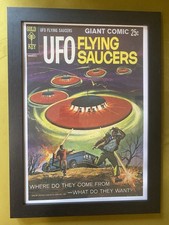
This does not mean pulp magazines “predicted” or “invented” UFOs in a simple sense. The evidence is messier. Some early science fiction art did include round, flattened or disc-like machines, but many craft looked nothing like later saucer stereotypes. The stronger claim is that pulp magazines loosened the public’s expectations about what a flying machine could look like. A strange object did not have to resemble a conventional aeroplane to be imagined as a vehicle.
That shift can be seen in the range of pulp imagery. Spaceships could be rockets, cylinders, flying wings, spheres, floating cities, streamlined liners or hybrids of ship and aircraft. The visual field was experimental. When the post-war press began reporting fast, unidentified objects, that older visual variety gave journalists, editors and readers a ready-made imaginative storehouse.[sf-encyclopedia.com]sf-encyclopedia.comOpen source on sf-encyclopedia.com.
The timing also matters. Arnold’s report came in 1947, just after a war in which secret weapons had become a fact of life. V-2 rockets, radar, jet aircraft and atomic bombs had compressed the distance between wild speculation and engineering reality. Pulp stories had already spent years turning advanced devices into dramatic objects; wartime technology made the habit feel less childish.
The Shaver Mystery as a Bridge Case
The strangest bridge between pulp science fiction and the UFO boom was the Shaver Mystery in Amazing Stories. Beginning in 1945, editor Raymond A. Palmer promoted Richard Shaver’s tales of ancient beings, subterranean civilisations, hidden machines and harmful underground “deros”. These stories were presented ambiguously, often as if they might be true rather than straightforward fiction.[David Halperin]davidhalperin.netDavid Halperin Richard Shaver, Ray Palmer, and the Quest for Lemuria (Part 3David Halperin Richard Shaver, Ray Palmer, and the Quest for Lemuria (Part 3
The Shaver Mystery matters because it blurred boundaries that later became central to UFO culture: fiction and testimony, entertainment and revelation, hidden technology and personal experience, ancient aliens and present danger. It was not just a set of stories. It generated letters, arguments and claims from readers who believed the material resonated with their own experiences. Contemporary accounts and later summaries agree that the feature dramatically increased Amazing Stories’ circulation, even as established science fiction fans attacked it as an embarrassment to the genre.[David Halperin]davidhalperin.netDavid Halperin Richard Shaver, Ray Palmer, and the Quest for Lemuria (Part 3David Halperin Richard Shaver, Ray Palmer, and the Quest for Lemuria (Part 3
The June 1947 issue of Amazing Stories is especially striking because it was entirely devoted to Shaver material and appeared in the same month as Arnold’s sighting. That coincidence should not be overstated: Shaver did not create Kenneth Arnold’s report, and not all UFO imagery can be reduced to Palmer’s editorial choices. But the overlap shows how close the pulp world was to the emergence of modern saucer culture.[Internet Archive]archive.orgAmazing Stories Volume21Number06 692Amazing Stories Volume21Number06 692
Palmer himself later became a major figure in flying saucer publishing, including work with Arnold. That continuity is one reason historians of UFO culture often treat the Shaver Mystery as a precursor rather than a sideshow. It demonstrated that a magazine audience existed for stories presented at the edge of science fiction, occult speculation, hidden history and alleged fact.[Global Grey]globalgreyebooks.comGlobal Grey The Coming of the Saucers by Kenneth Arnold …It chronicles one of the most influential early UFO encounters in modern histoGlobal Grey The Coming of the Saucers by Kenneth Arnold …It chronicles one of the most influential early UFO encounters in modern histo
How Pulp Images Shaped Public Expectation
Pulp magazines shaped the UFO era less by planting one exact belief than by creating mental shortcuts. When people encountered an ambiguous aerial report, several pulp-trained assumptions were already available.
Unknown craft could be technological. A strange light or shape might be interpreted as a machine, not merely a meteor, cloud or omen. Pulp science fiction had filled the sky with devices: rockets, ray-ships, flying laboratories, war machines and interplanetary vessels.
Advanced craft could come from elsewhere. The idea of visitors from Mars, Venus or distant stars had become ordinary magazine furniture. Readers had already met alien civilisations in adventure form, so extraterrestrial interpretation did not require inventing a new category from scratch.[sf-encyclopedia.com]sf-encyclopedia.comOpen source on sf-encyclopedia.com.
Secret weapons were plausible. The Second World War made dramatic technologies real. Pulp fiction had long imagined future arms; wartime developments made the public more willing to ask whether strange aerial objects were experimental military devices.
The sky was narratively charged. In pulp fiction, the sky and space were not empty. They were routes of invasion, exploration, surveillance, escape and revelation. That made UFO reports culturally sticky: each sighting could be folded into a story already familiar from fiction.
This does not mean witnesses merely copied fiction. UFO reports have always included varied descriptions, mundane explanations, sincere uncertainty and unresolved cases. The pulp influence is better understood as a shaping environment. It affected which possibilities seemed memorable, which metaphors came easily, and which images journalists and readers amplified.
What Pulp Did Not Explain
A careful account has to avoid two exaggerations. The first is the sceptical overreach that says UFOs were simply a pulp invention. That is too neat. People reported strange aerial phenomena before science fiction pulps, and after 1947 governments, militaries and civilian investigators dealt with reports that arose from many causes: misidentifications, aircraft, balloons, astronomical objects, weather effects, hoaxes, classified technology and unresolved observations.
The second exaggeration is the believer’s mirror-image claim that pulp magazines somehow foresaw a later reality. Similar-looking images are not proof of extraterrestrial visitation. Pulp artists and writers were paid to visualise exciting machines, and they drew on existing technology, naval design, aircraft, rockets, astronomy, fantasy and commercial spectacle. A rounded spacecraft on a magazine cover is evidence of imagination, not evidence of aliens.
The most useful middle position is historical-comparative. Before 1947, pulps had already built a shared language of space visitors, hidden machines, future war and strange craft. After 1947, UFO reports entered that language and changed it. The saucer boom then fed back into fiction, film, comics and later television, but the public was not starting from a blank page.
Why These Pulp Roots Still Matter
The pulp roots of UFO culture explain why the saucer era caught so quickly. The modern UFO wave began with a news event, but it spread through a culture already primed to imagine extraordinary aircraft and non-human intelligence. Without the pulps, the same reports might still have circulated, but they would have had fewer ready-made images to attach to them.
They also explain why UFO culture has always had a double character. It can sound technical, with talk of speed, propulsion, radar and secret weapons. It can also sound mythic, with hidden beings, cosmic visitors and revelations withheld from ordinary people. Pulp science fiction combined those modes decades earlier: science as spectacle, machinery as wonder, aliens as drama, and the unknown sky as a place where the future might suddenly arrive.
The result was not a straight line from magazine cover to witness report. It was a shared imaginative climate. Pulp magazines before the UFO boom gave readers practice in seeing the sky as a frontier of machines, visitors and danger. When the flying saucer headlines arrived in 1947, many people already knew how such a story was supposed to feel.
Amazon book picks
Further Reading
Books and field guides related to What Pulp Sci-Fi Gave the UFO Era. Use these as the next step if you want deeper reading beyond the article.
The UFO Experience
Connects public UFO interpretations to broader cultural expectations.
The Time Machines
Directly explains how pulp science fiction shaped ideas later associated with UFO culture.
The Encyclopedia of Science Fiction
Provides context on pulp themes, aliens, spacecraft and future technology.
Passport to Magonia
Explores cultural narratives that shape interpretations of unexplained aerial phenomena.
eBay marketplace picks
Marketplace Samples
Live-tested eBay searches with available results related to this page.



Endnotes
1.
Source: sf-encyclopedia.com
Link:https://sf-encyclopedia.com/entry/amazing
2.
Source: sf-encyclopedia.com
Link:https://sf-encyclopedia.com/entry/spaceships
3.
Source: sf-encyclopedia.com
Link:https://sf-encyclopedia.com/entry/aliens
4.
Source: Wikipedia
Title: Wonder Stories
Link:https://en.wikipedia.org/wiki/Wonder_Stories
5.
Source: wired.com
Title: 0816hugo gernsback born
Link:https://www.wired.com/2010/08/0816hugo-gernsback-born
6.
Source: Wikipedia
Title: Amazing Stories
Link:https://en.wikipedia.org/wiki/Amazing_Stories
7.
Source: archive.org
Title: Amazing Stories Volume21Number06 692
Link:https://archive.org/details/AmazingStoriesVolume21Number06_692
8.
Source: Wikipedia
Title: Other Worlds, Universe Science Fiction, and Science Stories
Link:https://en.wikipedia.org/wiki/Other_Worlds%2C_Universe_Science_Fiction%2C_and_Science_Stories
9.
Source: Wikipedia
Title: Flying saucer
Link:https://en.wikipedia.org/wiki/Flying_saucer
10.
Source: Wikipedia
Title: Raymond A. Palmer
Link:https://en.wikipedia.org/wiki/Raymond_A._Palmer
11.
Source: Wikipedia
Title: Richard Sharpe Shaver
Link:https://en.wikipedia.org/wiki/Richard_Sharpe_Shaver
12.
Source: Wikipedia
Title: Kenneth Arnold UFO sighting
Link:https://en.wikipedia.org/wiki/Kenneth_Arnold_UFO_sighting
13.
Source: Wikipedia
Title: Frank R. Paul
Link:https://en.wikipedia.org/wiki/Frank_R._Paul
14.
Source: Wikipedia
Title: Historical Dictionary of Science Fiction
Link:https://en.wikipedia.org/wiki/Historical_Dictionary_of_Science_Fiction
15.
Source: sf-encyclopedia.com
Link:https://sf-encyclopedia.com/entry/asf
16.
Source: sf-encyclopedia.com
Link:https://sf-encyclopedia.com/category/publication
17.
Source: sf-encyclopedia.com
Link:https://sf-encyclopedia.com/entry/religion
18.
Source: sf-encyclopedia.com
Title: startling stories
Link:https://sf-encyclopedia.com/entry/startling_stories
19.
Source: sf-encyclopedia.com
Link:https://sf-encyclopedia.com/category/theme
20.
Source: sf-encyclopedia.com
Title: tubb e c
Link:https://sf-encyclopedia.com/entry/tubb_e_c
21.
Source: sf-encyclopedia.com
Title: gernsback hugo
Link:https://sf-encyclopedia.com/entry/gernsback_hugo
22.
Source: sf-encyclopedia.com
Title: leinster murray
Link:https://sf-encyclopedia.com/entry/leinster_murray
23.
Source: sf-encyclopedia.com
Title: wonder stories
Link:https://sf-encyclopedia.com/entry/wonder_stories
24.
Source: archive.org
Title: Amazing Stories Volume01Number01
Link:https://archive.org/details/AmazingStoriesVolume01Number01
25.
Source: archive.org
Link:https://archive.org/details/ScienceWonderStoriesV01n11193004c2cbogof39Cape1736
26.
Source: archive.org
Title: Wonder Stories v02n11 1931 04
Link:https://archive.org/details/Wonder_Stories_v02n11
27.
Source: archive.org
Link:https://archive.org/details/wonderstoriesv04n10193303.stellar
28.
Source: archive.org
Title: Wonder Stories v02n04 1930 09
Link:https://archive.org/details/Wonder_Stories_v02n04
29.
Source: archive.org
Title: Astounding Stories of Super Science 1930
Link:https://archive.org/details/Astounding_Stories_of_Super_Science_1930
30.
Source: archive.org
Link:https://archive.org/details/historicaldictio0000book
31.
Source: encyclopedia.com
Title: amazing stories
Link:https://www.encyclopedia.com/media/encyclopedias-almanacs-transcripts-and-maps/amazing-stories
32.
Source: youtube.com
Title: Hugo Gernsback
Link:http://www.youtube.com/watch?v=2CnS-ZNvRDs
Source snippet
Pulp Magazines in the 1920s...
33.
Source: airandspace.si.edu
Title: 1947 year flying saucer
Link:https://airandspace.si.edu/stories/editorial/1947-year-flying-saucer
Source snippet
Rainier on June 24, 1947, remains a mystery. He spent the rest of his life trying to explain...
Published: June 24, 1947
34.
Source: loc.gov
Title: The Library of Congress Not Just Pulp Fiction (
Link:https://www.loc.gov/loc/lcib/9616/scifi.html
35.
Source: bis-space.com
Link:https://www.bis-space.com/from-amazing-stories-to-the-bis-100-years-of-scientifiction/
36.
Source: societyillustrators.org
Link:https://societyillustrators.org/award-winners/frankrpaul/
37.
Source: davidhalperin.net
Title: David Halperin Richard Shaver, Ray Palmer, and the Quest for Lemuria (Part 3)
Link:https://www.davidhalperin.net/the-shaver-mystery-richard-shaver-ray-palmer-and-the-quest-for-lemuria-part-3/
38.
Source: globalgreyebooks.com
Link:https://www.globalgreyebooks.com/coming-of-the-[saucers
39.
Source: openculture.com
Title: astounding stories
Link:https://www.openculture.com/2022/06/astounding-stories.html
40.
Source: korshakcollection.com
Link:https://www.korshakcollection.com/frank-r-paul
41.
Source: ebay.co.uk
Title: Amazing Stories
Link:https://www.ebay.co.uk/itm/405226977187
42.
Source: library.umbc.edu
Link:https://library.umbc.edu/speccoll/scifi/
43.
Source: sciencefictionruminations.com
Link:https://sciencefictionruminations.com/tag/1930s/page/4/
44.
Source: sffremembrance.com
Title: amazing stories
Link:https://sffremembrance.com/tag/amazing-stories/
Additional References
45.
Source: youtube.com
Title: Science Fiction Fantasy Pulps from the 40s and 50s
Link:http://www.youtube.com/watch?v=nlTgFCPbJTU
Source snippet
History of pulp science fiction magazines High Literature from Pulp Magazines with Jason Carney Case Western Reserve University...
46.
Source: youtube.com
Title: Hugo Gernsback, Amazing Stories and H.G. Wells’ “New Accelerator” | Episode 31.1
Link:http://www.youtube.com/watch?v=yj9UUwNtQe0
Source snippet
Science Fiction Fantasy Pulps from the 40s and 50s...
47.
Source: cia.gov
Link:https://www.cia.gov/readingroom/document/cia-rdp81r00560r000100010002-9
48.
Source: youtube.com
Title: A Short History of Pulp Magazines
Link:http://www.youtube.com/watch?v=iLhqWFzqEyg
Source snippet
Hugo Gernsback, Amazing Stories and H.G. Wells' "New Accelerator" | Episode 31.1...
49.
Source: researchgate.net
Link:https://www.researchgate.net/publication/304652761_A_Ghost_in_the_Machine_How_Sociology_Tried_to_Explain_Away_American_Flying_Saucers_and_European_Ghost_Rockets
50.
Source: readthespirit.com
Link:https://readthespirit.com/explore/ray-palmer-interview-with-biographer-fred-nadis-about-flying-saucers-and-pulp-fiction/?print=print
51.
Source: reddit.com
Link:https://www.reddit.com/r/books/comments/87jlwz/enter_the_pulp_magazine_archive_featuring_over/
52.
Source: frankwu.com
Link:https://www.frankwu.com/paul1.html
53.
Source: dokumen.pub
Link:https://dokumen.pub/historical-dictionary-of-science-fiction-in-literature-0810878844-9780810878846.html
54.
Source: facebook.com
Link:https://www.facebook.com/groups/BritishScienceFictionAssociation/posts/10162564898727045/
Topic Tree
Follow this branch
Parent topic
UFO FictionRelated pages 29
- Alien Roles The alien roles waiting for saucer stories
- Amazing Stories How Amazing Stories trained readers for UFOs
- Craft Shapes Why strange shapes could still look like craft
- Frank R Paul The illustrator who made strange craft visible
- Future War When pulp weapons met postwar reality
- +1 more in sidebar