Within UFO Fiction
Why Flying Saucers Became Invasion Machines
1950s invasion films turned the flying saucer into a symbol of national vulnerability and technological shock.
On this page
- The saucer as hostile technology
- Atomic fear on the cinema screen
- Why invasion plots endured
Page outline Jump by section
Introduction
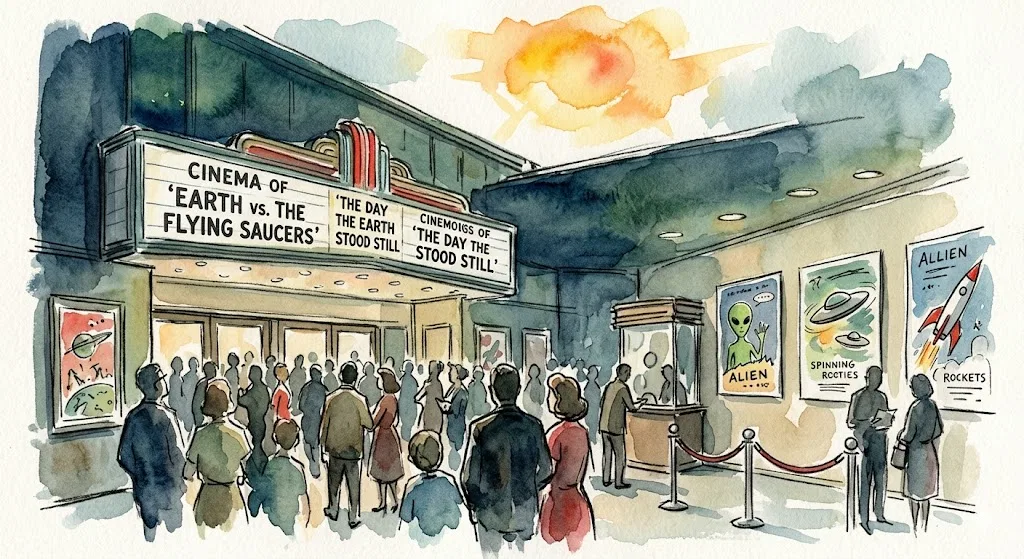
Hollywood invasion films helped turn the flying saucer from a puzzling news item into a screen image of national vulnerability. In the late 1940s and 1950s, UFO reports, Cold War suspicion, nuclear fear and rapid rocketry all converged in popular culture. Films did not simply copy the UFO panic; they gave it shape, sound, scale and emotion. A radar blip or newspaper report became, on screen, a spinning disc over Washington, a Martian war machine crossing California, or a neighbour whose familiar face hid an alien takeover. That is why 1950s saucer cinema matters in the relationship between UFOs and science fiction: it made the idea of aerial mystery feel immediate, visual and collective, while translating political and technological anxiety into stories audiences could watch together. The Library of Congress notes that 1940s and 1950s flying saucer reports became raw material for Hollywood visions of threat, with atomic destruction and Cold War fear providing especially fertile ground.[The Library of Congress]loc.govUFOs and Aliens Among Us | Life on Other Worlds | Articles and Essays | Finding Our Place in the Cosmos: From Galileo to Sagan and Beyond…
Why saucers became invasion machines
The flying saucer was not automatically an invasion image. Early UFO language could suggest curiosity, mistaken observation, secret aircraft, cosmic warning or benevolent contact. Hollywood’s 1950s invasion cycle narrowed that ambiguity into a vivid dramatic question: what if the thing in the sky was not just unknown, but hostile? The British Film Institute summarises the wider climate clearly: Cold War paranoia and fear of imminent destruction fed an unusually strong wave of alien invasion films and apocalyptic space adventures in American 1950s cinema.[BFI]bfi.org.uk10 great american sci fi films 1950s10 great american sci fi films 1950s
That shift made sense for cinema. A saucer was simple, legible and mobile. It could hover over a city, land on a government lawn, evade ordinary aircraft, or become a glowing mark of superior technology. Unlike older monsters, it did not have to emerge from a Gothic castle, a laboratory or a remote island. It could arrive in the middle of modern public life, from the sky that commercial aviation, radar, missiles and atomic bombers had already made politically charged.
The connection to real UFO culture was close but not identical. Federal concern about UFOs grew amid Cold War tensions, Roswell rumours and reports by officials as well as civilians. The National Archives describes Project Blue Book as a response to public concern, possible Soviet secret weapons and anxiety about extraterrestrial life; it also notes that the Air Force’s refusal to rule out extraterrestrial explanations encouraged some members of the public to read UFOs as alien evidence.[Pieces of History]prologue.blogs.archives.govOpen source on archives.gov. Hollywood did not need to prove the alien interpretation. It only needed audiences to recognise the emotional premise: strange objects in the sky could mean that the United States was exposed.
This is the key difference between an official UFO file and an invasion film. A file asks what a witness saw. A film asks what society fears the sighting means. The 1950s saucer movie turned uncertainty into a public scenario: warning sirens, scrambled jets, failed scientific explanations, military briefings, panicked crowds and monuments under attack.
The saucer as hostile technology
One reason flying saucers worked so well on screen was that they looked like machines rather than monsters. They were not merely alien bodies; they were alien systems. Their smooth surfaces, silent movement and indifference to ordinary defences made them symbols of technological shock. The terror was not only that outsiders had arrived, but that they had arrived with equipment that made human weapons look obsolete.
The Day the Earth Stood Still, released in 1951, is not a simple invasion film, but it established a crucial screen grammar for saucer anxiety. Its alien visitor lands in Washington with a saucer-shaped craft and a robot powerful enough to make national military confidence look fragile. The story is framed by nuclear danger and global politics rather than by simple conquest, which makes it a useful hinge between warning story and invasion story. Cambridge University Press’s overview of 1950s science fiction cinema treats it as one of the major studio landmarks of the decade, alongside The War of the Worlds and Forbidden Planet, rather than as disposable B-picture material.[Cambridge University Press & Assessment]resolve.cambridge.orgscience fiction films in the 1950sscience fiction films in the 1950s
The War of the Worlds, released in 1953, pushed the pattern towards catastrophe. George Pal’s adaptation moved H. G. Wells’s Victorian invasion story into modern Southern California, where Martian technology becomes a test of contemporary military power. Its war machines are not classic saucers, but the film belongs to the same emotional lane: alien technology appears suddenly, advances across familiar terrain, and exposes the limits of human control. The Library of Congress’s National Film Registry later included War of the Worlds among culturally, historically or aesthetically significant films, underlining how central it became to American screen memory of invasion science fiction.[The Library of Congress]loc.govOpen source on loc.gov.
Earth vs. the Flying Saucers, released in 1956, made the saucer itself the attacking machine. Turner Classic Movies describes how Ray Harryhausen faced the unusual task of animating not creatures but spacecraft, giving smooth spinning discs a sense of motion and life. It also notes that those discs became a definitive UFO image, widely imitated in later alien invasion films.[Turner Classic Movies]tcm.comTurner Classic Movies Earth vs. the Flying SaucersTurner Classic Movies Earth vs. the Flying Saucers This is where saucer panic becomes especially visual: the object is not just unidentified, it is a designed threat, able to descend on Washington and reduce the symbols of government to targets.
That matters because the saucer film translated technological uncertainty into a recognisable image. The real world of the early Cold War was full of hard-to-see systems: radar, classified aircraft, missiles, atomic stockpiles, intelligence networks. The screen saucer simplified those anxieties into one object. It was fast, foreign, airborne, technologically superior and impossible to ignore.
Atomic fear on the cinema screen
The 1950s invasion film did not only ask whether aliens might exist. It asked whether modern science had made humanity powerful enough to destroy itself and vulnerable enough to be destroyed from outside. The Library of Congress links flying saucer fears directly to the atomic bomb’s challenge to faith in technological progress, noting that Cold War destruction fears helped generate visions of visitors from other worlds and enemies hidden in plain sight.[The Library of Congress]loc.govUFOs and Aliens Among Us | Life on Other Worlds | Articles and Essays | Finding Our Place in the Cosmos: From Galileo to Sagan and Beyond…
This is why so many films from the same period blend UFOs, radiation, mutation, rockets and military response. Some are direct saucer films; others are adjacent atomic-age fantasies. The common thread is not simply “aliens”. It is the feeling that technology has outrun social confidence. A laboratory, launch site, radar station or military command room may appear to be a place of control, but the plot repeatedly shows that control breaking down.
Invasion of the Body Snatchers, released in 1956, shows how invasion panic could move away from spectacular saucers and into ordinary neighbourhood life. The Library of Congress essay on the film places it within an explosion of science fantasy and science horror fuelled by the atomic age, space rocketry and Cold War anxieties. Its seed pods turn into human doubles, leaving the victim’s appearance intact while transforming the personality.[The Library of Congress]loc.govThe Library of Congress Invasion of the Body SnatchersThe Library of Congress Invasion of the Body Snatchers The terror is not a disc in the sky but a social invasion already under way.
That makes Body Snatchers central to saucer panic even though its most famous image is the pod, not the UFO. It answers a question raised by flying saucer culture: if visitors came, where would they be? The answer is more frightening than a sky battle. They might be in the next house, the next office, the next bed. The film’s famous warning that others are “next” compresses Cold War fear into a nightmare of conversion, conformity and delayed recognition. The threat is external in origin but internal in effect.
Atomic-age monster films such as Them! also belong near this discussion, though they are not flying saucer films. They show the same era’s habit of turning scientific fear into public menace. Environmental history projects on risk and militarisation note that radioactive and chemical pollution fears helped generate 1950s monster films, including The Beast from 20,000 Fathoms and Them!, where nuclear tests produce giant ants in the American Southwest.[environmentandsociety.org]environmentandsociety.orgMonster moviesMonster movies In saucer films, the threat comes from above; in atomic monster films, it comes from what human technology has already disturbed. Together they formed a cinema of technological dread.
Why Hollywood made panic feel public
Official UFO investigations were bureaucratic: reports, interviews, radar traces, explanations and unresolved files. Hollywood made the same atmosphere public and emotional. It supplied crowd scenes, news bulletins, military mobilisation and household fear. The viewer did not need to believe a particular UFO case to understand the sensation of a society suddenly watching the sky.
The 1952 Washington UFO events help explain why that screen language resonated. The National Archives describes UFO concern as tied to Cold War tensions and public mass anxiety, while the UK National Archives’ UFO files note that the summer of 1952 saw a wave of sightings, including more than 500 reports to the United States Air Force in July alone.[Pieces of History]prologue.blogs.archives.govOpen source on archives.gov. The same period produced films in which the capital, the military and scientific experts are forced into emergency interpretation. Saucer cinema did not invent the mood; it arranged it into dramatic form.
The films also exploited a tension that official statements could not easily resolve. If authorities said most sightings were explainable, the unexplained residue remained narratively powerful. If officials investigated UFOs at all, that investigation could be read as confirmation that the issue mattered. National Archives records state that Project Blue Book ultimately collected 12,618 sightings from 1947 to 1969, with 701 remaining unidentified, while also making clear that the project closed in 1969.[National Archives]archives.govNational Archives Project BLUE BOOKNational Archives Project BLUE BOOK For storytellers, the important detail was not statistical proof of alien craft; it was the existence of an official archive full of unresolved aerial mystery.
Hollywood invasion films turned that unresolved quality into a pattern audiences could immediately follow:
- The sighting: a flash, disc, meteor-like arrival or radar return interrupts normal life.
- The expert phase: scientists, military officers or doctors try to explain the event with existing knowledge.
- The failure of reassurance: official confidence collapses as the threat exceeds ordinary categories.
- The public crisis: the private sighting becomes a national or planetary emergency.
- The technological contest: human science must either fail, adapt or discover the invader’s weakness.
This structure made saucer panic portable. It could be replayed as all-out war, secret infiltration, moral warning or biological takeover. The saucer did not have to mean one thing. It became a flexible sign of exposure.
The invasion was not always literal
The most interesting 1950s invasion films are not all saying the same thing. Some imagine direct attack, some imagine infiltration, and some use alien arrival to criticise human militarism. Treating them as one simple anti-communist code flattens the evidence. Invasion of the Body Snatchers, for example, has often been read as an allegory of communist threat, but scholarship also links it to McCarthyism, capitalism, conformity, radiation anxiety, Korean War brainwashing fears and post-war gender or social tensions.[Springer]link.springer.comRemaking Cultural Anxieties in Invasion of the Body SnatchersRemaking Cultural Anxieties in Invasion of the Body Snatchers
That range of interpretation is part of the reason the films endured. A flying saucer could stand for Soviet bombers, but also for American military overconfidence. A pod person could suggest communist conformity, but also suburban emptiness or social pressure to suppress emotion. A peaceful alien could expose Earth’s own aggression. The films worked because they did not require every viewer to decode the same political message.
The Day the Earth Stood Still is the clearest example of this ambiguity. Its saucer landing creates a security crisis, yet the visitor’s purpose is warning rather than conquest. The fear comes from humanity’s response to the unknown as much as from the unknown itself. Earth vs. the Flying Saucers, by contrast, gives audiences a more direct war fantasy, with flying discs transformed into targets and spectacle. Body Snatchers removes the public saucer battle and makes invasion intimate. These differences show how flexible the UFO-science-fiction feedback loop had become by the mid-1950s.
The common element is vulnerability. Whether the invader lands openly, attacks monuments, replaces neighbours or delivers a warning backed by overwhelming force, the human world is shown as newly penetrable. That is the emotional achievement of the 1950s saucer cycle: it makes the sky, the state, the home and even the self feel less secure than they looked.

Why invasion plots endured
Hollywood’s saucer panic endured because it gave later science fiction a reusable grammar. The visual grammar included spinning discs, beams, domes, control rooms, military convoys and city panic. The narrative grammar included ignored warnings, disputed sightings, official secrecy, scientific improvisation and last-minute survival. Later alien films could embrace the pattern, soften it, parody it or reject it, but they inherited a recognisable template.
Earth vs. the Flying Saucers is especially important here because its saucers became cinematic objects in their own right. TCM’s account of Harryhausen’s work stresses that the discs were made to feel alive despite being machines, and that their smooth grey form became a defining UFO image in later invasion cinema.[Turner Classic Movies]tcm.comTurner Classic Movies Earth vs. the Flying SaucersTurner Classic Movies Earth vs. the Flying Saucers Once audiences had seen saucers topple landmarks, the flying disc was no longer just a reported shape. It was a ready-made visual shorthand for superior force.
The endurance also comes from the films’ historical balance between specificity and flexibility. They belong unmistakably to the 1950s: Cold War fear, atomic dread, space-age technology and official UFO investigation all shape them. Yet the underlying pattern can be updated whenever new anxieties attach to the sky. Drones, surveillance balloons, stealth aircraft, satellites and renewed unidentified-anomalous-phenomena debates can all reactivate the same old question: what is overhead, who controls it, and what does it mean if authorities cannot explain it quickly?
Within the broader relationship between UFOs and science fiction, Hollywood invasion films did not prove that UFOs were alien craft. Their importance is cultural rather than evidential. They made saucer panic emotionally vivid, gave official uncertainty a dramatic body, and turned the flying saucer into one of the most durable symbols of technological surprise in modern popular imagination.
Amazon book picks
Further Reading
Books and field guides related to Why Flying Saucers Became Invasion Machines. Use these as the next step if you want deeper reading beyond the article.
Watch the Skies!
Directly explains how flying saucers evolved into a major cultural and cinematic myth.
The Flying Saucers are Real
Captures the early flying-saucer era that fed Hollywood invasion narratives.
The War of the Worlds
Foundational alien-invasion story behind later saucer invasion cinema.
Flying Saucers from Outer Space
Strong link between Cold War UFO fears and invasion-era thinking.
eBay marketplace picks
Marketplace Samples
Live-tested eBay searches with available results related to this page.


Endnotes
1.
Source: loc.gov
Title: The Library of Congress
Link:https://www.loc.gov/collections/finding-our-place-in-the-cosmos-with-carl-sagan/articles-and-essays/life-on-other-worlds/ufos-and-aliens-among-us/
Source snippet
UFOs and Aliens Among Us | Life on Other Worlds | Articles and Essays | Finding Our Place in the Cosmos: From Galileo to Sagan and Beyond...
2.
Source: prologue.blogs.archives.gov
Link:https://prologue.blogs.archives.gov/2019/12/19/saucers-over-washington-the-history-of-project-blue-book/
3.
Source: resolve.cambridge.org
Title: science fiction films in the 1950s
Link:https://resolve.cambridge.org/core/services/aop-cambridge-core/content/view/4F77995811535B3CA2ACD5BD78ACDAEB/9780748628704c2_p29-74_CBO.pdf/science-fiction-films-in-the-1950s.pdf
4.
Source: tcm.com
Title: Turner Classic Movies Earth vs. the Flying Saucers
Link:https://www.tcm.com/articles/28072/earth-vs-the-flying-saucers
5.
Source: environmentandsociety.org
Title: Monster movies
Link:https://www.environmentandsociety.org/exhibitions/risk-and-militarization/monster-movies
6.
Source: archives.gov
Title: National Archives Project BLUE BOOK
Link:https://www.archives.gov/research/military/air-force/ufos
7.
Source: link.springer.com
Title: Remaking Cultural Anxieties in Invasion of the Body Snatchers
Link:https://link.springer.com/chapter/10.1057/9781137263353_7
8.
Source: history.com
Title: of UFOs
Link:https://www.history.com/articles/history-of-ufos
9.
Source: history.com
Title: ufos washington dc news reports
Link:https://www.history.com/articles/ufos-washington-dc-news-reports
10.
Source: bfi.org.uk
Title: 10 great american sci fi films 1950s
Link:https://www.bfi.org.uk/lists/10-great-american-sci-fi-films-1950s
11.
Source: loc.gov
Link:https://www.loc.gov/programs/national-film-preservation-board/film-registry/complete-national-film-registry-listing/
12.
Source: loc.gov
Title: The Library of Congress Invasion of the Body Snatchers
Link:https://www.loc.gov/static/programs/national-film-preservation-board/documents/invasion_body.pdf
13.
Source: cdn.nationalarchives.gov.uk
Title: the ufo files extract
Link:https://cdn.nationalarchives.gov.uk/documents/the-ufo-files-extract.pdf
14.
Source: Wikipedia
Title: Project Blue Book
Link:https://en.wikipedia.org/wiki/Project_Blue_Book
15.
Source: Wikipedia
Title: The Flying Saucer
Link:https://en.wikipedia.org/wiki/The_Flying_Saucer
16.
Source: Wikipedia
Title: Earth vs. the Flying Saucers
Link:https://en.wikipedia.org/wiki/Earth_vs._the_Flying_Saucers
17.
Source: Wikipedia
Title: The Day the Earth Stood Still
Link:https://en.wikipedia.org/wiki/The_Day_the_Earth_Stood_Still
18.
Source: Wikipedia
Title: Invasion of the Body Snatchers
Link:https://en.wikipedia.org/wiki/Invasion_of_the_Body_Snatchers
19.
Source: Wikipedia
Link:https://en.wikipedia.org/wiki/Them%21
21.
Source: blogs.loc.gov
Title: and a fire come out at night ufos space exploration and folklife
Link:https://blogs.loc.gov/folklife/2024/07/and-a-fire-come-out-at-night-ufos-space-exploration-and-folklife/
22.
Source: blogs.loc.gov
Title: of note eleanor roosevelt alien investigator
Link:https://blogs.loc.gov/manuscripts/2024/05/of-note-eleanor-roosevelt-alien-investigator/
23.
Source: tile.loc.gov
Link:https://tile.loc.gov/storage-services/master/gdc/gdcebookspublic/20/20/71/54/77/2020715477/2020715477.pdf
24.
Source: ask.loc.gov
Link:https://ask.loc.gov/science/faq/409587
25.
Source: blogs.loc.gov
Title: broadening our national film heritage
Link:https://blogs.loc.gov/now-see-hear/2026/01/broadening-our-national-film-heritage/
26.
Source: loc.gov
Link:https://www.loc.gov/programs/national-film-preservation-board/film-registry/descriptions-and-essays/
27.
Source: youtube.com
Link:https://www.youtube.com/watch?v=QB9-Ng25VIU
28.
Source: youtube.com
Link:https://www.youtube.com/watch?v=Xz0Ym1wVxTM
29.
Source: bfi.org.uk
Title: invaders from mars alien invasion movie
Link:https://www.bfi.org.uk/features/invaders-from-mars-alien-invasion-movie
30.
Source: bfi.org.uk
Title: pod people legacy invasion body snatchers
Link:https://www.bfi.org.uk/features/pod-people-legacy-invasion-body-snatchers
31.
Source: bfi.org.uk
Title: 10 great films about nuclear apocalypse
Link:https://www.bfi.org.uk/lists/10-great-films-about-nuclear-apocalypse
32.
Source: britannica.com
Title: Project Blue Book | Definition, History, Aliens, UFOs, & Facts
Link:https://www.britannica.com/topic/Project-Blue-Book
33.
Source: gwangipedia.fandom.com
Title: Earth vs. the Flying Saucers
Link:https://gwangipedia.fandom.com/wiki/Earth_vs._the_Flying_Saucers
34.
Source: aw1x.wordpress.com
Title: alien invasion
Link:https://aw1x.wordpress.com/tag/alien-invasion/
35.
Source: leepers.us
Link:https://leepers.us/stood.htm
Additional References
36.
Source: youtube.com
Title: Nuclear Nightmares and Alien Invasions: Scifi in USA during the Cold War
Link:https://www.youtube.com/watch?v=Q6yKf54gxTg
Source snippet
Cinema Secrets You Missed in 1950s Alien Invasion Movies...
37.
Source: cia.gov
Link:https://www.cia.gov/readingroom/document/cia-rdp81r00560r000100010001-0
38.
Source: youtube.com
Title: 10 ’50s Atomic Monster Movies Born From Real Nuclear Panic
Link:https://www.youtube.com/watch?v=TjcOJobmShE
Source snippet
Why This 1956 Alien Invasion Film Still Terrifies Viewers Today...
39.
Source: youtube.com
Link:https://www.youtube.com/watch?v=jUzzNL6iCUg
Source snippet
10 '50s Atomic Monster Movies Born From Real Nuclear Panic...
40.
Source: youtube.com
Link:https://www.youtube.com/watch?v=_bLMi1nqDQQ
Source snippet
Ultimate 1950s Flying Saucer, UFO, and Alien Encounter Movies...
41.
Source: facebook.com
Link:https://www.facebook.com/groups/435820846445944/posts/9839250992769502/
42.
Source: thehistoryreader.com
Link:https://www.thehistoryreader.com/cultural-history/official-history-ufos/
43.
Source: reddit.com
Link:https://www.reddit.com/r/UFOs/comments/1nscs8i/youve_been_lied_to_australian_intel_report/
44.
Source: humanities.org
Link:https://www.humanities.org/spark/movie-critic-robert-horton-discusses-sci-fi-films-the-cold-war-and-today/
45.
Source: facebook.com
Link:https://www.facebook.com/groups/classic.[television
Topic Tree