Within Online Rumors
Why UFO Debunks Do Not End Rumors
Debunks can correct bad claims, but they can also spread the original clip and harden group identities around belief or skepticism.
On this page
- How open source checks test UFO claims
- Why corrections can amplify the original video
- How belief and skepticism become community signals
Page outline Jump by section
Introduction
Debunking is often imagined as the final step in a UFO story: a claim appears, investigators check it, an explanation is found, and the rumour ends. Online UFO culture rarely works that way. On social platforms, debunks frequently become part of the story itself. The original video gains a second life through reaction posts, frame-by-frame analyses, rebuttals and counter-rebuttals. Even when a mundane explanation is persuasive, the debate can strengthen community identities, spread the footage to larger audiences and create new reasons for people to remain engaged with the claim. Research on misinformation consistently finds that corrections reduce false beliefs but do not always eliminate their influence entirely, especially when the original claim has already become familiar or socially meaningful.[chapman.edu]digitalcommons.chapman.edun, and How to Stop It?June 22, 2019…
 Within the broader relationship between UFOs and science fiction, this matters because the argument over a sighting often becomes as culturally important as the sighting itself. The mystery is no longer just the object in the sky. It is also the ongoing contest over who gets to define what the object means.
How open-source checks test UFO claims
The modern UFO ecosystem relies heavily on open-source investigation. Amateur researchers, sceptics, aviation enthusiasts and UFO believers all use publicly available tools to analyse claims. A viral video may be compared against satellite databases, aircraft transponder records, astronomical software, weather data, military exercise schedules or geolocation evidence.
This process has become increasingly visible because social media platforms reward public investigation. Instead of quietly publishing a conclusion months later, investigators often post their work in real time. Screenshots, map overlays and flight-path reconstructions become content in their own right.
Many official investigations reach similarly mundane conclusions. The U.S. Department of Defense’s All-domain Anomaly Resolution Office (AARO) has repeatedly attributed resolved cases to balloons, aircraft, birds, satellites and other ordinary causes, while emphasising that unresolved cases often remain unresolved because of insufficient data rather than confirmed anomalies.[reuters.com]reuters.comPentagon UFO report says most sightings 'ordinary objects' and phenomenaMost sightings were identified as ordinary objects or phenomena. The All-domain Anomaly Resolution Office (AARO) released this conclusion…
Yet online, a debunk is rarely evaluated only on technical grounds. A geolocation analysis may be accepted by one audience and rejected by another because participants disagree about the investigator’s motives, expertise or institutional affiliations. The result is that evidence checking becomes intertwined with questions of trust.
Why investigation itself becomes entertainment
Open-source analysis has transformed UFO investigation into a participatory activity. Viewers do not simply consume a claim; they join an unfolding puzzle.
This creates a paradox. The stronger the public effort to investigate a video, the more attention the video receives. A clip that might otherwise disappear can remain visible for weeks because thousands of people are trying to prove or disprove it.
In practice, debunking often increases the cultural reach of a UFO claim even when it weakens the claim’s factual credibility.
Why corrections can amplify the original video
One reason UFO rumours survive corrections is that exposure and correction are not the same thing. People often remember striking imagery more easily than detailed explanations. Psychological research on misinformation describes a “continued influence effect”: information can continue shaping judgments even after it has been corrected. Meta-analyses show that corrections help, but they do not completely erase the original influence.[chapman.edu]digitalcommons.chapman.edun, and How to Stop It?June 22, 2019…
Online UFO debates provide ideal conditions for this effect.
A user may encounter:
- The original UFO clip.
- A post claiming it shows alien technology.
- A debunk identifying a likely balloon or aircraft.
- A rebuttal attacking the debunk.
- A reaction video arguing that the case remains unexplained.
Weeks later, the person may remember the dramatic footage and the fact that it was controversial, while forgetting the technical details that supposedly resolved it.
Importantly, modern research suggests that corrections do not necessarily create a simple “backfire effect” in which people automatically believe false claims more strongly after seeing a correction. Evidence for that stronger claim is limited. However, corrections can still keep misinformation active in public discussion by extending attention to it and by introducing the claim to new audiences.[SpringerLink]cognitiveresearchjournal.springeropen.comSpringerLinkCan corrections spread misinformation to new audiences? Testing for the elusive familiarity backfire effect | Cognitive Resea…
In UFO culture, this means that debunking can increase the visibility of a sighting even when it decreases confidence in its extraordinary interpretation.

The algorithmic advantage of controversy
Social media systems tend to reward engagement rather than resolution. A settled explanation often generates less interaction than an unresolved argument.
A headline stating that a mysterious light was probably a satellite flare may attract modest attention. A dispute between prominent believers and sceptics about whether the explanation is convincing can attract far more.
As a result, platforms often amplify the debate surrounding a debunk rather than the debunk’s conclusion. The argument becomes the content.
How belief and skepticism become community signals
Perhaps the most important reason debunks do not end UFO rumours is that UFO discussions are also social identity discussions.
In many online spaces, positions on UFO evidence communicate membership in a community. Accepting a debunk can signal trust in scientific investigation, aviation expertise or institutional analysis. Rejecting a debunk can signal independence from official narratives, commitment to disclosure efforts or solidarity with other believers.
The disagreement therefore becomes larger than the individual case.
Research on misinformation correction finds that corrective messages tend to work better when they fit an audience’s existing worldview and come from trusted sources. They are less effective when audiences perceive a correction as threatening group identity or coming from an untrusted authority.[chapman.edu]digitalcommons.chapman.edun, and How to Stop It?June 22, 2019…
Online UFO communities frequently display this dynamic. A believer may interpret a debunk as evidence of closed-minded scepticism. A sceptic may interpret resistance to a debunk as evidence of conspiracy thinking. Each side can view the other as proving its broader narrative about how the world works.
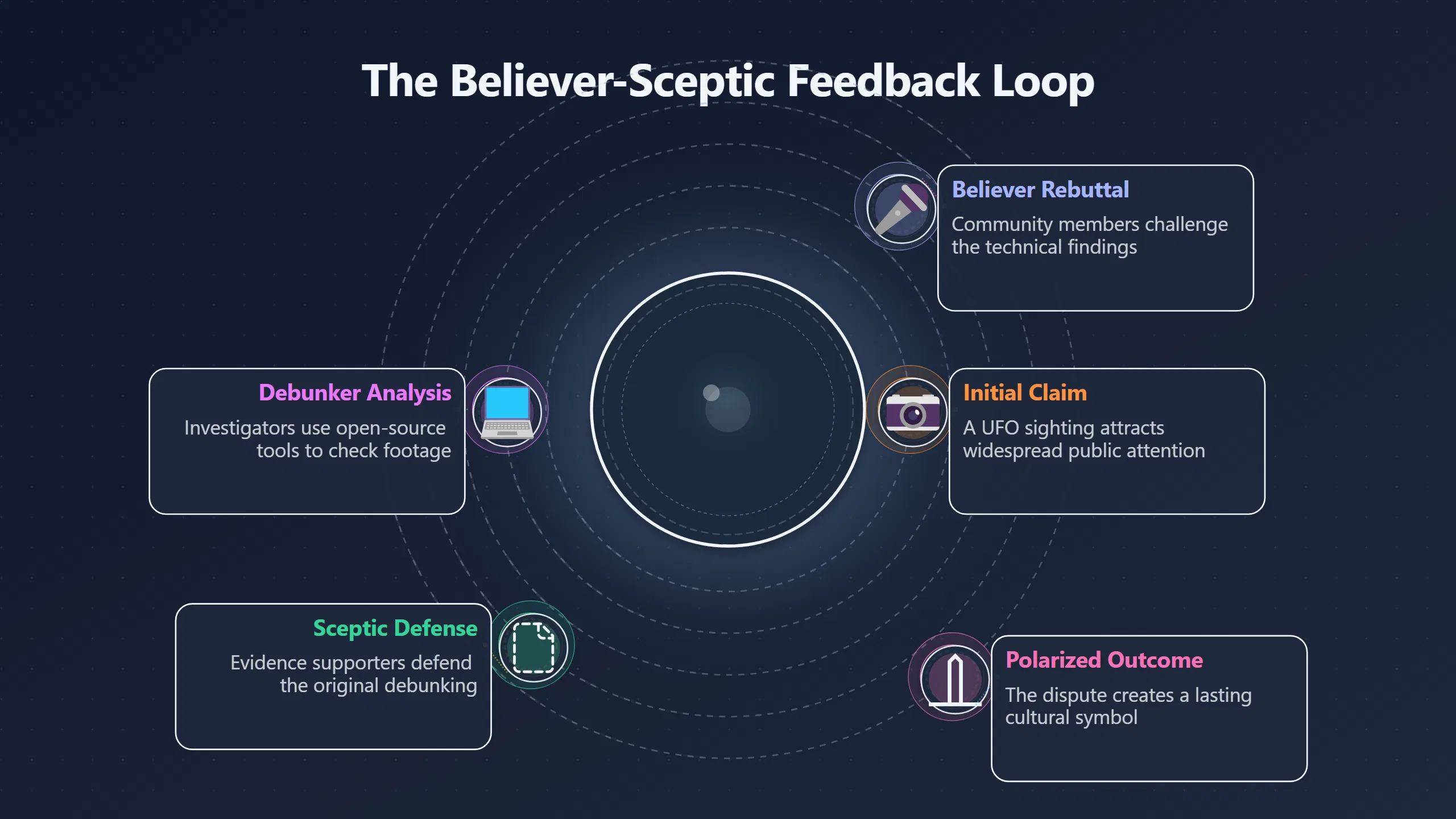
The believer-sceptic feedback loop
This produces a self-reinforcing cycle:
- A UFO claim attracts attention.
- Debunkers investigate it.
- Believers challenge the debunk.
- Sceptics defend the debunk.
- The dispute attracts new participants.
- The original claim becomes more famous than before.
The final outcome is often not consensus but polarisation. The same video can become a symbol of institutional credibility for one group and institutional failure for another.

Why this matters for UFO culture and science fiction
Online UFO culture increasingly resembles a collaborative storytelling environment in which evidence, interpretation and identity interact continuously. Studies of paranormal and UFO-related online video ecosystems suggest that digital platforms can reinforce paranormal belief by repeatedly exposing audiences to claims, imagery and interpretive frameworks.[Sage Journals]journals.sagepub.comSage JournalsHaunting Messages: Online Videos and Public Belief in Paranormal Phenomena - Holly Wright, Erin Oittinen, Paul R. Brewer, 20…
In that environment, debunks do not simply remove mistaken ideas. They become additional narrative layers. Every explanation generates counter-explanations, every investigation becomes a public performance, and every resolved case can be reframed as unresolved by a different audience.
This helps explain why UFO rumours often persist long after technical investigators consider a case settled. The social life of a UFO claim can outlast the evidential question. Once a sighting becomes a symbol in an online community, the debate over the explanation may become more important than the explanation itself.
eBay marketplace picks
Marketplace Samples
Live-tested eBay searches with available results related to this page.




Endnotes
1.
Source: digitalcommons.chapman.edu
Link:https://digitalcommons.chapman.edu/comm_articles/61/
Source snippet
n, and How to Stop It?June 22, 2019...
Published: June 22, 2019
2.
Source: reuters.com
Title: Pentagon UFO report says most sightings ‘ordinary objects’ and phenomena
Link:https://www.reuters.com/technology/space/pentagon-ufo-report-says-most-sightings-ordinary-objects-phenomena-2024-03-08/
Source snippet
Most sightings were identified as ordinary objects or phenomena. The All-domain Anomaly Resolution Office (AARO) released this conclusion...
3.
Source: reddit.com
Link:https://www.reddit.com/r/UfoUapNews/comments/1rqhe9d/aaro_finds_no_extraterrestrial_origin_in_hundreds/
Source snippet
AARO Finds No Extraterrestrial Origin in Hundreds of UAP Reports, With Most Incidents Explained as Drones, Balloons, or Satellites...
4.
Source: journals.sagepub.com
Link:https://journals.sagepub.com/doi/10.1177/0093650219854600
5.
Source: journals.sagepub.com
Link:https://journals.sagepub.com/doi/pdf/10.1177/0093650219854600
6.
Source: cognitiveresearchjournal.springeropen.com
Link:https://cognitiveresearchjournal.springeropen.com/articles/10.1186/s41235-020-00241-6
Source snippet
SpringerLinkCan corrections spread misinformation to new audiences? Testing for the elusive familiarity backfire effect | Cognitive Resea...
7.
Source: journals.sagepub.com
Link:https://journals.sagepub.com/doi/abs/10.1089/cyber.2023.0667
Source snippet
Sage JournalsHaunting Messages: Online Videos and [Public Belief]({{ 'public-belief/' | relative_url }}) in Paranormal Phenomena - Holly Wright, Erin Oittinen, Paul R. Brewer, 20...
8.
Source: doi.org
Link:https://doi.org/10.1177/00936502241287870
Source snippet
lse or Uncertain Pre-Existing Beliefs - Viorela Dan, Renita Coleman, 2025October 18, 2024...
Published: October 18, 2024
9.
Source: journals.sagepub.com
Link:https://journals.sagepub.com/doi/pdf/10.1177/0963662515617706
Source snippet
Greg Eghigian, 2017December 6, 2015...
Published: December 6, 2015
Additional References
10.
Source: nature.com
Link:https://www.nature.com/articles/s41562-023-01623-8
Source snippet
meta-analysis of correction effects in science-relevant misinformation | Nature Human BehaviourJune 15, 2023...
Published: June 15, 2023
11.
Source: pubmed.ncbi.nlm.nih.gov
Link:https://pubmed.ncbi.nlm.nih.gov/38916099/
Source snippet
Haunting Messages: Online Videos and Public Belief in Paranormal Phenomena - PubMed...
12.
Source: ufouap.com
Link:https://www.ufouap.com/es/articles/aaro-2024-annual-report-757-cases/
Source snippet
El Pentágono registró 757 informes de OVNIs en un año. Esto es lo que encontró. — UFOUAP...
13.
Source: youtube.com
Title: The UFO ‘cookbook’: How the American government investigates the unexplainable
Link:https://www.youtube.com/watch?v=6NrAQbco7dQ
Source snippet
Why people believe weird things | Michael Shermer...
14.
Source: iheartaliens.com
Title: i Heart Aliens — Where Truth Hides in Plain Sight
Link:https://iheartaliens.com/
Source snippet
iHeart Aliens — Where Truth Hides in Plain SightMay 31, 2026...
Published: May 31, 2026
15.
Source: youtube.com
Title: UFO Videos Explained: Mick West’s Expert Analysis
Link:https://www.youtube.com/watch?v=-_4QF__92q0
Source snippet
The UFO 'cookbook': How the American government investigates the unexplainable...
16.
Source: youtube.com
Title: UFO Skeptic Mick West: Alien Explanation Extraordinarily Unlikely
Link:https://www.youtube.com/watch?v=qlSX7p3Bjy0
Source snippet
UFO Videos Explained: Mick West's Expert Analysis...
17.
Source: youtube.com
Title: Why people believe weird things | Michael Shermer
Link:https://www.youtube.com/watch?v=8T_jwq9ph8k
Source snippet
Who believes conspiracies and why? | Michael Shermer...
18.
Source: online225.psych.wisc.edu
Link:https://online225.psych.wisc.edu/wp-content/uploads/225-Master/225-UnitPages/Unit-02/Lewandowsky_PSPI_2012.pdf
19.
Source: youtube.com
Title: Not As They Seem
Link:https://www.youtube.com/watch?v=ciopi2r7j-k
Source snippet
Debunking UFO [Skeptics]({{ 'skeptics/' | relative_url }}) w/ @JimmyAkin...
Topic Tree