Within Pulp Roots
The alien roles waiting for saucer stories
Pulp magazines supplied familiar roles for unknown visitors: invaders, explorers, hidden rulers, scientists and superior watchers.
On this page
- Martians, monsters and human like civilizations
- Invasion, rescue and hidden superiority plots
- How stock roles shaped UFO meaning
Page outline Jump by section
Introduction
When flying saucer reports burst into newspapers after 1947, the mystery was not only what had been seen in the sky. It was also who might be inside the craft. For many readers, pulp science-fiction magazines had already supplied a set of familiar answers. Decades of stories about Martians, space explorers, hidden super-civilisations, cosmic scientists and superior beings had created ready-made roles that could be attached to unexplained aerial phenomena. Rather than inventing meanings from scratch, readers could draw on story patterns they already knew. Scholars of UFO culture have argued that popular culture helped create the interpretive framework through which strange objects came to be understood as alien spacecraft rather than merely unexplained lights or atmospheric curiosities.[EAP IEA]eap-iea.orgMay 10, 2012…
 The significance of pulp fiction was therefore not that it predicted UFO reports. Its influence lay in providing a catalogue of possible alien identities and motives. When saucers appeared, many people already possessed a narrative vocabulary for understanding them.[EAP IEA]eap-iea.orgMay 10, 2012…
Martians, monsters and human-like civilisations
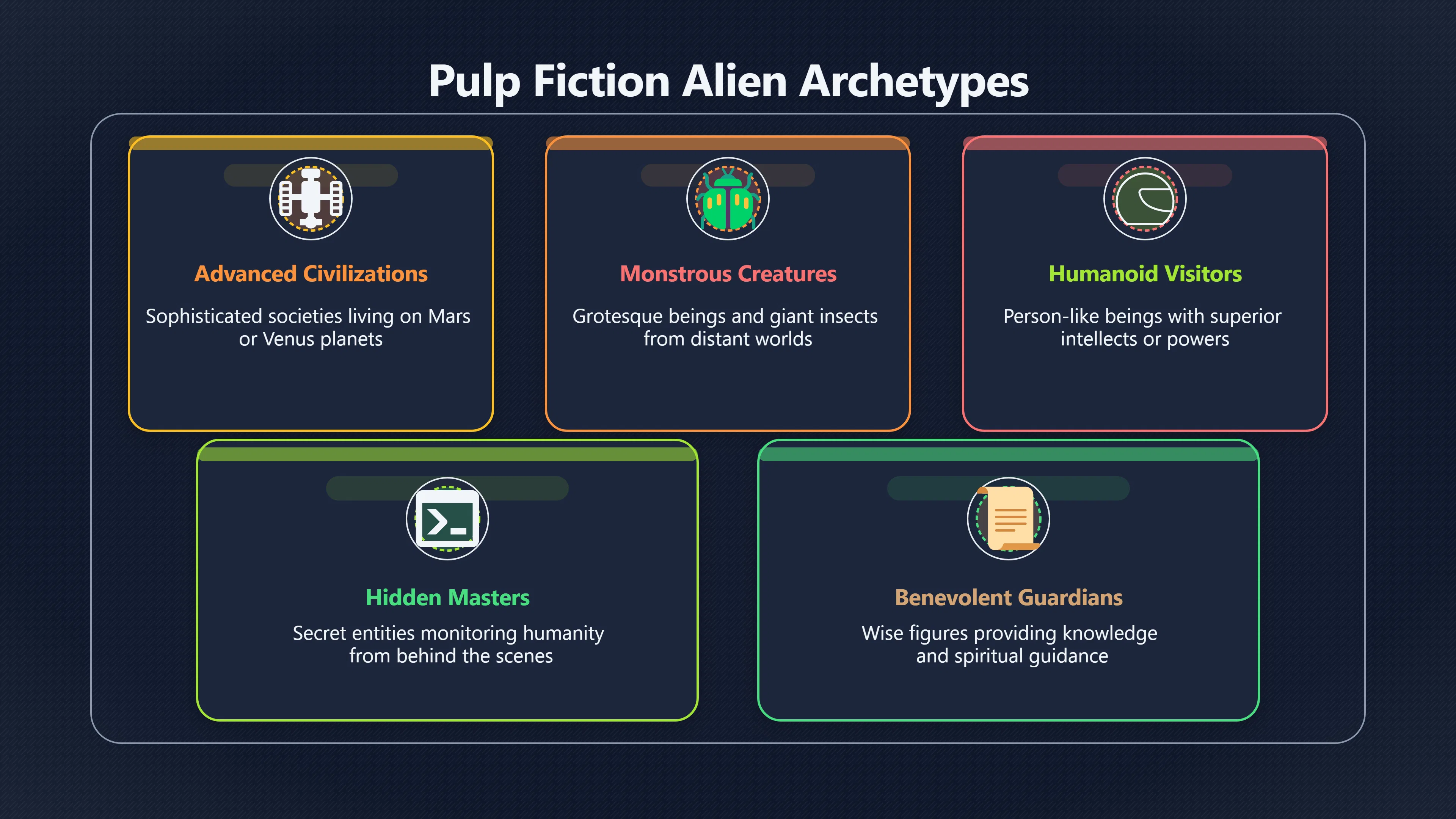
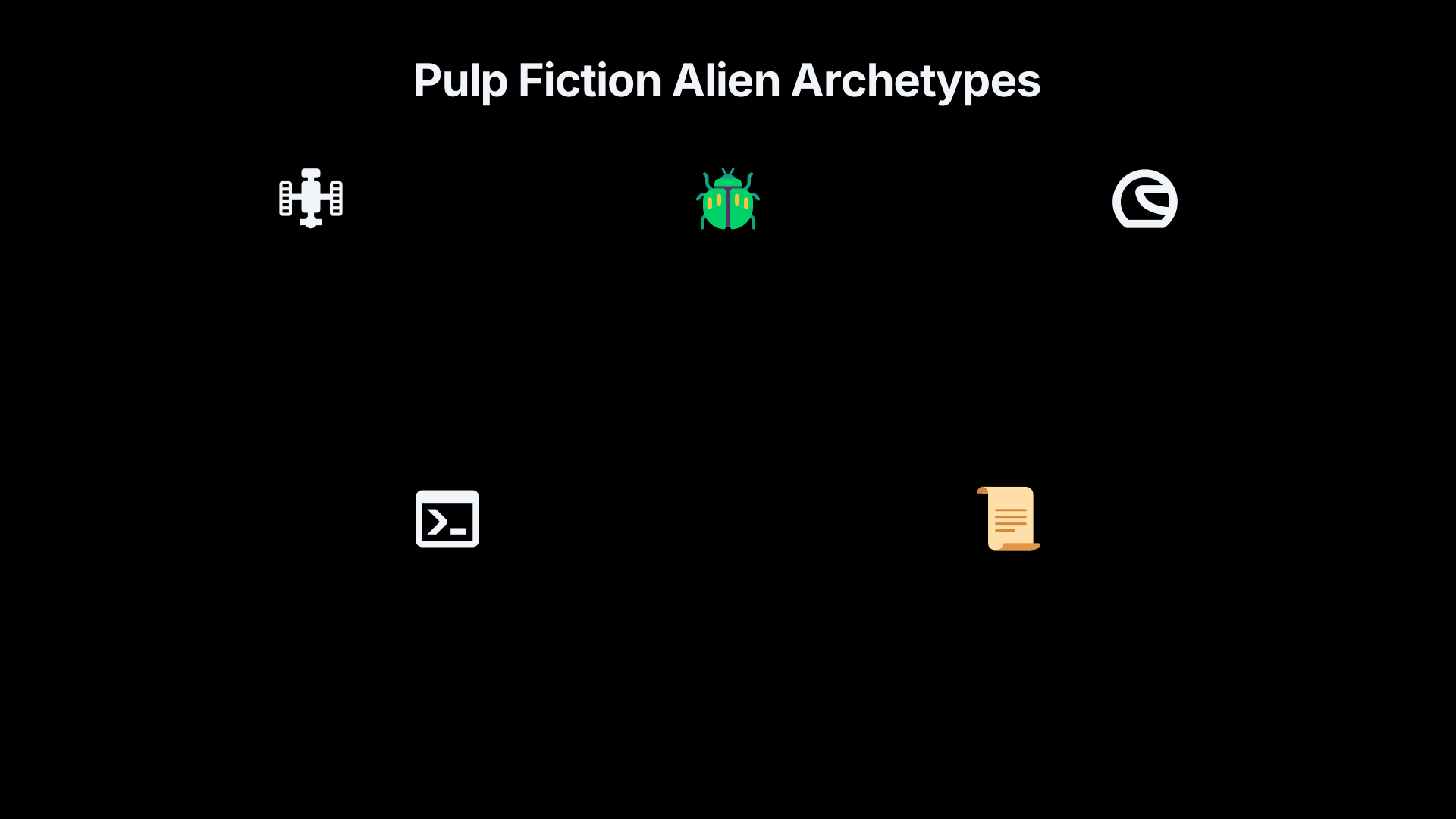
Early pulp magazines presented extraterrestrials in several recurring forms. One was the advanced planetary civilisation, often located on Mars, Venus or another nearby world. These societies could be more technologically sophisticated than humanity, morally wiser, or simply different versions of human civilisation. Stories in magazines such as Amazing Stories regularly featured interplanetary cultures and encounters between Earth travellers and alien societies.[Encyclopedia.com]encyclopedia.comAmazing Stories | Encyclopedia.comAmazing Stories | Encyclopedia.com
Alongside these civilised aliens were monsters. Pulp covers and illustrations were crowded with strange creatures, giant insects, bizarre humanoids and exotic beings from distant worlds. The visual culture of science-fiction magazines made the idea of non-human intelligence vivid and familiar long before flying saucers became a public obsession. Artists such as Frank R. Paul filled magazine pages with alien races that ranged from nearly human to utterly grotesque.[Amazing Stories]amazingstories.comAmazing Stories Loving the AlienAmazing StoriesLoving the Alien - Amazing StoriesJanuary 25, 2013…
A third category was the human-like extraterrestrial. Many pulp aliens differed from humans only slightly. They might possess unusual powers, superior intellects or advanced technology, but they remained recognisably person-like. This type proved especially important because it made communication, diplomacy and shared motives imaginable. Later UFO narratives frequently described occupants who fit this pattern more closely than the monstrous aliens common in horror fiction.[The New Yorker]newyorker.comThe New Yorker The Cosmic MenagerieFrom early speculative works to modern sci-fi, aliens were often designed to reflect human traits or critique societal norms. In 1996, NA…
The result was a menu of possibilities. An unexplained craft might contain monsters, fellow humanoids, noble explorers or advanced planetary citizens. Readers did not have to invent these possibilities after 1947; they already existed in popular fiction.
Invasion, rescue and hidden superiority plots
Pulp magazines also provided familiar explanations for what aliens might want.
One powerful template was invasion. Ever since influential works such as The War of the Worlds, extraterrestrials could be imagined as conquerors. By the pulp era, space-war adventures had become a staple of science fiction. Alien fleets, planetary conflicts and technologically superior enemies were common narrative devices. The unknown visitor was therefore easy to cast as a threat.[The New Yorker]newyorker.comThe New Yorker The Cosmic MenagerieFrom early speculative works to modern sci-fi, aliens were often designed to reflect human traits or critique societal norms. In 1996, NA…
Another template was rescue or guidance. Some stories portrayed advanced beings as benevolent guardians who possessed knowledge humanity lacked. They observed Earth, intervened selectively and occasionally aided human progress. This role became especially visible in early UFO contactee stories of the 1950s, in which saucer occupants often appeared as wise and friendly figures rather than invaders. The National Air and Space Museum notes that many of the earliest reported close encounters described aliens as kind, inviting and spiritually elevated.[National Air and Space Museum]airandspace.si.eduOpen source on si.edu.
A third role involved hidden superiority. Pulp fiction frequently imagined secret masters whose technology and understanding far exceeded ordinary human capabilities. Such figures might live on another planet, in a hidden civilisation, or behind the scenes of world events. Later UFO mythology often adopted similar assumptions, portraying alien visitors as observers conducting long-term monitoring of humanity or possessing knowledge unavailable to governments and scientists.[era.ed.ac.uk]era.ed.ac.ukNovember 25, 2014…
These roles shared a common feature: they answered the question of motive. Once a craft was imagined as extraterrestrial, pulp narratives already supplied reasons for its presence.
How stock roles shaped UFO meaning
The most important influence of pulp fiction may have been interpretive rather than visual. Early saucer reports often provided little information about occupants. Yet people still speculated about intentions, origins and identities. The speculative leap from “unknown object” to “alien visitor” became easier when popular culture had already established recognisable character types.[EAP IEA]eap-iea.orgMay 10, 2012…
This process can be understood as narrative pattern recognition. Readers encountering a mysterious report did not begin with a blank slate. They already knew stories about explorers arriving from other worlds, hostile invaders threatening Earth, enlightened cosmic teachers and hidden observers monitoring humanity. UFO reports could be fitted into these existing frameworks.[EAP IEA]eap-iea.orgMay 10, 2012…
The influence worked even when specific details changed. A witness might describe a disc-shaped craft rather than a pulp rocket ship, but the occupants could still be interpreted through familiar roles. The unknown became intelligible because fiction had already rehearsed the possibilities. As historians and cultural scholars have noted, popular culture helped construct the semantic framework through which flying saucers were interpreted as alien technology and alien presence.[EAP IEA]eap-iea.orgMay 10, 2012…
In that sense, pulp magazines did more than imagine extraterrestrials. They supplied a cast of characters waiting for a stage. When flying saucers entered public life, readers already knew the parts those aliens might play: conquerors, explorers, guardians, scientists, hidden rulers or superior watchers. The stories came before the sightings, and they offered ready-made meanings for whatever might be found inside the mysterious craft. EAP IEA+2National Air and Space Museum[eap-iea.org]eap-iea.orgMay 10, 2012…
Amazon book picks
Further Reading
Books and field guides related to Relationships betwee d7372c pulp scifi ufo roots 18b6cc pulp alien roles c40f18. Use these as the next step if you want deeper reading beyond the article.
The War of the Worlds
Established many alien roles later echoed in pulp fiction and UFO culture.
eBay marketplace picks
Marketplace Samples
Example marketplace items related to this page. Use the search link to explore similar finds on eBay.
Endnotes
1.
Source: eap-iea.org
Link:https://www.eap-iea.org/index.php/eap/article/view/643
Source snippet
May 10, 2012...
Published: May 10, 2012
2.
Source: encyclopedia.com
Title: Ufo | Encyclopedia.com
Link:https://www.encyclopedia.com/science-and-technology/technology/aviation-general/ufo
3.
Source: encyclopedia.com
Title: Amazing Stories | Encyclopedia.com
Link:https://www.encyclopedia.com/media/encyclopedias-almanacs-transcripts-and-maps/amazing-stories
4.
Source: era.ed.ac.uk
Link:https://era.ed.ac.uk/handle/1842/10586?show=full
Source snippet
November 25, 2014...
Published: November 25, 2014
5.
Source: youtube.com
Title: PULP FICTION
Link:https://www.youtube.com/watch?v=_TAZkrwmKN8
Source snippet
Ultimate 1950s Flying Saucer, UFO, and Alien Encounter Movies...
6.
Source: amazingstories.com
Title: Amazing Stories Loving the Alien
Link:https://amazingstories.com/2013/01/loving-the-alien/
Source snippet
Amazing StoriesLoving the Alien - Amazing StoriesJanuary 25, 2013...
Published: January 25, 2013
7.
Source: newyorker.com
Title: The New Yorker The Cosmic Menagerie
Link:https://www.newyorker.com/magazine/2012/06/04/the-cosmic-menagerie
Source snippet
From early speculative works to modern sci-fi, aliens were often designed to reflect human traits or critique societal norms. In 1996, NA...
8.
Source: airandspace.si.edu
Link:https://airandspace.si.edu/stories/editorial/study-flying-saucer-sightings
Additional References
9.
Source: wired.com
Title: www.wired.com Out of This World: 60 Years of Flying Saucers
Link:https://www.wired.com/2007/06/flyingsaucer-anniversary
Source snippet
The phenomenon has inspired conspiracy theories and cults, including notable incidents such as the [Roswell]({{ 'roswell/' | relative_url }}) event and subsequent governmen...
10.
Source: reddit.com
Title: www.reddit.com Sci-fi literary origins of UFOs sucking people up
Link:https://www.reddit.com/r/printSF/comments/gax6gr
Source snippet
www.reddit.comSci-fi literary origins of UFOs sucking people upApril 30, 2020...
Published: April 30, 2020
11.
Source: youtube.com
Link:https://www.youtube.com/watch?v=jUzzNL6iCUg
Source snippet
History of UFO and alien encounters | Prof. Greg Eghigian...
12.
Source: youtube.com
Title: History of UFO and alien encounters | Prof. Greg Eghigian
Link:https://www.youtube.com/watch?v=XAqOUoUIJWA
Source snippet
FLYING SAUCERS To UFOs Opinion??? Pulps & [Comics]({{ 'comics/' | relative_url }})...
13.
Source: academic.oup.com
Link:https://academic.oup.com/book/56340/chapter/445465595
Source snippet
OUP AcademicSpaceships, Conspiracies, and the Birth of the UFO Detective, 1948–1953 | After the Flying Saucers Came: A Global History of...
14.
Source: arxiv.org
Title: Aerodynamics of flying saucers
Link:https://arxiv.org/abs/1810.04855
Source snippet
October 11, 2018...
Published: October 11, 2018
15.
Source: youtube.com
Link:https://www.youtube.com/watch?v=p9pWfJMrVco
16.
Source: reddit.com
Title: www.reddit.com On flying saucers
Link:https://www.reddit.com/r/CuratedTumblr/comments/1hdgzy8
Source snippet
flying saucersDecember 13, 2024...
Published: December 13, 2024
17.
Source: library.umbc.edu
Title: AOK Library Science Fiction Pulps & Fanzines
Link:https://library.umbc.edu/speccoll/scifi/index.html
Topic Tree