Within Mars Myths
Why Lowell's Mars Felt Believable
Lowell gave the canal idea a dramatic system of drought, polar water and planet-wide engineering that many readers could imagine.
On this page
- Lowell's drying planet argument
- The Flagstaff observatory as public theatre
- Why a wrong theory still persuaded readers
Page outline Jump by section
Introduction
Before flying saucers entered popular culture, Percival Lowell did more than argue that life existed on Mars: he constructed a persuasive story explaining why an advanced civilisation would have built vast planetary works. His influence came from combining uncertain astronomical observations with a coherent environmental narrative. Mars, he claimed, was an ageing world running out of water. Intelligent inhabitants had responded by building a globe-spanning network of canals to carry meltwater from the polar regions to the dry equatorial lands. To many readers around 1900, this did not feel like fantasy. It felt like a logical scientific deduction from visible evidence.[Wikipedia]WikipediaLowell ObservatoryLowell Observatory
 Within the broader history of Martian civilisations before the flying-saucer era, Lowell’s achievement was not proving Martians existed. It was making the idea appear reasonable enough for educated people, newspapers and even some scientists to discuss seriously.[RASC]rasc.caHonorary Member: Percival Lowell | RASCHonorary Member: Percival Lowell | RASC…
Lowell’s Drying-Planet Argument
Lowell’s most powerful contribution was turning a collection of lines on Mars into a dramatic planetary problem with a plausible solution.
He argued that Mars was smaller and older than Earth and had therefore cooled and dried more quickly. The white polar caps were interpreted as reservoirs of water. The dark regions appeared to change seasonally. To Lowell, these observations fitted together into a single picture: a civilisation facing environmental decline and responding through engineering on an immense scale. In books such as Mars (1895), Mars and Its Canals (1906) and Mars as the Abode of Life (1908), he repeatedly presented canals, oases and seasonal changes as interconnected evidence for intelligent life.[rasc.ca]rasc.caHonorary Member: Percival Lowell | RASCHonorary Member: Percival Lowell | RASC…
The theory appealed because it echoed real-world concerns and achievements. The late nineteenth century was an age of large infrastructure projects and confidence in engineering. Readers were accustomed to hearing about major canals, irrigation schemes and technological solutions to environmental challenges. Lowell’s Martians did not seem magical; they seemed like highly capable engineers confronting a drought crisis.[skepticalinquirer.org]skepticalinquirer.orgPercival Lowell and the Canals of Mars | Skeptical InquirerPercival Lowell and the Canals of Mars | Skeptical Inquirer
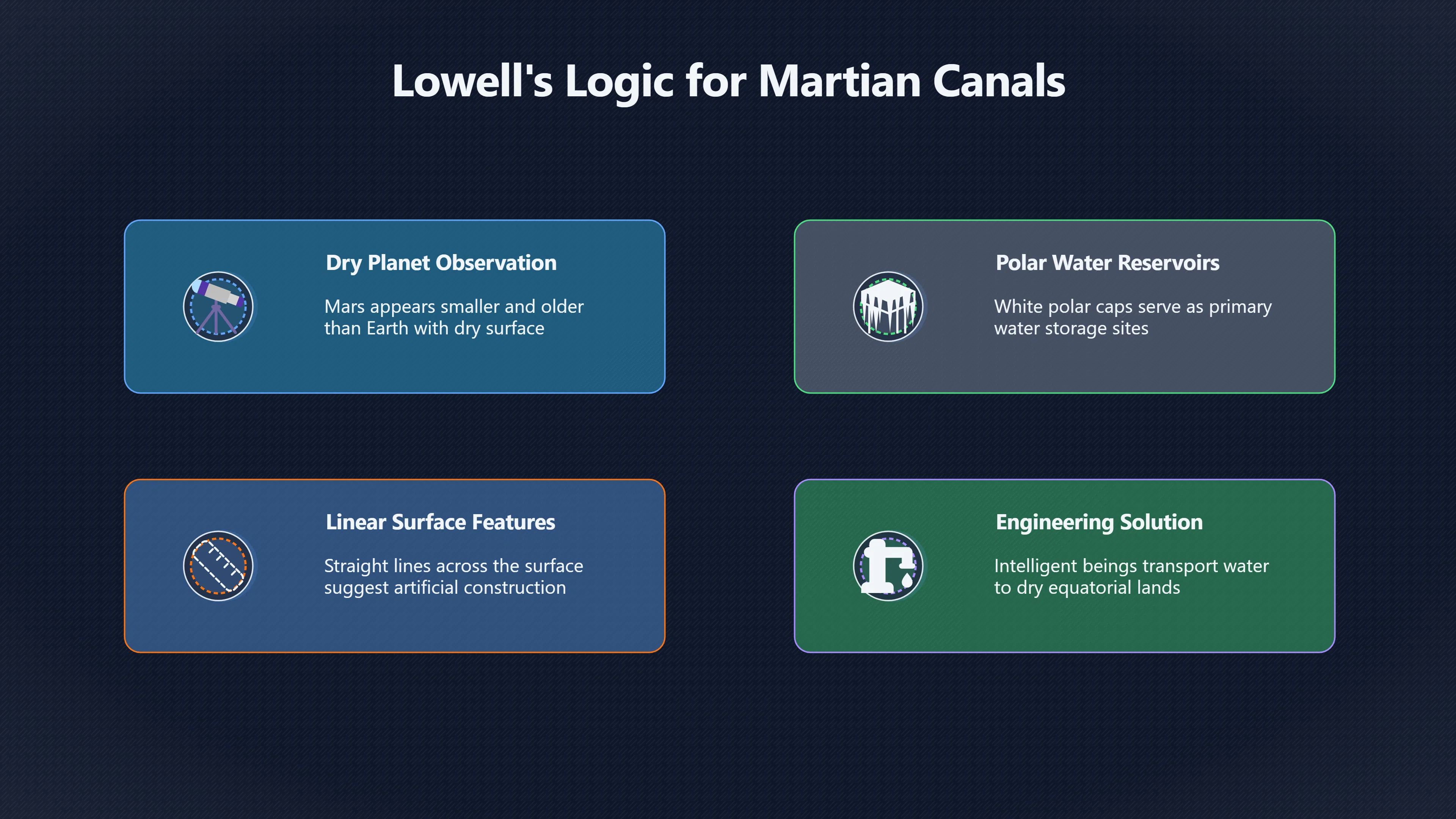
This narrative gave purpose to features that otherwise appeared mysterious. Rather than asking people to believe in aliens first, Lowell asked them to follow what seemed to be a chain of evidence:
- Mars appeared dry.
- Water seemed concentrated near the poles.
- Straight lines appeared across the surface.
- Intelligent beings might logically transport water where it was needed.
Even though the observations were flawed, the reasoning felt internally consistent to many contemporaries.[skepticalinquirer.org]skepticalinquirer.orgPercival Lowell and the Canals of Mars | Skeptical InquirerPercival Lowell and the Canals of Mars | Skeptical Inquirer
The Flagstaff Observatory as Public Theatre
Lowell’s credibility depended not only on his ideas but also on how he presented them.
In 1894 he established an observatory at Flagstaff, Arizona, specifically chosen for its high altitude, dark skies and favourable viewing conditions. At a time when scientific authority carried enormous cultural weight, the observatory provided a visible institutional foundation for his claims. The Martian canal theory was not being promoted from a parlour or a newspaper office; it appeared to emerge from a purpose-built research centre dedicated to studying the heavens.[Wikipedia]WikipediaLowell ObservatoryLowell Observatory
Lowell also understood the value of public engagement. He invited visitors to observe Mars, delivered lectures, published books aimed at general audiences and distributed maps showing the canal system. Many observers reported seeing similar linear features through telescopes, reinforcing the impression that the canals were real. The observatory therefore functioned not only as a scientific workplace but also as a stage on which evidence could be displayed and interpreted.[Wikipedia]WikipediaLowell ObservatoryLowell Observatory
His personal style mattered as well. Contemporary accounts and later historians have noted that Lowell presented his arguments with confidence while framing them as careful scientific reasoning. The result was a message that seemed adventurous without appearing reckless. Readers encountered not a sensational prophet but a well-connected astronomer offering what looked like a rational explanation for puzzling observations.[The New Yorker]newyorker.comIt begins with 19th-century astronomer Giovanni Schiaparelli, who mapped what he termed "canali" on Mars, sparking public intrigue. Perci…
Why a Wrong Theory Still Persuaded Readers
The enduring puzzle is why so many intelligent people found Lowell convincing when the canals did not actually exist.
Part of the answer lies in the limits of observation. Mars was viewed through Earth’s atmosphere using telescopes that could not clearly resolve fine surface details. Human vision naturally links scattered markings into continuous patterns. Under those conditions, observers could sincerely believe they were seeing long straight lines even when no such structures existed. Later spacecraft photography showed that the famous canals were optical and perceptual illusions rather than planetary engineering works.[skepticalinquirer.org]skepticalinquirer.orgPercival Lowell and the Canals of Mars | Skeptical InquirerPercival Lowell and the Canals of Mars | Skeptical Inquirer
Another reason was that Lowell offered a complete explanatory framework rather than an isolated claim. A single line on Mars might be doubtful. A network of lines connected to polar water, seasonal changes and planetary evolution felt more persuasive because each element appeared to support the others. The story had explanatory power, even though its foundations were mistaken.[loc.gov]loc.govMars as the abode of life, | Library of CongressMars as the abode of life, | Library of Congress
Finally, Lowell’s theory arrived at a moment when many people wanted the universe to be inhabited. The possibility of intelligent neighbours on a nearby planet was scientifically exciting, culturally appealing and easier to imagine than entirely unknown forms of extraterrestrial life. His Martians were understandable beings confronting familiar problems of resource management, technology and survival.[Vox]vox.comThe fake news that helped put us on a path to MarsIt highlights Elon Musk's aspirations to build a self-sustaining Martian city and situates this goal within a long lineage of interest in…
The Legacy of Believable Martians
Lowell’s canals eventually disappeared under the scrutiny of better observations and spacecraft exploration, but the broader effect remained. He helped establish a template in which ambiguous astronomical evidence could be interpreted as signs of extraterrestrial intelligence. More importantly, he transformed Mars from a distant point of light into a world populated by purposeful beings with history, problems and technological achievements.[Wikipedia]WikipediaLowell (Martian craterLowell (Martian crater
That achievement mattered for the later relationship between science fiction and UFO culture. Long before reports of flying saucers, Lowell had shown how scientific authority, compelling storytelling and a plausible technological narrative could make alien civilisations seem not merely imaginable but almost visible through the telescope.[RASC]rasc.caHonorary Member: Percival Lowell | RASCHonorary Member: Percival Lowell | RASC…

Amazon book picks
Further Reading
Books and field guides related to Relationships betwee d7372c martian civilization 772d5e lowell plausible mar 6fa472. Use these as the next step if you want deeper reading beyond the article.
Mars and Its Canals
Explains Lowell's canal network and drying-planet argument in detail.
The Demon-Haunted World
Rating: 4.5/5 from 43 Google Books ratings
Helps readers understand why persuasive narratives can appear scientifically convincing.
Cosmos
Provides modern scientific perspective on planetary life and historical speculation.
eBay marketplace picks
Marketplace Samples
Example marketplace items related to this page. Use the search link to explore similar finds on eBay.


Endnotes
1.
Source: Wikipedia
Title: Lowell Observatory
Link:https://en.wikipedia.org/wiki/Lowell_Observatory
2.
Source: rasc.ca
Title: Honorary Member: Percival Lowell | RASC
Link:https://www.rasc.ca/node/40450
Source snippet
Honorary Member: Percival Lowell | RASC...
3.
Source: loc.gov
Title: Mars as the abode of life, | Library of Congress
Link:https://www.loc.gov/resource/gdcmassbookdig.marsasabodeoflif00lowe/?st=list
4.
Source: loc.gov
Title: Mars as the abode of life, | Library of Congress
Link:https://www.loc.gov/item/08036795
5.
Source: skepticalinquirer.org
Title: Percival Lowell and the Canals of Mars | Skeptical Inquirer
Link:https://skepticalinquirer.org/2018/05/percival-lowell-and-the-canals-of-mars/
6.
Source: Wikipedia
Title: Percival Lowell
Link:https://en.wikipedia.org/wiki/Percival_Lowell
7.
Source: Wikipedia
Title: Lowell (Martian crater)
Link:https://en.wikipedia.org/wiki/Lowell_%28Martian_crater%29
8.
Source: vox.com
Title: The fake news that helped put us on a path to Mars
Link:https://www.vox.com/podcasts/458097/mars-elon-musk-space-race
Source snippet
It highlights Elon Musk's aspirations to build a self-sustaining Martian city and situates this goal within a long lineage of interest in...
9.
Source: youtube.com
Title: When Mars Fooled the Astronomers – clip from “Mars Calling” 4K Documentary
Link:https://www.youtube.com/watch?v=8ohua6nx9wM
Source snippet
Percival Lowell...
10.
Source: youtube.com
Title: Percival Lowell
Link:https://www.youtube.com/watch?v=UvmoKv1BOAw
Source snippet
Mars canals documentary life civilization A Century Later: Celebrating the Life of Percival Lowell, Part 1 Lowell Observatory...
11.
Source: newyorker.com
Link:https://www.newyorker.com/news/fault-lines/the-long-history-of-life-on-mars
Source snippet
It begins with 19th-century astronomer Giovanni Schiaparelli, who mapped what he termed "[canali]({{ 'canali/' | relative_url }})" on Mars, sparking public intrigue. Perci...
Additional References
12.
Source: wired.com
Title: mars a world for exploration 1959
Link:https://www.wired.com/2012/05/mars-a-world-for-exploration-1959
Source snippet
Tombaugh also provided a detailed analysis of the Martian surface conditions in 1959, dismantling many of Percival Lowell's romantic theo...
13.
Source: youtube.com
Link:https://www.youtube.com/watch?v=cStCiyOrJNA
Source snippet
Mars and the Gilded Age Imagination Lecture...
14.
Source: scientificamerican.com
Title: www.scientificamerican.com100 Years Ago in Scientific American
Link:https://www.scientificamerican.com/article/100-years-ago-riddle-of-mars/
Source snippet
The Riddle of Mars | Scientific AmericanJune 11, 2007...
Published: June 11, 2007
15.
Source: youtube.com
Title: Why Martian Canals Still Matter
Link:https://www.youtube.com/watch?v=TpTJbtMFKAU
Source snippet
The Man who was Obsessed with Mars | History | Mistranslations | Japan | Canals | Percival Lowell...
16.
Source: youtube.com
Title: Mars and the Gilded Age Imagination Lecture
Link:https://www.youtube.com/watch?v=fsXBcWJFtTQ
Source snippet
When Mars Fooled the Astronomers – clip from “Mars Calling” 4K Documentary...
17.
Source: commons.wikimedia.org
Title: File:Mars as the abode of life (IA marsasabodeoflif00lowe).pdf
Link:https://commons.wikimedia.org/wiki/File%3AMars_as_the_abode_of_life_%28IA_marsasabodeoflif00lowe%29.pdf
Source snippet
Wikimedia Commons...
18.
Source: reddit.com
Link:https://www.reddit.com/r/aliens/comments/1kevg0v
Source snippet
fact: People in the late 1800s actually believed that intelligent aliens lived on Mars.May 4, 2025...
Published: May 4, 2025
19.
Source: openlibrary.org
Title: Mars as the abode of life by Percival Lowell | Open Library
Link:https://openlibrary.org/books/OL7035558M/Mars_as_the_abode_of_life
Topic Tree