Within UFO Fiction
When Machines Became UFO Witnesses
Radar and sensor reports gave UFOs a technical aura, but they also introduced errors, artifacts, and interpretation problems.
On this page
- Why sensor data feels persuasive
- Artifacts, limits, and misreadings
- How technical evidence changes the story
Page outline Jump by section
Introduction
Radar and sensor reports gave UFOs a new kind of authority. A witness could be mistaken, frightened, suggestible or influenced by science fiction, but a radar set seemed to offer something colder and more objective: a machine that had “seen” the object too. That is the machine-witness problem. Sensors can strengthen a UFO report, especially when radar, infrared, optical and pilot testimony appear to converge, but they also create their own ambiguities through calibration limits, missing metadata, atmospheric effects, compression artefacts, display interpretation and human decisions about what counts as a target.
This matters for the relationship between UFOs and science fiction because machines changed the genre of the story. The classic flying saucer was a visual mystery; the radar UFO became a technical mystery. It seemed to belong not only to folklore or popular media, but to air defence, aerospace engineering and national security. Yet the best official and scientific sources do not support a simple conclusion that sensor cases prove extraterrestrial craft. They point instead to a harder and more interesting problem: technical evidence can make a UFO report more serious while still leaving it unresolved, misread or only partly understood. NASA’s 2023 UAP study, for example, argued that future progress depends on multiple well-calibrated sensors, good metadata and baseline data, precisely because many existing reports lack those conditions.[NASA Science]science.nasa.govNASA Science…
Why sensor data feels persuasive
A radar return has a special cultural weight because it seems to remove imagination from the chain of evidence. Radar does not care about flying-saucer films, Cold War rumours or a witness’s expectations. It emits or receives signals, processes them and displays a track. For a public already used to science fiction’s language of advanced craft, force fields, invisible vehicles and alien machines, radar made UFOs feel less like campfire stories and more like contact with technology.
That impression has deep roots in post-war life. The modern UFO era grew alongside air-defence networks, rocketry, nuclear anxiety and the idea that the sky could be monitored by instruments. Radar was itself a wartime miracle technology that had become a peacetime symbol of hidden detection. When UFO reports included radar, they seemed to enter the same world as military command rooms and science-fiction screens: glowing displays, coded signals and operators trying to interpret intruders at the edge of the known.
The persuasive force grows when sensors are combined. The 2021 preliminary assessment from the Office of the Director of National Intelligence said that most UAP in its reviewed set probably represented physical objects because a majority were registered across multiple sensors, including radar, infrared, electro-optical systems, weapon seekers and visual observation. But the same passage warned that some unusual flight characteristics could result from sensor errors, spoofing or observer misperception and required more rigorous analysis.[Director of National Intelligence]dni.govDirector of National Intelligence
That tension is the heart of the machine-witness problem. A sensor report is not simply a mechanical fact. It is a chain: a physical event, an instrument designed for a particular mission, software filters, display conventions, operators, later analysts, missing or retained metadata, and then public storytelling. Each link can add confidence, but each can also add uncertainty.

When radar made UFOs look official
The 1952 Washington, DC, sightings remain the classic example of radar turning a UFO story into a national-security story. Air traffic controllers and military radar operators reported unusual returns near the US capital; jets were scrambled; the incidents made national headlines; and the Pentagon held a major press conference. The official explanation pointed to temperature inversions and related radar effects, while many UFO advocates argued that experienced operators had tracked something more substantial. That disagreement has lasted because the case sits exactly where technical evidence feels strongest and most vulnerable: a real operational setting, multiple observers, and a plausible atmospheric mechanism that does not satisfy everyone.[Wikipedia]Wikipedia1952 Washington, D.C., UFO incident1952 Washington, D.C., UFO incident
Project Blue Book, the US Air Force’s long-running UFO investigation, shows the same double role of instrumentation. It collected 12,618 reports from 1947 to 1969, of which 701 remained “unidentified” when the programme ended. Those figures are often quoted as proof either that the mystery survived official scrutiny or that only a small residue remained after ordinary explanations were applied. Both readings miss the more useful lesson: a case could remain unidentified because it was extraordinary, but also because the evidence was incomplete, ambiguous or not collected in a way that allowed later resolution.[National Archives]archives.govNational Archives Project BLUE BOOKNational Archives Project BLUE BOOK
Radar cases were especially powerful because they suggested independent corroboration. A pilot might see a light and a radar operator might see a target. Yet even this pairing is not as simple as it sounds. The apparent visual object and the radar return may not be the same thing; the radar may be detecting weather, ground clutter, birds, chaff, aircraft, balloons, unusual propagation or electronic effects; and the visual observer may be looking at a star, aircraft light, meteor or reflected glare. A radar-visual case is stronger than a lone anecdote, but it is not automatically a solved physical object.
This is where UFO culture and science fiction overlap most subtly. The machine does not merely add evidence; it changes the plot. A lone witness has had an experience. A radar-confirmed witness appears to have entered a system: command, detection, pursuit, secrecy, classification and technical failure. That is why radar cases so easily become stories about hidden knowledge, superior craft and official denial, even when the underlying evidence points to a narrower problem of instrument interpretation.
Artifacts, limits, and misreadings
Modern sensors are impressive, but they are not general-purpose truth machines. They are built for particular jobs: tracking aircraft, guiding weapons, managing air traffic, surveilling battlefields or imaging thermal contrast. A sensor optimised for combat may not be optimised for later public scientific analysis of a fleeting unknown object. AARO’s 2024 historical report made this point directly, noting that when hard data exists it is often incomplete or poor quality, and that military sensors most often capturing UAP are calibrated and optimised for combat rather than routine high-definition scientific collection.[U.S. Department of War]media.defense.govU.S. Department of War AARO Historical Record Report Volume 1U.S. Department of War AARO Historical Record Report Volume 1(https://media.defense.gov/2024/Mar/08/2003409233/-1/-1/0/DOPSR-2024-0263-AARO-HISTORICAL-RECORD-REPORT-VOLUME-1-2024.PDF)
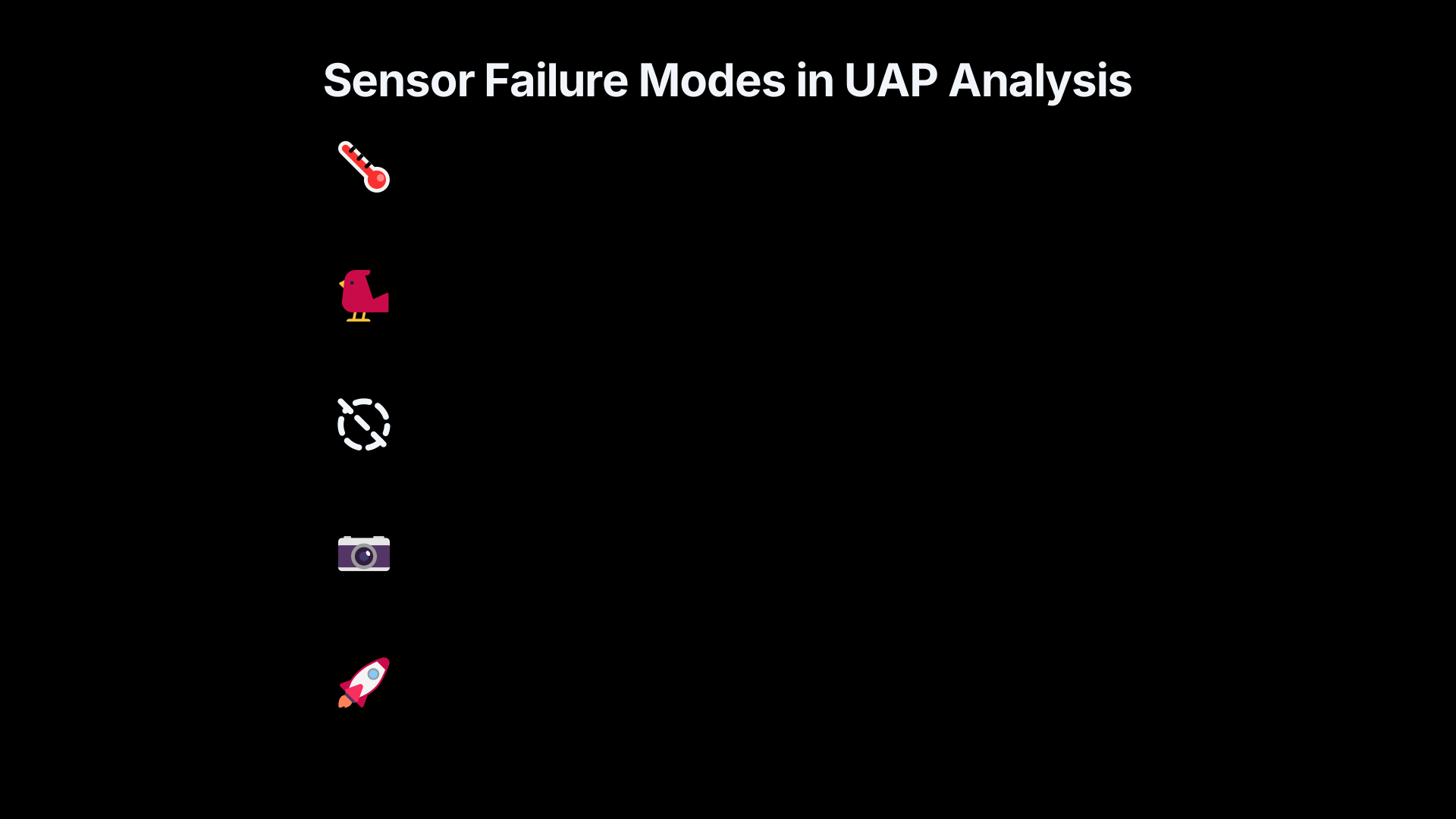
Several failure modes matter more than the word “malfunction” suggests. Many disputed cases do not require a broken sensor. They require an ordinary sensor doing its job under conditions that later readers misunderstand.
Atmospheric propagation can bend or scatter radar energy, producing returns from objects or layers that are not where the display seems to place them. This is why temperature inversions have been invoked in older radar-UFO cases, including Washington in 1952. Whether or not that explanation resolves every detail of a case, it shows why “radar saw it” is not the end of the analysis.
Clutter and filtering are central to radar interpretation. Radar systems must decide what to suppress: birds, weather, ground returns, sea returns, debris, drones, balloons or slow-moving objects. A display designed to help controllers avoid collisions or help military crews identify threats may hide some ambiguous data and emphasise other tracks.
Metadata gaps can make later analysis fragile. Time, location, sensor angle, range, aircraft position, observing mode and calibration status are not decorative details. Without them, apparent speed, size and altitude can be wrong by large margins. NASA’s 2023 UAP report stressed that poor calibration, lack of multiple measurements, lack of sensor metadata and lack of baseline data hamper UAP analysis.[NASA Science]science.nasa.govNASA Science…
Optical and infrared artefacts can look like exotic motion. A camera pod may track contrast, heat, glare or a small object against a moving background. Compression can smear edges. Zoom levels and field of view can make ordinary movement seem abrupt or fast. A blob on a display is not the same as a measured craft.
The official AARO treatment of the “Go Fast” video is a useful modern case. The video became famous because it appeared to show an object moving rapidly over the ocean. AARO’s methodology paper explained that the analysis relied on manually extracted data from a publicly available compressed video, that the original file and metadata were unavailable, and that the aircraft’s exact location and heading were unknown. It also stated that military sensor video of this kind is not necessarily intended to support rigorous full-motion intelligence analysis and may contain compression artefacts or lack necessary metadata.[AARO]aaro.milGo Fast Case ResolutionGo Fast Case Resolution
The lesson is not that every famous sensor case is fake or trivial. It is that sensor evidence often answers a smaller question than the public asks. It may show that “something produced a contrast on this display”, or that “a system generated a track”, not that “a structured craft made the apparent manoeuvre described in the headline”.
Multiple sensors help, but only when they truly converge
The phrase “multiple sensors” sounds decisive, and sometimes it can be. If independent systems, from different locations, with good calibration and time synchronisation, record the same object in mutually consistent ways, the evidential value rises sharply. That is the sort of data that could distinguish an aircraft from a balloon, a bird from a drone, or an apparent acceleration from a tracking artefact.
But multiple sensors do not automatically mean independent confirmation. Several systems can be cued by the same initial error, affected by the same environmental condition, or interpreted through the same operational assumptions. A pilot who is told to look for a target may see an ambiguous light in the expected area. A camera may be pointed because radar first suggested a track. Later, a narrative may merge separate fragments into one apparently continuous event.
NASA’s recommended solution is not simply “more sensors”, but better sensor practice: systematic calibration, multiple measurements, metadata, baseline data and clear evidence thresholds. The report also noted that artificial intelligence and machine learning can help find rare events in large datasets, but only if the data are well-characterised and gathered to strong standards.[NASA Science]science.nasa.govNASA Science…
This point is especially important because UFO stories often treat technology as self-validating. In science fiction, a sensor screen frequently functions as narrative proof: the ship’s computer detects an object, so the object is there. Real-world sensors are different. They produce measurements that need calibration, context, error bars, cross-checking and sometimes humility.
The modern shift from saucers to datasets
Older UFO culture centred on shapes: discs, cigars, triangles, lights and domes. Modern UAP debate increasingly centres on datasets: radar tracks, infrared clips, telemetry, range values, frame rates, satellite imagery, sensor metadata and classified collection systems. That shift has made the subject sound less like pulp science fiction and more like aerospace forensics.
AARO’s public imagery page illustrates the new texture of the problem. Several cases are presented not as dramatic alien encounters, but as short videos with cautious classifications: resolved as balloons, resolved as birds, closed as not anomalous, unresolved because data are insufficient, or assessed as likely showing a physical object without showing extraordinary performance. In one infrared case, AARO stated that an apparent heat signature might come from a physical source, a thermal reflection, an environmental heat differential or sensor display error, and that available data were insufficient to evaluate performance characteristics.[AARO]aaro.milOfficial UAP ImageryAARO UAP Imagery…
That language is far less cinematic than the popular image of a UFO chase, but it is more revealing. The modern machine witness often says: there is a signal, but the signal’s meaning is underdetermined. A balloon can be a UAP until its motion and shape are matched with wind and known lighter-than-air behaviour. Birds can become infrared mystery objects until morphology and migration patterns are checked. A physical object can remain unresolved without implying extraordinary technology.
This has consequences for how UFO stories travel. Public imagination tends to compress “unresolved” into “unexplainable”, and “unexplainable” into “advanced”. Technical investigations resist that compression. They may leave a case open while also narrowing what would count as a strong claim. A case can be unresolved and still not show anomalous performance. It can involve a physical object and still be a balloon, bird, drone, aircraft or debris.
How technical evidence changes the story
Sensor evidence changes UFO narratives in three main ways.
First, it raises the seriousness of the report. A radar return or infrared track can justify investigation in a way that a casual sighting may not. It can affect air safety, military readiness and public confidence. The 2021 ODNI assessment explicitly treated UAP as an issue involving flight safety and possible national-security concerns, even while acknowledging limited data and possible sensor errors.[Director of National Intelligence]dni.govDirector of National Intelligence
Second, it shifts the burden from belief to interpretation. The question becomes less “Did the witness see anything?” and more “What exactly did this system record, under what conditions, and how should it be reconstructed?” That is a better scientific question, but it is also a harder public question. It demands knowledge of sensor geometry, radar propagation, atmospheric conditions, platform motion and data handling.
Third, it gives UFO stories a modern technological aesthetic. Science fiction has long imagined machines encountering other machines: scanners detecting alien craft, defence systems baffled by unknown signatures, artificial intelligence discovering patterns humans missed. Contemporary UAP discourse often resembles that fiction structurally, even when the evidence is mundane. The drama lies in whether human systems can correctly identify anomalies in crowded skies full of aircraft, drones, balloons, satellites, birds, weather and sensor noise.
The result is a more disciplined but less satisfying kind of mystery. A classic saucer story asks what the witness saw. A sensor-era UAP case asks whether the available data are good enough to reconstruct the event at all.
What would count as stronger machine evidence?
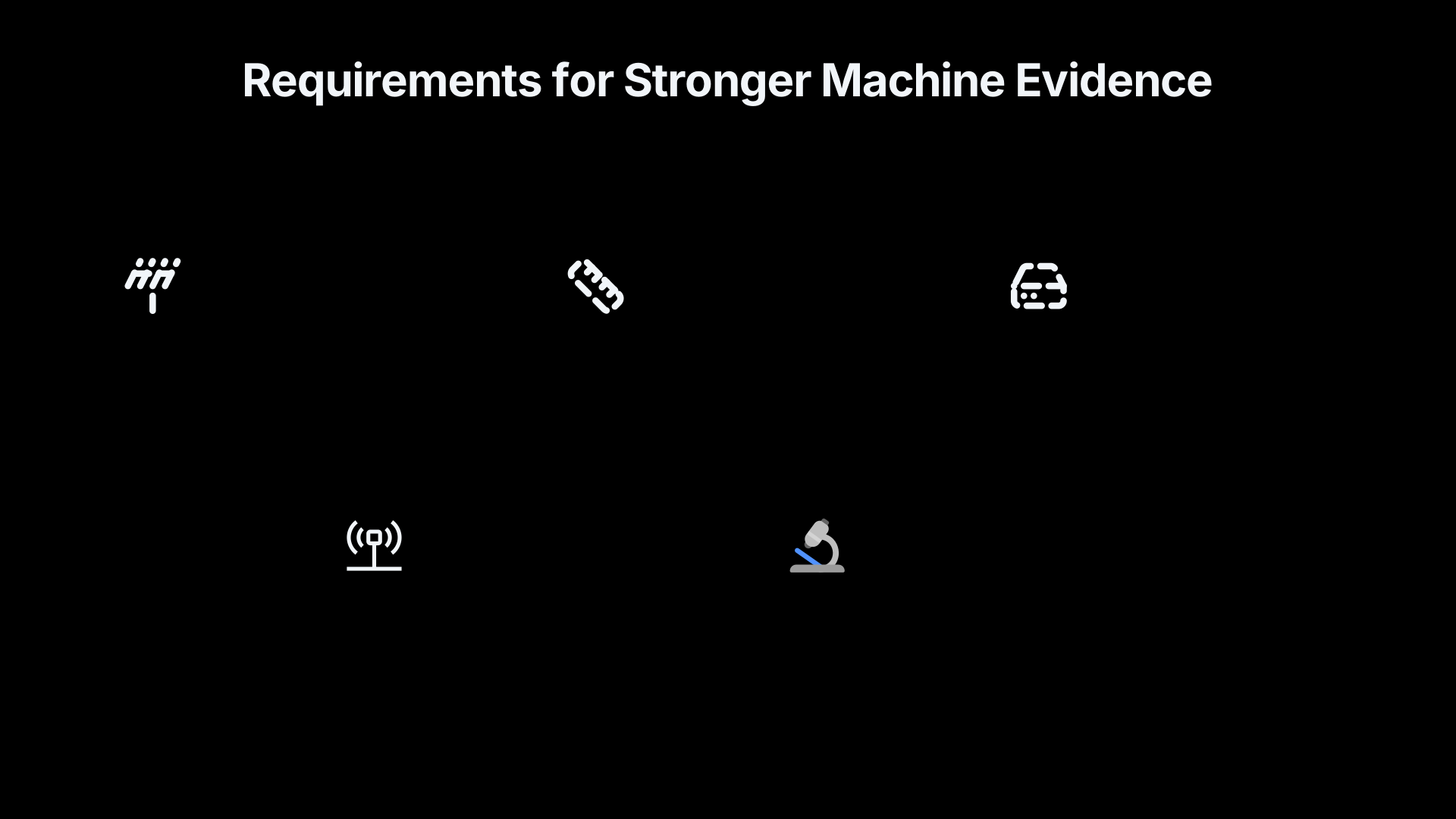
A convincing machine-witness case would not simply be a sharper video or a more dramatic radar anecdote. It would need a chain of evidence strong enough to survive alternative explanations. The most useful features would include:
- independent sensors from different locations, recording the same event at the same time;
- calibrated instruments with known error margins;
- retained raw data rather than compressed public clips;
- full metadata, including sensor mode, time, position, range, angle and platform motion;
- environmental data such as weather, wind, temperature gradients and known air traffic;
- reproducible analysis by qualified teams with access to the original data;
- clear separation between what was measured, what was inferred and what remains unknown.
This is why current scientific proposals for UAP study emphasise purpose-built, multimodal observation rather than opportunistic fragments. The Galileo Project’s proposed approach, for instance, describes coordinated cameras, passive radar-derived measurements, radio spectrum instruments, microphones and environmental sensors, with the explicit aim of recognising artefacts and corroborating true detections across modalities.[arXiv]arxiv.orgOpen source on arxiv.org.
The key word is “corroborating”. A machine witness is strongest when it is not alone. Radar, optical imagery, infrared data and environmental context must agree in ways that rule out ordinary sources, not merely accumulate ambiguity.
Why the machine-witness problem belongs in UFO–science fiction history
Radar and sensor reports occupy a distinctive place in the relationship between UFOs and science fiction because they blur the boundary between imagination and instrumentation. Science fiction trained audiences to expect that advanced encounters would first appear as strange signals, impossible tracks or objects that outperformed known machines. Real UFO history then supplied cases that looked superficially like that script: radar blips over Washington, fighter intercepts, infrared clips from Navy aircraft, and official language about anomalous objects.
But the evidence does not behave like fiction. It rarely provides a clean revelation. Instead, it produces partial traces, missing context and contested interpretations. The machine witness is compelling because it seems non-human; it is problematic because humans designed it, configured it, filtered it, interpreted it and later turned its output into a story.
The most evidence-aware position is therefore neither “the machines prove alien craft” nor “all sensor cases are worthless”. Radar and sensors made UFO reports technically serious, but not automatically technically settled. They moved the subject from the witness stand to the data lab, where the central question is not whether machines can see, but whether their sightings can be understood.
Amazon book picks
Further Reading
Books and field guides related to When Machines Became UFO Witnesses. Use these as the next step if you want deeper reading beyond the article.

UFOs : Generals, Pilots, and Government Officials Go on the R...
Strong focus on military and sensor-supported cases.
The Demon-Haunted World
Rating: 4.5/5 from 43 Google Books ratings
Encourages careful evaluation of sensor claims.
eBay marketplace picks
Marketplace Samples
Live-tested eBay searches with available results related to this page.



Endnotes
1.
Source: science.nasa.gov
Link:https://science.nasa.gov/wp-content/uploads/2023/09/uap-independent-study-team-final-report.pdf
Source snippet
NASA Science...
2.
Source: nasa.gov
Title: UPDATE: NASA Shares UAP Independent Study Report; Names Director
Link:https://www.nasa.gov/news-release/update-nasa-shares-uap-independent-study-report-names-director/
Source snippet
UPDATE: NASA Shares UAP Independent Study Report; Names Director - NASA...
3.
Source: dni.gov
Title: Director of National Intelligence
Link:https://www.dni.gov/files/ODNI/documents/assessments/Prelimary-Assessment-UAP-20210625.pdf
4.
Source: Wikipedia
Title: 1952 Washington, D.C., UFO incident
Link:https://en.wikipedia.org/wiki/1952_Washington%2C_D.C.%2C_UFO_incident
5.
Source: archives.gov
Title: National Archives Project BLUE BOOK
Link:https://www.archives.gov/research/military/air-force/ufos
6.
Source: aaro.mil
Title: Go Fast Case Resolution
Link:https://www.aaro.mil/Portals/136/PDFs/case_resolution_reports/AARO_GoFast_Case_Resolution_Card_Methodology_Final.pdf
7.
Source: aaro.mil
Title: Official UAP Imagery
Link:https://www.aaro.mil/UAP-Cases/Official-UAP-Imagery/
Source snippet
AARO UAP Imagery...
8.
Source: arxiv.org
Link:https://arxiv.org/abs/2305.18566
9.
Source: Wikipedia
Title: Project Blue Book
Link:https://en.wikipedia.org/wiki/Project_Blue_Book
10.
Source: Wikipedia
Link:https://en.wikipedia.org/wiki/NASA
11.
Source: Wikipedia
Title: NASA Unidentified Anomalous Phenomena Independent Study Team
Link:https://en.wikipedia.org/wiki/NASA_Unidentified_Anomalous_Phenomena_Independent_Study_Team
12.
Source: Wikipedia
Title: Pentagon UFO videos
Link:https://en.wikipedia.org/wiki/Pentagon_UFO_videos
13.
Source: Wikipedia
Title: All domain Anomaly Resolution Office
Link:https://en.wikipedia.org/wiki/All-domain_Anomaly_Resolution_Office
14.
Source: Wikipedia
Title: Identification studies of UFOs
Link:https://en.wikipedia.org/wiki/Identification_studies_of_UFOs
15.
Source: Wikipedia
Title: Flying saucer
Link:https://en.wikipedia.org/wiki/Flying_saucer
16.
Source: Wikipedia
Title: List of reported UFO sightings
Link:https://en.wikipedia.org/wiki/List_of_reported_UFO_sightings
17.
Source: Wikipedia
Title: J. Allen Hynek
Link:https://en.wikipedia.org/wiki/J._Allen_Hynek
18.
Source: nasa.gov
Link:https://www.nasa.gov/
19.
Source: science.nasa.gov
Link:https://science.nasa.gov/uap/
20.
Source: science.nasa.gov
Link:https://science.nasa.gov/uap/faqs/
21.
Source: aaro.mil
Link:https://www.aaro.mil/
22.
Source: aaro.mil
Title: Next UAP Report Documents
Link:https://www.aaro.mil/Next-AARO-Home-redesign/Next-Parent/Next-UAP-Report-Documents/
23.
Source: secnav.navy.mil
Title: mil Prelimary Assessment UAP
Link:https://www.secnav.navy.mil/foia/readingroom/CaseFiles/UAP%20INFO/Prelimary%20Assessment%20UAP.pdf
24.
Source: history.com
Title: of UFOs
Link:https://www.history.com/articles/history-of-ufos
25.
Source: history.com
Title: j allen hynek ufos project blue book
Link:https://www.history.com/articles/j-allen-hynek-ufos-project-blue-book
26.
Source: intelligence.gov
Link:https://www.intelligence.gov/publics-daily-brief/publics-daily-brief-articles/unidentified-aerial-phenomena-preliminary-intelligence-assessment
27.
Source: arxiv.org
Link:https://arxiv.org/html/2506.00125v1
28.
Source: war.gov
Title: dod examining unidentified anomalous phenomena
Link:https://www.war.gov/News/News-Stories/Article/Article/3965403/dod-examining-unidentified-anomalous-phenomena/
29.
Source: media.defense.gov
Title: U.S. Department of War AARO Historical Record Report Volume 1
Link:https://media.defense.gov/2024/Mar/08/2003409233/-1/-1/0/DOPSR-2024-0263-AARO-HISTORICAL-RECORD-REPORT-VOLUME-1-2024.PDF
30.
Source: reddit.com
Title: office of the director of national intelligence
Link:https://www.reddit.com/r/space/comments/o7wpjg/office_of_the_director_of_national_intelligence/
31.
Source: britannica.com
Title: Project Blue Book
Link:https://www.britannica.com/topic/Project-Blue-Book
32.
Source: nationalarchives.gov.uk
Link:https://www.nationalarchives.gov.uk/explore-the-collection/explore-by-time-period/postwar/ufo-reports/
33.
Source: uapedia.ai
Title: nasas 2023 uap study
Link:https://uapedia.ai/wiki/nasas-2023-uap-study/
Additional References
34.
Source: youtube.com
Title: Inside the AI Alien Hunting Project at Harvard
Link:https://www.youtube.com/watch?v=oDAY0_wRjxA
Source snippet
This video provides the full, official briefing from the NASA independent study team outlining how rigorous calibration, metadata, and sc...
35.
Source: youtube.com
Link:https://www.youtube.com/watch?v=bi0H_mkwTW0
Source snippet
Avi Loeb | The Crisis of Perception: UFOs, AI & Reality | TFP #103...
36.
Source: youtube.com
Title: How UFO Encounters Defeated Advanced US Fighter Jet Sensors | WION Podcast
Link:https://www.youtube.com/watch?v=XdAwIJbNeQE
Source snippet
Former Military Radar Technician Reacts to Newly Declassified UAP Evidence...
37.
Source: youtube.com
Title: Former Military Radar Technician Reacts to Newly Declassified UAP Evidence
Link:https://www.youtube.com/watch?v=nbC6dFb35Jo
Source snippet
Declassified UFO Files Reveal America's Airspace Crisis | WION Podcast...
38.
Source: youtube.com
Title: How RADAR Actually Works
Link:https://www.youtube.com/watch?v=UzkZ2IdtgHs
Source snippet
This video collection features expert discussions, tech breakdowns, and complete official briefings examining how calibration, artifacts...
39.
Source: youtube.com
Link:https://www.youtube.com/watch?v=xYNnjEHbDOc
Source snippet
Raytheon ATFLIR expert discusses Navy gimbal UFO/UAP video with Mick West...
40.
Source: youtube.com
Title: Raytheon ATFLIR expert discusses Navy gimbal UFO/UAP video with Mick West
Link:https://www.youtube.com/watch?v=FGHeu5GeR-0
Source snippet
Unidentified Anomalous Phenomena Report from NASA...
41.
Source: youtube.com
Title: How Military Sensors Proved UFO Craft Were Physically Real | WION Podcast
Link:https://www.youtube.com/watch?v=H6eK1VbrHPY
Source snippet
Tech 101: Unidentified Anomalous Phenomenon...
42.
Source: cia.gov
Link:https://www.cia.gov/readingroom/docs/CIA-RDP81R00560R000100060001-5.pdf
43.
Source: cia.gov
Link:https://www.cia.gov/readingroom/document/cia-rdp81r00560r000100010001-0
Topic Tree