Within UFO Fiction
Why Vallee Linked UFOs to Older Legends
Jacques Vallee's work made the case that UFO encounters should be compared with older legends of strange visitors.
On this page
- Magonia and encounter patterns
- Why folklore matters to UFO interpretation
- The limits of symbolic comparison
Page outline Jump by section
Introduction
Jacques Vallée changed one of the central questions in UFO culture. Instead of asking only whether UFOs were spacecraft from another planet, he asked why modern UFO encounters so often resembled older stories about fairies, angels, demons, sky ships, little people and strange visitors from hidden realms. His best-known statement of that argument was Passport to Magonia, first published in 1969, a book that compared modern close encounters with folklore and historical reports rather than treating them as a wholly new space-age phenomenon.[Archive.org]ia801409.us.archive.orgPassport to Magonia—UFOs, Folklore, and Parallel Worlds, Jacques Vallée (1993Passport to Magonia—UFOs, Folklore, and Parallel Worlds, Jacques Vallée (1993
The point was not simply that UFO witnesses were copying old legends. Vallée’s stronger claim was that recurring encounter patterns may be filtered through the language of each period. A medieval witness might describe an aerial realm or supernatural beings; a twentieth-century witness, living in the age of rockets, radar and science fiction, might describe a craft, pilots and advanced technology. That comparison matters for the relationship between UFOs and science fiction because it shifts the UFO from a single “alien spaceship” narrative into a broader history of how cultures imagine contact with the non-human, the hidden and the technologically miraculous.[Archive.org]ia801409.us.archive.orgPassport to Magonia—UFOs, Folklore, and Parallel Worlds, Jacques Vallée (1993Passport to Magonia—UFOs, Folklore, and Parallel Worlds, Jacques Vallée (1993
Magonia and Encounter Patterns
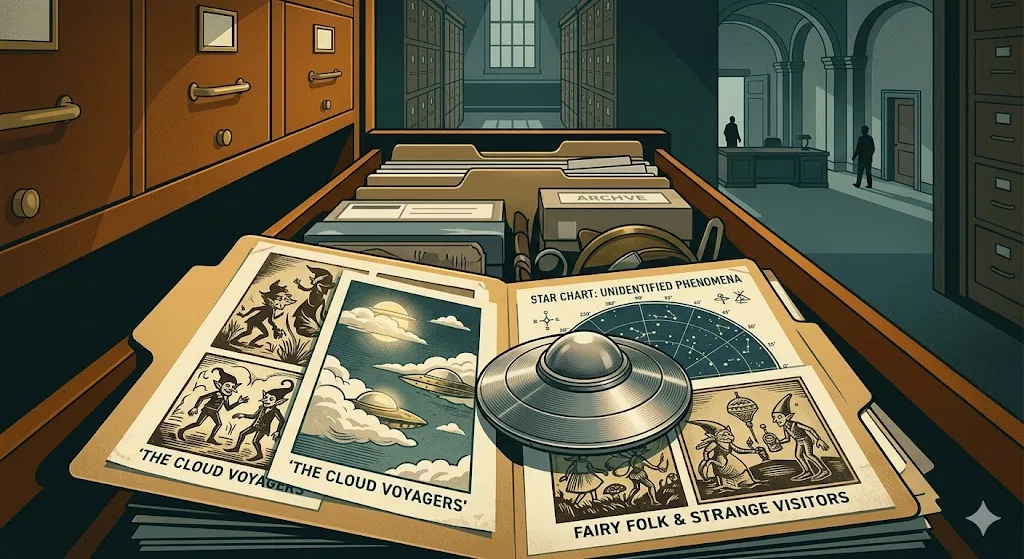
The title Passport to Magonia comes from a medieval story about a region called Magonia, from which ships were said to sail in the clouds. Vallée used that story as a symbolic doorway into a larger argument: reports of extraordinary visitors did not begin with flying saucers in 1947, and the “craft from the sky” motif had much older precedents. In the text, Magonia is introduced through cloud ships, storm wizards and alleged travellers from an aerial country, a framing that lets Vallée place modern UFO reports beside pre-modern stories without claiming they are identical in every detail.[Archive.org]ia801409.us.archive.orgPassport to Magonia—UFOs, Folklore, and Parallel Worlds, Jacques Vallée (1993Passport to Magonia—UFOs, Folklore, and Parallel Worlds, Jacques Vallée (1993
What interested Vallée was pattern rather than costume. In Passport to Magonia, older accounts include beings who appear and vanish, small or oddly proportioned visitors, aerial movement, strange lights, abduction-like journeys, gifts that change value, distorted time, sexual or reproductive motifs, warnings, prophecies and ambiguous physical traces. In one cited folklore passage, fairies are described as diminutive beings who could speak to people and then vanish; another passage links fairy traditions to aerial beings, prophecy and intervention in human affairs.[Archive.org]ia801409.us.archive.orgPassport to Magonia—UFOs, Folklore, and Parallel Worlds, Jacques Vallée (1993Passport to Magonia—UFOs, Folklore, and Parallel Worlds, Jacques Vallée (1993
Those motifs overlap with many twentieth-century close-encounter reports: humanoid occupants, paralysis, beams of light, craft that land or disappear, beings who speak in puzzling ways, and witnesses left frightened or transformed. Vallée’s catalogue of UFO landings includes examples from the late nineteenth century through the 1960s: airship crews asking for water, small figures seen near craft, beings carrying strange devices, witnesses who report paralysis, and objects that leave marks, sounds or lights behind.[Archive.org]ia801409.us.archive.orgPassport to Magonia—UFOs, Folklore, and Parallel Worlds, Jacques Vallée (1993Passport to Magonia—UFOs, Folklore, and Parallel Worlds, Jacques Vallée (1993
This is where the science-fiction connection becomes subtle. Vallée was not mainly saying that science fiction invented UFO encounters. He was suggesting that science fiction supplied one modern vocabulary for an older-looking encounter structure. In a religious culture, the visitor might be an angel or demon; in a fairy tradition, a member of the hidden people; in a space-age society, an alien pilot. The narrative frame changes, but some reported encounter features recur.
Why Folklore Matters to UFO Interpretation
Vallée’s comparison pushed against the two dominant interpretive habits of mid-century UFO debate. One side tended to reduce UFO reports to misidentifications, hoaxes, psychological errors or mass excitement. The other side treated the strongest cases as evidence for extraterrestrial craft. Vallée was dissatisfied with both because neither, in his view, explained the strangeness, symbolism and historical continuity of close-encounter narratives. WIRED’s profile of Vallée summarises this position clearly: he regarded the phenomenon as both a scientific and social frontier, requiring databases and pattern analysis as well as attention to testimony, culture and interpretation.[WIRED]wired.comJacques Vallée Still Doesn’t Know What UFOs Are | WIREDJacques Vallée Still Doesn’t Know What UFOs Are | WIRED
That view grew out of the late 1960s moment. Project Blue Book, the United States Air Force’s long-running UFO investigation, ended in 1969; the Air Force later stated that 12,618 sightings had been reported to the project and 701 remained unidentified, while also concluding that there was no evidence that unidentified cases represented extraterrestrial vehicles or technology beyond modern science.[U.S. Air Force]af.milUnidentified Flying Objects and Air Force Project Blue Book > Air Force > Fact Sheet Display… Vallée’s Passport to Magonia appeared in the same period, offering a third route: not official dismissal, not simple alien confirmation, but comparative study of how extraordinary encounters are reported across time.
Folklore mattered to Vallée because it made UFO testimony culturally legible. A report is not just a neutral data point; it is told by a witness using available images, fears, expectations and story forms. That does not automatically make it false. Folklorists have long studied how recurring narratives can preserve experience, social anxiety and symbolic meaning without being straightforward literal records. Vallée applied a similar instinct to UFOs: he treated the witness story as evidence of something worth studying, while resisting the leap from “strange encounter” to “interstellar vehicle”.
This approach also complicates the role of science fiction. By the 1950s and 1960s, science fiction had normalised the idea of visitors from other planets, advanced craft, alien bodies and cosmic messages. Vallée’s folklore comparison implies that science fiction did not merely entertain the public; it helped organise how people imagined the unknown. The flying saucer became a modern mask for older motifs of contact, abduction, revelation and danger.
Vallée’s Challenge to the Extraterrestrial Script
Vallée’s reputation is partly built on his refusal to settle for the standard extraterrestrial hypothesis. He had scientific credentials and was deeply involved in data-driven UFO study: Rice University’s archive describes his papers as including background files, correspondence, field notes and press documents collected between 1960 and 2015, amounting to 48 linear feet of material.[archives.library.rice.edu]archives.library.rice.eduOpen source on rice.edu. Yet his comparative method led him away from the idea that UFOs should be understood simply as machines travelling from another star system.
The reason was not that he rejected physical evidence altogether. Vallée continued to investigate cases with alleged traces, including later work on materials analysis. The issue was that the reported behaviour of UFOs often seemed theatrically absurd, culturally adaptive or psychologically charged. WIRED notes that he doubted the idea of UFOs as “interstellar SUVs” and preferred to keep open stranger possibilities, including models that would explain why encounters appear to interact with belief, perception and mythology.[WIRED]wired.comJacques Vallée Still Doesn’t Know What UFOs Are | WIREDJacques Vallée Still Doesn’t Know What UFOs Are | WIRED
In this sense, Vallée’s folklore argument was also a critique of science-fiction literalism. Popular science fiction often turns mystery into hardware: a ship, a crew, a planet of origin, a mission. Vallée argued that many UFO stories do not behave like straightforward reconnaissance reports. They resemble initiations, tricks, visions, ordeals, warnings or symbolic dramas. That does not prove they are supernatural, extraterrestrial or psychological. It does show why a purely mechanical reading can miss important parts of the testimony.
Rice University’s Archives of the Impossible places Vallée’s influence in exactly this mixed register, describing his work as combining scientific analysis with folklore and parapsychological approaches; it also notes that Steven Spielberg read and admired these books when shaping Close Encounters of the Third Kind.[Title of Site | Rice University]impossiblearchives.rice.eduOpen source on rice.edu. That connection is important: Vallée’s ideas entered the cultural space where UFO investigation and science-fiction storytelling were already feeding each other.
The Limits of Symbolic Comparison
The folklore comparison is powerful, but it has limits. Similar stories across time do not automatically prove a single underlying phenomenon. Human beings repeatedly tell stories about lights in the sky, hidden beings, journeys to other realms and encounters with powerful outsiders because those themes are deeply available to imagination, religion, fear and social life. A recurring motif can point to a shared human narrative pattern rather than a shared external cause.
There is also a source problem. Older reports often survive through chronicles, religious texts, antiquarian collections or retellings shaped by translation, selection and later interpretation. A medieval cloud-ship story, a fairy abduction and a modern UFO landing report may look similar when placed side by side, but each belongs to a different evidential world. The medieval account may be theological or satirical; the fairy story may be oral tradition; the UFO report may come from journalism, police notes, a private investigator or a witness interview. Treating them as equivalent evidence can flatten the differences that historians and folklorists care about.
A second limit is that symbolic comparison can become too elastic. If every strange visitor becomes part of the same pattern, the pattern risks explaining everything and nothing. Vallée’s best use of folklore is not as a shortcut to a grand answer, but as a warning against premature certainty. It asks researchers to notice repeated motifs, cultural translation and narrative form before declaring that the case must be alien, imaginary or fraudulent.
That caution is also what keeps Vallée relevant beyond UFO belief communities. His archive at Rice, his long record of field investigation, and continuing scholarly interest in extraordinary experience show that his work is not merely a claim about “ancient aliens”. It is a method for asking how anomalous reports move between experience, memory, culture, technology and story.[archives.library.rice.edu]archives.library.rice.eduOpen source on rice.edu.
Why Vallée Still Matters for UFOs and Science Fiction
Vallée’s folklore comparison helps explain why UFOs have remained so durable in modern culture. The UFO is not only an object in the sky; it is a narrative container. It can hold Cold War anxiety, religious expectation, technological awe, distrust of authority, hopes of cosmic contact and fears of manipulation. Science fiction amplifies those meanings, but it did not create the deeper structure from nothing.
This is why Passport to Magonia still stands out in the history of UFO interpretation. It treats the “alien” not only as a possible biological visitor, but as a cultural role: the stranger from elsewhere who arrives with superior knowledge, ambiguous motives and a form that reflects the age. In a world of rockets, satellites and cinema, that figure wears the costume of science fiction. In older traditions, it wore other costumes.
The lasting value of Vallée’s argument is not that it solves UFOs. It changes the question. Instead of asking only “Are they spacecraft?”, it asks “Why do these encounters look the way they do, and why do they keep returning in forms each era can recognise?” For the relationship between UFOs and science fiction, that is the key insight: modern UFO stories are not just reports competing with fiction. They are part of a much older human habit of translating mystery into the most convincing language available at the time.

Amazon book picks
Further Reading
Books and field guides related to Why Vallee Linked UFOs to Older Legends. Use these as the next step if you want deeper reading beyond the article.
Passport to Magonia
Directly argues that UFO encounters share patterns with folklore, myths and older legends.
Dimensions
Expands the challenge to simple extraterrestrial explanations and explores recurring encounter patterns.
The Mothman Prophecies
Rating: 4.5/5 from 6 Google Books ratings
Examines recurring paranormal patterns that overlap with Vallée-style interpretations.
Wonders in the Sky
Documents unusual aerial phenomena across centuries, supporting the historical-comparison approach.
eBay marketplace picks
Marketplace Samples
Live-tested eBay searches with available results related to this page.

Endnotes
1.
Source: ia801409.us.archive.org
Title: Passport to Magonia—UFOs, Folklore, and Parallel Worlds, Jacques Vallée (1993)
Link:https://ia801409.us.archive.org/0/items/PassportToMagonia–UFOsFolkloreAndParallelWorldsJacquesVallee1993/Passport%20to%20Magonia%E2%80%94UFOs%2C%20Folklore%2C%20and%20Parallel%20Worlds%2C%20Jacques%20Vall%C3%A9e%20%281993%29.pdf
2.
Source: wired.com
Title: Jacques Vallée Still Doesn’t Know What UFOs Are | WIRED
Link:https://www.wired.com/story/jacques-vallee-still-doesnt-know-what-ufos-are
3.
Source: af.mil
Title: U.S. Air Force
Link:https://www.af.mil/About-Us/Fact-Sheets/Display/Article/104590/unidentified-flying-objects-and-air-force-project-blue-book/
Source snippet
Unidentified Flying Objects and Air Force Project Blue Book > Air Force > Fact Sheet Display...
4.
Source: archives.library.rice.edu
Link:https://archives.library.rice.edu/repositories/2/resources/1085
5.
Source: impossiblearchives.rice.edu
Link:https://impossiblearchives.rice.edu/archives-impossible-intro
6.
Source: news.rice.edu
Title: s archives impossible offer insight and expertise world ufo day
Link:https://news.rice.edu/news/2025/rices-archives-impossible-offer-insight-and-expertise-world-ufo-day
7.
Source: news.rice.edu
Link:https://news.rice.edu/news/2025/exploring-unexplained-new-chapter-archives-impossible-brings-together-people-different
8.
Source: news.rice.edu
Title: decade discovery 10 years rices archives impossible
Link:https://news.rice.edu/news/2024/decade-discovery-10-years-rices-archives-impossible
9.
Source: Wikipedia
Title: Jacques Vallée
Link:https://en.wikipedia.org/wiki/Jacques_Vall%C3%A9e
10.
Source: Wikipedia
Title: Archives of the Impossible
Link:https://en.wikipedia.org/wiki/Archives_of_the_Impossible
11.
Source: Wikipedia
Title: Project Blue Book
Link:https://en.wikipedia.org/wiki/Project_Blue_Book
12.
Source: Wikipedia
Link:https://en.wikipedia.org/wiki/Jacques
13.
Source: thetalkingllama.wordpress.com
Title: passport to magonia
Link:https://thetalkingllama.wordpress.com/2012/06/27/passport-to-magonia/
14.
Source: archives.gov
Title: Project BLUE BOOK
Link:https://www.archives.gov/research/military/air-force/ufos
15.
Source: reddit.com
Link:https://www.reddit.com/r/TheWhyFiles/comments/1ggdwha/rice_universitys_archives_of_the_impossible/
16.
Source: britannica.com
Title: Project Blue Book
Link:https://www.britannica.com/topic/Project-Blue-Book
17.
Source: ia601409.us.archive.org
Title: Passport to Magonia—UFOs, Folklore, and Parallel Worlds, Jacques Vallée (1993)
Link:https://ia601409.us.archive.org/0/items/PassportToMagonia–UFOsFolkloreAndParallelWorldsJacquesVallee1993/Passport%20to%20Magonia%E2%80%94UFOs%2C%20Folklore%2C%20and%20Parallel%20Worlds%2C%20Jacques%20Vall%C3%A9e%20%281993%29.pdf
18.
Source: archive.org
Link:https://archive.org/details/messengersofdece0000vall
19.
Source: archive.org
Title: passporttomagoni0000vall m8g5
Link:https://archive.org/details/passporttomagoni0000vall_m8g5
20.
Source: ia800500.us.archive.org
Link:https://ia800500.us.archive.org/29/items/JacquesValleeChrisAubeckWondersInTheSkyUnexplainedAerialObjectsFromAntiquityToModernTimes/Jacques%20Vallee%2C%20Chris%20Aubeck%20Wonders%20in%20the%20Sky%20%20Unexplained%20Aerial%20Objects%20from%20Antiquity%20to%20Modern%20Times.pdf
21.
Source: dictionary.cambridge.org
Link:https://dictionary.cambridge.org/pronunciation/english/jacques
22.
Source: journal.equinoxpub.com
Link:https://journal.equinoxpub.com/IR/article/view/19355
23.
Source: intownmag.com
Title: archives of the impossible
Link:https://www.intownmag.com/2025/03/archives-of-the-impossible/
24.
Source: wakefieldbooks.com
Link:https://wakefieldbooks.com/book/9780975720042
25.
Source: sobrief.com
Title: Passport to Magonia
Link:https://sobrief.com/books/passport-to-magonia-2
Additional References
26.
Source: youtube.com
Title: Jacques Vallée, UFOs, and the Case against Extraterrestrial Origins
Link:https://www.youtube.com/watch?v=lmLE0X5FRFc
Source snippet
Dr. Jacques Vallée: UAP Encounters, Patterns, and the Signals of Intelligence | The Sol Forum #4...
27.
Source: youtube.com
Link:https://www.youtube.com/watch?v=NJ4JuA2UYL4
Source snippet
Passport To Magonia by Jacques Vallée - Chapter 1...
28.
Source: youtube.com
Title: The New Era in UFO Research with Jacques Vallée
Link:https://www.youtube.com/watch?v=eze1ikq-sMQ
Source snippet
Jacques Vallee Passport to Magonia folklore UFOs Passport To Magonia by Jacques Vallée - Chapter 1 Disinfo Zone...
29.
Source: cia.gov
Link:https://www.cia.gov/readingroom/docs/CIA-RDP81R00560R000100010008-3.pdf
30.
Source: reddit.com
Link:https://www.reddit.com/r/UFOs/comments/ig4zb1/92_paper_summarizing_jacques_vallees_hypothesis/
31.
Source: goodreads.com
Link:https://www.goodreads.com/list/book/71255
32.
Source: dreamstudies.org
Link:https://dreamstudies.org/abduction-encounters-sleep-paralysis-and-the-extraordinary/
33.
Source: reddit.com
Link:https://www.reddit.com/r/CriticalTheory/comments/1bomals/any_serious_critical_theory_on_ufos/
34.
Source: reddit.com
Link:https://www.reddit.com/r/UFOs/comments/1d6rn56/anyone_else_read_passport_to_magonia/
35.
Source: dur.ac.uk
Link:https://www.dur.ac.uk/media/durham-university/departments-/law-school/news-and-events/events/seti-and-uap-event—bohlander-2025/Senn.pdf
Topic Tree