Within UFO Fiction
Do UFO Stories Shape What Witnesses See?
Sincere witnesses may describe strange events using familiar images borrowed from films, magazines, television, and rumor.
On this page
- Perception, memory, and cultural language
- Common UFO shapes and motifs
- Why influence does not equal dishonesty
Page outline Jump by section
Introduction
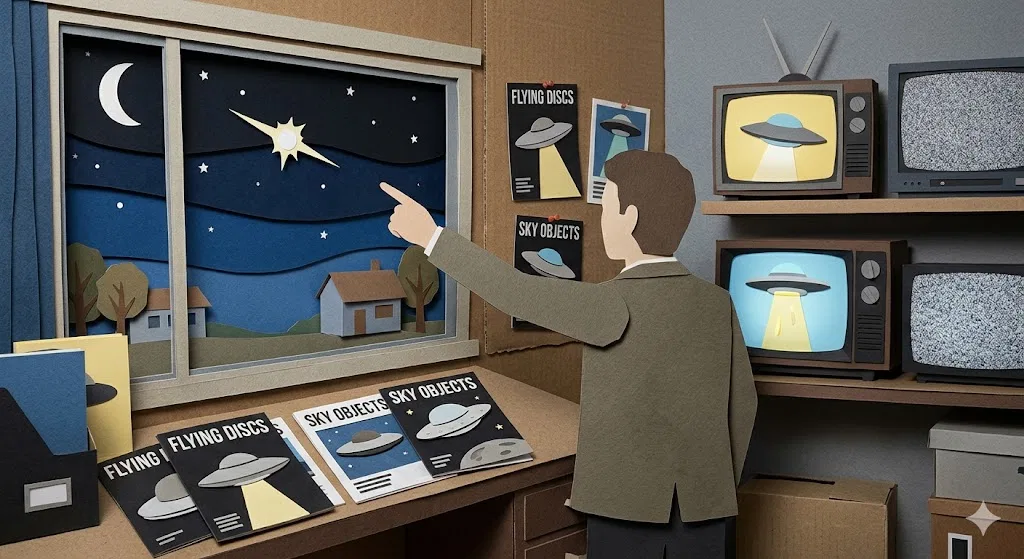
UFO stories can shape what witnesses see, but not in the crude sense that people simply copy science fiction or lie about what happened. The stronger explanation is subtler: when someone sees an ambiguous light, shape, movement, or frightening bedroom experience, they reach for the visual and verbal templates already available in their culture. Since the late 1940s, science fiction has supplied many of those templates: saucers, discs, glowing beams, silent hovering craft, medical rooms, small humanoids, missing time, and secret government knowledge.
This matters because witness testimony is not just a recording of raw perception. It is perception plus memory, emotion, language, expectation, retelling, media framing, and later interpretation. Official and scientific discussions of UFOs repeatedly stress the problem of sparse, incomplete, and unevenly reported data, while historians and psychologists show that reports are also shaped by the imagery a culture gives people for describing the unknown.[NASA Science]science.nasa.govScience Independent Study Team ReportNASA ScienceIndependent Study Team ReportSeptember 13, 2023 — NASA's very involvement in UAP will play a vital role in reducing stigma as…
Perception, memory, and cultural language
A witness normally begins with an experience, not a polished UFO narrative. They may see a moving light, a fast object, a silhouette, a reflection, a cluster of lights, or something that seems to behave unlike aircraft they recognise. The first stage is perceptual: distance, darkness, haze, surprise, fear, speed, and lack of scale can all make an ordinary or unresolved stimulus hard to identify. Project Blue Book material itself shows how many reports were investigated through questionnaires, witness statements, clippings, photographs, and physical-evidence analysis rather than through direct instrument records.[National Archives]archives.govproject blue book 50th anniversaryThe files contain reports from UFO observers, correspondence…Read more…
The second stage is linguistic. Once a person tries to explain what they saw, they need comparison words. “Saucer”, “disc”, “cigar”, “triangle”, “orb”, “beam”, “mother ship”, “alien”, and “abduction” are not neutral labels; they come with stories attached. A witness may use one of those words because it is the closest available description, not because they are consciously invoking a film plot. The result is a kind of cultural compression: a messy, brief, uncertain sighting can be retold through a familiar image that sounds more definite than the original perception.
The Kenneth Arnold case shows how powerful this compression can be. Arnold’s June 1947 report near Mount Rainier helped launch the modern “flying saucer” era, but later accounts and historical summaries note that the public phrase was shaped by reporting and metaphor as much as by a simple claim that the objects were literal saucers. The Smithsonian’s National Air and Space Museum says Arnold’s sighting added “flying saucer” to the vocabularies of millions, while later discussion of the case has stressed the difference between shape, motion, and press language.[National Air and Space Museum]airandspace.si.edu1947 year flying saucerRainier on June 24, 1947, remains a mystery. He spent the rest of his life trying to explain…
That distinction matters for later testimony. Once “flying saucer” became a public term, future witnesses had a ready-made category. A person did not have to invent a description from scratch; they could say, “It looked like a flying saucer,” and be understood immediately. Science fiction, newspapers, magazines, radio, cinema, and later television then reinforced the same image, turning a phrase from one early wave of reports into a durable visual template.
Common UFO shapes and motifs
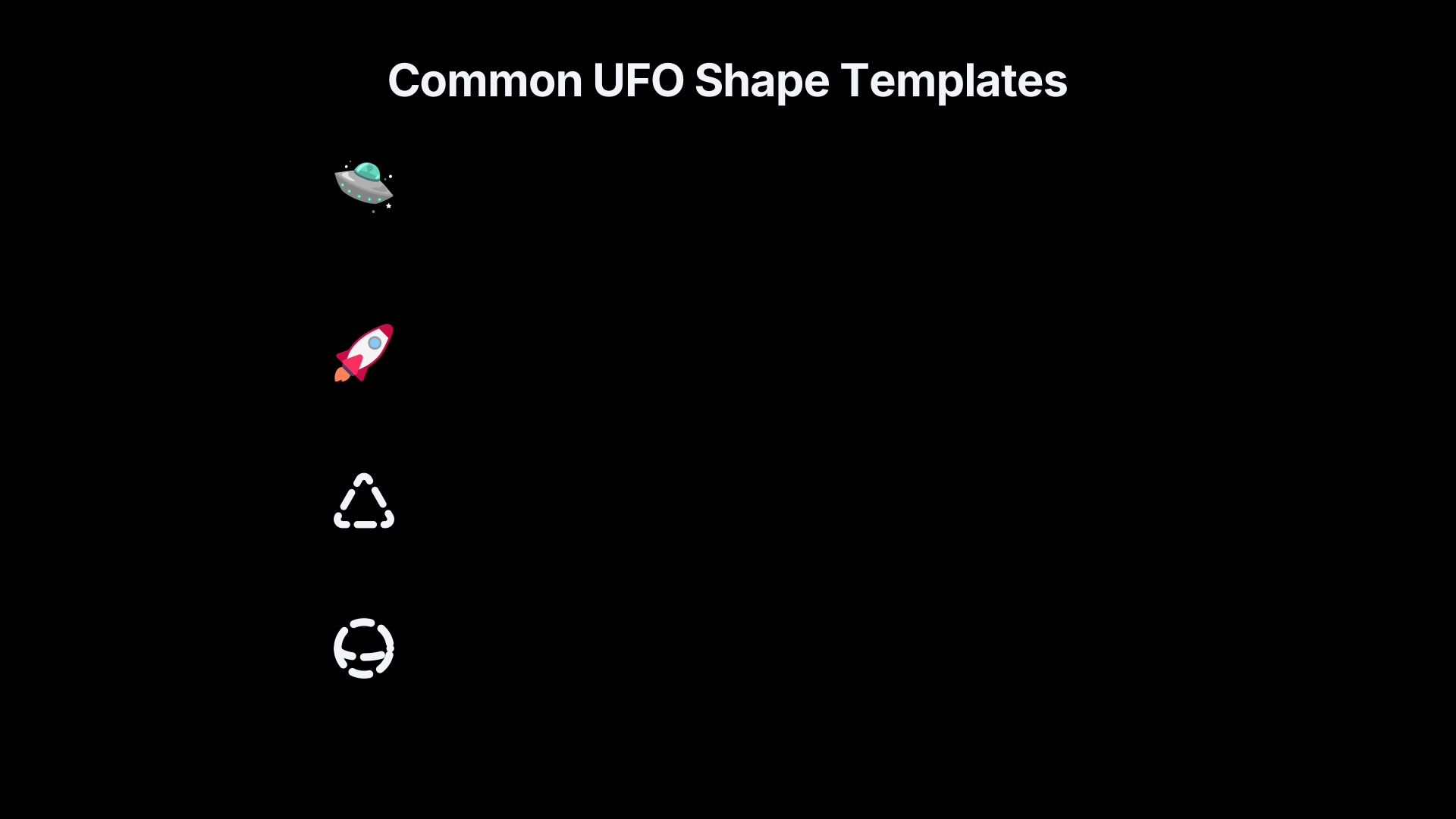
Science-fiction templates do not appear only in the classic saucer shape. They also appear in the recurring motifs people use to organise UFO experiences into recognisable scenes. The motifs vary by period, but several have become especially persistent.
The disc or saucer became the most recognisable mid-century form because it was simple, aerodynamic-looking, and visually distinct from ordinary aircraft. It matched a post-war imagination already filled with rockets, secret weapons, atomic technology, and space travel. It was also easy for artists and film-makers to reproduce: a round craft with a dome could be instantly read as “alien” even before any story was explained.
The cigar or cylinder offered a different template. It resembled rockets, airships, missiles, and futuristic transport. Reports of elongated objects therefore sat between older airship lore and newer space-age imagery. British Ministry of Defence sighting files from 2000, for example, include witnesses using plain comparative descriptions such as “cigar shaped object”, showing how such terms functioned as practical witness language rather than as technical classification.[GOV.UK]assets.publishing.service.gov.ukOpen source on service.gov.uk.
The triangle became especially prominent in later decades, partly because it resembles stealth aircraft, secret military platforms, and large cinematic spaceships. Triangular UFO reports should not be reduced to science fiction alone, since military aviation, aircraft lighting, and formation effects may also be relevant in particular cases. But the triangle works as a template because it bridges two stories at once: “advanced human technology” and “non-human craft”.
The orb or glowing sphere is one of the oldest and most flexible templates. It can fit stars, planets, balloons, flares, drones, atmospheric effects, and unresolved sightings, but it also fits the science-fiction image of energy-like alien technology. Recent reporting on newly released Pentagon-related UFO files described witness accounts involving glowing red orbs, plasma-like spheres, shape changes, and smaller lights separating from a main object. Those descriptions do not prove an alien source, but they show how modern witness language still gravitates towards vivid, genre-ready forms when the object is hard to classify.[Reuters]reuters.comNew Pentagon UFO file reveals glowing orbs in US NortheastThe newly released 72 files, originating from the FBI, CIA, and Pentagon, include testimonies, videos, and artwork depicting the sighting…
The beam, levitation, and medical-room sequence belongs especially to abduction narratives. Here the template is no longer just a shape in the sky; it is a story structure. A person may report paralysis, a presence, light in the room, being moved through a wall or window, entering a craft, examination by non-human beings, missing time, and later partial recall. Psychologists have linked some such accounts to sleep paralysis, hypnopompic hallucinations, suggestibility, and memory construction, while also noting that many claimants are not simply “mad” or knowingly deceptive.[sagepub.com]journals.sagepub.comOpen source on sagepub.com.
How fiction becomes a witness template
Science fiction influences testimony most strongly when it supplies a complete interpretive package. A witness does not merely borrow an image; they borrow a way of making sense of a puzzling event. Three mechanisms are especially important.
First, fiction makes the unknown nameable. Before a culture has a familiar term, people describe anomalies through loose comparisons: a plate, a wheel, a star, a kite, a cigar, a balloon. After a genre stabilises, those comparisons harden into categories. “Flying saucer” became not just a metaphor but a public object-type, even though individual sightings varied widely. The National Archives notes that Blue Book files contain observer reports, correspondence, clippings, and analytic material, which means witness language and media language often sit side by side in the historical record.[National Archives]archives.govproject blue book 50th anniversaryThe files contain reports from UFO observers, correspondence…Read more…
Second, fiction teaches expectations about behaviour. A UFO is expected to hover silently, accelerate suddenly, stop at impossible angles, emit light, interfere with engines, or leave no trace. Some of these features appear in reports because they were genuinely perceived; some may arise from misperception; others may be added or strengthened as the story is retold. The important point is that witnesses and listeners share a repertoire of “UFO-like” behaviour before any single case is judged.
Third, fiction can organise memory after the event. Memory is not a fixed recording pulled from storage. It can be reconstructed under questioning, retelling, hypnosis, media exposure, or group discussion. Research on alien-abduction memory has examined how people may come to interpret sleep paralysis or other anomalous experiences through the culturally available abduction story, especially when ambiguity is reduced by a therapist, investigator, book, programme, or community that treats the alien framework as plausible.[jstor.org]jstor.orgThe Construction of Space Alien Abduction MemoriesThe Construction of Space Alien Abduction Memories
This does not mean every witness “got it from a movie”. Cultural influence can be diffuse. Someone may never have watched a particular film, yet still absorb its imagery through posters, parodies, news graphics, memes, documentaries, book covers, toys, or other people’s stories. By the time a motif is culturally common, it no longer belongs only to the original work of fiction.
The Arnold lesson: a template can start as a misunderstanding
The Arnold sighting is useful because it shows how a template can form even when the starting point is ambiguous. Arnold compared the motion of the objects to something skipping over water, and early reporting helped attach “saucer” language to the case. Whatever Arnold saw, the public inherited a compact image: fast, shiny, disc-like objects from the sky.[National Air and Space Museum]airandspace.si.edu1947 year flying saucerRainier on June 24, 1947, remains a mystery. He spent the rest of his life trying to explain…
That image then became available to everyone else. Later witnesses could report “saucers” because the word had already become culturally legible. Journalists could headline sightings as saucers. Film-makers could depict saucers and have audiences understand the reference instantly. Toy manufacturers, pulp illustrators, comic artists, and television producers could repeat the shape until it felt like the natural form of an alien craft.
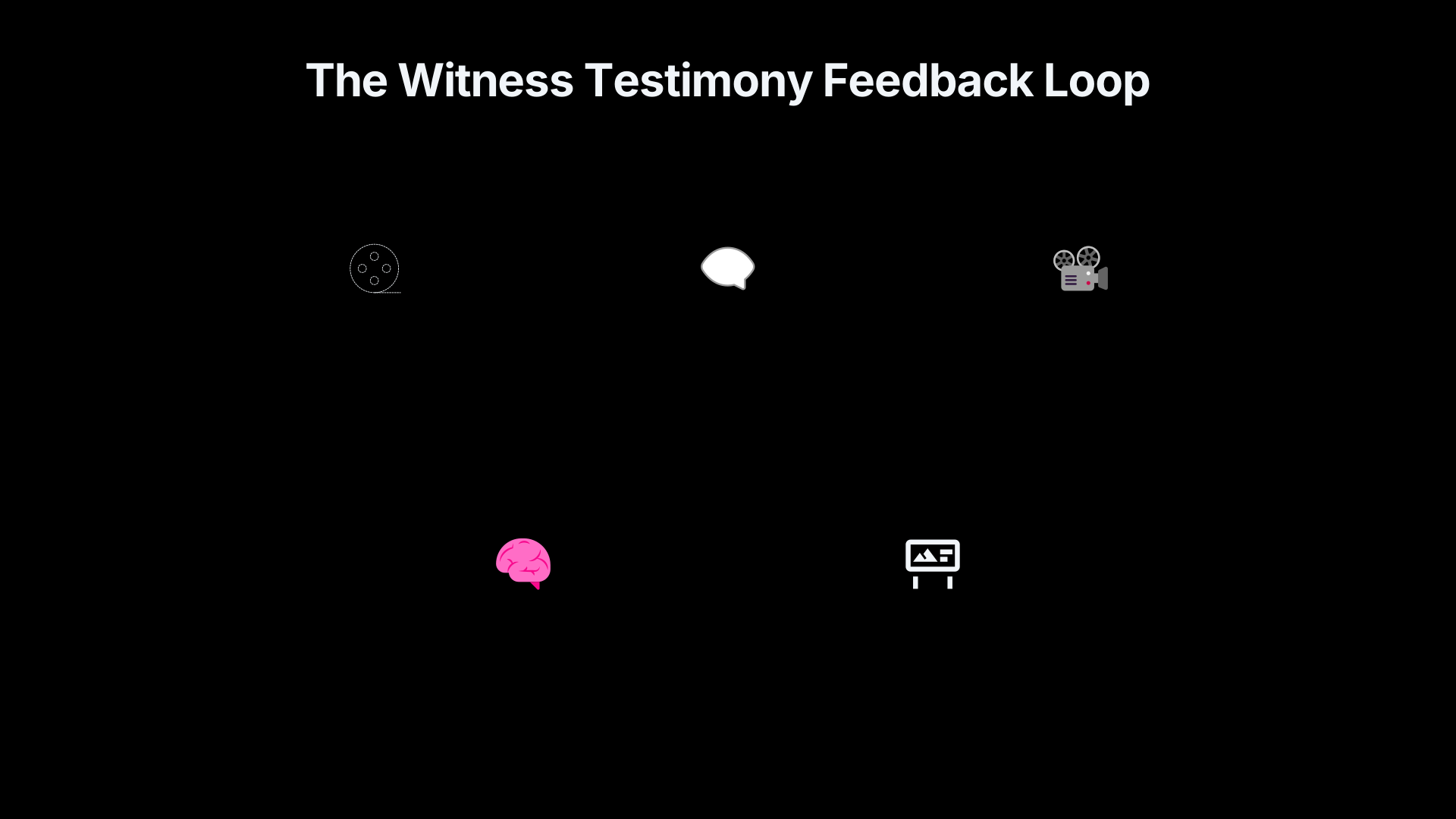
The key mechanism is feedback. A sighting generates a phrase; the phrase generates images; the images shape expectations; later witnesses use those expectations to describe new sightings. This does not require a conspiracy or mass dishonesty. It is how cultural categories work. Once a culture has a ready-made container for an ambiguous experience, more experiences get poured into it.
Abduction stories and the move from sighting to script
The science-fiction template becomes even clearer in abduction accounts because many reports follow a recognisable sequence rather than a single visual comparison. The experiencer is often alone or in bed, senses a presence, sees lights or beings, loses control, undergoes an examination, and later tries to recover missing memory. This structure resembles a narrative script: it has a setting, agents, movement, procedure, threat, revelation, and aftermath.
Psychological research does not treat all such witnesses as frauds. Susan Clancy’s work, reported by Wired, argued that many abductees are psychologically normal people trying to explain disturbing experiences, with sleep hallucinations, suggestibility, cultural influence, and the human need for meaning all playing roles. McNally and Clancy’s study in Transcultural Psychiatry specifically examined people whose abduction claims were linked to apparent sleep-paralysis episodes interpreted as alien encounters.[WIRED]wired.comOpen source on wired.com.
This is where science fiction’s influence is strongest: not in causing the initial paralysis or fear, but in supplying a story that makes the experience coherent. In another period, a terrifying night-time paralysis might have been explained through demons, witches, ghosts, fairies, or religious visitation. In a space-age culture, the same bodily and emotional features can be interpreted through alien beings, craft, beams, implants, and examinations.
There is also a social element. Once abduction narratives circulate in books, television interviews, documentaries, support groups, podcasts, and online communities, witnesses can compare their own fragments with a recognised pattern. That recognition may comfort them because it turns an isolating experience into a shared one. But it can also make later recall more template-like, especially when investigators ask leading questions or treat uncertain memories as hidden evidence waiting to be recovered.
Why influence does not equal dishonesty
The most common mistake is to assume that if science fiction shapes testimony, the witness must be lying. That is not how perception or memory usually works. People can sincerely report what they believe they saw while still using culturally borrowed images to describe it. A comparison word may be honest even when it is imprecise. “It looked like a saucer” may mean “flat, bright, and unfamiliar”, not “I identified a manufactured disc-shaped spacecraft”.
Official sources also separate “unidentified” from “alien”. The National Archives’ discussion of Project Blue Book stresses that unidentified does not mean impossible and does not mean extraterrestrial; it means the object was not readily identifiable on the available evidence. NASA’s UAP independent study team similarly emphasised better data collection, standardised civilian reporting, stigma reduction, and transparent analysis rather than treating witness reports alone as decisive proof.[Pieces of History]prologue.blogs.archives.govPieces of History UFOs: Man-Made, Made Up, and UnknownPieces of History UFOs: Man-Made, Made Up, and Unknown
That distinction protects both sides of the discussion. It protects witnesses from being dismissed as fools or frauds simply because their language resembles fiction. It also protects inquiry from treating vivid narrative as reliable evidence of extraordinary origin. A sincere report can still be shaped by expectation. A culturally familiar image can still describe a real perception. A story can be meaningful without being literally accurate in every inferred detail.
The best reading, then, is not “science fiction invented UFO testimony”. It is that science fiction provides part of the vocabulary through which UFO testimony becomes tellable. The witness supplies the experience; culture supplies many of the available forms.

What this changes when reading UFO testimony
Recognising science-fiction templates changes how a reader should evaluate UFO accounts. It encourages attention to the gap between the initial observation and the later story. The most useful questions are not only “Was the witness honest?” or “Was it alien?” but also: What exactly was seen first? What words were used before media attention? Which details appeared later? Was the witness describing shape, motion, brightness, emotion, or interpretation? Were investigators asking open questions or fitting the report into a known UFO category?
This approach also explains why UFO reports can feel both varied and repetitive. The sky offers many ambiguous stimuli, but culture offers a smaller set of familiar ways to describe them. That is why reports may include unusual local detail while still returning to discs, lights, beams, triangles, or bedroom visitors. The template does not erase the individual experience; it gives the experience a recognisable outline.
For the wider relationship between UFOs and science fiction, witness testimony is the place where the feedback loop becomes most visible. Fiction borrows from reports to create compelling images. Those images enter public culture. Later witnesses use them to describe new anomalies. The cycle does not prove that UFOs are fictional, and it does not prove that science fiction is prophetic. It shows that the unknown is rarely described in a cultural vacuum.
Amazon book picks
Further Reading
Books and field guides related to Do UFO Stories Shape What Witnesses See?. Use these as the next step if you want deeper reading beyond the article.

UFOs : Generals, Pilots, and Government Officials Go on the R...
Provides context for UFO witness reports and how testimony is evaluated.
American Cosmic
Examines how culture, stories, and belief systems shape UFO narratives.
The Demon-Haunted World
Rating: 4.5/5 from 43 Google Books ratings
Explains perception, evidence, belief, and how people interpret ambiguous experiences.
The Believing Brain
Directly addresses how humans form interpretations and beliefs from uncertain information.
eBay marketplace picks
Marketplace Samples
Example marketplace items related to this page. Use the search link to explore similar finds on eBay.

Endnotes
1.
Source: science.nasa.gov
Title: Science Independent Study Team Report
Link:https://science.nasa.gov/wp-content/uploads/2023/09/uap-independent-study-team-final-report.pdf
Source snippet
NASA ScienceIndependent Study Team ReportSeptember 13, 2023 — NASA's very involvement in UAP will play a vital role in reducing stigma as...
Published: September 13, 2023
2.
Source: archives.gov
Title: project blue book 50th anniversary
Link:https://www.archives.gov/news/articles/project-blue-book-50th-anniversary
Source snippet
The files contain reports from UFO observers, correspondence...Read more...
3.
Source: history.com
Title: Kenneth Arnold
Link:https://www.history.com/articles/kenneth-arnold
4.
Source: assets.publishing.service.gov.uk
Link:https://assets.publishing.service.gov.uk/media/5a78cd1d40f0b6324769a45e/UFOReport2000.pdf
5.
Source: reuters.com
Title: New Pentagon UFO file reveals glowing orbs in US Northeast
Link:https://www.reuters.com/world/us/new-pentagon-ufo-file-reveals-glowing-orbs-us-northeast-2026-06-12/
Source snippet
The newly released 72 files, originating from the FBI, CIA, and Pentagon, include testimonies, videos, and artwork depicting the sighting...
6.
Source: dash.harvard.edu
Link:https://dash.harvard.edu/bitstream/handle/1/8862147/alien_abduction.pdf
7.
Source: wired.com
Link:https://www.wired.com/2005/10/regret-is-alien-to-ufo-abductees
8.
Source: jstor.org
Title: The Construction of Space Alien Abduction Memories
Link:https://www.jstor.org/stable/1449005
9.
Source: prologue.blogs.archives.gov
Title: Pieces of History UFOs: Man-Made, Made Up, and Unknown
Link:https://prologue.blogs.archives.gov/2018/04/23/ufos-man-made-made-up-and-unknown/
10.
Source: archives.gov
Title: Project BLUE BOOK
Link:https://www.archives.gov/research/military/air-force/ufos
11.
Source: archives.gov
Title: do records show proof of ufos
Link:https://www.archives.gov/news/articles/do-records-show-proof-of-ufos
12.
Source: prologue.blogs.archives.gov
Link:https://prologue.blogs.archives.gov/wp-content/uploads/sites/9/2018/03/report.pdf
13.
Source: prologue.blogs.archives.gov
Title: invasion of privacy
Link:https://prologue.blogs.archives.gov/2018/04/09/invasion-of-privacy/
14.
Source: archives.gov
Link:https://www.archives.gov/citizen-archivist/missions
15.
Source: jstor.org
Link:https://www.jstor.org/stable/4137923
16.
Source: airandspace.si.edu
Title: 1947 year flying saucer
Link:https://airandspace.si.edu/stories/editorial/1947-year-flying-saucer
Source snippet
Rainier on June 24, 1947, remains a mystery. He spent the rest of his life trying to explain...
Published: June 24, 1947
17.
Source: journals.sagepub.com
Link:https://journals.sagepub.com/doi/abs/10.1177/1363461505050715
18.
Source: Wikipedia
Title: Project Blue Book
Link:https://en.wikipedia.org/wiki/Project_Blue_Book
19.
Source: facebook.com
Link:https://www.facebook.com/groups/397526214154529/posts/437467070160443/
20.
Source: britannica.com
Title: Project Blue Book
Link:https://www.britannica.com/topic/Project-Blue-Book
21.
Source: frontiersin.org
Link:https://www.frontiersin.org/journals/psychology/articles/10.3389/fpsyg.2015.01926/pdf
22.
Source: airandspace.si.edu
Title: study flying saucer sightings
Link:https://airandspace.si.edu/stories/editorial/study-flying-saucer-sightings
23.
Source: journals.sagepub.com
Link:https://journals.sagepub.com/doi/10.1177/0963662515617706
24.
Source: ndl.ethernet.edu.et
Link:https://ndl.ethernet.edu.et/bitstream/123456789/19086/1/130.pdf
Additional References
25.
Source: apnews.com
Link:https://apnews.com/article/34c2a9b294e94a972f352df42c4a17ae
Source snippet
Notable cases include a 2022 sighting by Army personnel in Colorado Springs of a shimmering, potato-shaped object with irregular, scaly p...
26.
Source: esd.whs.mil
Link:https://www.esd.whs.mil/Portals/54/Documents/FOID/Reading%20Room/UFOsandUAPs/proj_b1.pdf?ver=2017-05-22-113513-837
Source snippet
WHS Enterprise Service DeskProject Blue BookTYPES OF UFO IDENTIFICATIONS AND EVALUATIONS. There are various types of UFO sightings. Most...
27.
Source: cia.gov
Link:https://www.cia.gov/readingroom/document/cia-rdp81r00560r000100010002-9
28.
Source: nsa.gov
Link:https://www.nsa.gov/portals/75/documents/news-features/declassified-documents/ufo/usaf_fact_sheet_95_03.pdf
29.
Source: youtube.com
Title: History of UFO and alien encounters | Prof. Greg Eghigian
Link:https://www.youtube.com/watch?v=XAqOUoUIJWA
Source snippet
Open Space 88: UFO Culture with Author Sarah Scoles...
30.
Source: reddit.com
Link:https://www.reddit.com/r/HighStrangeness/comments/14i2ztm/ufo_shapes_changed_over_time_seems_to_be_a_myth/
31.
Source: facebook.com
Link:https://www.facebook.com/groups/physicsisfun109/posts/963703769641801/
32.
Source: medium.com
Link:https://medium.com/%40waderitter144/[close-encounters
33.
Source: emerald.com
Link:https://www.emerald.com/jtf/article/8/1/7/253695/Encountering-UFOs-and-aliens-in-the-tourism
34.
Source: archive.org
Link:https://archive.org/stream/parallels-ancient-insights-into-modern-ufo-phenomena-by-richard-l.-thompson/Parallels%20Ancient%20Insights%20Into%20Modern%20UFO%20Phenomena%20by%20Richard%20L.%20Thompson_djvu.txt
Topic Tree