Within Mars Myths
The Spacecraft That Closed Canal Mars
Spacecraft observations replaced the imagined canal network with a colder, thinner-aired and more cratered Mars.
On this page
- What Mariner 4 changed in 1965
- How later mapping weakened canal claims
- Why disproved canals still mattered culturally
Page outline Jump by section
Introduction
For decades, the idea of a canal-covered Mars helped sustain the belief that the planet might host an intelligent civilisation. Telescopic observers such as Percival Lowell interpreted faint linear markings as immense engineering works built by Martians struggling to distribute water across a drying world. By the middle of the twentieth century, however, the canal hypothesis survived more as a cultural image than as a strong scientific theory. The decisive blow came from NASA’s Mariner spacecraft. Between 1965 and the early 1970s, Mariner missions replaced speculative telescopic interpretations with direct images from close range. What they revealed was not a planet crossed by artificial waterways, but a cold, thin-aired world marked by craters, deserts and complex natural geology. The result was the collapse of the classical “canal Mars” that had influenced both science fiction and later ideas about extraterrestrial intelligence.[loc.gov]loc.govlileo to Sagan and Beyond | Digital Collections | Library of Congress…

What Mariner 4 Changed in 1965
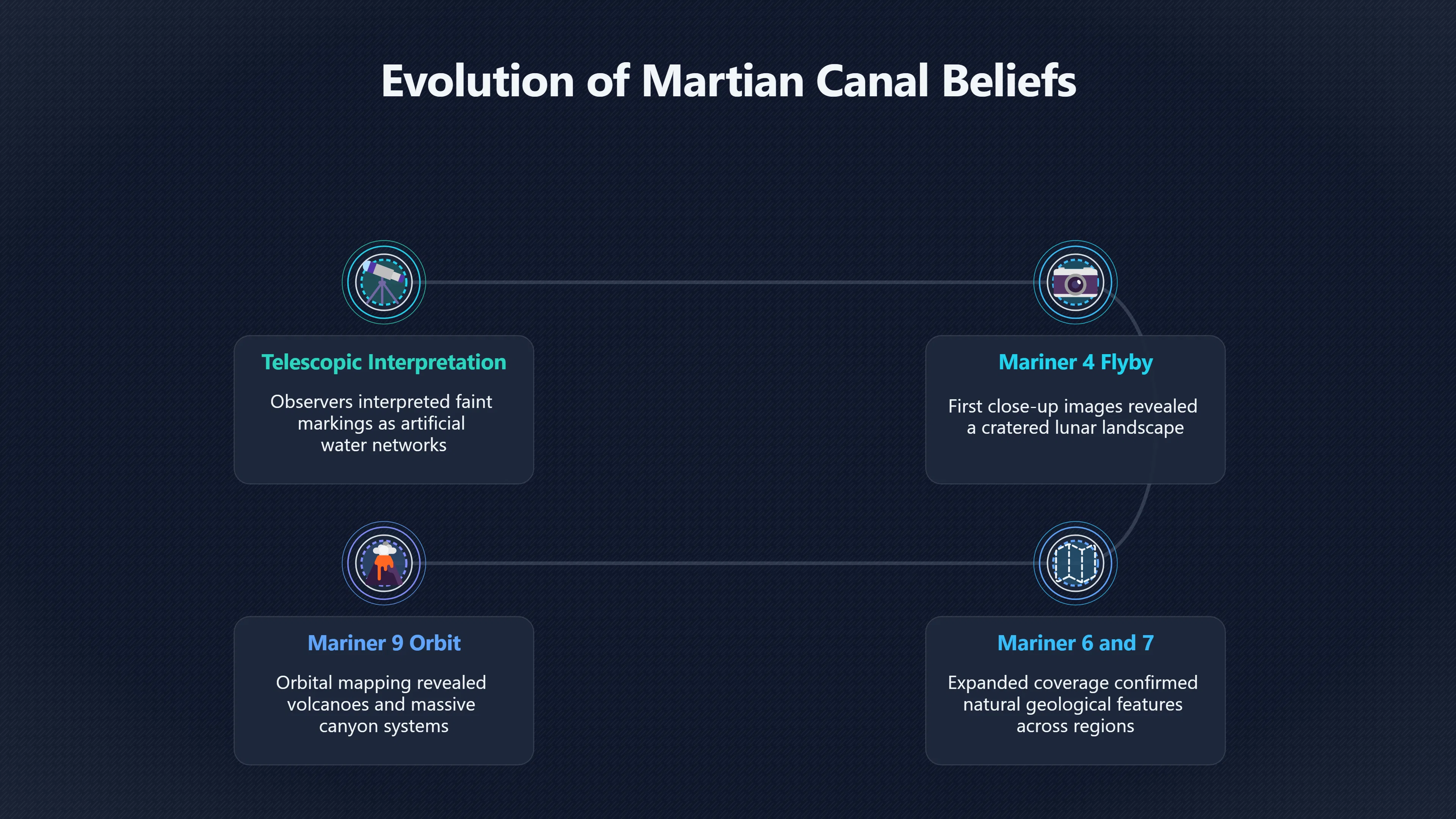
When NASA’s Mariner 4 flew past Mars in July 1965, it became the first spacecraft to return close-up images of another planet. The mission transmitted 21 photographs of the Martian surface from a distance impossible for Earth-based telescopes to match. Instead of revealing geometric networks or signs of planetary engineering, the images showed a heavily cratered landscape more reminiscent of the Moon than of Lowell’s inhabited world.[NASA]nasa.govAdvances in NASA Imaging Changed How World Sees MarsAdvances in NASA Imaging Changed How World Sees Mars - NASA…
The importance of these photographs lay not simply in what they showed, but in what they failed to show. Canal advocates had long argued that the linear markings seen through telescopes represented real physical structures. Yet Mariner 4 found no vast artificial waterways and no organised network of straight lines crossing the planet. The spacecraft’s images offered direct observational evidence that superseded decades of interpretation based on distant viewing conditions.[loc.gov]loc.govlileo to Sagan and Beyond | Digital Collections | Library of Congress…
Mariner 4 also returned measurements indicating that Mars possessed a much thinner atmosphere than many earlier models had assumed. A thin atmosphere reduced the likelihood of extensive surface water and made the vision of a thriving civilisation maintaining a global irrigation system increasingly implausible. The spacecraft therefore challenged not only the canals themselves but also the broader environmental assumptions that had supported the idea of an inhabited Mars.[Time]time.comSee the First Close-Up Photo of Mars Ever TakenThis monumental achievement came after early malfunctions and last-minute fears of camera failure. Unlike modern digital images, each pho…
A note of caution is necessary. Mariner 4 photographed only a tiny fraction of the planet. Some scientists initially worried that the spacecraft had merely sampled an unusually barren region. Nevertheless, the mission shifted the burden of proof. After 1965, supporters of canal Mars could no longer point to a lack of direct evidence; spacecraft observations had begun to test the hypothesis directly.[WIRED]wired.comearly candidate viking landing sitesCongress. The Viking mission, scheduled for 1973, included two missions, each with an orbiter and a lander. Early debates on the lander d…
How Later Mapping Weakened Canal Claims
If Mariner 4 opened the case against canal Mars, later Mariner missions effectively closed it.
The twin flyby missions Mariner 6 and Mariner 7 reached Mars in 1969 and returned hundreds of additional images from different regions of the planet. These observations expanded scientific knowledge far beyond the limited coverage of Mariner 4 and continued to reveal natural geological features rather than artificial linear systems. The more terrain that was photographed, the harder it became to argue that a planetary network of canals existed but had somehow escaped detection. NASA Science+2NASA Jet Propulsion Laboratory (JPL)[science.nasa.gov]science.nasa.govScience Mariner 6NASA ScienceMariner 6 - NASA ScienceNovember 2, 2024…
The decisive stage came with Mariner 9, which entered orbit around Mars in 1971. Unlike the earlier flyby missions, Mariner 9 was able to map most of the planet. It revealed enormous volcanoes, gigantic canyon systems, impact craters, dust-covered plains and evidence of ancient geological processes. These discoveries transformed understanding of Mars from a world supposedly shaped by intelligent engineers into a world shaped by natural planetary forces.[NASA]nasa.govMariner - NASA…
Crucially, improved imaging demonstrated why the canal observations had arisen in the first place. Features that appeared as straight lines through nineteenth-century telescopes dissolved into disconnected natural formations when viewed at higher resolution. Human observers had unconsciously connected faint patches and contrasts into orderly patterns. What looked like a global network from Earth was largely a product of visual perception and observational limits. The Library of Congress notes that spacecraft photography ultimately showed there were no canals to be explained and that the supposed structures had been an optical illusion.[loc.gov]loc.govlileo to Sagan and Beyond | Digital Collections | Library of Congress…
This represented a broader lesson in scientific methodology. The canal controversy became a classic example of how expectations can shape interpretation when data are ambiguous. Spacecraft did not merely provide more information; they changed the quality of evidence available, replacing inference with direct observation.[loc.gov]loc.govlileo to Sagan and Beyond | Digital Collections | Library of Congress…
Why Disproved Canals Still Mattered Culturally
Although the Mariner missions destroyed the scientific credibility of canal Mars, they did not erase its cultural influence.
For generations, the canal hypothesis had provided one of the most convincing images of intelligent extraterrestrial life available to the public. It encouraged readers, writers and filmmakers to imagine technologically advanced beings living on a neighbouring planet. Long before flying saucers became part of popular culture, Mars had already accustomed audiences to the possibility that alien intelligence might leave visible technological traces. The canals functioned as an early model for interpreting mysterious observations as evidence of non-human engineering.[loc.gov]loc.govlileo to Sagan and Beyond | Digital Collections | Library of Congress…
The collapse of canal Mars also helped redirect science fiction. Earlier stories often depicted Martians as inhabitants of a declining but sophisticated civilisation. After the Mariner missions, writers increasingly had to confront a harsher and less hospitable Mars. The focus shifted from living Martian societies toward ancient life, lost civilisations, hidden artefacts or human exploration. The dream of a populated Mars did not disappear, but it became harder to present as a straightforward extension of contemporary astronomy.[NASA]nasa.govAdvances in NASA Imaging Changed How World Sees MarsAdvances in NASA Imaging Changed How World Sees Mars - NASA…
In the wider history of UFO beliefs and science fiction, the Mariner findings marked an important transition. They demonstrated that appealing extraterrestrial narratives could persist for decades despite weak evidence, yet they also showed that new technologies could overturn deeply rooted assumptions. The spacecraft did more than photograph a planet. They ended one of the most influential visions of extraterrestrial civilisation ever attached to a real astronomical world.[loc.gov]loc.govlileo to Sagan and Beyond | Digital Collections | Library of Congress…
Amazon book picks
Further Reading
Books and field guides related to Relationships betwee d7372c martian civilization 772d5e mariner ended canal 213a05. Use these as the next step if you want deeper reading beyond the article.
Mars and Its Canals
The foundational book presenting the canal theory that Mariner missions effectively disproved.
The Case for Mars
Provides broad Mars context and illustrates how scientific understanding of the planet evolved beyond earlier speculation about civilizat...
Mapping Mars
Directly addresses how perceptions of Mars changed from telescopic interpretation to spacecraft observation.
A City on Mars
Examines modern ideas about Mars settlement using evidence-based science, contrasting with earlier beliefs about intelligent Martians.
eBay marketplace picks
Marketplace Samples
Live-tested eBay searches with available results related to this page.




Endnotes
1.
Source: loc.gov
Link:https://www.loc.gov/collections/finding-our-place-in-the-cosmos-with-carl-sagan/articles-and-essays/life-on-other-worlds/seeing-and-interpreting-martian-oceans-and-canals/
Source snippet
lileo to Sagan and Beyond | Digital Collections | Library of Congress...
2.
Source: nasa.gov
Title: Advances in NASA Imaging Changed How World Sees Mars
Link:https://www.nasa.gov/solar-system/planets/mars/advances-in-nasa-imaging-changed-how-world-sees-mars/
Source snippet
Advances in NASA Imaging Changed How World Sees Mars - NASA...
3.
Source: jpl.nasa.gov
Title: pia01685 mariner 4 meets mars global surveyor mariner crater 1965 and 1999
Link:https://www.jpl.nasa.gov/images/pia01685-mariner-4-meets-mars-global-surveyor-mariner-crater-1965-and-1999/
Source snippet
NASA Jet Propulsion Laboratory (JPL)Mariner 4 Meets Mars Global Surveyor -- Mariner Crater 1965 and 1999 | NASA Jet Propulsion Laboratory...
4.
Source: time.com
Title: See the First Close-Up Photo of Mars Ever Taken
Link:https://time.com/3949257/mars-photos-mariner-iv/
Source snippet
This monumental achievement came after early malfunctions and last-minute fears of camera failure. Unlike modern digital images, each pho...
5.
Source: wired.com
Title: early candidate viking landing sites
Link:https://www.wired.com/2012/11/early-candidate-viking-landing-sites
Source snippet
Congress. The Viking mission, scheduled for 1973, included two missions, each with an orbiter and a lander. Early debates on the lander d...
6.
Source: science.nasa.gov
Title: Science Mariner 6
Link:https://science.nasa.gov/mission/mariner-6/
Source snippet
NASA ScienceMariner 6 - NASA ScienceNovember 2, 2024...
Published: November 2, 2024
7.
Source: jpl.nasa.gov
Title: Jet Propulsion Laboratory (JPL)Mariner 7
Link:https://www.jpl.nasa.gov/missions/mariner-7/
Source snippet
NASA Jet Propulsion Laboratory (JPL)Mariner 7 - Mars Missions - NASA Jet Propulsion Laboratory | NASA Jet Propulsion Laboratory (JPL)...
8.
Source: nasa.gov
Link:https://www.nasa.gov/missions/mariner/
Source snippet
Mariner - NASA...
Additional References
9.
Source: youtube.com
Title: Mariner 4 Anniversary
Link:https://www.youtube.com/watch?v=OTn0_XA6mwU
Source snippet
The Launch That Changed Mars Forever | Mariner 9...
10.
Source: youtube.com
Title: Images from Deep Space: Mariner 4
Link:https://www.youtube.com/watch?v=ia5TxWSiMLE
Source snippet
Mariner 4 Anniversary - 60 years at Mars, by NASA/JPL-Caltech...
11.
Source: reddit.com
Link:https://www.reddit.com/r/space/comments/vymw97
Source snippet
4 flys by Mars in 1965 taking the first ever pictures of the Red planet and transmitting back to Earth.July 14, 2022...
Published: July 14, 2022
12.
Source: youtube.com
Link:https://www.youtube.com/watch?v=hTfn0MSNTCc
Source snippet
Images from Deep Space: Mariner 4...
13.
Source: youtube.com
Link:https://www.youtube.com/watch?v=a5M8DtKkkTo
Source snippet
4 Mars Flyby (1965/07/15) - Mars images on a modern map - First images from Mars - YouTubeJuly 14, 2020...
Published: July 14, 2020
14.
Source: en.wikisource.org
Title: Mars (Lowell)/Chapter 4
Link:https://en.wikisource.org/wiki/Mars_%28Lowell%29/Chapter_4
Source snippet
Wikisource, the free online library...
15.
Source: youtube.com
Title: The Launch That Changed Mars Forever | Mariner 9
Link:https://www.youtube.com/watch?v=bYKhmLzcCHc
Source snippet
Mariner IV Visits Mars...
16.
Source: youtube.com
Title: Mariner IV Visits Mars
Link:https://www.youtube.com/watch?v=hPloHHC5j64
Topic Tree