Within Skeptics
When Does a Light Become a Craft?
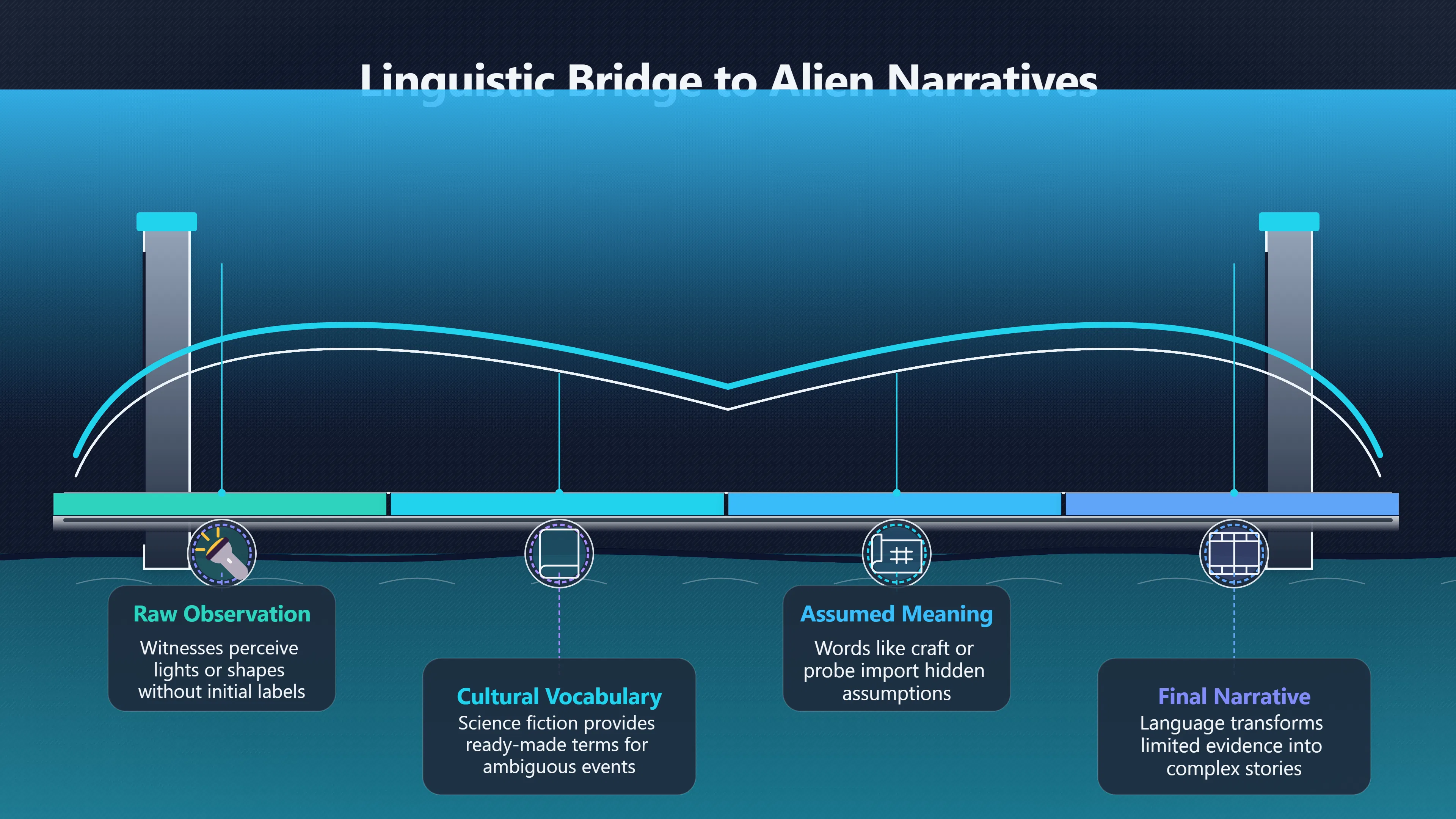
Words such as craft, mothership, and probe can turn a limited observation into a much richer UFO story.
On this page
- Observation words versus interpretation words
- How science fiction vocabulary adds assumptions
- How careful wording protects weak evidence
Page outline Jump by section
Introduction
A central sceptical argument about UFO reports is that the most dramatic part of a story is often introduced by language rather than by observation. A witness may directly observe a light, a shape, a flash, or an unusual movement. Yet when that observation is retold, the object can become a “craft”, a “mothership”, a “probe”, or even an alien vehicle. The shift may seem minor, but it changes the meaning of the report completely.
 Within discussions about the relationship between UFOs and science fiction, this is an important mechanism. Science-fiction vocabulary does more than describe; it supplies assumptions about technology, intelligence, purpose, and origin. Sceptics therefore pay close attention to the words used in reports, because language can transform limited evidence into a much richer narrative without adding any new observational facts.[CIA]cia.govHow To Investigate a Flying SaucerHow To Investigate a Flying Saucer - CIAJanuary 21, 2016…
Observation Words Versus Interpretation Words
One useful way to analyse UFO accounts is to separate observation from interpretation.
Observation words describe what was directly perceived:
- Light
- Flash
- Object
- Shape
- Disc-like form
- Bright point
- Moving light
Interpretation words explain what the observer believes the object was:
- Craft
- Spaceship
- Mothership
- Probe
- Vehicle
- Alien technology
- Extraterrestrial craft
The distinction matters because the second group contains information that was not necessarily observed. Calling something a “craft” implies engineering and control. Calling it a “probe” implies a mission. Calling it a “mothership” implies a larger system of alien activity.
Investigators have long tried to collect reports in ways that focus on observable details rather than conclusions. Historical UFO investigation programmes such as Project Blue Book used structured questionnaires that emphasised appearance, location, movement, duration, and environmental conditions before attempting any interpretation.[CIA]cia.govHow To Investigate a Flying SaucerHow To Investigate a Flying Saucer - CIAJanuary 21, 2016…
A witness who reports “a bright white light moving across the horizon” provides a description. A witness who reports “an alien reconnaissance probe” has already crossed into explanation.
How Science-Fiction Vocabulary Adds Assumptions
Science fiction provides a ready-made vocabulary for ambiguous events. Once words such as “mother ship”, “scout craft”, “drone”, or “probe” enter popular culture, they become available as interpretive tools.
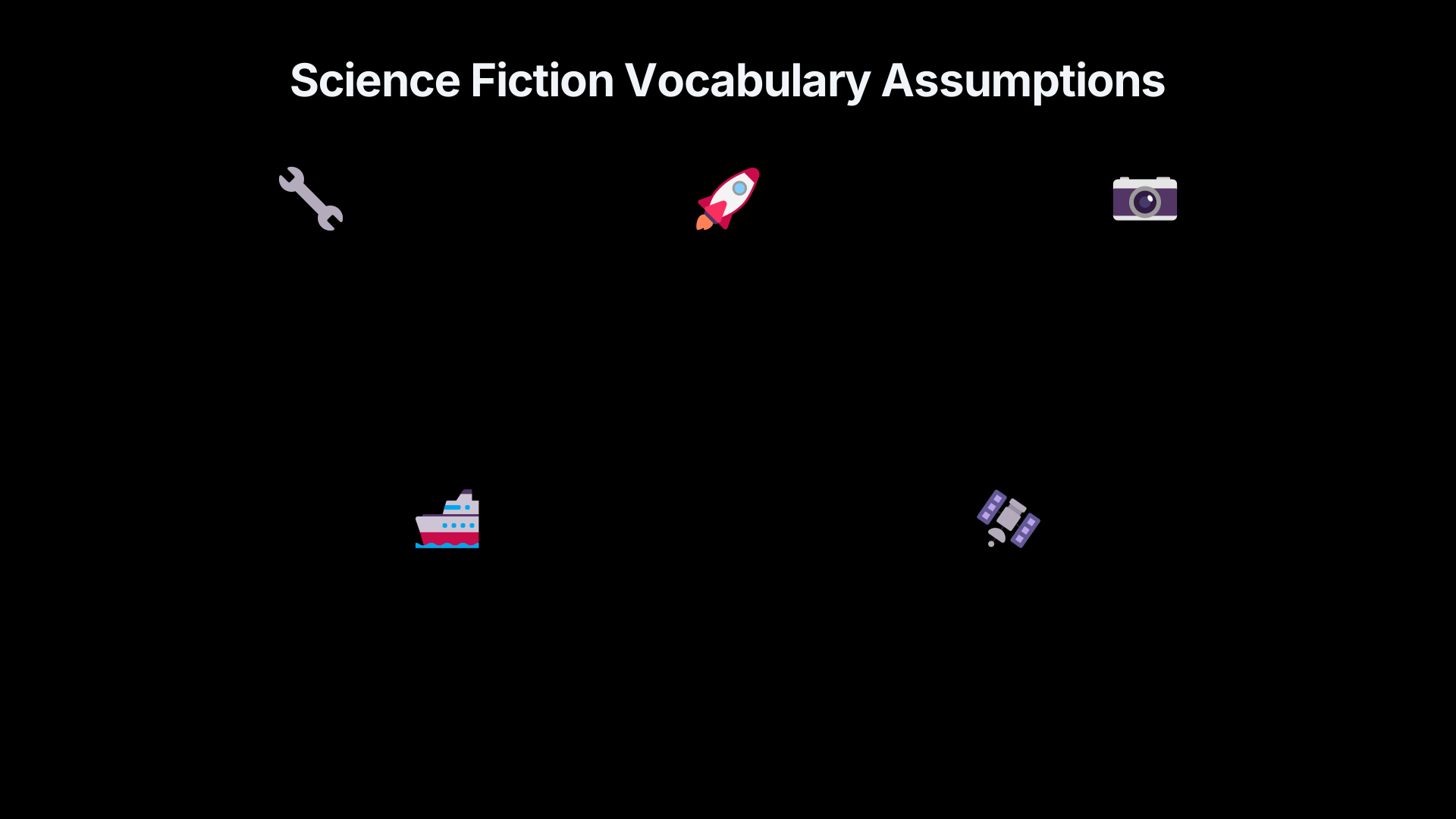
This process is often invisible because the words sound descriptive. In reality, each term imports additional assumptions:
WordHidden assumptionCraftArtificial technologySpaceshipCapable of space travelProbePerforming a missionMothershipPart of a larger fleetAlien vehicleNon-human originReconnaissance craftIntentional surveillance
None of these conclusions follows automatically from seeing a distant light.
Science-fiction stories are particularly influential because they provide coherent explanations for incomplete observations. If a witness already knows narratives involving alien visitors, exploration vessels, or hidden spacecraft, those ideas can supply meaning where the raw observation contains uncertainty.
Sceptics therefore argue that language can function as a bridge between a limited sensory event and a complex extraterrestrial story. The bridge is built from familiar cultural concepts rather than from additional evidence.
A Historical Example: When Labels Change the Phenomenon
One of the most revealing examples comes from the history of UFO terminology itself.
A declassified discussion cited by later investigators noted that during the Second World War, pilots reported mysterious luminous objects known as “Foo Fighters”. These were often described as glowing balls of light accompanying aircraft. A later review observed that if the term “flying saucer” had already existed during that period, many of those same reports would probably have been labelled flying saucers instead.[CIA]cia.govHow To Investigate a Flying SaucerHow To Investigate a Flying Saucer - CIAJanuary 21, 2016…
The significance is not that the pilots invented the sightings. The lights were reportedly observed. The significance is that the available language influences what category an observation enters.
The same stimulus can become:
- A strange light
- An atmospheric phenomenon
- A flying saucer[cia.gov]cia.govHow To Investigate a Flying SaucerHow To Investigate a Flying Saucer - CIAJanuary 21, 2016…
- A spacecraft
- An alien probe
The observation may remain unchanged while the interpretation evolves.
Why “Craft” Is a Particularly Powerful Word
Among UFO terms, “craft” occupies a special position because it sounds cautious while still carrying strong implications.
A witness who says “I saw a spacecraft” openly claims a technological object. A witness who says “I saw a craft” may appear more restrained. Yet the word still implies manufacture, structure, and control.
This creates a subtle shift in perception. Readers often stop questioning whether the object was technological at all and instead begin discussing who built it, where it came from, or what it was doing.
In this sense, “craft” can act as a linguistic shortcut. It bypasses earlier questions about identification and moves the conversation directly toward explanations.
That is one reason official and scientific investigations increasingly favour neutral terms such as “object”, “phenomenon”, or “UAP” (Unidentified Anomalous Phenomenon). These terms attempt to avoid embedding conclusions within the description itself. NASA’s recent UAP work similarly stresses the need for better observational data and cautions against drawing conclusions beyond what evidence supports.[nasa.gov]nasa.govUPDATE: NASA Shares UAP Independent Study Report; Names DirectorUPDATE: NASA Shares UAP Independent Study Report; Names Director - NASA…
How Language Can Reshape Memory
The effect of loaded vocabulary is not limited to storytelling. Research on memory and eyewitness testimony shows that recall is reconstructive rather than perfectly recorded. The wording used when discussing an event can influence how it is later remembered. Even subtle language changes can affect recollections and confidence levels.[Social Sci LibreTexts]socialsci.libretexts.orgSocial Sci Libre Texts5.7: Reconstruction of MemoriesSocial Sci LibreTexts5.7: Reconstruction of Memories - Social Sci LibreTextsJanuary 2, 2025…
Applied to UFO reports, this means that repeated references to a light as a “craft” may gradually reinforce the idea that technological features were present, even if those features were not clearly observed at the time.
A common progression might look like this:

- A witness sees an unusual light.
- The event is discussed as a possible UFO.
- Interviews introduce terms such as “craft”.
- Retellings become more detailed.
- The final narrative contains stronger technological implications than the original observation.
This does not require dishonesty. It can arise from ordinary processes of memory reconstruction and narrative development.[Social Sci LibreTexts]socialsci.libretexts.orgSocial Sci Libre Texts5.7: Reconstruction of MemoriesSocial Sci LibreTexts5.7: Reconstruction of Memories - Social Sci LibreTextsJanuary 2, 2025…
How Careful Wording Protects Weak Evidence
For sceptics, careful wording is not merely a stylistic preference. It is a way of preserving the distinction between what was observed and what was inferred.
Compare these statements:
- “A bright object was visible for approximately ten seconds.”
- “An alien reconnaissance craft hovered overhead.”
The first statement leaves multiple explanations open. The second has already selected one.
When evidence is limited, neutral language helps prevent interpretation from outrunning observation. It allows investigators to evaluate possibilities without embedding conclusions into the report itself.
This is especially important in UFO cases because many sightings involve distant, brief, poorly recorded, or ambiguous stimuli. Once loaded terms enter the account, they can make a tentative observation appear stronger than the underlying evidence warrants.
The sceptical concern is therefore not simply about whether witnesses saw something unusual. It is about the moment when a light becomes a craft. In many UFO narratives, that transformation occurs not through new evidence but through the language used to describe the original observation.
Amazon book picks
Further Reading
Books and field guides related to When Does a Light Become a Craft?. Use these as the next step if you want deeper reading beyond the article.
The Demon-Haunted World
Rating: 4.5/5 from 43 Google Books ratings
Focuses on separating observation from interpretation.
Why People Believe Weird Things
Rating: 4.0/5 from 7 Google Books ratings
Examines how narratives and assumptions shape conclusions.
eBay marketplace picks
Marketplace Samples
Example marketplace items related to this page. Use the search link to explore similar finds on eBay.

Endnotes
1.
Source: cia.gov
Title: How To Investigate a Flying Saucer
Link:https://www.cia.gov/stories/story/how-to-investigate-a-flying-saucer/
Source snippet
How To Investigate a Flying Saucer - CIAJanuary 21, 2016...
Published: January 21, 2016
2.
Source: nasa.gov
Title: UPDATE: NASA Shares UAP Independent Study Report; Names Director
Link:https://www.nasa.gov/news-release/update-nasa-shares-uap-independent-study-report-names-director/
Source snippet
UPDATE: NASA Shares UAP Independent Study Report; Names Director - NASA...
3.
Source: science.nasa.gov
Title: Science UAP
Link:https://science.nasa.gov/uap
Source snippet
NASA ScienceUAP - NASA Science...
4.
Source: socialsci.libretexts.org
Title: Social Sci Libre Texts5.7: Reconstruction of Memories
Link:https://socialsci.libretexts.org/Bookshelves/Psychology/Cognitive_Psychology/Cognitive_Psychology_%28Andrade_and_Walker%29/05%253A_Working_Memory/5.07%253A_Reconstruction_of_Memories
Source snippet
Social Sci LibreTexts5.7: Reconstruction of Memories - Social Sci LibreTextsJanuary 2, 2025...
Published: January 2, 2025
Additional References
5.
Source: cambridge.org
Link:https://www.cambridge.org/core/books/abs/adult-eyewitness-testimony/memory-source-monitoring-and-eyewitness-testimony/D91E27C9DBCF5DA8E21FAAC672E3C263
Source snippet
Cambridge University Press & AssessmentMemory source monitoring and eyewitness testimony (Chapter 2) - Adult Eyewitness Testimony...
6.
Source: abc.net.au
Link:https://www.abc.net.au/news/2023-09-15/nasa-releases-ufo-report/102859124
Source snippet
releases UAP report, says more data and scientific techniques are needed to better understand UFOs - ABC NewsSeptember 15, 2023...
Published: September 15, 2023
7.
Source: arstechnica.com
Link:https://arstechnica.com/space/2023/06/nasa-panel-no-convincing-evidence-for-extraterrestrial-life-connected-with-uaps/?view=archive
Source snippet
Ars TechnicaNASA panel: No convincing evidence for extraterrestrial life connected with UAPs - Ars Technica...
8.
Source: youtube.com
Title: Kacey Musgraves vs. Mick West: Country star mocks UFO skeptic | Unreported
Link:https://www.youtube.com/watch?v=MYyrXyLAGeQ
Source snippet
Neil deGrasse Tyson on UFOs, Government Files, and the Physics of Alien Claims is relevant because it features an in-depth conversation w...
9.
Source: youtube.com
Link:http://www.youtube.com/watch?v=8n9P0oGegsU
Source snippet
"Project Blue Book" classification language ufo history Ancient Aliens: Project Blue Book Proves UFO Phenomenon (Season 16) | History HIS...
10.
Source: youtube.com
Link:https://www.youtube.com/watch?v=0QK0QqdKv4s
Source snippet
Xenolinguistics: Alien Language and First Contact | Ryan Rhodes from @LanguageofMind...
11.
Source: youtube.com
Title: HISTORY OF UFOs AND ALIENS COMPILATION
Link:https://www.youtube.com/watch?v=SqxG1voGDJM
Source snippet
Witnesses Recount Their Terrifying Tales through Drawings & Models | UFO Witness | Travel Channel...
12.
Source: youtube.com
Title: Neil de Grasse Tyson on Aliens, Intelligence & the Unknown | Nerd Exchange Ep. 2
Link:https://www.youtube.com/watch?v=mfirobnmC88
Source snippet
Kacey Musgraves vs. Mick West: Country star mocks UFO skeptic | Unreported...
13.
Source: youtube.com
Title: Popular Science Fiction and the Genesis of Paranormal Claims (Thomas Holtz)
Link:http://www.youtube.com/watch?v=KMv4E8TCL9A
Source snippet
2 UFOs History in TV, Movies, and Pop Culture Explained...
14.
Source: youtube.com
Title: UFOs History in TV, Movies, and Pop Culture Explained
Link:http://www.youtube.com/watch?v=dGvkWAYr7a4
Source snippet
3 Alien Abduction and UFOs: Why Are Grays So Common? (feat Josef Lorenzo) | Monstrum...
Topic Tree