Within UFO Fiction
How One Sighting Named the Flying Saucer
Kenneth Arnold's 1947 sighting shows how one news phrase helped turn a complex report into a lasting visual icon.
On this page
- What Arnold reported near Mount Rainier
- How newspapers shaped the saucer phrase
- Why the image outgrew the original case
Page outline Jump by section
Introduction
Kenneth Arnold’s 24 June 1947 sighting near Mount Rainier matters less because it proved what UFOs were than because it helped decide what UFOs would look like in the public imagination. Arnold reported nine fast, shiny objects moving near the Cascade Mountains; within days, newspapers had turned a complicated description of motion, shape and speed into the unforgettable phrase “flying saucer”. The Smithsonian’s National Air and Space Museum notes that Arnold’s report added those words to the vocabulary of millions, while the National Archives preserves his Air Force sighting file as part of the early documentary record of modern UFO history.[National Air and Space Museum]airandspace.si.edu1947 year flying saucerNational Air and Space Museum1947: Year of the Flying Saucer | National Air and Space Museum…
The case sits at the hinge between observation and storytelling. Arnold did not simply hand the world a clean image of alien discs. His account moved through pilots, reporters, wire services, headline writers, military investigators and readers already primed by aviation, wartime technology and science-fiction ideas of strange craft. That process is why the Arnold sighting is central to the relationship between UFOs and science fiction: it shows how one reported event can become a durable visual icon.
What Arnold Reported Near Mount Rainier
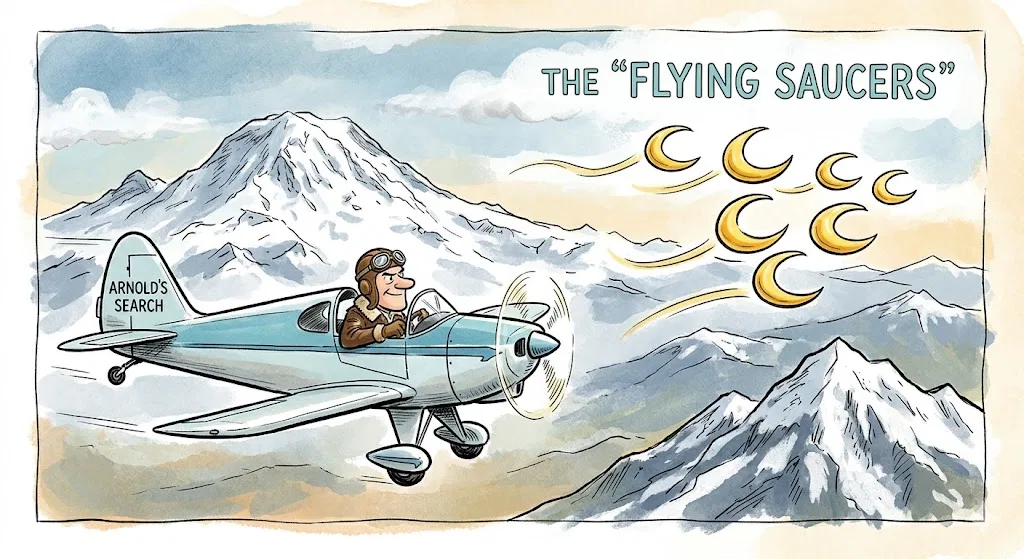
Arnold was a Boise businessman and experienced private pilot flying a CallAir A-2 from Chehalis, Washington, towards an air show in Pendleton, Oregon, with a planned stop at Yakima. He made a detour to look for a missing Marine Corps C-46 transport that had crashed in the Cascades. The Smithsonian account places him about 20 miles west of Mount Rainier shortly before 3 p.m., in clear weather, when he saw a bright flash and initially thought it might be sunlight reflecting from another aircraft.[National Air and Space Museum]airandspace.si.edu1947 year flying saucerNational Air and Space Museum1947: Year of the Flying Saucer | National Air and Space Museum…
What followed was not a simple “I saw a saucer” report. Arnold described multiple objects, usually counted as nine, moving in formation along the mountain range. Early accounts emphasised speed, brightness, altitude and unusual motion. The East Oregonian’s retrospective on its own June 1947 coverage records that its first short story described “nine saucer-like aircraft” between Mount Rainier and Mount Adams, at around 9,500 to 10,000 feet, travelling at an estimated 1,200 miles per hour — far beyond ordinary aircraft speeds of the period.[East Oregonian]eastoregonian.comEast Oregonian The sighting | East OregonianEast Oregonian The sighting | East Oregonian
Those speed estimates were part of the story’s power, but they were also fragile. Arnold calculated them from the distance he believed the objects covered and the time he believed they took; small errors in distance, angle or identification could produce large errors in speed. Even so, the figure made the report feel technically modern. This was not a ghost light or a rural omen. It was framed from the start as an aviation mystery in the age of jets, rockets and post-war military secrecy.
Arnold’s own visual descriptions also resisted the later stereotype. The Smithsonian notes that in a July report sent to the U.S. Air Force, Arnold drew a form closer to the heel of a shoe, with a rounded leading edge and a trailing edge tapering to a shallow point. That is not the clean domed disc of later popular culture. It is flatter, stranger and harder to summarise in a headline.[National Air and Space Museum]airandspace.si.edu1947 year flying saucerNational Air and Space Museum1947: Year of the Flying Saucer | National Air and Space Museum…
How Newspapers Shaped the Saucer Phrase
The key transformation happened when Arnold’s words entered the newspaper system. The East Oregonian, whose reporters Bill Bequette and Nolan Skiff first handled the story, later stressed an important distinction: its own reporting did not use the exact phrase “flying saucer”, even though it did describe “saucer-like aircraft”. The phrase itself appears to have spread through later newspaper handling, including wire-service circulation and headline writing, rather than from a single neat act of naming by Arnold himself.[East Oregonian]eastoregonian.comEast Oregonian The sighting | East OregonianEast Oregonian The sighting | East Oregonian
The common simplified version says Arnold was misquoted: he meant the objects moved like saucers skipping over water, but newspapers treated them as saucer-shaped. That is broadly useful, but it can become too tidy. Early stories and later reconstructions show a messier overlap. Arnold did compare the movement to a saucer skipping across water, but some early accounts also used shape words such as “saucer-like”, “disc” and “pie-pan”. The important point is not that journalists invented everything from nothing. It is that they compressed a mixed report into a phrase that was far easier to remember than Arnold’s full description.[Wikipedia]WikipediaKenneth Arnold UFO sightingKenneth Arnold UFO sighting
That compression mattered because “flying saucer” worked as both description and story hook. It was visual, domestic and uncanny: an everyday object lifted into the sky. It also gave readers a ready-made mental picture. A phrase such as “unidentified high-speed aircraft with a rounded front and tapered rear” invites uncertainty; “flying saucer” invites an image.
The East Oregonian’s own 70th-anniversary account captures the speed of the change. Its initial 191-word story was written for the evening paper and Associated Press wire, then rapidly drew national attention. Within days, another newspaper writer had coined or popularised the phrase that stuck in the American vocabulary.[East Oregonian]eastoregonian.comEast Oregonian The sighting | East OregonianEast Oregonian The sighting | East Oregonian
Why the Image Outgrew the Original Case
The saucer image outgrew Arnold’s case because it solved a cultural problem. It gave the new UFO wave a recognisable shape. Before 1947, people had reported mysterious airships, ghost rockets, lights and strange aerial phenomena, but Arnold’s case arrived at a moment when mass newspapers, post-war aviation and science-fiction imagery could turn one report into a national pattern. HistoryLink, a Washington State history resource, describes the sighting as the beginning of the modern “flying saucer” phenomenon in Washington and notes that it triggered many similar reports locally and across the United States.[HistoryLink]historylink.orgOpen source on historylink.org.
Once the phrase circulated, it created a feedback loop. Readers who had never heard of Arnold could still look up and ask whether an odd glint, light or aircraft was a “flying saucer”. Later witnesses did not need to copy Arnold deliberately. They inherited a label that organised perception. The phrase made the sky searchable by imagination.
This is where the link with science fiction becomes important. Science fiction did not need to invent the Arnold sighting for it to shape what came next. The genre had already normalised ideas of advanced craft, interplanetary travel, secret weapons and visitors from elsewhere. After June 1947, the “saucer” offered a simple visual container into which those themes could be poured. The Library of Congress describes UFOs and alien visitors as part of a broader twentieth-century cultural field that included comics, television and anxieties about hidden outsiders.[The Library of Congress]loc.govOpen source on loc.gov.
The result was a cultural icon that was more stable than the evidence behind it. Arnold’s original shapes could vary in retelling; the speed estimate could be challenged; the objects could be interpreted as unknown aircraft, atmospheric effects, birds, reflections or something still unexplained. But the saucer survived because it was narratively efficient. It could appear in headlines, pulp covers, film posters, cartoons, toys and later television without requiring the audience to know the details of Mount Rainier.

What the Arnold Case Shows About UFOs and Science Fiction
Arnold’s sighting shows that UFO culture is not just a set of claims about objects in the sky. It is also a history of translation: sighting into report, report into headline, headline into image, image into genre convention. That does not mean Arnold saw nothing. It means the public meaning of what he saw was produced collectively after the event.
Several features made the case unusually fertile for that process:
- A credible modern witness: Arnold was not presented as a mystic or fabulist, but as an experienced pilot reporting an aviation puzzle. The Smithsonian emphasises his flight experience and search-and-rescue connection, which helped the story read as serious rather than purely fanciful.[National Air and Space Museum]airandspace.si.edu1947 year flying saucerNational Air and Space Museum1947: Year of the Flying Saucer | National Air and Space Museum…
- A dramatic technical claim: The estimated speed made the objects seem beyond known aircraft, placing the report in the same imaginative space as secret technology and advanced civilisation.[East Oregonian]eastoregonian.comEast Oregonian The sighting | East OregonianEast Oregonian The sighting | East Oregonian
- A phrase that could travel: “Flying saucer” was short, visual and strange. It could move through newspapers faster than a careful description could.[Wikipedia]WikipediaKenneth Arnold UFO sightingKenneth Arnold UFO sighting
- A post-war audience ready for sky mysteries: The early Cold War made unknown objects over national airspace feel potentially significant. Later Air Force projects, including Sign, Grudge and Blue Book, grew from security concerns as well as public fascination.[sgp.fas.org]sgp.fas.orgOpen source on fas.org.
The science-fiction connection is therefore not a claim that reporters consciously fictionalised Arnold’s sighting. It is subtler. Science fiction supplied a cultural grammar for interpreting advanced craft and visitors from beyond ordinary experience. Arnold’s report supplied a dramatic real-world news event. The phrase “flying saucer” joined the two.
The Lasting Icon Was Simpler Than the Sighting
The most useful way to read the Kenneth Arnold case is as a before-and-after moment in visual culture. Before the newspaper phrase settled, Arnold’s report was a specific and awkward account: nine bright, fast objects, seen from a light aircraft, moving near Mount Rainier, described through comparisons to skipping saucers, fish flashing in sunlight, pie pans, bat-like forms and later drawings that were not classic discs. After the phrase settled, the public inherited something much simpler: a flying saucer.
That simplification did not merely distort the case; it made the modern UFO era legible. It gave newspapers a recurring label, governments a public concern to investigate, sceptics a cultural contagion to analyse, believers a recognisable craft to imagine, and science fiction a shape that could stand instantly for alien technology. The saucer became more famous than Arnold’s actual description because icons do not preserve complexity. They condense it.
Arnold’s sighting remains unresolved in the narrow sense that no universally accepted identification has displaced the story. But its cultural effect is much clearer. It shows how UFO history can turn on wording: a pilot’s simile, a reporter’s phrasing, a headline’s compression, and a public ready to see the future in the sky.
Amazon book picks
Further Reading
Books and field guides related to How One Sighting Named the Flying Saucer. Use these as the next step if you want deeper reading beyond the article.
The Report on Unidentified Flying Objects
Provides context for the early cases that followed Arnold's sighting.
The Flying Saucers are Real
Captures the public reaction to the post-Arnold saucer wave.
eBay marketplace picks
Marketplace Samples
Example marketplace items related to this page. Use the search link to explore similar finds on eBay.



Endnotes
1.
Source: archives.gov
Link:https://www.archives.gov/news/articles/project-blue-book-50th-anniversary
2.
Source: Wikipedia
Title: Kenneth Arnold UFO sighting
Link:https://en.wikipedia.org/wiki/Kenneth_Arnold_UFO_sighting
3.
Source: history.com
Title: Kenneth Arnold
Link:https://www.history.com/articles/kenneth-arnold
4.
Source: historylink.org
Link:https://www.historylink.org/File/5336
5.
Source: sgp.fas.org
Link:https://sgp.fas.org/library/ciaufo.html
6.
Source: Wikipedia
Title: 1947 flying disc craze
Link:https://en.wikipedia.org/wiki/1947_flying_disc_craze
7.
Source: Wikipedia
Title: Kenneth Arnold
Link:https://en.wikipedia.org/wiki/Kenneth_Arnold
8.
Source: Wikipedia
Title: Unidentified flying object
Link:https://en.wikipedia.org/wiki/Unidentified_flying_object
9.
Source: archives.gov
Title: Project BLUE BOOK
Link:https://www.archives.gov/research/military/air-force/ufos
10.
Source: archives.gov
Title: do records show proof of ufos
Link:https://www.archives.gov/news/articles/do-records-show-proof-of-ufos
11.
Source: historylink.org
Link:https://www.historylink.org/file/2067
12.
Source: airandspace.si.edu
Title: 1947 year flying saucer
Link:https://airandspace.si.edu/stories/editorial/1947-year-flying-saucer
Source snippet
National Air and Space Museum1947: Year of the Flying Saucer | National Air and Space Museum...
13.
Source: eastoregonian.com
Title: East Oregonian The sighting | East Oregonian
Link:https://eastoregonian.com/2017/06/16/the-sighting/
14.
Source: loc.gov
Link:https://www.loc.gov/collections/finding-our-place-in-the-cosmos-with-carl-sagan/articles-and-essays/life-on-other-worlds/ufos-and-aliens-among-us
15.
Source: facebook.com
Title: The Library of Congress#Onthisdate in #history
Link:https://www.facebook.com/libraryofcongress/posts/on-this-day-in-1947-what-many-consider-to-be-the-first-modern-ufo-sighting-took-/1150298620475987/
16.
Source: cdn.nationalarchives.gov.uk
Title: briefing guide 12 07 12
Link:https://cdn.nationalarchives.gov.uk/documents/briefing-guide-12-07-12.pdf
17.
Source: cdn.nationalarchives.gov.uk
Link:https://cdn.nationalarchives.gov.uk/documents/aug-2011-research-guide.pdf
18.
Source: science.howstuffworks.com
Title: ufo history
Link:https://science.howstuffworks.com/space/aliens-ufos/ufo-history.htm
19.
Source: blogs.loc.gov
Title: of note eleanor roosevelt alien investigator
Link:https://blogs.loc.gov/manuscripts/2024/05/of-note-eleanor-roosevelt-alien-investigator/
20.
Source: airandspace.si.edu
Title: all stories
Link:https://airandspace.si.edu/explore/all-stories?field_flat_taxonomy_target_id=335&page=5
21.
Source: airandspace.si.edu
Title: reports ufos 1947 [roswell]({{ ‘roswell/’ | relative_url }}) incident
Link:https://airandspace.si.edu/stories/editorial/reports-ufos-1947-roswell-incident
Additional References
22.
Source: youtube.com
Title: Where Did The Term ‘Flying Saucer’ Come From? | Mossback’s Northwest
Link:https://www.youtube.com/watch?v=ap0whDDDU1Y
Source snippet
24th June 1947: The first widely-reported UFO sighting was made by private pilot Kenneth Arnold...
Published: June 1947
23.
Source: youtube.com
Title: Kenneth Arnold UFO Sighting The First UFOs
Link:https://www.youtube.com/watch?v=xLuHgsXGpqc
Source snippet
Project Blue Book: The Government's Failed War on Flying Saucers | Curious History...
24.
Source: youtube.com
Link:https://www.youtube.com/watch?v=sSY6NB6m2PU
Source snippet
Kenneth Arnold UFO Sighting The First UFOs - Jimmy Akin's Mysterious World...
25.
Source: cia.gov
Link:https://www.cia.gov/readingroom/document/cia-rdp81r00560r000100010001-0
26.
Source: facebook.com
Link:https://www.facebook.com/groups/435820846445944/posts/9839250992769502/
27.
Source: researchgate.net
Link:https://www.researchgate.net/publication/304652761_A_Ghost_in_the_Machine_How_Sociology_Tried_to_Explain_Away_American_Flying_Saucers_and_European_Ghost_Rockets
28.
Source: academia.edu
Link:https://www.academia.edu/35460877/A_Mysterious_Light_Flying_Saucer_Narratives_in_Post_War_USA
29.
Source: skepticalinquirer.org
Link:https://skepticalinquirer.org/wp-content/uploads/sites/29/2014/11/p16.pdf
30.
Source: reddit.com
Link:https://www.reddit.com/r/UFOs/comments/19cc2n4/hours_after_his_sighting_of_9_ufos_pilot_kenneth/
31.
Source: reddit.com
Link:https://www.reddit.com/r/ufo/comments/vhee5w/kenneth_arnold_most_likely_did_see_flying_discs/
Topic Tree