Within Mars Myths
How Mars Became an Invasion Threat
Wells transformed the idea of an older dying Mars into a lasting story pattern of advanced neighbours becoming invaders.
On this page
- The dying Mars premise
- Martians as older technological rivals
- The invasion pattern later UFO culture inherited
Page outline Jump by section
Introduction
H. G. Wells’s The War of the Worlds (1897–1898) did more than tell a story about aliens from Mars. It transformed a popular astronomical speculation—the idea that Mars might host an ancient civilisation—into one of science fiction’s most enduring narrative patterns: the technologically superior neighbour who crosses space to invade Earth. Before Wells, imagined Martians were often treated as objects of curiosity, potential counterparts to humanity, or examples of an older civilisation. After Wells, Mars became associated with menace, invasion and existential danger. The novel created a template that later science fiction and, indirectly, UFO culture would repeatedly reuse.[Encyclopedia Britannica]britannica.comEncyclopedia Britannica The War of the Worlds (novelEncyclopedia BritannicaThe War of the Worlds (novel) | Summary, Analysis, & Characters | BritannicaFebruary 13, 2026…

The Dying-Mars Premise
Wells built his invasion story on ideas already circulating in late nineteenth-century astronomy. Mars was widely believed to be an older world than Earth, and many readers were familiar with theories that the planet was drying out and approaching ecological decline. Rather than simply accepting these ideas as evidence of a noble advanced civilisation, Wells asked what desperate measures such a civilisation might take to survive.[All Bookstores]allbookstores.comThe War Worlds WellsAll BookstoresThe War of the Worlds by H. G. Wells (9781448647699)July 28, 2009…
The opening of The War of the Worlds presents Mars as a planet nearing the end of its habitable life. The Martians are not conquerors seeking glory; they are a species facing environmental collapse. Earth, warmer and richer in resources, becomes an attractive target. This shift was crucial. Earlier discussions of Martian life often focused on what humans might learn from an advanced society. Wells instead imagined what might happen if that advanced society viewed humanity as irrelevant.
The result was a powerful reversal of perspective. Humans, accustomed to seeing themselves as the dominant species, suddenly occupied the position that imperial powers often imposed on others. Wells’s Martians looked upon humanity much as European empires had looked upon indigenous populations: as obstacles, resources or subjects rather than equals. Modern commentators and literary historians frequently identify this inversion as one of the novel’s central themes.[Wikipedia]WikipediaMars in fictionMars in fiction
Martians as Older Technological Rivals
A second innovation was Wells’s portrayal of the Martians themselves. They were not idealised humans living on another world. Instead, they were radically alien beings equipped with technologies that rendered human military power almost useless. Heat-rays, chemical weapons and towering fighting machines created a striking image of technological superiority.[Encyclopedia Britannica]britannica.comEncyclopedia Britannica The War of the Worlds (novelEncyclopedia BritannicaThe War of the Worlds (novel) | Summary, Analysis, & Characters | BritannicaFebruary 13, 2026…
This mattered because it linked the idea of an older civilisation directly to technological dominance. Mars was no longer merely older; it was more advanced. The age of the planet became an explanation for why its inhabitants had surpassed humanity.
Wells therefore connected three concepts that would remain tightly linked in later science fiction:
- An ancient extraterrestrial civilisation.
- Superior technology developed over immense timescales.
- Human vulnerability in the face of that superiority.
The Martians’ invasion was frightening precisely because it seemed rational. They were not supernatural monsters. They were engineers, strategists and survivors acting according to their own interests. That approach made extraterrestrial intelligence feel more plausible and more threatening than many earlier fictional depictions.
How Wells Created the Invasion Pattern
The lasting importance of The War of the Worlds lies less in its specific plot than in the narrative structure it established.
The novel introduced a sequence that later became familiar across science fiction:
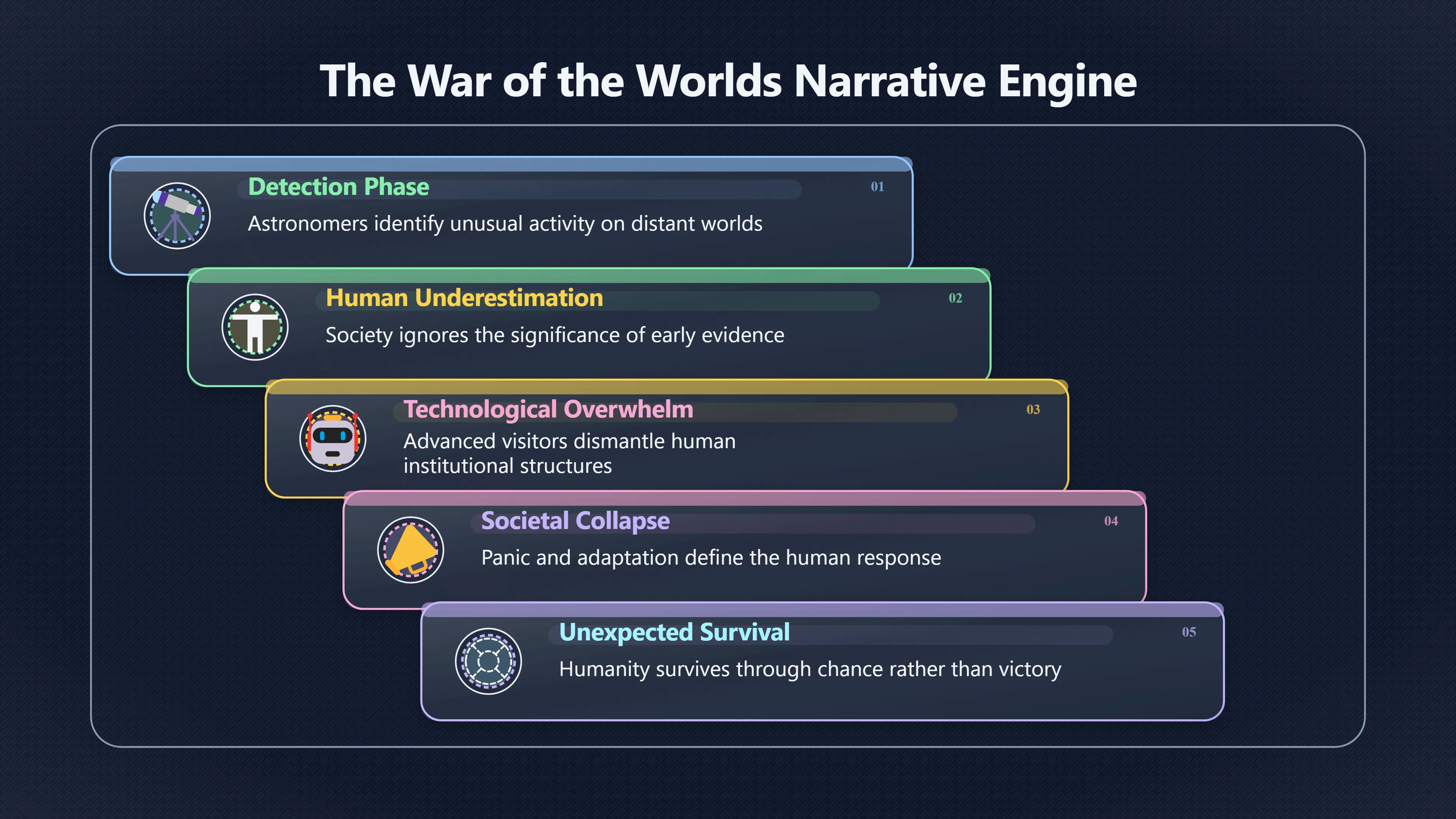
- Astronomers detect unusual activity on another world.
- Humanity underestimates the significance of the evidence.
- Advanced visitors arrive from space.
- Their technology overwhelms human institutions.
- Society experiences panic, collapse and adaptation.
- Humanity survives through unexpected circumstances rather than military victory.
Many later invasion stories would modify the details while retaining the basic pattern. The invading civilisation might come from Mars, another planet, a distant star system or an alternative dimension. The central dramatic relationship remained the same: contact with a technologically superior external intelligence becomes a crisis rather than a diplomatic encounter.[Encyclopedia Britannica]britannica.comEncyclopedia Britannica The War of the Worlds (novelEncyclopedia BritannicaThe War of the Worlds (novel) | Summary, Analysis, & Characters | BritannicaFebruary 13, 2026…
In this sense, Wells turned astronomical speculation into a reusable narrative engine. The Martians themselves became less important than the model they provided.
The Invasion Pattern Later UFO Culture Inherited
The relationship between UFO culture and science fiction is often complex, but Wells’s influence can be seen in how later generations imagined extraterrestrial visitors.
By the mid-twentieth century, reports of flying saucers emerged in a culture already familiar with stories of advanced beings arriving from elsewhere. Although UFO narratives developed through many influences, The War of the Worlds had helped establish several assumptions that audiences readily recognised:
- Extraterrestrials might possess technology far beyond human capabilities.
- Visitors from space might monitor Earth before acting.
- Contact with non-human intelligence could threaten civilisation.
- Human governments and militaries might be unable to respond effectively.
These ideas became recurring features of alien-invasion fiction, UFO rumours and popular media. Even when Mars ceased to be considered a plausible home for intelligent life, the narrative framework survived. Alien visitors simply moved farther away, from neighbouring planets to distant star systems.
The endurance of this pattern is one reason The War of the Worlds remains a landmark in the history of science fiction. It took the late Victorian image of a drying, ageing Mars and converted it into a dramatic story about vulnerability, technological imbalance and extraterrestrial threat. In doing so, it helped define how generations of readers, filmgoers and UFO enthusiasts would imagine encounters with intelligent beings from beyond Earth.[britannica.com]britannica.comEncyclopedia Britannica The War of the Worlds (novelEncyclopedia BritannicaThe War of the Worlds (novel) | Summary, Analysis, & Characters | BritannicaFebruary 13, 2026…
Amazon book picks
Further Reading
Books and field guides related to Relationships betwee d7372c martian civilization 772d5e wells mars invasion 4870f5. Use these as the next step if you want deeper reading beyond the article.
The War of the Worlds
Directly examines Wells's transformation of Martian civilization ideas into an invasion narrative.
The Martians
Explores the historical belief in Martian civilizations that helped shape the context from which Wells drew inspiration.
The Mammoth Encyclopedia of Science Fiction
Places Wells's Martian invasion story within the wider development of science-fiction themes and tropes.
The Oxford Book of Science Fiction Stories
Helps readers understand how Wells's depiction of Martians influenced later science-fiction literature.
eBay marketplace picks
Marketplace Samples
Example marketplace items related to this page. Use the search link to explore similar finds on eBay.
Endnotes
1.
Source: britannica.com
Title: Encyclopedia Britannica The War of the Worlds (novel)
Link:https://www.britannica.com/topic/The-War-of-the-Worlds-novel-by-Wells
Source snippet
Encyclopedia BritannicaThe War of the Worlds (novel) | Summary, Analysis, & Characters | BritannicaFebruary 13, 2026...
Published: February 13, 2026
2.
Source: Wikipedia
Title: Mars in fiction
Link:https://en.wikipedia.org/wiki/Mars_in_fiction
3.
Source: allbookstores.com
Title: The War Worlds Wells
Link:https://www.allbookstores.com/The-War-Worlds-Wells/9781448647699
Source snippet
All BookstoresThe War of the Worlds by H. G. Wells (9781448647699)July 28, 2009...
Published: July 28, 2009
4.
Source: allbookstores.com
Title: War Worlds Wells
Link:https://www.allbookstores.com/War-Worlds-Wells/9781605149349
Source snippet
of the Worlds by H. G. Wells (9781605149349)...
5.
Source: gutenberg.org
Title: The War of the Worlds | Project Gutenberg
Link:https://gutenberg.org/files/36/36-h/36-h.htm
Additional References
6.
Source: reddit.com
Link:https://www.reddit.com/r/WarofTheWorlds/comments/1tq5zyn/an_interesting_take_on_wells_intentions_behind/
Source snippet
An interesting take on Wells' intentions behind Wars of the Worlds published in the Heat Death newsletter...
7.
Source: wired.com
Title: Rise of the Machines: Why We Keep Coming Back to H.G
Link:https://www.wired.com/2011/10/h-g-wells-dystopian-future
Source snippet
Wells' Visions of a Dystopian Future"Rise of the Machines: Why We Keep Coming Back to H.G. Wells' Visions of a Dystopian Future" discusse...
8.
Source: wired.com
Title: www.wired.com [Close Encounters]({{ ‘close-encounters/’ | relative_url }}) of the Worst Kind
Link:https://www.wired.com/2005/06/war-2
Source snippet
Wells' "War of the Worlds" was set to hit screens. The production, starring Tom Cruise and Dakota Fanning, was fast-tracked to meet a luc...
9.
Source: loc.gov
Title: www.loc.gov Discover the Library of Congress | Library of Congress
Link:https://www.loc.gov/discover/
Source snippet
the Library of Congress | Library of Congress...
10.
Source: rogerebert.com
Title: www.rogerebert.com Xenu-phobia: Scientology in ‘War’?
Link:https://www.rogerebert.com/scanners/xenu-phobia-scientology-in-war
Source snippet
www.rogerebert.comXenu-phobia: Scientology in 'War'?December 19, 2012...
Published: December 19, 2012
11.
Source: youtube.com
Link:https://www.youtube.com/watch?v=QhYlQ1iYYN4
Source snippet
The War of the Worlds (1953): The Banned Ending They Hid for Over 70 Years...
12.
Source: youtube.com
Title: H.G. Wells and the War of the Worlds: A Documentary (FULL MOVIE)
Link:https://www.youtube.com/watch?v=h8sSKMZiPMI
Source snippet
Great Books: THE WAR OF THE WORLDS, H. G. Wells (TLC 1993)...
13.
Source: youtube.com
Link:https://www.youtube.com/watch?v=Qj_6H0PLoec
Source snippet
The War of the Worlds by H. G. Wells...
14.
Source: openlibrary.org
Title: The War of the Worlds by H. G. Wells | Open Library
Link:https://openlibrary.org/books/OL7576882M/The_War_of_the_Worlds
Source snippet
December 2, 1986...
Published: December 2, 1986
15.
Source: thebeliever.net
Title: www.thebeliever.net Red Eden
Link:https://www.thebeliever.net/red-eden/
Source snippet
Eden - Believer MagazineMay 1, 2011...
Published: May 1, 2011
Topic Tree